Finding the right talent in Europe can open new opportunities for business growth, but establishing a legal entity in another country can involve significant administrative work, regulatory requirements and ongoing operational costs. For companies looking to hire international employees without immediately setting up a subsidiary, an Employer of Record (EOR) offers an alternative employment structure.
With an EOR for hiring in Europe, businesses can employ eligible international talent through an established local employment arrangement while retaining control over employees’ daily responsibilities and business activities. The EOR manages formal employment responsibilities, including employment contracts, payroll administration, statutory contributions and relevant local employment requirements.
FastLaneRecruit helps businesses expand their international workforce through Employer of Record services in selected European markets, including the United Kingdom and Switzerland, alongside key markets across Asia Pacific and the Middle East & Africa.
Whether you are hiring your first overseas employee, building a remote team or expanding an existing international operation, understanding how an Employer of Record in Europe works can help you choose a practical employment structure for your business.
Content Outline
Key Summary
Hire in Europe Without Establishing a Local Entity
An Employer of Record provides a local employment structure for eligible hires, allowing businesses to employ international talent without establishing their own legal entity in every supported country.
Simplify International Employment Administration
An EOR can manage employment contracts, payroll processing, statutory contributions, employee benefits administration, onboarding and other applicable employment responsibilities.
Retain Control Over Daily Business Operations
Your company generally continues to manage employees’ daily work, responsibilities, performance and business objectives, while the EOR handles the formal employment relationship.
Understand Country-Specific Employment Requirements
European employment regulations vary by jurisdiction. Employment contracts, statutory benefits, working hours, taxation and termination procedures must reflect the applicable local requirements.
Choose the Right Structure for Your Expansion
An EOR can be suitable for businesses hiring a small overseas team or entering a new market. Establishing a subsidiary may be more appropriate when building a substantial, long-term local operation.
Work With One Partner Across Multiple Markets
FastLaneRecruit supports international employment across selected markets in Asia Pacific, Europe, and the Middle East & Africa, helping businesses coordinate their international workforce through one EOR partner.
What Is an Employer of Record (EOR) in Europe?
An Employer of Record (EOR) in Europe is a third-party organisation that legally employs workers on behalf of another company in a particular country. Instead of establishing its own local legal entity, the client company engages the EOR to manage the formal employment relationship and applicable employer responsibilities.
The EOR enters into an employment agreement with the employee and handles relevant administrative and statutory obligations according to local employment regulations.
Meanwhile, the client company generally retains responsibility for managing the employee’s daily activities, including work assignments, performance, productivity and business objectives.
For international businesses, an EOR provides an alternative way to employ talent in supported European markets without immediately incorporating a subsidiary or branch office.
How Does an Employer of Record Work?
An EOR operates through a structured employment arrangement involving three parties:
| Party | Main Responsibilities |
| Client Company | Selects candidates, defines job responsibilities, manages daily activities and evaluates employee performance. |
| Employer of Record | Becomes the formal local employer and manages employment contracts, payroll, statutory obligations and employment administration. |
| Employee | Signs an employment agreement with the EOR and performs work for the client company under the agreed arrangement. |
For example, a company headquartered in Singapore wants to hire a marketing manager based in the United Kingdom but does not have a UK legal entity.
Instead of incorporating a UK subsidiary immediately, the company may engage an EOR to employ the individual locally, subject to the applicable UK regulations and suitability of the arrangement.
The employee works with the Singapore-based company’s marketing team, follows its business objectives and reports to its designated manager. The EOR manages the formal employment arrangement, payroll and relevant employment administration.
This allows the business to access international talent without independently establishing all the local employment infrastructure.
Why Hire Employees in Europe Through an EOR?
Expanding into European markets can help businesses access specialised talent, reach new customers and strengthen their international operations. However, managing employment across borders requires an understanding of local regulations and administrative responsibilities.
An Employer of Record offers several practical advantages.
1. Hire Employees Without Establishing a Local Entity
Setting up a subsidiary or branch office can involve company registration, local corporate administration, banking arrangements, tax registrations and ongoing compliance obligations.
For businesses that only need to employ a small number of people, establishing a separate legal entity may not be the most practical first step.
An EOR provides an alternative employment arrangement in supported jurisdictions, allowing eligible businesses to hire employees without first incorporating their own local company.
This can be particularly useful for:
- Hiring the first employee in a new country.
- Building a small international team.
- Recruiting remote employees based overseas.
- Testing a new market before making a larger investment.
- Expanding an existing workforce across borders.
2. Simplify Payroll and Employment Administration
Managing international payroll involves more than transferring employee salaries.
Businesses may need to account for local tax deductions, employer contributions, statutory benefits, payroll reporting and country-specific payment requirements.
An EOR helps coordinate these responsibilities through an established local employment arrangement.
Depending on the country and agreed service scope, support may include:
- Monthly payroll administration.
- Salary and employee payment coordination.
- Statutory tax deductions.
- Employer social security contributions.
- Mandatory employee benefits administration.
- Payroll documentation and reporting.
This reduces the need for businesses to coordinate every employment-related administrative process independently.
3. Support Local Employment Compliance
Employment regulations differ between European countries. Businesses must consider local requirements relating to employment contracts, minimum employment rights, working hours, paid leave, employee benefits and termination.
An EOR helps manage applicable employment responsibilities through the relevant local framework.
This is particularly important when hiring employees in countries where the business does not have an established HR or legal team.
4. Access International Talent More Flexibly
Businesses are no longer restricted to recruiting employees who live near their headquarters.
An EOR can help companies employ qualified professionals in supported international markets while maintaining their existing operational structure.
This can benefit businesses recruiting:
- Software developers and IT specialists.
- Finance and accounting professionals.
- Marketing and sales managers.
- Customer support representatives.
- Business development specialists.
- Regional operations personnel.
5. Reduce the Administrative Burden of Market Entry
International expansion requires businesses to coordinate multiple operational activities.
By using an EOR, companies can delegate formal employment administration to a local provider instead of developing every employment process internally.
This allows management and HR teams to focus on recruitment, workforce planning, employee performance and business expansion.
Important: An EOR can reduce the need for entity setup solely to employ eligible workers, but it does not remove every regulatory obligation. Corporate tax, permanent establishment, immigration, data protection and other business activities may create separate requirements.
How to Hire Employees in Europe Without Establishing a Local Entity
Hiring through an Employer of Record involves several stages, from identifying a candidate to managing ongoing employment.
The exact process depends on the employee’s country, role, documentation and applicable regulations.
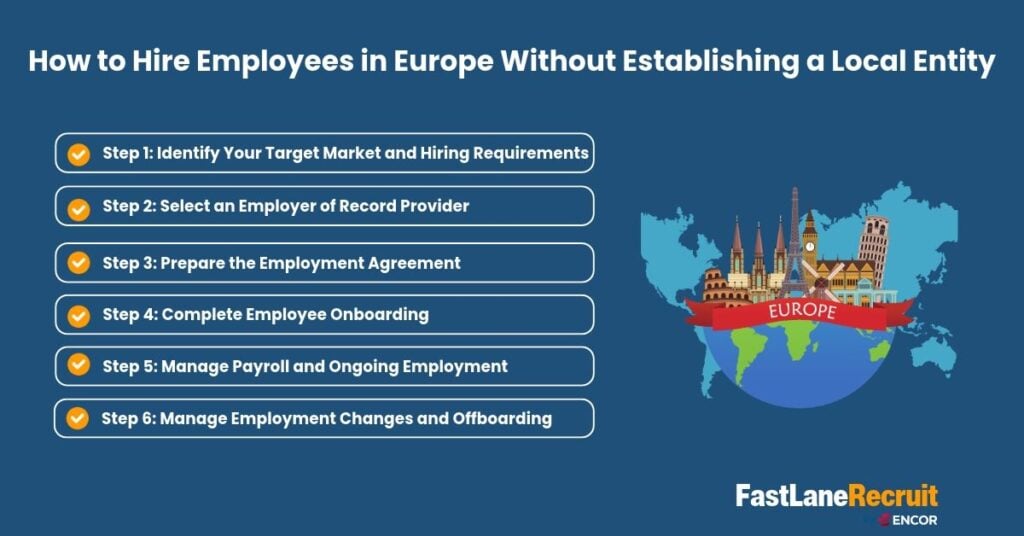
Step 1: Identify Your Target Market and Hiring Requirements
Start by identifying where you want to hire and what type of employee your business needs.
Consider:
- Country of employment.
- Job title and responsibilities.
- Expected salary and compensation structure.
- Employment type and working arrangement.
- Intended start date.
- Employee’s immigration and work authorisation status, where applicable.
These details help determine whether an EOR arrangement is suitable.
Step 2: Select an Employer of Record Provider
Choose an EOR provider with the appropriate local employment infrastructure and knowledge of the target country’s regulations.
Before proceeding, review:
- Country coverage.
- Employment contract arrangements.
- Payroll and statutory contribution management.
- Employee benefits administration.
- Onboarding and offboarding support.
- Service fees and additional charges.
- Data protection and confidentiality arrangements.
A provider should also explain which responsibilities it assumes and which remain with your business.
Step 3: Prepare the Employment Agreement
Once the arrangement is confirmed, the EOR coordinates the employment documentation.
The agreement should reflect the applicable local employment requirements, including relevant terms such as:
- Job title and responsibilities.
- Salary and payment frequency.
- Working hours and arrangements.
- Annual leave and applicable benefits.
- Probationary period, where permitted.
- Notice periods and termination provisions.
- Confidentiality and other contractual obligations.
Employment agreements should be reviewed according to the laws of the employee’s country.
Step 4: Complete Employee Onboarding
The EOR coordinates the required employment documentation and onboarding procedures.
Depending on the jurisdiction, this may involve identity verification, payroll information, tax documentation, social security registration and other statutory requirements.
Step 5: Manage Payroll and Ongoing Employment
After the employee starts working, the EOR supports the ongoing employment administration.
This can include monthly payroll, salary payments, statutory contributions, employee benefits, leave administration and relevant employment documentation.
Your company continues to manage the employee’s daily responsibilities and performance.
Step 6: Manage Employment Changes and Offboarding
Employment administration continues throughout the employee lifecycle.
Changes to salary, working arrangements, benefits, leave or contractual terms may require documentation and local compliance review.
When employment ends, the EOR helps coordinate the applicable notice, final payments, accrued leave, statutory entitlements and offboarding procedures.
European Employment Compliance: What Businesses Need to Know
Hiring employees in Europe requires more than preparing an employment contract and processing monthly salaries.
Businesses must understand the applicable employment framework in each jurisdiction. Although EU legislation establishes certain minimum employment protections, individual countries implement and supplement these requirements through national laws and collective agreements.
The United Kingdom and Switzerland also have their own employment and regulatory frameworks.
1. Employment Contracts and Employee Rights
Employment agreements establish the terms and conditions of the employment relationship.
Depending on the country, employers may need to provide written information covering:
- Employment start date.
- Job title and responsibilities.
- Salary and payment arrangements.
- Working hours.
- Annual leave entitlement.
- Probationary period.
- Notice and termination provisions.
- Applicable collective agreements.
For EU member states, the Transparent and Predictable Working Conditions Directive establishes requirements concerning information that employers must provide to workers. National implementation determines the specific application.
2. Payroll, Tax and Social Security Contributions
Employers must account for applicable payroll taxes, employee deductions and employer contributions.
These obligations differ between countries and may depend on:
- Employee salary.
- Employment status.
- Social security registration.
- Applicable tax residency rules.
- Country-specific payroll requirements.
- Relevant international social security arrangements.
An EOR can support the local payroll and employment administration within the agreed scope.
However, businesses should separately evaluate their own corporate tax and permanent establishment exposure when conducting activities in another country.
3. Working Hours and Annual Leave
Working time and paid leave are important elements of European employment compliance.
For EU member states, the Working Time Directive establishes minimum standards concerning working time, rest periods and paid annual leave, subject to applicable provisions and national implementation.
Countries may provide additional protections through domestic employment legislation or collective agreements.
Businesses should confirm the applicable requirements before establishing employee schedules and leave policies.
4. Employee Benefits and Statutory Entitlements
Employee benefits differ across jurisdictions.
Depending on the country, employment arrangements may involve:
- Statutory pension contributions.
- Health and social insurance.
- Paid annual leave.
- Sick leave.
- Parental and maternity protections.
- Public holiday entitlements.
- Other mandatory employment benefits.
An EOR helps administer applicable employment benefits according to local requirements and the agreed service scope.
5. Termination and Severance Requirements
Ending employment in another country can involve specific legal procedures.
Businesses should consider:
- Contractual notice periods.
- Statutory notice requirements.
- Valid termination grounds.
- Redundancy procedures.
- Consultation requirements.
- Severance or other termination payments.
- Final salary and accrued leave.
Termination procedures should be assessed before any decision is communicated to the employee. An EOR can coordinate the employment administration and applicable procedures, but the client company should communicate its business requirements and proposed actions in advance.
6. Immigration and Work Authorisation
An employment arrangement does not automatically provide an employee with permission to work in another country.
Businesses hiring foreign nationals should establish whether the individual already has the appropriate right to work or requires immigration permission.
The relevant immigration requirements depend on nationality, residence, job type and country.
An EOR should not be assumed to provide visa sponsorship automatically. Confirm the available immigration support and sponsorship arrangements separately.
EOR vs. Establishing a Local Entity: Which Is Better for Hiring in Europe?
Choosing between an Employer of Record and establishing a local legal entity depends on your business objectives, hiring volume, investment plans and long-term presence in the target country.
Both approaches can support international expansion, but they involve different responsibilities and operational commitments.
| Comparison | Employer of Record (EOR) | Local Legal Entity |
| Entity incorporation | Not required solely for eligible employment through the EOR | Required to establish the local subsidiary or company |
| Legal employment | EOR becomes the formal employer under the arrangement | Your local company employs the workers |
| Payroll administration | Managed through the EOR arrangement | Managed directly or through a payroll provider |
| Employment compliance | EOR manages agreed local employment responsibilities | Your company assumes direct employer responsibilities |
| Setup requirements | Employment onboarding and documentation | Incorporation, registrations and operational setup |
| Administrative workload | Can reduce internal employment administration | Requires ongoing local administration |
| Business operations | Suitable for employment without necessarily establishing a full local operation | Suitable for establishing a direct local business presence |
| Long-term expansion | Useful for initial or flexible workforce expansion | May be preferable for substantial long-term operations |
When Should You Choose an EOR?
An EOR may be more suitable when:
- You need to hire one or a few employees overseas.
- You want to enter a new market without immediate incorporation.
- Your business is testing international demand.
- You need a local employment structure for remote employees.
- You want to centralise international employment administration.
- Your current hiring requirements do not justify maintaining a separate subsidiary.
When Should You Establish a Local Entity?
A local legal entity may be more appropriate when:
- You plan to establish a substantial permanent operation.
- You intend to hire a large local workforce.
- Your business requires direct local contracting or invoicing.
- You need a local corporate banking and operational structure.
- Your commercial activities require a registered local presence.
- Your long-term investment strategy justifies incorporation and ongoing administration.
Decision tip: An EOR and a local subsidiary are not necessarily competing long-term solutions. Some businesses begin with an EOR for initial hiring and later establish their own entity when their operations expand. Any employee transfer should be planned according to applicable employment laws and contractual requirements.
Also Read: EOR vs Staffing Agency vs Contractor Management: The Best Fit for Global Hiring
Is an Employer of Record Legal in Every European Country?
An important consideration when choosing an Employer of Record in Europe is that there is no single, universally applicable EU-wide EOR licensing framework that makes every EOR arrangement automatically permissible across all member states.
The legal treatment depends on the actual employment structure and the country’s national legislation.
Some arrangements may fall within rules governing temporary agency work, labour leasing, employment agencies or other regulated employment activities.
For example, the EU Temporary Agency Work Directive (2008/104/EC) establishes a framework for equal treatment of temporary agency workers in terms of basic working and employment conditions. Its application depends on whether the arrangement falls within the directive’s scope and the relevant national implementing legislation.
Businesses should therefore assess:
- Whether the proposed EOR structure is permitted in the target country.
- Whether the provider requires specific licences or registrations.
- Whether temporary agency work or labour-leasing rules apply.
- Whether local restrictions affect the proposed employment arrangement.
- Whether the arrangement creates separate tax or permanent establishment considerations.
The United Kingdom and Switzerland are not EU member states and have their own regulatory frameworks.
For businesses expanding internationally, checking the legal suitability of an EOR arrangement before onboarding employees is essential.
How Much Does It Cost to Hire Employees Through an EOR in Europe?
The cost of hiring through an Employer of Record depends on the employee’s country, salary, statutory employment costs and the provider’s service fees.
Unlike company incorporation, which involves establishing and maintaining a separate legal entity, EOR pricing generally combines employment-related costs with an ongoing service fee.
Common EOR Cost Components
| Cost Component | What It Covers |
| Employee Gross Salary | Agreed employee compensation before applicable deductions |
| Employer Contributions | Applicable social security, pension and other statutory employer contributions |
| Employee Benefits | Mandatory and agreed supplementary benefits |
| EOR Service Fee | Employment administration, payroll coordination and EOR services |
| Onboarding Costs | Applicable documentation, registration and onboarding expenses |
| Additional Services | Immigration assistance or other services, where offered and applicable |
What Determines EOR Pricing?
Several factors influence the total cost:
Country of Employment: Different countries have different employer contribution rates, statutory benefits and payroll requirements.
Employee Compensation: Higher salaries generally increase employer contributions and other salary-linked costs.
Employment Requirements: Certain positions may involve additional benefits, insurance or regulatory considerations.
Service Scope: The provider’s fee may vary depending on the services included in the arrangement.
Workforce Size: Hiring multiple employees across several countries may require different service arrangements and pricing structures.
How to Evaluate an EOR Quote
Before selecting a provider, request a breakdown that distinguishes:
- Gross employee salary.
- Employer statutory contributions.
- Employee benefit costs.
- Monthly EOR service fees.
- Onboarding and offboarding charges.
- Additional administrative or compliance expenses.
Comparing the full employment cost rather than only the monthly EOR fee helps businesses make a more informed decision.
How FastLaneRecruit Supports International Hiring
Expanding into a new market requires an employment structure that accounts for local requirements without creating unnecessary administrative complexity.
FastLaneRecruit provides Employer of Record services to businesses looking to hire international employees without establishing their own legal entity in every supported market.
Our EOR support covers key stages of the employment lifecycle, helping businesses coordinate local employment administration while maintaining control over their workforce.
Local Employment Contracts
We coordinate employment documentation based on the applicable requirements of the employee’s country.
This helps establish a formal employment relationship with appropriate terms and conditions.
Payroll Administration
We support payroll administration and employee payments, including applicable statutory deductions and employer contributions according to local requirements.
Employee Benefits Administration
We help coordinate applicable statutory and agreed employee benefits as part of the employment arrangement.
Employee Onboarding
We support the preparation of employment documentation and onboarding procedures, helping businesses bring international employees into their teams.
Ongoing Employment Administration
Our EOR services support ongoing employment administration, including relevant payroll, employee documentation and statutory requirements.
Offboarding Support
When employment ends, we help coordinate the required employment administration according to the applicable local framework.
Why Businesses Choose FastLaneRecruit
Managing an international workforce across different countries requires more than payroll processing. Businesses need an employment partner that understands the practical requirements of hiring across jurisdictions.
FastLaneRecruit helps businesses simplify international employment through the following capabilities.
1. One EOR Partner Across Multiple Markets
Instead of coordinating multiple employment providers independently, businesses can work with FastLaneRecruit across selected markets in Asia Pacific, Europe and the Middle East & Africa.
This provides a central point of coordination for international employment requirements.
2. International Hiring Without Local Entity Setup
Our EOR model helps businesses employ eligible workers in supported markets without first establishing their own local company solely for employment purposes.
This can be particularly useful for initial market entry and building international teams.
3. Support Across the Employment Lifecycle
From employment contracts and onboarding to payroll administration and offboarding, we support important stages of the employment relationship.
4. Practical Country-Specific Employment Support
Employment requirements differ across jurisdictions. Our approach considers the relevant local employment framework rather than applying a single process to every country.
5. Flexible International Workforce Expansion
Whether you are hiring your first overseas employee or expanding an existing team, our EOR services provide an alternative employment structure that can support your international workforce strategy.
FastLaneRecruit’s Global EOR Coverage
FastLaneRecruit supports international employment across selected markets in three major regions. We Operate in,
- Asia Pacific: Malaysia, Singapore, Hong Kong, China, India, Philippines, Taiwan, Vietnam, Australia,
- Europe: United Kingdom, Switzerland
- Middle East & Africa: UAE, Saudi Arabia, Qatar
Our multi-market coverage allows businesses to work with one EOR partner when building teams across different international markets.
Employment arrangements, onboarding procedures, payroll requirements and statutory obligations vary by country. Our team can help assess your target market and explain the relevant employment requirements before proceeding.
Hire in Europe and Beyond With FastLaneRecruit
International hiring should help your business grow, not create unnecessary administrative obstacles.
Whether you are recruiting your first overseas employee, expanding a remote team or entering multiple international markets, an Employer of Record can provide a practical employment structure without requiring your business to establish a separate legal entity in every supported country.
FastLaneRecruit supports international employment through local employment arrangements, payroll administration, statutory contributions, employee benefits coordination, onboarding and ongoing employment administration.
With EOR coverage across selected markets in Asia Pacific, Europe and the Middle East & Africa, we help businesses coordinate international hiring through one partner.
Ready to Expand Your International Workforce?
Tell us where you plan to hire, how many employees you need and your expected start date. Our team can review your requirements, assess the available EOR options and explain the relevant employment arrangements.
Book a Free EOR Consultation With FastLaneRecruit
Start Hiring Without Establishing a Local Entity.
Frequently Asked Questions About EOR for Hiring in Europe
1. What is an Employer of Record in Europe?
An Employer of Record in Europe is a third-party organisation that legally employs workers on behalf of another company in a supported country. It manages the formal employment relationship and applicable responsibilities, such as employment contracts, payroll and statutory administration, while the client company generally manages the employee’s daily work.
2. Can I hire employees in Europe without establishing a local entity?
Yes, an EOR can provide an alternative employment structure for eligible hires in supported countries. The EOR becomes the formal employer, allowing your business to hire internationally without incorporating its own local entity solely for that employment arrangement. Suitability depends on the country’s regulations and the actual business structure.
3. Is using an Employer of Record legal in Europe?
EOR arrangements may be permitted in European countries, but their legal treatment varies. Depending on the structure, national rules governing employment agencies, temporary agency work or labour leasing may apply. Businesses should verify local requirements before entering into an arrangement.
4. Does an EOR manage my employees’ daily work?
Generally, no. The client company retains responsibility for day-to-day work management, including assignments, performance, responsibilities and business objectives. The EOR manages the formal employment relationship and agreed administrative responsibilities.
5. What responsibilities does an EOR handle?
Depending on the country and service agreement, an EOR may manage:
- Local employment contracts.
- Payroll administration.
- Salary payments.
- Statutory tax and social security deductions.
- Mandatory employee benefits.
- Employment onboarding.
- Ongoing employment documentation.
- Employment offboarding.
6. How much does an Employer of Record cost in Europe?
EOR costs depend on the employee’s country, gross salary, employer contributions, statutory benefits and provider service fees. Businesses should request an itemised quotation that separates employment costs from EOR administration fees.
7. Can an EOR hire employees in the UK and Switzerland?
An EOR arrangement can support employment in the UK and Switzerland, subject to the applicable local regulations and provider capabilities. These countries have separate employment, payroll and regulatory frameworks. FastLaneRecruit lists both the United Kingdom and Switzerland among its European EOR markets.
8. Is an EOR better than setting up a subsidiary?
It depends on your business objectives. An EOR may be more practical when hiring a small team, entering a new market or avoiding immediate entity incorporation. A subsidiary may be preferable when establishing substantial long-term operations, building a larger workforce or conducting activities that require a local legal presence.
9. Can an EOR help with payroll and employee benefits?
Yes. Payroll administration and employee benefits coordination are common components of EOR services. The provider helps administer applicable salary payments, statutory deductions, employer contributions and relevant benefits according to the country’s requirements and the agreed service scope.
10. Can I transfer employees from an EOR to my own company later?
Yes, a business may transition employees from an EOR arrangement to its own local entity when its operations expand. However, this requires careful planning, including consideration of employment continuity, employee consent where required, accrued entitlements, contractual obligations and applicable local employment laws.
11. Does using an EOR automatically resolve permanent establishment risks?
No. An EOR does not automatically eliminate permanent establishment or corporate tax exposure. These risks depend on the company’s activities, employee responsibilities, contractual arrangements and applicable tax rules. Businesses should obtain appropriate tax advice when expanding into another country.
12. How long does it take to hire an employee through an EOR?
The timeline varies depending on the country, employee documentation, payroll registration requirements and onboarding procedures. Once the employment arrangement is confirmed and the required information is available, the EOR can coordinate the remaining steps and provide an expected start date.