Indonesia offers international businesses access to a large and diverse workforce across Southeast Asia. However, hiring locally involves more than finding the right candidates. Employers must understand Indonesian employment regulations, payroll obligations, social security contributions and employee entitlements before bringing people into their workforce.
For businesses exploring expansion, an Employer of Record (EOR) in Indonesia may provide a way to manage local employment administration without immediately establishing a separate Indonesian entity, where the proposed arrangement is legally permitted.
FastLaneRecruit helps businesses navigate international employment and workforce administration across multiple markets. Our team can help you understand the considerations involved in hiring in Indonesia, assess your employment requirements and identify an appropriate approach for your expansion plans.
Whether you are considering your first Indonesian hire or planning to build a wider regional team, understanding the local employment framework is an important first step.
Content Outline
Key Summary
An EOR can support local employment administration
An Employer of Record generally acts as the formal employer under an agreed employment arrangement, handling employment documentation, payroll administration and applicable statutory obligations. The client business typically directs the employee’s day-to-day work.
Indonesia has specific employment and payroll obligations
Businesses hiring employees in Indonesia must consider employment contracts, minimum wages, working hours, overtime, income tax, social security and statutory employee benefits.
Outsourcing rules affect EOR arrangements
Indonesia’s Minister of Manpower Regulation No. 7 of 2026, effective from 30 April 2026, limits the categories of work that may be outsourced. Businesses should not assume that every professional or operational role can automatically be engaged through an EOR arrangement.
An EOR is not always a substitute for establishing a local company
An EOR may be suitable for certain employment and outsourcing arrangements. Businesses planning substantial operations, regulated activities or roles outside the permitted outsourcing categories should assess whether establishing a local entity is more appropriate.
The right employment structure depends on your business needs
The number of employees, type of work, operational presence and long-term expansion plans all influence the most suitable hiring approach.
What Is an Employer of Record in Indonesia?
An Employer of Record (EOR) is a third-party organisation that formally employs workers on behalf of another business under an agreed legal arrangement.
In a typical EOR model, the EOR takes responsibility for designated employment administration, while the client business manages the employee’s daily responsibilities, performance and operational activities.
For international companies considering hiring in Indonesia, an EOR arrangement may help coordinate employment documentation, payroll processing and statutory administration without requiring the client to establish its own Indonesian employing entity, provided the arrangement complies with applicable Indonesian law.
How Does an Indonesia EOR Work?
A typical EOR arrangement involves three parties:
| Party | Main responsibility |
| EOR provider | Handles the formal employment relationship and agreed employment administration. |
| Client company | Defines the role, selects the candidate and manages day-to-day work and business objectives. |
| Employee | Performs the agreed duties and receives employment entitlements under the applicable employment arrangement. |
Important: An EOR arrangement must be assessed according to its actual legal and operational structure. Calling a service an EOR does not automatically exempt it from Indonesian outsourcing rules.
When Should a Business Consider an EOR in Indonesia?
An EOR may be worth assessing when a company:
- Wants to explore the Indonesian market before committing to a local entity.
- Needs support with local employment administration.
- Plans to engage workers in roles that can legally be structured through an outsourcing arrangement.
- Wants to coordinate employment administration across several countries.
- Needs help understanding local payroll and statutory employment requirements.
An EOR should not be treated as a universal hiring solution. The nature of the employee’s work and the legal eligibility of the arrangement must be reviewed first.
Is It Legal to Use an Employer of Record in Indonesia?
The legal position requires careful consideration.
Indonesia does not provide a blanket exemption for EOR arrangements. Where an arrangement involves a company supplying workers to another business, it may fall within the country’s outsourcing framework, known as alih daya.
Under Minister of Manpower Regulation No. 7 of 2026, outsourcing is limited to specified supporting activities, including:
- Cleaning services.
- Food and beverage provision.
- Security services.
- Drivers and worker transportation.
- Operational support services.
- Supporting work in mining, oil, gas and electricity sectors.
The regulation also sets requirements for written outsourcing agreements, worker protections and the responsibilities of the outsourcing company and the business receiving the services. Existing arrangements have a transition period of up to two years to align with the regulation.
What Does This Mean for Businesses Hiring in Indonesia?
Businesses should assess the proposed role before choosing an EOR.
| Hiring consideration | What businesses should assess |
| Job responsibilities | Whether the role falls within a permitted outsourcing category. |
| Provider structure | Whether the provider meets the applicable legal and licensing requirements. |
| Employment agreement | Whether the contract and employment arrangement comply with Indonesian law. |
| Worker protection | Whether wages, leave, social security and other entitlements are properly addressed. |
| Business operations | Whether the company’s activities require a different local employment or incorporation structure. |
Professional recommendation: Before proceeding, confirm that the proposed EOR arrangement is legally suitable for the specific job category. For roles such as sales, engineering, management or other core business functions, do not assume that a standard outsourced-worker model is available. Seek Indonesian employment-law advice where necessary.
This distinction is especially important for foreign companies that want to hire Indonesian employees while retaining direct operational control.
Also Read: EOR Arrangement: Who Legally Employs Your Staff?
What Employment and Payroll Requirements Should Businesses Know in Indonesia?
Employers must understand several areas of Indonesian employment law before hiring locally. These requirements influence employment contracts, payroll budgets, employee benefits and termination procedures.
The following are key considerations for businesses planning to hire in Indonesia.
1. Employment Contracts: PKWT and PKWTT
Indonesian employment arrangements generally distinguish between two main types of employment agreements:
| Contract type | Meaning | Key consideration |
| PKWT | Fixed-term employment agreement | Used for work that legally qualifies for a fixed-term arrangement. |
| PKWTT | Indefinite-term employment agreement | Used for ongoing employment without a predetermined end date. |
A fixed-term employment agreement, or PKWT, must be made in writing in Indonesian. A bilingual agreement may also be used, but the Indonesian-language version is important in the event of inconsistencies.
Fixed-term employment is subject to restrictions on the types and duration of work for which it can be used. Probation periods are not permitted for PKWT arrangements. For PKWTT employment, any probation period must comply with the applicable statutory limits.
Businesses should select the appropriate agreement based on the actual nature of the work rather than using fixed-term contracts as a default hiring method.
Chambers and Partners+2
2. Minimum Wage Requirements in Indonesia
Indonesia’s minimum wage framework includes regional wage requirements. Employers must consider the applicable minimum wage for the employee’s work location rather than applying one national figure across the country.
Relevant wage benchmarks include:
- UMP (Upah Minimum Provinsi): Provincial minimum wage.
- UMK (Upah Minimum Kabupaten/Kota): Regency or city minimum wage, where applicable.
The applicable wage can vary by province and locality. Businesses should confirm the current rate for the employee’s actual work location and the relevant wage-setting rules before finalising an employment offer.
What this means for employers: A salary that meets the minimum wage in one Indonesian city may not meet the applicable requirement in another. Budgeting should therefore account for the employee’s location and any applicable wage adjustments.
3. Payroll, Income Tax and PPh 21
Payroll in Indonesia involves more than paying employees their monthly salaries. Employers must consider applicable income tax withholding, statutory contributions, payroll records and reporting obligations.
One important requirement is PPh 21, the income tax withholding system applicable to employment income and certain other individual income payments.
Businesses should account for:
- Monthly salary and applicable allowances.
- PPh 21 calculation and withholding.
- Tax reporting and remittance requirements.
- Employee deductions and employer-paid contributions.
- Payroll records and supporting documentation.
The amount of income tax payable depends on the employee’s taxable income and applicable tax rules. Payroll calculations should be reviewed against current Indonesian tax requirements.
4. BPJS: Mandatory Social Security Contributions
Indonesia’s social security system includes two main institutions:
- BPJS Kesehatan: National health insurance.
- BPJS Ketenagakerjaan: Employment-related social security programmes.
Depending on the applicable employment arrangement and employee eligibility, social security coverage can include:
| Programme | Indonesian name | Purpose |
| Health insurance | BPJS Kesehatan | Provides access to the national health insurance programme. |
| Work accident insurance | JKK | Provides protection for qualifying work-related accidents and occupational risks. |
| Death insurance | JKM | Provides benefits in qualifying death-related circumstances. |
| Old-age security | JHT | Provides savings-related benefits under the statutory programme. |
| Pension security | JP | Provides pension-related benefits for eligible participants. |
| Job-loss security | JKP | Provides support under the applicable job-loss protection programme. |
Employer and employee contribution responsibilities vary by programme. Some contributions are shared, while others are primarily employer-funded. Contribution rates, wage ceilings and eligibility conditions should be checked against current BPJS rules.
For businesses: BPJS administration should be included in the overall employment cost calculation, rather than treated as an optional employee benefit.
bpjsketenagakerjaan.go.id+2
5. THR: Religious Holiday Allowance
Indonesia requires eligible employees to receive a religious holiday allowance known as Tunjangan Hari Raya (THR).
THR is generally paid before the employee’s relevant religious holiday. Employees who have completed at least 12 months of continuous service are generally entitled to one month’s wages, while employees with shorter qualifying service receive a proportional amount, subject to the applicable rules.
Businesses should account for THR when calculating the annual cost of employment. It is a statutory employment entitlement, not simply a discretionary performance bonus.
6. Working Hours, Overtime and Annual Leave
Indonesian employment rules establish standard working-hour arrangements and employee rest entitlements.
| Area | General statutory position |
| Five-day workweek | 8 hours per day and 40 hours per week. |
| Six-day workweek | 7 hours per day and 40 hours per week. |
| Weekly rest | Generally two days for a five-day workweek or one day for a six-day workweek. |
| Annual leave | At least 12 working days after 12 months of continuous service, subject to applicable provisions. |
| Overtime | Subject to statutory limits, employee consent requirements and overtime pay rules. |
Overtime must be handled according to applicable employment regulations, including the rules on employee consent, permitted hours and compensation.
The standard framework is set out in Government Regulation No. 35 of 2021, which remains an important reference for employment agreements, working hours, rest periods and termination.
jdih.kemnaker.go.id+1
7. Termination and Severance Obligations
Ending an employment relationship in Indonesia requires consideration of the legal reason for termination and the employee’s statutory entitlements.
Depending on the circumstances, the employer may need to account for:
- Severance pay.
- Long-service pay.
- Compensation for outstanding employee rights.
- Unused leave or other applicable entitlements.
- Required termination procedures and documentation.
For fixed-term employment, compensation obligations may also arise when the agreement ends, subject to the applicable legal requirements.
Businesses should not assume that employment can be terminated simply by providing notice or paying a standard fee. The correct procedure and financial obligations depend on the employment contract, length of service and reason for termination.
What Services Can an Employer of Record Provide in Indonesia?
Subject to the legal eligibility of the arrangement and the provider’s authorised operating structure, an EOR service may coordinate several employment-related responsibilities.
| EOR service area | Typical responsibilities |
| Employment documentation | Preparing and administering employment agreements and related documents. |
| Employee onboarding | Coordinating employment information, documentation and onboarding administration. |
| Payroll administration | Processing salaries, deductions and payroll records. |
| Tax administration | Coordinating applicable income tax withholding and reporting processes. |
| Social security | Supporting applicable BPJS registration and contribution administration. |
| Employee entitlements | Coordinating statutory benefits, leave and THR administration. |
| Employment changes | Supporting documentation for changes to employment terms. |
| Offboarding | Coordinating termination documentation, final payroll and applicable employee entitlements. |
The precise scope should be confirmed in the service agreement. An EOR does not automatically assume every legal or operational responsibility of the client company.
EOR vs Setting Up a Company in Indonesia: Which Is Better?
Choosing between an EOR arrangement and establishing a local Indonesian entity depends on the business’s long-term objectives, the nature of its operations and the roles it intends to hire.
| Consideration | EOR arrangement | Establishing a local entity |
| Local company incorporation | May not require the client to establish its own employing entity, subject to legal eligibility. | Requires the business to establish and maintain an Indonesian entity. |
| Employment administration | Can be handled by the EOR under the agreed arrangement. | Managed by the company’s own HR and payroll functions or appointed providers. |
| Payroll | Coordinated through the EOR service. | Managed directly or outsourced to a payroll provider. |
| Operational control | Client typically manages day-to-day work, within the agreed legal structure. | Company manages its employees and operations directly. |
| Compliance responsibility | Certain employment responsibilities are handled by the EOR, but the client may retain responsibilities. | The company is directly responsible for its employer obligations. |
| Long-term business presence | May suit certain limited hiring requirements where legally permitted. | More suitable for businesses planning an ongoing local business presence. |
When Should You Consider an EOR?
An EOR may be worth evaluating when:
- You want to explore a limited hiring requirement before committing to incorporation.
- The proposed roles can legally be engaged through the relevant outsourcing structure.
- You need support coordinating employment administration.
- You want to manage regional employment processes through a service provider.
When Should You Establish a Local Entity?
A local entity may be more suitable when:
- You plan to establish a substantial and continuing business presence.
- Your employees perform core business functions that do not qualify for the applicable outsourcing framework.
- You need to conduct local business activities through your own registered company.
- You require greater direct control over your local corporate and employment operations.
Decision point: Do not select an EOR simply because it appears faster or less expensive. First determine whether the role and business arrangement are permitted under Indonesian law. A local entity may be the more appropriate route for some hiring plans.
Also Read: How Do EOR Services Manage Payroll, Taxes, and Employee Benefits?
EOR vs Independent Contractors in Indonesia
Businesses sometimes consider independent contractors as an alternative to employing workers through an EOR. However, the two arrangements serve different purposes.
| Consideration | EOR employment | Independent contractor |
| Working relationship | Employment relationship under the agreed legal structure. | Independent service or project-based relationship. |
| Work arrangement | Employee performs duties under agreed employment terms. | Contractor provides services under a commercial agreement. |
| Payroll | Employment payroll and applicable statutory administration. | Contractor invoices or receives payment under the service agreement. |
| Benefits | Applicable employee entitlements must be addressed. | Generally governed by the commercial contract rather than employee benefits. |
| Main risk | The EOR structure must comply with employment and outsourcing rules. | Misclassification risk if the actual relationship resembles employment. |
A contractor agreement should reflect a genuine independent business relationship. If the individual works under conditions that legally constitute employment, describing them as a contractor does not necessarily remove employment obligations.
Businesses should assess the actual working relationship, level of control, responsibilities and applicable Indonesian rules before deciding how to engage an individual.
How to Hire Employees in Indonesia Through an EOR
Hiring in Indonesia requires preparation across recruitment, legal eligibility, employment documentation and payroll administration.
For businesses considering an EOR, the following steps provide a practical starting point.
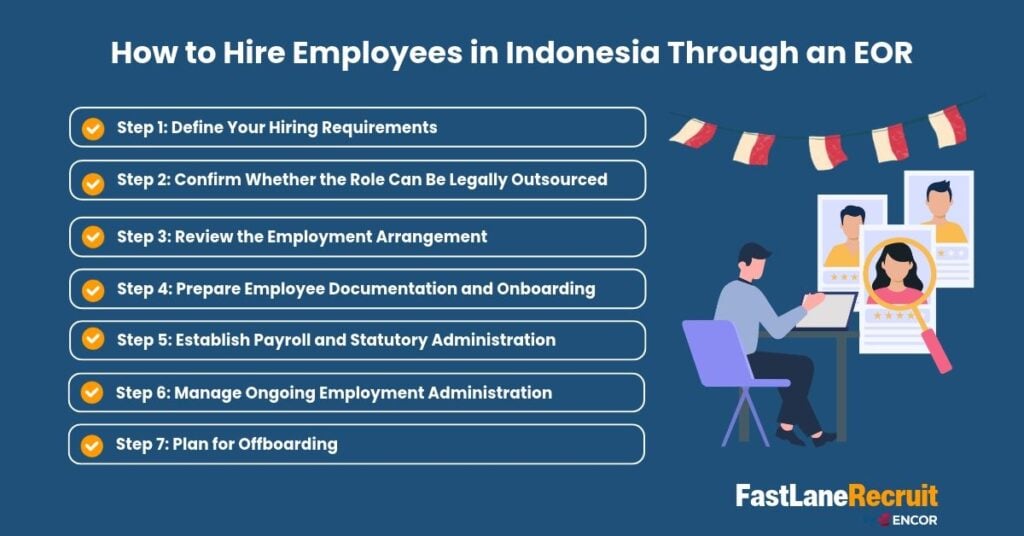
Step 1: Define Your Hiring Requirements
Start by identifying the position, responsibilities, work location and expected employment duration.
Important details include:
- Job title and responsibilities.
- Number of employees required.
- Proposed salary and allowances.
- Work location and working arrangements.
- Expected start date.
- Whether the role is ongoing or project-based.
These details help determine the appropriate employment structure.
Step 2: Confirm Whether the Role Can Be Legally Outsourced
Before proceeding with an EOR, assess whether the proposed role fits within the categories permitted under Indonesia’s outsourcing framework.
This step is particularly important following Minister of Manpower Regulation No. 7 of 2026.
If the role falls outside the permitted categories, the business should consider alternative arrangements, including establishing a local entity where appropriate.
Step 3: Review the Employment Arrangement
Once the appropriate structure has been identified, review the relevant employment and service agreements.
The review should address:
- Employment classification.
- Contract duration and terms.
- Salary and payment arrangements.
- Employee rights and statutory entitlements.
- Working hours and overtime.
- Responsibilities of each party.
Step 4: Prepare Employee Documentation and Onboarding
Collect the information and documentation required for employment administration and applicable statutory registration.
This may include employee identification and personal information, employment details, bank information and other required records.
Step 5: Establish Payroll and Statutory Administration
Before the first payroll cycle, determine the applicable salary, tax withholding, BPJS contributions and employee entitlements.
Businesses should also agree on payroll cut-off dates, payment schedules and the process for handling salary changes or additional payments.
Step 6: Manage Ongoing Employment Administration
After onboarding, employment administration continues throughout the working relationship.
This includes payroll processing, employee record updates, leave administration, statutory contributions and changes to employment terms.
Step 7: Plan for Offboarding
When employment ends, the relevant parties should review the contractual terms, statutory requirements, final payroll and applicable termination entitlements.
Proper documentation helps support an orderly and compliant offboarding process.
How Much Does an Employer of Record Cost in Indonesia?
The cost of an Employer of Record in Indonesia depends on the employment arrangement, salary level, statutory contributions and service scope.
There is no single standard EOR price that applies to every business or employee.
What Affects Indonesia EOR Costs?
| Cost component | What businesses should consider |
| EOR service fee | The provider’s fee for employment administration and agreed services. |
| Employee salary | The agreed gross salary, taking applicable regional minimum wages into account. |
| Employer contributions | Applicable employer-funded BPJS contributions. |
| Employee tax | Applicable PPh 21 withholding and administration. |
| THR | Statutory religious holiday allowance. |
| Overtime | Applicable overtime payments and related costs. |
| Additional benefits | Any contractual benefits provided beyond statutory requirements. |
| Offboarding costs | Applicable termination payments and final employment obligations. |
What Should You Ask an EOR Provider Before Signing?
To understand the full cost, ask for a breakdown covering:
- The recurring EOR service fee.
- Employer-paid statutory contributions.
- Employee deductions and tax administration.
- THR and other annual employment costs.
- Additional charges for onboarding, changes or offboarding.
- The legal structure and role eligibility of the proposed arrangement.
A transparent cost breakdown helps businesses compare providers based on the total employment cost rather than the monthly service fee alone.
Why Businesses Choose FastLaneRecruit
Expanding into a new market involves more than finding employees. Businesses need a clear understanding of local employment requirements, payroll administration and the responsibilities involved in managing an international workforce.
FastLaneRecruit supports companies exploring international employment through our regional service coverage and EOR-focused approach.
1. Support for Multi-Country Workforce Planning
Businesses expanding into Southeast Asia and other regions may need to manage employment administration across several jurisdictions.
FastLaneRecruit operates across multiple markets, helping businesses explore regional hiring requirements through one service provider.
2. Employment and Payroll Administration
International hiring involves employment documentation, payroll coordination, statutory contributions and ongoing employee administration.
Our services focus on helping businesses manage these employment processes according to the agreed service scope and applicable local requirements.
3. A Practical Approach to International Expansion
Every market has different employment rules and business requirements. FastLaneRecruit helps businesses assess their workforce needs and consider the appropriate employment approach before proceeding.
For Indonesia, this includes recognising the importance of the 2026 outsourcing restrictions and reviewing the proposed role and legal structure before recommending an EOR arrangement.
4. Support Beyond a Single Market
Businesses planning regional expansion can explore FastLaneRecruit’s wider country coverage instead of treating each hiring market as an entirely separate project.
Where FastLaneRecruit Operates
FastLaneRecruit supports international employment across selected markets in Asia Pacific, Europe, and the Middle East and Africa.
FastLaneRecruit operates in
- Asia Pacific: Malaysia, Singapore, Hong Kong, China, India, Philippines, Taiwan, Vietnam, Australia,
- Europe: United Kingdom, Switzerland
- Middle East & Africa: UAE, Saudi Arabia, Qatar
For businesses expanding across multiple markets, our regional coverage can help simplify the process of exploring employment and workforce administration requirements.
Explore Your Indonesia Hiring Options with FastLaneRecruit
Entering the Indonesian market can create opportunities to access new talent and expand your regional operations. However, choosing the right employment structure is essential to managing hiring costs, employment administration and regulatory requirements.
An Employer of Record may be an option for certain legally eligible arrangements, but it is important to understand the limitations of Indonesia’s outsourcing framework before moving forward.
FastLaneRecruit helps businesses explore international employment solutions and workforce administration across multiple markets. Speak with our team about your hiring plans, the roles you need to fill and the employment structure that may suit your business.
Book a Free Consultation with an Expert
Discuss your international hiring requirements with FastLaneRecruit and take the next step towards a more structured approach to workforce expansion.
Frequently Asked Questions About Employer of Record Indonesia
1. What is an Employer of Record in Indonesia?
An Employer of Record is a third-party organisation that formally employs workers under an agreed employment arrangement and manages designated employment administration. The client company typically directs the employee’s day-to-day work. In Indonesia, the proposed arrangement must also comply with applicable employment and outsourcing regulations.
2. Is using an EOR legal in Indonesia?
An EOR arrangement is not automatically permitted for every type of job. Where the arrangement constitutes outsourcing, it must comply with Indonesia’s outsourcing framework, including Minister of Manpower Regulation No. 7 of 2026. Businesses should confirm that the role, provider and employment structure meet the applicable requirements before hiring.
3. Can a foreign company hire employees in Indonesia without setting up a local entity?
Potentially, yes, depending on the proposed employment structure and the type of work. An EOR may provide an alternative to establishing a local employing entity for certain legally eligible arrangements. However, businesses should not assume that every role can be hired this way. Some hiring plans may require a locally established entity.
4. What types of jobs can be outsourced in Indonesia?
Under Minister of Manpower Regulation No. 7 of 2026, permitted outsourcing activities include cleaning, food and beverage provision, security, drivers and worker transportation, operational support, and certain supporting activities in mining, oil, gas and electricity. The exact scope of a role should be assessed against the regulation.
5. What is the difference between an EOR and a local entity in Indonesia?
An EOR arrangement may allow a business to engage workers through a third-party employment structure without establishing its own Indonesian employing entity, where legally permitted. A local entity gives the business a direct corporate presence and allows it to manage its own employment relationships, subject to local requirements.
6. What payroll taxes apply to employees in Indonesia?
Employment income is generally subject to PPh 21 withholding. Employers must also consider applicable BPJS contributions and other payroll-related obligations. The exact tax calculation depends on the employee’s income and applicable tax rules.
7. What is BPJS in Indonesia?
BPJS is Indonesia’s national social security system. BPJS Kesehatan administers health insurance, while BPJS Ketenagakerjaan administers employment-related programmes such as work accident, old-age, pension and other statutory protections.
8. Do employees in Indonesia receive THR?
Yes. Eligible employees are generally entitled to a religious holiday allowance, known as THR. Employees with at least 12 months of continuous service are generally entitled to one month’s wages, while qualifying employees with shorter service receive a proportional amount under the applicable rules.
9. What is the minimum wage in Indonesia?
Indonesia has regional minimum wage requirements, including provincial minimum wages (UMP) and regency or city minimum wages (UMK), where applicable. The relevant rate depends on the employee’s work location and the applicable wage rules for the year.
10. How long does it take to hire employees through an EOR in Indonesia?
The timeline depends on role eligibility, provider requirements, employment documentation, statutory registration and onboarding readiness. Businesses should obtain a proposed timeline after the employment structure and required documentation have been reviewed.
11. Can an EOR manage payroll and employee benefits in Indonesia?
An EOR may coordinate payroll, applicable tax withholding, BPJS administration and statutory employee entitlements as part of its agreed service scope. Businesses should confirm which responsibilities are included in the provider’s service agreement.
12. How much does an EOR cost in Indonesia?
EOR costs vary according to the service fee, employee salary, employer contributions, statutory benefits and additional administration charges. Businesses should request an itemised quotation to understand the full cost of employment.
13. Should I use an EOR or hire independent contractors in Indonesia?
An EOR employment arrangement may be more appropriate where the working relationship is genuinely employment and the arrangement is legally permitted. Independent contractors are generally suitable for genuine independent service arrangements. Businesses should assess the actual working relationship to avoid worker misclassification.
14. Can FastLaneRecruit help my business hire in Indonesia?
FastLaneRecruit supports businesses exploring international employment and EOR services across multiple markets. For Indonesia, the proposed role and employment structure should first be assessed against the current outsourcing framework. Contact our team to discuss your hiring requirements and identify an appropriate next step.