
Hiring internationally opens access to new talent, markets, and business opportunities. However, every new country introduces employment requirements that businesses must understand before bringing an employee on board.
An employment contract is one of the most important parts of this process. It establishes the terms of employment, clarifies the employer’s and employee’s responsibilities, and documents the conditions under which the working relationship operates. When hiring through an Employer of Record (EOR), businesses must also understand how the employment contract relates to the agreement between the company and its EOR provider.
EOR employment contracts must reflect the applicable local employment requirements and the agreed terms of the working relationship. These may cover compensation, working hours, leave, benefits, termination, confidentiality, and other employment conditions, depending on the country and role.
An EOR can help businesses manage employment documentation and related administration when hiring in supported markets without establishing their own local employing entity.
This guide explains what an EOR employment contract should cover, which clauses employers should review, and how to determine whether an EOR arrangement is suitable for your international hiring plans.
Content Outline
Key Summary
EOR Employment Contracts Establish the Employment Relationship
An Employer of Record becomes the legal employer under the agreed EOR arrangement and enters into an employment contract with the employee. The client company generally directs the employee’s day-to-day work, subject to the agreed arrangement and applicable law.
Contract Requirements Depend on the Country
There is no single employment contract template that automatically satisfies the requirements of every country. Mandatory terms, statutory benefits, working-time rules, notice periods, and termination procedures can differ by jurisdiction.
Important Clauses Go Beyond Salary
An employment contract may need to address the employee’s role, compensation, working hours, leave entitlements, benefits, confidentiality, intellectual property, and termination conditions. The exact requirements depend on local law and the employment arrangement.
An EOR Can Simplify International Employment Administration
Businesses hiring in supported markets can use EOR services to manage local employment arrangements, payroll administration, onboarding, and applicable statutory requirements without establishing a separate local employing entity for each hire.
Review Both the Employment Contract and the EOR Service Agreement
The employee’s employment contract and the service agreement between the client company and the EOR serve different purposes. Reviewing both helps clarify responsibilities, service scope, costs, and the process for managing employment changes.
What Is an EOR Employment Contract?
An EOR employment contract is an employment agreement between an employee and an Employer of Record. It documents the employment terms under which the EOR employs the individual in the relevant country.
An Employer of Record is a third-party organisation that legally employs workers on behalf of a client company. The EOR manages agreed employment responsibilities, while the client company typically retains responsibility for directing the employee’s day-to-day activities and business performance.
This arrangement can help businesses hire internationally without establishing their own local employing entity in every target market.
How Does an EOR Employment Contract Work?
The process generally involves the following steps:
- Select the employee: The client company identifies the candidate it wants to hire.
- Determine the employment requirements: The EOR and client company review the country, role, compensation, benefits, and applicable employment conditions.
- Prepare the employment contract: The EOR arranges the appropriate employment documentation based on local requirements and the agreed terms.
- Complete onboarding: The employee completes the required documentation and onboarding procedures.
- Manage ongoing employment: The EOR administers agreed employment responsibilities, including payroll and applicable statutory requirements.
The precise process depends on the country, the employment arrangement, and the EOR provider’s service scope.
EOR Employment Contract vs. EOR Service Agreement
These two agreements should not be confused.
| Aspect | EOR employment contract | EOR service agreement |
| Parties | EOR and employee | EOR and client company |
| Main purpose | Establishes the employment terms | Defines the commercial arrangement and services |
| Key provisions | Compensation, role, working conditions, leave, and termination | Service scope, fees, responsibilities, billing, and termination of the service arrangement |
| Legal significance | Documents the employment relationship | Establishes the contractual relationship between the provider and client |
| Main consideration | Compliance with applicable employment requirements | Clarity regarding commercial obligations and service responsibilities |
What employers should check: Make sure the employment contract and service agreement are consistent about the role, compensation, benefits, responsibilities, and procedures for employment changes.
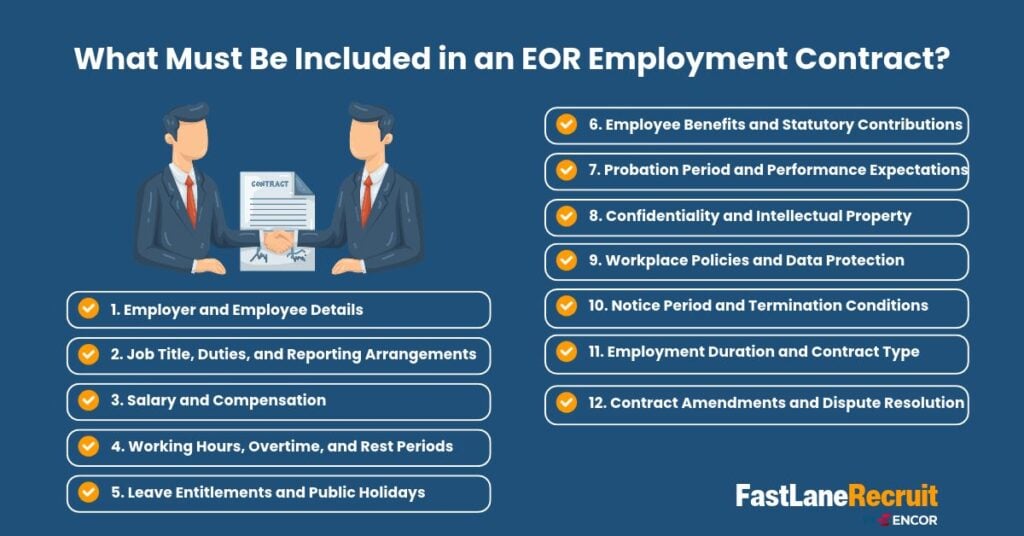
What Must Be Included in an EOR Employment Contract?
The required contents of an employment contract vary by jurisdiction. Some information may be legally mandatory, while other provisions help clarify the working relationship and reduce ambiguity.
The following checklist covers the main areas employers should review when hiring through an EOR.
1. Employer and Employee Details
The contract should correctly identify the parties to the employment relationship.
Depending on local requirements, this may include:
- The EOR’s full legal name and registered details.
- The employee’s legal name and relevant identifying information.
- The employee’s work location.
- The employment start date.
- The applicable employment arrangement.
Why it matters: Accurate identification helps establish who employs the worker and provides a clear record of the employment relationship.
Employers should confirm which legal entity will sign the contract and whether the proposed arrangement is available in the employee’s country.
2. Job Title, Duties, and Reporting Arrangements
The contract should describe the employee’s position and relevant employment responsibilities.
Depending on the role and local requirements, this may include:
- Job title and position.
- Main responsibilities or a reference to an applicable job description.
- Work location or remote-working arrangements.
- Working hours or schedule.
- Reporting arrangements, where appropriate.
Why it matters: Clear role definitions help align expectations between the employee and the client company.
Businesses should also clarify how performance management, role changes, and changes to working arrangements will be handled under the EOR service agreement.
3. Salary and Compensation
Compensation is a central part of an employment contract and should be clearly documented.
Relevant terms may include:
- Base salary or wages.
- Currency and payment frequency.
- Payment method and applicable payroll arrangements.
- Commission, bonuses, or other variable compensation, where applicable.
- Overtime compensation, where required.
- Any applicable allowances.
Why it matters: Ambiguous compensation terms can create payroll discrepancies, employee disputes, and administrative complications.
Employers should verify that the agreed compensation meets applicable minimum-wage requirements and complies with local rules governing payment frequency, overtime, deductions, and other compensation-related obligations.
Variable pay should also be clearly defined, including eligibility, calculation methods, payment conditions, and any applicable restrictions.
4. Working Hours, Overtime, and Rest Periods
Employment contracts or accompanying documents may need to specify normal working hours, working schedules, and other applicable working-time conditions.
Depending on the country and role, relevant provisions may address:
- Normal working hours.
- Work schedules and rest days.
- Overtime arrangements and compensation.
- Public holidays.
- Breaks and statutory rest periods.
- Flexible or remote-working arrangements.
Why it matters: Working-time requirements differ between jurisdictions and may include statutory limits or mandatory entitlements.
Employers should not assume that an arrangement permitted in their home country will automatically be acceptable in the employee’s country.
5. Leave Entitlements and Public Holidays
Leave provisions should reflect the employee’s contractual entitlements and applicable local requirements.
These may include:
- Annual leave.
- Sick leave.
- Public holidays.
- Maternity and paternity leave.
- Other statutory family or medical leave.
- Procedures for requesting and recording leave.
The applicable entitlements depend on local employment legislation and, where permitted, the terms of the employment agreement.
Why it matters: Clear leave arrangements help businesses plan staffing while ensuring that employees receive the leave to which they are entitled.
Employers should also understand how leave balances, carryover, unused leave, and final leave payments are administered where applicable.
6. Employee Benefits and Statutory Contributions
The employment arrangement should clearly address applicable statutory benefits and any additional benefits offered to the employee.
Depending on the country and package, these may include:
- Social security or pension contributions.
- Health insurance or other required coverage.
- Workers’ compensation or equivalent protections.
- Employer-provided insurance.
- Additional leave or employee benefits.
- Other mandatory employment-related entitlements.
Why it matters: Statutory contributions and benefits can affect both the employee’s entitlements and the employer’s total employment costs.
Businesses should distinguish between legally required benefits and discretionary benefits. The contract, applicable benefit documentation, and EOR service agreement should accurately reflect the agreed arrangement.
7. Probation Period and Performance Expectations
Where probationary arrangements are permitted, the contract should clearly state the relevant conditions.
These may include:
- The probation period’s duration.
- Any applicable assessment process.
- Performance expectations.
- Notice requirements during probation.
- Any legally permitted extension provisions.
Why it matters: Probation does not automatically remove statutory employment protections. The applicable country may regulate its duration, extension, notice requirements, or other conditions.
Employers should confirm these requirements before agreeing on the contract terms.
8. Confidentiality and Intellectual Property
Depending on the employee’s role, the contract or associated agreements may need to address confidential information and intellectual property.
Relevant provisions may cover:
- Protection of confidential business information.
- Handling of company data.
- Ownership of work created during employment.
- Use of company systems and resources.
- Return or deletion of confidential information when employment ends.
Why it matters: Businesses hiring internationally must consider both employment requirements and applicable intellectual property and data-protection laws.
Ownership of employee-created work is not necessarily determined by a single universal rule. The appropriate contractual provisions depend on the relevant law, the type of work, and the circumstances in which it is created.
9. Workplace Policies and Data Protection
Employees may need to comply with applicable workplace policies and data-handling procedures.
Relevant documentation may cover:
- Information security.
- Personal data processing.
- Acceptable use of company devices.
- Remote-working requirements.
- Health and safety.
- Relevant workplace conduct policies.
Why it matters: International employment can involve multiple parties handling employee and business information. The arrangements should clarify applicable responsibilities and comply with relevant data-protection requirements.
Employers should also assess whether information transfers across borders require additional safeguards.
10. Notice Period and Termination Conditions
Employment contracts should address termination in accordance with applicable local requirements.
Relevant provisions may cover:
- Notice periods.
- Termination procedures.
- Grounds or circumstances for termination, where relevant.
- Final salary payments.
- Unused leave payments, where applicable.
- Return of company property.
- Post-employment obligations, where enforceable.
Why it matters: Termination rules can be complex, and contractual terms cannot necessarily override mandatory employee protections.
Employers should establish a clear process with their EOR before making termination decisions. Depending on the jurisdiction, procedural requirements, statutory payments, consultation obligations, or other restrictions may apply.
11. Employment Duration and Contract Type
The contract should identify whether the employment is indefinite or for a fixed term, where these arrangements are permitted.
For fixed-term employment, the relevant terms may include:
- The contract’s duration.
- Start and end dates, where applicable.
- The purpose or basis of the fixed-term arrangement, where required.
- Renewal conditions.
- Rules governing expiry or early termination.
Why it matters: Some jurisdictions restrict the use, duration, or renewal of fixed-term contracts.
Employers should confirm that the proposed contract type is appropriate for the role and complies with the applicable local framework.
12. Contract Amendments and Dispute Resolution
The contract and related documentation should establish how changes to employment terms will be handled.
Relevant provisions may address:
- Procedures for changing compensation or responsibilities.
- Written documentation of agreed changes.
- Applicable grievance procedures.
- Dispute-resolution processes.
- Governing law or jurisdiction, where appropriate and legally effective.
Why it matters: Employment terms may change as business needs evolve. A clear process helps prevent misunderstandings and ensures that changes are handled appropriately.
Contractual provisions concerning governing law and disputes should be reviewed carefully because mandatory local employment protections may still apply.
EOR Employment Contract Checklist: What Should Employers Review?
Before onboarding an international employee, businesses should review the following areas with their EOR provider.
| Review area | Questions to ask |
| Legal employer | Which legal entity will employ the worker and sign the contract? |
| Local requirements | Does the contract reflect the applicable employment legislation? |
| Compensation | Are salary, payment frequency, and variable pay clearly documented? |
| Working conditions | Are working hours, work location, and overtime arrangements addressed? |
| Leave and benefits | Are statutory entitlements and agreed additional benefits accounted for? |
| Probation | Are the proposed terms permitted under local law? |
| Confidentiality and IP | Are the relevant provisions appropriate for the role and jurisdiction? |
| Termination | Are notice requirements and applicable termination procedures understood? |
| Payroll | Are applicable statutory deductions and employer contributions included in the cost assessment? |
| Service agreement | Are responsibilities, service fees, and procedures for employment changes clearly defined? |
Practical recommendation: Ask the EOR to identify which contractual provisions are legally mandatory, which reflect agreed commercial terms, and which are additional protections. This distinction makes it easier to assess the contract and identify questions that require local legal advice.
Also Read: EOR Arrangement: Who Legally Employs Your Staff?
How Do EOR Employment Contract Requirements Differ by Country?
Employment contract requirements are not uniform across international markets. Each jurisdiction may impose different rules concerning written employment terms, minimum wages, working hours, leave, benefits, probation, termination, and statutory contributions.
For example, an employer hiring in Singapore may need to consider the applicable requirements for key employment terms and Central Provident Fund contributions. In Hong Kong, relevant considerations can include employment terms under the Employment Ordinance and applicable Mandatory Provident Fund obligations. In the United Kingdom, employers must consider the applicable rules governing written particulars of employment and statutory employment rights.
These examples illustrate why employers should assess the actual requirements of the employee’s work location rather than relying on a generic international employment contract.
Why Local Expertise Matters
Before finalising an employment contract, businesses should confirm:
- Which employment laws apply to the employee.
- Which contractual terms must be provided in writing.
- Which statutory benefits and contributions apply.
- Whether the proposed working arrangements are permitted.
- Which procedures apply when employment terms change or employment ends.
An EOR can help manage local employment documentation and associated administration in supported markets. However, using an EOR does not automatically eliminate every legal, tax, immigration, or corporate obligation that may apply to the client company.
Businesses should assess their circumstances and obtain appropriate professional advice when necessary.
EOR Employment Contracts vs. Direct Hiring: Which Is Right for Your Business?
The appropriate hiring model depends on your business’s local presence, hiring plans, administrative capacity, and long-term strategy.
| Consideration | Hiring through an EOR | Hiring through your own local entity |
| Local employing entity | The EOR serves as the legal employer under the arrangement | Your company employs the worker through its local entity |
| Entity setup | Can avoid establishing a separate local employing entity solely for the hire | Requires an appropriate local entity and related setup |
| Employment documentation | The EOR manages the employment contract within the agreed service scope | Your company manages the employment contract and related processes |
| Payroll and statutory administration | The EOR manages agreed responsibilities | Your company manages these responsibilities directly or through other providers |
| Operational control | Your company generally directs day-to-day work, subject to the arrangement and applicable law | Your company directs day-to-day work as the employer |
| Best-fit scenario | Entering a supported market, hiring a small team, or testing a new market | Building a substantial, long-term local operation or requiring a direct local employment structure |
When Should You Consider EOR Services?
An EOR may be appropriate when your business:
- Needs to hire an employee in another country without establishing its own local employing entity.
- Wants to enter a new market before committing to a permanent local structure.
- Needs help managing country-specific employment documentation and payroll administration.
- Wants to coordinate international employment through one provider across supported markets.
- Needs a structured way to employ an individual who should be classified as an employee rather than an independent contractor.
When Might Your Own Entity Be More Suitable?
Establishing your own local entity may be worth evaluating if your business plans substantial long-term operations, needs a permanent local corporate presence, or has broader commercial and regulatory requirements that an EOR arrangement does not address.
The decision should consider more than the cost of the employment contract. Businesses should also assess corporate obligations, tax exposure, immigration requirements, operational control, hiring volume, and long-term expansion plans.
Also Read: When to Use an Employer of Record: 7 Signs Your Business Needs an EOR
Why Businesses Choose FastLaneRecruit
International employment involves more than preparing an employment contract. Businesses must also coordinate onboarding, payroll administration, statutory contributions, benefits, and ongoing employment requirements across different jurisdictions.
FastLaneRecruit provides Employer of Record services to help businesses hire employees in supported markets without establishing their own local employing entity for every hire.
Local Employment Documentation
We support employment arrangements and documentation appropriate to the relevant country and agreed hiring structure.
This helps businesses address the employment administration required to onboard international employees while accounting for local requirements.
Payroll and Statutory Administration
Employment contracts must align with the employee’s compensation arrangements and applicable employment obligations.
Our EOR services support payroll administration and relevant statutory requirements within the agreed service scope, helping businesses coordinate employment-related processes in supported markets.
Support Across Multiple Markets
FastLaneRecruit supports EOR services across selected markets in Asia Pacific, Europe, and the Middle East & Africa.
Our published coverage includes:
- Asia Pacific: Malaysia, Singapore, Hong Kong, China, India, Philippines, Taiwan, Vietnam, Australia,
- Europe: United Kingdom, Switzerland
- Middle East & Africa: UAE, Saudi Arabia, Qatar
Service availability, employment structures, and country-specific requirements should be confirmed with our team before proceeding.
Onboarding and Ongoing Employment Administration
Our EOR service supports the employment process beyond contract preparation.
Depending on the country and agreed service scope, this can include onboarding documentation, payroll administration, statutory contributions, benefits administration, and ongoing employment-related processes.
A Practical Alternative to Setting Up a Local Entity
Establishing a local company solely to hire an employee may require additional time, cost, and administration.
For eligible hires in supported markets, an EOR arrangement can provide an alternative by allowing the business to employ talent through an established local employment structure.
This can be particularly useful for businesses testing a market, hiring their first international employee, or expanding a distributed team.
How to Get Started With FastLaneRecruit’s EOR Services
Choosing an EOR provider should begin with a clear understanding of your hiring requirements.
Step 1: Identify Your Target Market
Confirm where the employee will work and whether FastLaneRecruit supports the required employment arrangement in that country.
Step 2: Define the Role and Employment Terms
Prepare the proposed job title, responsibilities, compensation, working arrangements, benefits, and expected start date.
Step 3: Review the Employment Requirements
Work with our team to understand the applicable employment documentation, onboarding requirements, payroll arrangements, and relevant statutory obligations.
Step 4: Confirm the Service Scope and Costs
Review the proposed employment structure, service fees, applicable employer costs, and responsibilities of each party before proceeding.
Step 5: Complete the Employment Process
Once the arrangements are agreed, the required employment documentation and onboarding procedures can be completed in accordance with the applicable requirements.
Simplify International Employment With FastLaneRecruit
The right employment contract provides a clear foundation for an international working relationship. However, preparing the contract is only one part of hiring across borders. Businesses must also consider local employment requirements, payroll administration, statutory contributions, employee benefits, and ongoing employment responsibilities.
FastLaneRecruit helps businesses hire employees in supported markets through Employer of Record services, providing support with employment documentation, onboarding, payroll administration, and applicable employment requirements within the agreed service scope.
Whether you are hiring your first international employee or expanding an existing team, we can help you assess the appropriate EOR arrangement for your target market.
Ready to hire internationally without setting up a local employing entity?
Contact FastLaneRecruit to discuss your hiring plans, understand the requirements in your target country, and explore an EOR solution suited to your business.
Book a Free Consultation with an EOR Specialist.
Frequently Asked Questions About EOR Employment Contracts
1. What should an EOR employment contract include?
An EOR employment contract should cover the terms required by the applicable local employment framework. Depending on the jurisdiction, these may include the employer’s and employee’s details, job title, compensation, working hours, leave, benefits, probation, and termination conditions.
Additional provisions may address confidentiality, intellectual property, data protection, and other employment-related matters.
2. Who signs the employment contract in an EOR arrangement?
The EOR generally signs the employment contract with the employee because it is the legal employer under the arrangement. The client company enters into a separate service agreement with the EOR.
The specific legal entities and contractual structure should be confirmed before hiring.
3. Is an EOR employment contract the same as an EOR service agreement?
No. The employment contract governs the employment relationship between the EOR and employee. The service agreement governs the commercial relationship between the EOR and client company, including service scope, fees, responsibilities, and related terms.
Both documents should be reviewed to understand the full arrangement.
4. Can I use the same employment contract in every country?
Not safely as a universal approach. Employment laws and mandatory contractual requirements vary by jurisdiction. A template that is appropriate in one country may omit required terms or contain provisions that are unsuitable in another.
Employment documentation should be reviewed and adapted to the relevant local requirements.
5. Does an EOR employment contract protect my company from all employment risks?
No. An EOR can manage agreed employment responsibilities, but it does not automatically eliminate every risk for the client company.
Businesses should understand the responsibilities retained under the service agreement and assess any additional employment, tax, immigration, corporate, or other obligations that may apply.
6. Can an EOR help with payroll and statutory contributions?
Yes. EOR services commonly include agreed payroll administration and the management of applicable employment-related contributions. The precise scope depends on the provider, country, and contractual arrangement.
FastLaneRecruit supports payroll administration and relevant statutory requirements as part of its EOR offering in supported markets.
7. Can I hire an international employee through an EOR without establishing a local company?
In supported markets, an EOR can provide a way to employ eligible workers without requiring your company to establish its own local employing entity for that hire.
However, the suitability of this arrangement depends on the country, the nature of your business activities, and other applicable requirements.
8. How much does an EOR employment contract cost?
An employment contract is generally one component of the wider EOR arrangement rather than the sole determinant of cost.
Total employment costs may include the employee’s salary, statutory employer contributions, applicable benefits, and the EOR provider’s service fees. Other costs may apply depending on the country and employment arrangement.
Request an itemised cost breakdown to understand the total expected expenditure.
9. Can an EOR employment contract be changed after signing?
Employment terms may be changed where permitted by applicable law and the contractual arrangement. Changes may require written agreement, updated documentation, employee consent, or other procedures depending on the nature of the change and the jurisdiction.
Businesses should coordinate proposed changes with their EOR before implementing them.
10. What happens when an employee hired through an EOR leaves the company?
The EOR and client company should follow the applicable contractual and local employment procedures. Depending on the circumstances, this may involve notice requirements, final salary, unused leave payments, statutory entitlements, documentation, and return of company property.
The applicable process depends on the jurisdiction and the reason employment ends.
11. Which countries does FastLaneRecruit support for EOR employment?
FastLaneRecruit publishes EOR coverage across Malaysia, Singapore, Hong Kong, China, India, Philippines, Taiwan, Vietnam, Australia, the United Kingdom, Switzerland, the UAE, Saudi Arabia, and Qatar.
Country availability and the appropriate employment structure should be confirmed with our team based on your hiring requirements.
12. How do I know whether EOR services are right for my business?
An EOR may be worth considering if you need to hire employees in another country without establishing your own local employing entity and want support with local employment administration.
If you plan to build a substantial long-term operation, establishing a local entity may also be worth evaluating. The decision should account for hiring volume, costs, operational needs, and applicable legal and tax requirements.