Finding the right employee in another country can open new opportunities for your business. However, hiring international talent involves more than agreeing on a salary and signing an employment contract. Work authorization, immigration requirements, and local employment regulations can all affect whether and how you can hire a candidate.
An Employer of Record (EOR) can simplify international employment by acting as the local legal employer without requiring your business to establish its own entity in the target country. Depending on local laws and the scope of its services, an EOR may also be able to support certain work authorization processes.
However, using an EOR does not automatically make a candidate eligible for a work visa, authorize an EOR to sponsor every visa category, or guarantee visa approval. The rules depend on the destination country, the employee’s circumstances, the position, and the EOR’s legal eligibility to act as an employer or sponsor.
Understanding these limitations helps businesses choose the right hiring arrangement, assess immigration requirements early, and avoid delays or compliance risks.
Content Outline
Key Summary
An EOR Can Simplify International Employment
An EOR becomes the legal employer in the relevant market, handling employment administration such as contracts, payroll, statutory contributions, and applicable HR obligations. This can help businesses hire internationally without establishing their own local entity.
Work Visa Sponsorship Depends on Local Immigration Laws
An EOR may be able to sponsor or support a work visa where the relevant immigration framework permits the arrangement and the provider meets the necessary requirements. This capability should be confirmed for each country and visa category.
An EOR Cannot Guarantee Visa Approval
Immigration authorities make decisions based on applicable eligibility criteria, documentation, and other requirements. Using an EOR does not remove these conditions or guarantee a successful application.
Work Authorization and Employment Are Different Requirements
An employment contract does not, by itself, give a foreign national permission to work in a country. Employers must establish whether the employee already has valid work authorization or needs an appropriate visa or work permit.
Choose an EOR Based on Your Actual Hiring Needs
Before engaging an EOR, confirm its local employment capabilities, whether visa-related assistance is available, the scope of that assistance, and any additional costs or specialist support required.
What Is a Work Visa, and How Does an EOR Fit In?
A work visa or work permit is an authorization that allows a foreign national to undertake specified employment or work-related activities in a country, subject to the conditions attached to that authorization.
Terminology and procedures vary by jurisdiction. Some countries use separate visa and work permit systems, while others combine entry permission and work authorization into a single immigration process.
For businesses hiring internationally, the distinction between immigration authorization and employment administration is important.
What Is an Employer of Record?
An Employer of Record is an organization that legally employs a worker on behalf of a client company in a country where the client may not have its own legal entity.
Under an EOR arrangement:
- The EOR acts as the legal employer: It manages the employment relationship and applicable administrative responsibilities under the agreed service scope.
- The client directs day-to-day work: The client typically manages the employee’s responsibilities, objectives, workflows, and performance.
- The EOR manages employment administration: This can include locally compliant employment contracts, payroll, statutory contributions, and HR administration.
- Immigration responsibilities depend on the arrangement: Visa sponsorship, application assistance, and work permit management are not automatically included in every EOR service.
An EOR can therefore address certain employment barriers associated with international hiring. However, immigration support must be assessed separately rather than assumed to be part of the standard service.
Can an EOR Sponsor a Work Visa?
Yes, in some circumstances, but not universally.
An EOR may be able to act as a work visa sponsor when local immigration law permits the arrangement and the EOR satisfies the relevant employer, licensing, sponsorship, and employment requirements.
In other situations, immigration rules may require the sponsoring organization to meet specific conditions that an EOR arrangement does not satisfy. Some visa categories may also depend on a direct employment relationship, an approved sponsoring entity, a qualifying corporate relationship, or other conditions.
The important question is not simply whether an EOR operates in a particular country. It is whether the EOR can legally support the specific work authorization route required by the employee.
When an EOR May Be Able to Support Work Visa Sponsorship
An EOR may be a suitable option when:
- It is legally permitted to employ the relevant worker under the proposed arrangement.
- The applicable immigration rules allow that type of employer to sponsor or support the visa.
- The position meets the relevant occupation, salary, qualification, and other eligibility requirements.
- The EOR meets any necessary registration, licensing, or sponsorship conditions.
- The employee meets the applicable immigration and work authorization requirements.
- The responsibilities for applications, reporting, renewals, and ongoing compliance are clearly established.
Even when these conditions appear to be satisfied, the proposed arrangement should be assessed against current local requirements before the business commits to a hiring timeline.
When an EOR May Not Be Able to Sponsor a Work Visa
An EOR may not be an appropriate sponsorship route when:
- Local law does not permit the proposed third-party employment arrangement for the relevant visa.
- The visa category requires a particular type of sponsoring employer or a direct employment relationship.
- The EOR does not hold the required authorization or registration.
- The position does not meet the applicable visa eligibility criteria.
- The candidate does not meet the required immigration conditions.
- The intended work arrangement conflicts with the conditions of the visa.
In these situations, the business may need to consider direct employment through an eligible sponsoring entity, a different lawful immigration route, or another hiring arrangement that fits the circumstances.
Important: An EOR’s presence in a country does not establish that it can sponsor every category of work visa in that country.
What an EOR Can and Cannot Do for Work Visas
Understanding the difference between employment administration and immigration sponsorship helps businesses set realistic expectations.
| Requirement or activity | What an EOR may be able to do | Important limitation |
| Local employment | Employ a worker through a locally compliant employment arrangement. | The arrangement must be permitted under local law. |
| Employment contracts | Prepare or administer employment contracts reflecting applicable requirements. | A contract does not independently grant work authorization. |
| Payroll administration | Process salary payments and manage applicable payroll administration. | Payroll services do not establish immigration eligibility. |
| Statutory contributions | Administer applicable employment-related contributions and filings within the service scope. | Specific obligations depend on local law and the employment arrangement. |
| Work visa eligibility | Help identify employment-related information relevant to an assessment. | Eligibility must be assessed under the applicable immigration rules. |
| Visa application assistance | Coordinate documentation or applications if this is legally permitted and included in the service. | The EOR must be authorized to perform the relevant activities where required. |
| Work visa sponsorship | Act as a sponsor where legally eligible and contractually agreed. | Sponsorship is not available for every country, visa category, or employment arrangement. |
| Visa approval | Help coordinate required employment documentation where appropriate. | The EOR cannot guarantee a decision by immigration authorities. |
| Visa renewals | Help track deadlines or coordinate renewal-related employment information if included in the service. | Renewal eligibility and responsibilities depend on local rules and the agreed scope. |
| Immigration legal advice | Coordinate with an appropriately qualified immigration professional where necessary. | Businesses may need separate legal or immigration advisory services. |
The precise division of responsibilities should be confirmed before onboarding. A written service agreement should identify which activities the EOR will perform, which remain the client’s responsibility, and whether external immigration support is required.
How Work Visa Sponsorship Through an EOR May Work
When an EOR-supported sponsorship arrangement is legally available, the process typically involves several stages. The exact procedure varies by country and visa category.
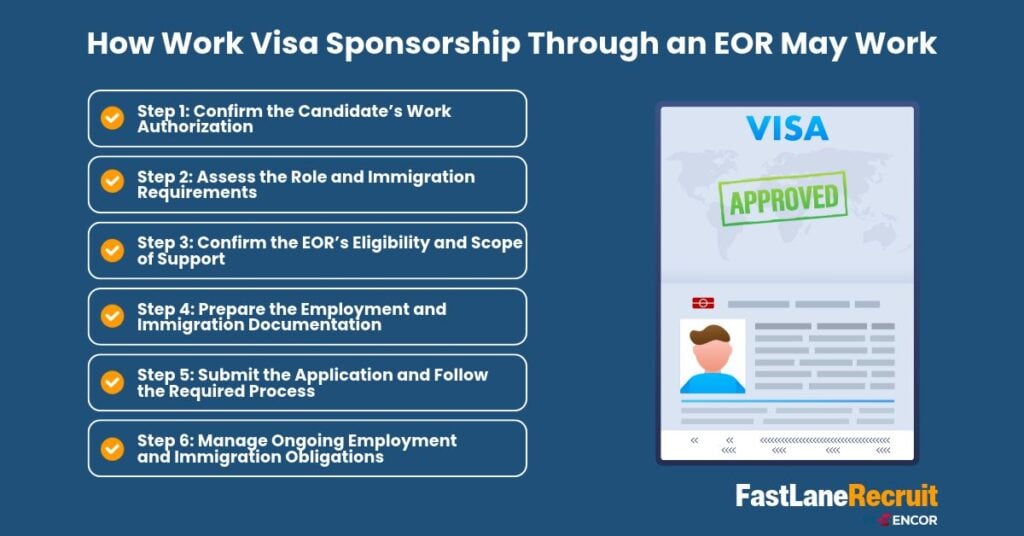
Step 1: Confirm the Candidate’s Work Authorization
Determine whether the candidate already has the right to work in the destination country.
Review the relevant visa or residence status, including any restrictions on the type of employment, employer, occupation, location, or working hours.
If the candidate does not have the required authorization, identify the available immigration routes before confirming a start date.
Step 2: Assess the Role and Immigration Requirements
Review the proposed position against the applicable work visa criteria.
Depending on the country and visa category, relevant considerations may include:
- Eligible occupations and job duties.
- Minimum salary or prevailing wage requirements.
- Educational qualifications and professional experience.
- Employer registration or sponsorship eligibility.
- Labour market testing or other recruitment requirements, where applicable.
- Required documentation and application procedures.
This assessment helps determine whether the proposed employment arrangement is viable.
Step 3: Confirm the EOR’s Eligibility and Scope of Support
Ask the EOR whether it can legally employ the candidate under the proposed arrangement and whether it is authorized to sponsor or support the required work visa.
Confirm whether the service includes application coordination, document preparation, government filings, renewal assistance, or communication with immigration authorities.
If these services are not included, establish whether an external immigration adviser or another eligible sponsor is needed.
Step 4: Prepare the Employment and Immigration Documentation
Where the proposed arrangement is permitted, the relevant parties prepare the required documentation.
Depending on the immigration route, this may include:
- Employment contracts and job descriptions.
- Salary and compensation details.
- Passport and identity documents.
- Educational or professional qualifications.
- Employer registration or sponsorship documentation.
- Additional forms and supporting evidence required by the relevant authority.
Documentation should accurately reflect the proposed employment arrangement. Inconsistencies between the contract, job duties, salary, and visa application may create delays or other complications.
Step 5: Submit the Application and Follow the Required Process
The responsible applicant, employer, sponsor, or authorized representative submits the relevant application according to local procedures.
The employee must satisfy the applicable personal eligibility requirements, and the sponsoring organization must meet its own obligations.
The employee should not begin work in circumstances where the required work authorization has not yet been granted or where existing authorization does not permit the proposed employment.
Step 6: Manage Ongoing Employment and Immigration Obligations
Immigration compliance may continue after the employee starts work.
Depending on the country and visa category, the relevant parties may need to monitor:
- Visa expiry and renewal deadlines.
- Changes in employment conditions or job duties.
- Salary or working-hour requirements.
- Changes in employer or work location.
- Reporting obligations.
- Employment termination and its potential effect on immigration status.
The EOR and client should agree on how relevant changes will be communicated and who is responsible for each required action.
Work Visa and EOR Requirements: Why Country Matters
Immigration rules differ significantly between jurisdictions. A hiring arrangement that works in one country may not be suitable in another.
For example, the UK generally requires an eligible employer to hold the appropriate sponsor licence to sponsor a worker under the Skilled Worker route. Australia’s employer-sponsored visa pathways also impose specific requirements on the sponsoring organization, nominated position, and worker.
These examples illustrate why businesses should verify the applicable immigration route instead of assuming that an EOR can sponsor a visa simply because it operates locally.
Questions to Ask Before Hiring Internationally
Before choosing an EOR for a candidate who needs a work visa, ask:
- Can the proposed employment arrangement legally support this visa category?
- Is the EOR eligible and authorized to act as the sponsor, if sponsorship is required?
- Does the candidate meet the relevant personal eligibility criteria?
- Does the role meet applicable occupation, salary, and qualification requirements?
- Who prepares and submits the application?
- Are immigration advisory services included in the EOR fee?
- Who monitors renewal deadlines and reporting obligations?
- What happens if the visa is delayed, refused, or no longer valid?
- What are the implications if the employee’s role, salary, or employment status changes?
- Is a separate immigration adviser or direct sponsoring employer required?
Obtaining clear answers to these questions before making an offer helps businesses manage costs, expectations, and hiring timelines.
What Are the Benefits of Using an EOR for International Hiring?
Although an EOR does not automatically solve immigration requirements, it can simplify the employment side of international expansion when the arrangement is appropriate.
Hire Without Establishing a Local Entity
An EOR can allow a business to employ workers in a supported market without setting up its own local legal entity, subject to the relevant legal and operational requirements.
This can be useful when testing a new market, hiring a small team, or entering a country before committing to a permanent local structure.
Simplify Employment Administration
Managing employment contracts, payroll, statutory contributions, and employee administration across multiple countries can create additional work for internal HR and finance teams.
An EOR can centralize relevant employment administration within an agreed service scope.
Address Local Employment Requirements
Employment laws and statutory obligations differ between countries. An EOR with appropriate local expertise can help businesses manage employment administration according to the applicable rules.
However, using an EOR does not eliminate every legal or compliance responsibility. Businesses should establish which obligations belong to the EOR and which remain with the client.
Support International Workforce Planning
An EOR can help businesses employ eligible workers in supported markets while they evaluate longer-term expansion plans.
This approach may be useful when a business needs international talent but is not yet ready to establish a local entity.
Clarify the Hiring Process Before Committing
Working with an EOR can help businesses establish the proposed employment structure, payroll arrangements, documentation requirements, and responsibilities before onboarding.
If immigration support is required, it is important to confirm that this can be arranged separately or as part of the agreed service.
Also Read: When to Use an Employer of Record: 7 Signs Your Business Needs an EOR
When Should You Choose an EOR, Direct Employment, or Another Hiring Model?
The most suitable approach depends on the candidate’s work authorization, your business structure, and the requirements of the destination country.
| Hiring situation | Potentially suitable approach | What to check |
| The candidate already has the right to work, and your business has no local entity. | EOR employment may be appropriate. | Verify the candidate’s work rights and any employer or visa restrictions. |
| The candidate needs a work visa, and an EOR sponsorship arrangement is legally available. | EOR employment with confirmed sponsorship support may be an option. | Confirm sponsor eligibility, service scope, visa criteria, and costs. |
| The visa requires a specific eligible sponsoring employer. | Direct employment through an eligible sponsor may be necessary. | Check the required employer structure and sponsorship conditions. |
| Your business already has a local entity and the necessary sponsorship authorization. | Direct employment may be appropriate. | Confirm immigration eligibility and ongoing employer obligations. |
| The individual genuinely operates as an independent contractor. | Contractor management may be suitable. | Verify worker classification and whether the proposed work is permitted under the individual’s immigration status. |
These options are not interchangeable in every situation. The correct choice should be based on the actual working relationship and the applicable employment and immigration rules.
An EOR should not be used to bypass visa restrictions or disguise an employment relationship that does not meet local legal requirements.
Also Read: EOR vs Staffing Agency vs Contractor Management: The Best Fit for Global Hiring
How FastLaneRecruit Supports International Employment
Hiring across borders requires a suitable employment structure, reliable administration, and a clear understanding of local requirements.
FastLaneRecruit provides Employer of Record services to help businesses hire employees in supported markets without establishing their own local entity. We support employment administration through locally appropriate employment arrangements, payroll processing, statutory contributions, and related HR administration within the agreed service scope.
Our EOR service can be relevant to businesses that want to expand internationally, employ remote team members, or build teams in new markets while managing the operational requirements of employment.
Employment and Payroll Administration
We help businesses coordinate employment contracts, payroll, applicable statutory contributions, and related employment administration in supported markets.
This provides a structured approach to managing the employment relationship while the client retains responsibility for directing the employee’s day-to-day work, subject to the agreed arrangement.
Local Employment Compliance
Employment requirements vary between countries. Our EOR model helps businesses manage relevant local employment and payroll obligations through an appropriate employment structure.
The scope of support depends on the destination market and the agreed service arrangement.
Support for International Expansion
Businesses can use our EOR services to employ eligible workers in supported markets without first establishing their own local entity, where the proposed arrangement is appropriate.
For candidates who require a work visa, we recommend confirming the relevant immigration requirements and the availability of any necessary sponsorship or advisory services before committing to a hiring timeline.
Why Businesses Choose FastLaneRecruit
Local Employment Expertise
We help businesses navigate local employment and payroll administration through an EOR arrangement suited to the relevant market and service requirements.
Simplified International Hiring
Our EOR model enables businesses to employ workers in supported countries without establishing their own local entity, where legally appropriate.
Integrated Payroll and HR Administration
We coordinate employment administration and payroll-related responsibilities within the agreed service scope, helping businesses manage cross-border workforce operations more efficiently.
Transparent Service Scope
We work with businesses to establish the relevant employment requirements, service responsibilities, and operational arrangements before proceeding.
For work visa cases, confirming the scope of immigration-related assistance in advance is particularly important.
Regional Market Coverage
FastLaneRecruit supports international employment across the following markets:
- Asia Pacific: Malaysia, Singapore, Hong Kong, China, India, Philippines, Taiwan, Vietnam, Australia,
- Europe: United Kingdom, Switzerland
- Middle East & Africa: UAE, Saudi Arabia, Qatar
Country coverage for EOR employment does not automatically mean that work visa sponsorship is available in every market. The relevant employment arrangement and immigration requirements must be assessed separately.
Plan Your International Hiring with FastLaneRecruit
Hiring internationally can create opportunities to access talent and expand into new markets, but the right employment structure must account for both local employment requirements and immigration restrictions.
FastLaneRecruit helps businesses manage international employment through EOR services, including employment administration, payroll processing, and applicable statutory obligations in supported markets.
If you are planning to hire overseas talent, we can help you assess your employment requirements and understand whether an EOR arrangement may suit your expansion plans. For candidates who require a work visa, the relevant sponsorship eligibility and immigration support requirements should be confirmed before onboarding.
Book a Free Consultation with an Expert
Discuss your international hiring plans with FastLaneRecruit and explore an appropriate EOR arrangement for your business.
Contact our team to discuss your target market, employment requirements, and next steps.
Frequently Asked Questions About Work Visas and EOR
Can an EOR sponsor a work visa?
An EOR may be able to sponsor a work visa where local immigration law permits the arrangement and the EOR meets the relevant sponsorship requirements. Availability depends on the country, visa category, employer eligibility, and the employee’s circumstances.
Can I hire a foreign employee through an EOR without a work visa?
Possibly, if the individual already has valid authorization to undertake the proposed work and the EOR employment arrangement complies with applicable requirements. Some visas restrict the employer, occupation, or type of work permitted. Always verify the person’s work rights before employment begins.
Does using an EOR guarantee work visa approval?
No. An EOR cannot guarantee that an immigration authority will approve an application. Approval depends on the relevant eligibility requirements, supporting documentation, and the authority’s decision.
What is the difference between an EOR and a visa sponsorship agency?
An EOR provides a legal employment arrangement and related employment administration. A visa sponsorship agency or immigration adviser may provide immigration-specific assistance, depending on its authorization and service scope. Some providers may offer both, but businesses should verify which services are actually included.
Can an EOR hire an employee who already has a work permit?
Potentially, yes. The candidate’s existing authorization must permit the proposed employment arrangement. Some work permits are tied to a specific employer, position, or occupation, so a change in employer may require additional approval.
Does an EOR handle work permit applications and renewals?
This depends on the provider, country, and service agreement. Some arrangements may include application coordination or renewal support, while others require a separate immigration service. Confirm the responsibilities and fees before proceeding.
Can an EOR sponsor a work visa in any country where it operates?
No. Operating in a country does not automatically make an EOR eligible to sponsor every visa category. Immigration rules, licensing requirements, and permitted employment arrangements vary by jurisdiction.
Is an EOR suitable if my company does not have a local entity?
An EOR may be suitable when you need to employ someone in a supported country without establishing your own local entity. However, the proposed arrangement must be legally appropriate, and separate immigration requirements may apply if the candidate needs work authorization.
What documents are needed for work visa sponsorship through an EOR?
Requirements depend on the country and visa category. Common documents may include a passport, employment contract, job description, salary information, qualifications, and employer or sponsorship documentation. Additional evidence may be required by the relevant immigration authority.
How long does work visa sponsorship through an EOR take?
There is no universal timeline. Processing depends on the country, visa category, employer eligibility, application completeness, and immigration authority processing times. Entity setup may be avoided through an EOR, but that does not eliminate visa processing requirements or guarantee a faster approval.
What happens if a work visa application is refused?
The next steps depend on the reasons for refusal and the applicable immigration rules. The business should review the decision, assess whether further action is available, and confirm whether the candidate can lawfully undertake the proposed work. The employment agreement and any associated costs should also be reviewed.
Can an EOR help my business expand internationally if visa sponsorship is not available?
Yes, an EOR may still be useful for employing candidates who already have the necessary work authorization in a supported market. Whether it is suitable depends on the candidate’s status, the employment arrangement, and local requirements.