Expanding into a new country can unlock access to skilled talent, new customers, and long-term business opportunities. But before making your first international hire, you need to decide how to employ your workforce without creating unnecessary costs, administrative burdens, or delays.
Two common options are establishing a foreign subsidiary or using an Employer of Record (EOR). A subsidiary gives your business its own local corporate structure, while an EOR allows you to hire employees through an established local employment arrangement without setting up your own employing entity, where legally permitted.
The difference can significantly affect your initial investment, hiring timeline, ongoing administrative responsibilities, and flexibility as your business grows.
For businesses that want to hire internationally without immediately establishing a local company, an EOR can offer a more practical route to market entry. However, a subsidiary may be more suitable when you need a permanent local corporate presence or plan to build substantial operations in a particular country.
This guide compares foreign subsidiary vs EOR costs, setup timelines, compliance responsibilities, and long-term suitability to help you choose the right international hiring model.
Content Outline
Key Summary
An EOR Can Help You Hire Without Establishing a Local Entity
An Employer of Record legally employs eligible workers on your company’s behalf under an agreed arrangement. This allows your business to hire in supported countries without establishing its own local employing entity, subject to local laws and the scope of the service.
A Foreign Subsidiary Requires More Than Incorporation
Establishing a subsidiary involves creating a separate legal entity. Depending on the country and business activities, you may also need to complete tax registrations, employment registrations, banking arrangements, and other regulatory requirements before operations can begin.
EOR Can Reduce Initial Setup Work and Hiring Delays
An EOR can help you move directly into the local employment process without waiting for your own subsidiary to be established. Actual onboarding times depend on the country, employee documentation, role, and applicable requirements.
The Cheapest Option Depends on Your Business Plans
An EOR generally involves recurring service fees, while a subsidiary carries incorporation, maintenance, and operating costs. The more appropriate option depends on workforce size, hiring duration, operational requirements, and the cost of maintaining each structure.
The Right Choice Depends on Your Expansion Strategy
An EOR may suit businesses testing a market, hiring their first overseas employee, or building a small international team. A subsidiary may be preferable when a business needs its own local legal structure for long-term commercial operations.
What Is the Difference Between a Foreign Subsidiary and an EOR?
A foreign subsidiary and an Employer of Record provide different ways to support international employment. The main difference is whether your business establishes its own local legal entity or uses an EOR to employ workers in the target country.
What Is a Foreign Subsidiary?
A foreign subsidiary is a separate legal entity established in another country and owned or controlled by a parent company. Its incorporation, ownership requirements, governance, and permitted activities depend on local company law.
A subsidiary can provide a business with a formal local presence for hiring employees, entering commercial agreements, conducting operations, and pursuing long-term growth.
However, establishing and maintaining a subsidiary may require investment in incorporation, accounting, tax compliance, corporate filings, banking, payroll, and local employment administration.
A foreign subsidiary may be suitable when:
- You intend to establish a permanent presence in the target market.
- Your business requires a locally incorporated entity for its commercial activities.
- You plan to build a substantial local workforce.
- You need a corporate structure to support broader local operations.
- Your long-term strategy justifies the cost of maintaining a separate legal entity.
What Is an Employer of Record (EOR)?
An Employer of Record is a third-party organisation that legally employs workers on behalf of a client company under an agreed employment arrangement.
Instead of establishing its own local employing entity for each new market, the client company engages an EOR to employ eligible workers in countries where the service is available and legally appropriate.
The EOR typically manages agreed employment responsibilities, including local employment contracts, payroll administration, statutory contributions, and employment documentation.
The client company generally retains responsibility for directing the employee’s day-to-day work, objectives, and performance.
An EOR may be suitable when:
- You want to hire employees in another country without immediately establishing your own local entity.
- You need to recruit one or several employees overseas.
- You want to evaluate a new market before making a larger investment.
- You need support with local employment administration and payroll.
- You want to expand internationally without building a separate HR infrastructure in every country.
The precise responsibilities of the EOR and client depend on the service agreement and applicable local laws.
Also Read: Hiring Globally: PEO, EOR, and Global Talent
Foreign Subsidiary vs EOR: Cost and Setup Time Compared
The most important difference between these models is the investment and infrastructure required before you can begin employing people.
A subsidiary requires your business to establish and maintain its own local legal entity. An EOR provides an existing employment framework, allowing you to proceed with hiring without first incorporating a separate company for that purpose.
The following table summarizes the main differences.
| Comparison Factor | Foreign Subsidiary | Employer of Record (EOR) |
| Initial setup | Requires incorporation and applicable registrations | No separate client subsidiary is needed for the EOR employment arrangement |
| Time to hire | Depends on incorporation, registrations, and operational readiness | Can be faster because the client does not need to establish its own employing entity first |
| Initial investment | Incorporation, professional fees, registrations, and other setup costs | EOR service fees and employment-related costs |
| Ongoing costs | Entity maintenance, accounting, filings, payroll, and employment administration | Recurring service fees, salaries, statutory costs, and agreed additional charges |
| Legal employer | The subsidiary generally employs its local staff | The EOR generally serves as the legal employer under the arrangement |
| Payroll and employment administration | Managed internally or through external providers | Managed by the EOR according to the service agreement |
| Operational control | The parent company exercises control through the subsidiary’s ownership and governance structure | The client generally directs employees’ day-to-day work while the EOR handles the legal employment relationship |
| Local corporate presence | Provides a separate local legal entity | Does not itself establish a subsidiary for the client |
| Flexibility | Supports a dedicated local operating structure | Can provide a practical route for initial hiring and market testing |
| Long-term suitability | May suit established, substantial, or permanent local operations | May suit ongoing international employment where the EOR arrangement remains appropriate |
Important: Costs, setup requirements, and employment responsibilities vary by country. This comparison is a general guide rather than a substitute for country-specific legal or tax advice.
Which Costs Less: A Foreign Subsidiary or an EOR?
There is no universal answer to whether a foreign subsidiary or an EOR is cheaper. The total cost depends on how many employees you plan to hire, how long you intend to operate in the market, the local regulatory requirements, and the services included in your EOR agreement.
The key is to compare the full cost of each model rather than looking only at incorporation fees or monthly EOR charges.
Foreign Subsidiary Costs
Establishing a foreign subsidiary can require substantial initial and ongoing investment.
Depending on the jurisdiction, expenses may include:
- Incorporation and registration: Company formation, government filing fees, and required professional services.
- Legal and accounting support: Advice on local corporate structures, tax obligations, and regulatory requirements.
- Tax and employer registrations: Registrations required before conducting business or employing staff.
- Corporate maintenance: Annual filings, accounting, company secretarial services, and other recurring obligations.
- Payroll and HR administration: Systems, professional support, and resources needed to manage employees.
- Banking and operational infrastructure: Business banking, office arrangements, and other requirements associated with local operations.
Some expenses arise before the first employee starts work, while others continue throughout the life of the subsidiary.
A subsidiary can become a suitable investment when the company needs its own local corporate structure and has sufficient business activity to justify the associated overhead.
EOR Costs
An EOR reduces the need to establish and maintain a separate client-owned employing entity for the employment arrangement. Instead, the business pays for the EOR service and the associated employment costs.
Typical cost components include:
- EOR service fees: Charges for providing the agreed employment and administration services.
- Employee compensation: Salary, bonuses, and other applicable remuneration.
- Employer statutory costs: Required employer contributions and employment-related costs under local law.
- Employee benefits: Mandatory benefits and any additional benefits included in the employment arrangement.
- Additional service charges: Any applicable onboarding, offboarding, or other fees specified in the agreement.
An EOR does not eliminate employment costs or statutory obligations. It changes how the employment relationship is structured and how responsibilities are administered.
Which Option Offers Better Value?
Consider the following scenarios.
| Business Situation | Potentially Suitable Option | Why |
| Hiring one employee in a new market | EOR | Avoids establishing a separate entity solely for that employment arrangement |
| Testing demand before committing to a market | EOR | Provides a way to hire while evaluating longer-term opportunities |
| Building a small international team | EOR | Can reduce the need to establish separate local employment infrastructure |
| Establishing a permanent local operation | Subsidiary may be appropriate | Provides a dedicated legal structure for ongoing business activities |
| Building substantial local commercial operations | Subsidiary may be appropriate | May better support the company’s broader corporate and operating requirements |
| Uncertain hiring plans | EOR may be appropriate | Can avoid an immediate commitment to establishing a new entity |
Cost-saving tip: Request a complete breakdown of EOR fees, employee-related expenses, and additional charges. Compare this with the subsidiary’s incorporation costs, ongoing maintenance, and internal administrative expenses over the same period.
This provides a more realistic basis for deciding which model offers better value.
Which Is Faster to Set Up: A Foreign Subsidiary or an EOR?
For businesses prioritizing speed, an EOR can provide a significant practical advantage because it removes the need to establish a separate client-owned employing entity before hiring.
However, the time required to hire an employee depends on more than the employment model.
Foreign Subsidiary Setup Timeline
Setting up a foreign subsidiary can involve several stages:
Step 1: Choose the Corporate Structure
Determine the appropriate entity type, ownership structure, and permitted business activities under local law.
Step 2: Complete Incorporation
Prepare and submit the required company formation documents and complete the applicable registration process.
Step 3: Obtain Required Registrations
Depending on the country and business activities, additional tax, employer, licensing, or regulatory registrations may be necessary.
Step 4: Establish Operational Infrastructure
Arrange banking, accounting, payroll, and other systems needed to operate the business and employ staff.
Step 5: Prepare for Employee Onboarding
Complete employment documentation and applicable registrations before bringing employees onto the payroll.
The process can take days, weeks, or longer depending on the jurisdiction, ownership structure, documentation, and operational requirements. There is no reliable universal timeline for establishing a foreign subsidiary.
EOR Setup and Employee Onboarding Timeline
An EOR can shorten the route to hiring by allowing your business to use an existing local employment framework.
The process generally involves:
Step 1: Select Your Candidate
Identify the employee you want to hire and confirm the proposed role, compensation, and start date.
Step 2: Confirm Local Employment Requirements
The EOR assesses the applicable employment requirements and gathers the information needed to prepare the employment arrangement.
Step 3: Prepare the Employment Contract
The EOR coordinates the appropriate local employment documentation and required terms.
Step 4: Complete Onboarding
The employee provides the required documentation, and the relevant onboarding and registration processes are completed.
Step 5: Begin Employment and Payroll Administration
Once the necessary requirements have been met, the employee can begin work under the agreed arrangement, with payroll and ongoing employment administration managed accordingly.
An EOR can often reduce the administrative steps required before hiring, but it cannot guarantee an immediate start. Local registrations, work authorization, background checks, and other requirements may affect the timeline.
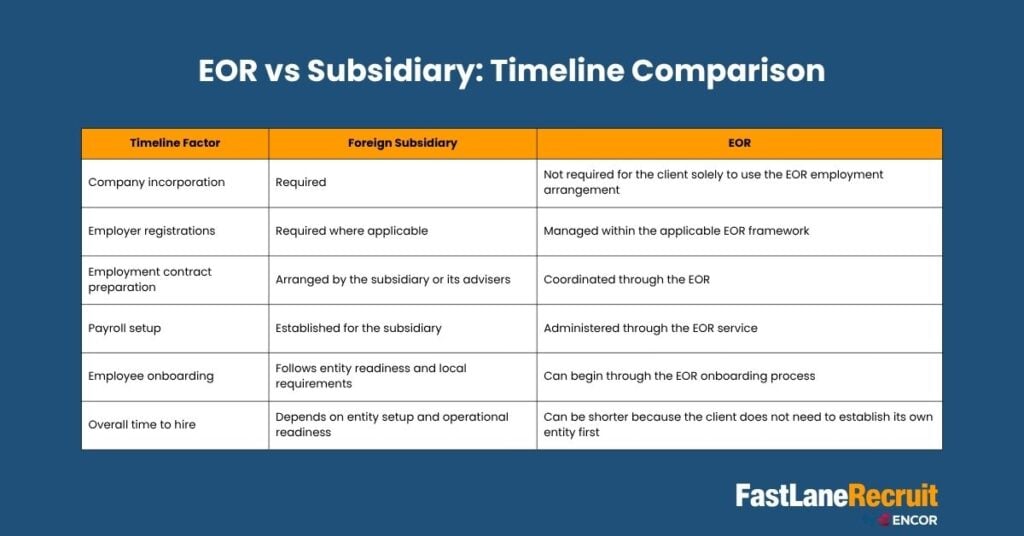
EOR vs Subsidiary: Timeline Comparison
| Timeline Factor | Foreign Subsidiary | EOR |
| Company incorporation | Required | Not required for the client solely to use the EOR employment arrangement |
| Employer registrations | Required where applicable | Managed within the applicable EOR framework |
| Employment contract preparation | Arranged by the subsidiary or its advisers | Coordinated through the EOR |
| Payroll setup | Established for the subsidiary | Administered through the EOR service |
| Employee onboarding | Follows entity readiness and local requirements | Can begin through the EOR onboarding process |
| Overall time to hire | Depends on entity setup and operational readiness | Can be shorter because the client does not need to establish its own entity first |
Bottom line: If your priority is to hire an employee without waiting for your own subsidiary to be established, an EOR may offer the more direct route. If you need a permanent local corporate presence, the additional setup work may be justified.
Foreign Subsidiary vs EOR: Which Is Right for Your Business?
The right model depends on your expansion strategy, the type of business activities you intend to conduct, and your long-term workforce requirements.
Choose an EOR When You Need a Practical Route to International Hiring
An EOR may be a strong fit if your business wants to:
- Hire its first employee in a new country.
- Recruit a small team without immediately establishing a local company.
- Test a market before committing to a permanent corporate structure.
- Access international talent without building a separate local HR infrastructure.
- Simplify employment contracts, payroll, and statutory administration.
- Expand into multiple supported markets using one EOR partner.
For example, a technology company that wants to hire three software engineers in a new market may not need to establish a subsidiary solely to employ those individuals. An EOR may allow the company to recruit and onboard eligible employees while it evaluates its longer-term plans.
The company must still assess whether an EOR arrangement is appropriate for its intended activities and whether local regulations impose additional requirements.
Choose a Foreign Subsidiary When You Need a Dedicated Local Entity
A subsidiary may be more appropriate if your business intends to:
- Establish a permanent operating presence in another country.
- Conduct local commercial activities that require its own legal entity.
- Build a substantial local workforce.
- Enter commercial arrangements that require a locally incorporated company.
- Invest in long-term operations, facilities, or local infrastructure.
- Manage employment through its own local corporate structure.
For example, a company planning to establish a regional headquarters, develop a local customer base, and operate a substantial office may find that a subsidiary better supports its broader commercial objectives.
The decision should account for local incorporation requirements, tax implications, regulatory obligations, and the company’s intended activities.
What If You Plan to Start With an EOR and Establish a Subsidiary Later?
These approaches do not necessarily have to be mutually exclusive over the life of your expansion.
Some businesses initially use an EOR while evaluating a market, then establish their own entity when their workforce or commercial operations grow.
However, transitioning employees from an EOR to a subsidiary requires careful planning. Depending on the jurisdiction, the process may involve new employment contracts, employee consent, payroll changes, accrued benefits, immigration considerations, and other legal or administrative requirements.
A transition should not be treated as an automatic transfer. The appropriate process depends on local law and the existing employment arrangements.
Decision rule: If your immediate objective is to employ people in a supported market, an EOR may be the more practical starting point. If your objective requires your own local corporate presence, investigate whether establishing a subsidiary is necessary.
Also Read: When to Use an Employer of Record: 7 Signs Your Business Needs an EOR
Why Businesses Choose FastLaneRecruit
International expansion involves more than finding qualified employees. Businesses must also manage local employment requirements, payroll administration, statutory obligations, employee documentation, and ongoing HR processes.
FastLaneRecruit provides Employer of Record services to help businesses employ talent in supported international markets without establishing their own local employing entity for each EOR arrangement, where legally appropriate.
1. Support for Faster International Hiring
Our EOR model helps businesses avoid the need to establish a separate local employing entity before hiring eligible employees.
This can be particularly useful when entering a new market, hiring a small initial team, or evaluating international growth opportunities.
2. Local Employment and Compliance Support
Employment requirements vary between countries. We support the employment administration associated with our EOR services, including local employment documentation, payroll processes, and applicable statutory requirements, according to the service agreement and local regulations.
3. Payroll and Employment Administration
Managing payroll across borders can create additional administrative work for internal HR and finance teams.
We help coordinate payroll and related employment administration for employees engaged through our EOR services, allowing your business to focus on its operations and workforce objectives.
4. Support Across Multiple International Markets
FastLaneRecruit supports EOR services across the following markets:
Malaysia, Singapore, Hong Kong, China, India, Philippines, Taiwan, Vietnam, Australia, United Kingdom, Switzerland, UAE, Saudi Arabia, Qatar
Service availability, permitted employment arrangements, and country-specific requirements should be confirmed with our team before hiring.
5. A Practical Approach to International Expansion
Not every business needs to establish a subsidiary before making its first international hire.
Our EOR services provide a route for businesses to explore hiring in supported markets while assessing their long-term workforce and corporate structure requirements.
Whether you are hiring one employee or building a team across multiple countries, we can help you evaluate the employment arrangements and administrative requirements relevant to your plans.
Hire Internationally Without Unnecessary Entity Setup
Establishing a foreign subsidiary can be the right decision for businesses building a permanent local operation. However, it may not be necessary when your immediate objective is to hire employees in a new market.
An Employer of Record can provide a more direct route to international hiring by helping manage local employment contracts, payroll administration, statutory requirements, and onboarding without requiring your business to establish its own local employing entity for that arrangement, where legally permitted.
The right choice depends on your hiring plans, total costs, operational requirements, and long-term expansion strategy.
Explore Your International Hiring Options With FastLaneRecruit
Whether you are hiring your first overseas employee, building a regional team, or comparing the cost of an EOR with establishing a subsidiary, FastLaneRecruit can help you assess the employment arrangements available in our supported markets.
Book a Free Consultation with an Expert!
Discuss your target country, workforce plans, expected hiring timeline, and employment requirements with our team to determine whether an EOR is the right approach for your business.
Frequently Asked Questions About Foreign Subsidiary vs EOR
1. Is an EOR cheaper than setting up a foreign subsidiary?
An EOR can reduce initial setup expenses because your business does not need to establish and maintain its own local employing entity for the EOR arrangement. However, recurring EOR service fees apply, and the overall cost depends on workforce size, employment duration, local requirements, and service scope. A subsidiary may offer better value for some businesses with substantial, long-term local operations.
2. How long does it take to set up an EOR compared with a subsidiary?
An EOR can often support a faster hiring process because the client does not need to incorporate its own local employing entity first. Establishing a subsidiary may require incorporation, registrations, and operational preparation before hiring can proceed. Actual timelines vary by country, documentation, and the requirements of the role.
3. Can I hire employees in another country without setting up a company?
In many cases, yes. An Employer of Record can legally employ eligible workers on your company’s behalf in supported markets, subject to local law and the specific arrangement. An EOR is not a substitute for every type of local business registration, license, or corporate presence that your activities may require.
4. Who is the legal employer under an EOR arrangement?
The EOR generally serves as the legal employer under the employment arrangement, while the client company directs the employee’s day-to-day work and performance. The exact allocation of responsibilities depends on local law and the service agreement.
5. What costs should I compare before choosing an EOR or subsidiary?
Compare the full cost of each model. For an EOR, consider service fees, salaries, employer contributions, benefits, and any additional charges. For a subsidiary, consider incorporation, professional services, registrations, corporate maintenance, accounting, payroll, and other operating expenses. Use the same time horizon and workforce assumptions when comparing the options.
6. Is an EOR suitable for hiring just one employee overseas?
Yes. An EOR may be appropriate when a business needs to hire one employee in a country where it does not have its own local employing entity. It can help avoid establishing a subsidiary solely for that employment arrangement, provided the proposed hiring model is legally appropriate.
7. Can I switch from an EOR to my own subsidiary later?
Potentially, yes. Businesses may move to their own local entity as their operations grow. The transition requires careful planning because employment contracts, statutory obligations, accrued benefits, payroll, immigration status, and employee rights may be affected. The process depends on the country and the existing employment arrangement.
8. Does an EOR handle payroll, taxes, and employee benefits?
An EOR typically manages agreed payroll and employment administration, including applicable statutory deductions, employer contributions, and employee benefits. The exact services depend on the provider, the service agreement, and local requirements. Businesses should confirm the scope of coverage before entering an arrangement.
9. Does using an EOR eliminate all legal and compliance risks?
No. An EOR can help manage local employment administration, but it does not eliminate every legal, tax, regulatory, or operational risk. Businesses should confirm that the arrangement is appropriate for their intended activities and understand their respective responsibilities under local law and the service agreement.
10. Which countries does FastLaneRecruit support for EOR services?
FastLaneRecruit supports EOR services in Malaysia, Singapore, Hong Kong, China, India, Philippines, Taiwan, Vietnam, Australia, the United Kingdom, Switzerland, the UAE, Saudi Arabia, and Qatar. Contact our team to confirm availability and any country-specific requirements for your planned hire.