Hiring international talent gives businesses access to specialised skills without limiting recruitment to one country. However, choosing the right workforce model is essential to managing employment responsibilities, controlling costs and supporting sustainable growth.
When comparing EOR vs contractor arrangements, the decision comes down to more than flexibility or fees. Businesses must consider the nature of the working relationship, local employment laws, worker classification, tax obligations and the level of administrative support required.
An Employer of Record (EOR) provides a local employment structure for eligible employees, while independent contractors typically provide services under commercial agreements. Contractor management helps businesses administer genuine contractor relationships, including documentation, invoicing and payments.
Choosing the appropriate model can help businesses manage international workforce operations more effectively. FastLaneRecruit provides both contractor management and Employer of Record services, helping businesses evaluate their hiring needs and organise the relevant administrative processes across supported markets.
Content Outline
Key Summary
EOR and Contractor Arrangements Serve Different Purposes
An EOR is generally suitable when a business needs to employ someone in another country. Contractor management is appropriate when the individual genuinely operates as an independent contractor.
Worker Classification Is a Critical Compliance Consideration
A contractor agreement does not automatically establish independent-contractor status. Authorities may consider the actual working relationship, including control, independence and the nature of the work.
The Cheapest Option Is Not Always the Most Appropriate
Compare the total costs of each arrangement, including service fees, compensation, statutory contributions, benefits, administration and potential compliance exposure.
EOR Services Simplify International Employment Administration
An EOR manages employment responsibilities covered by the arrangement, which may include employment contracts, payroll administration and statutory processes. The precise allocation of responsibilities depends on local law and the service agreement.
FastLaneRecruit Supports Both Workforce Models
Our contractor management services support the administration of international contractor engagements, while our EOR services provide an employment structure for eligible workers. The appropriate solution depends on the actual working relationship and local requirements.
What Is an Employer of Record (EOR)?
An Employer of Record is a third-party organisation that legally employs workers on behalf of a client company under an agreed employment arrangement.
The EOR establishes the local employment relationship and manages the employment administration covered by its services. Meanwhile, the client company generally retains responsibility for the employee’s day-to-day work, objectives and performance.
Businesses often use EOR services when they want to hire employees internationally without establishing their own local employing entity in every target market, where the arrangement is permitted and appropriate.
What Does an EOR Manage?
Depending on the country and service agreement, EOR responsibilities may include:
- Employment contracts: Preparing employment documentation appropriate to the local employment arrangement.
- Payroll administration: Coordinating salary calculations, payments and applicable deductions.
- Statutory requirements: Managing relevant employment-related contributions and filings within the agreed scope.
- Employee benefits: Administering applicable benefits according to local requirements and the agreement.
- Onboarding: Coordinating employment documentation and onboarding processes.
- Ongoing administration: Supporting employment records, changes and offboarding.
An EOR can simplify the operational side of international employment, but it does not automatically eliminate every compliance risk. The client must also understand its responsibilities under local law and the EOR agreement.
Also Read: What Does EOR Do? 10 Key Responsibilities of an Employer of Record
What Is an Independent Contractor?
An independent contractor is a self-employed professional or business engaged to provide services under a commercial agreement rather than an employment contract.
Contractors may provide specialised expertise, complete defined projects or deliver specific business outcomes. They generally have greater independence over how their work is organised and delivered, subject to the agreement and applicable law.
For businesses, contractor engagements can provide access to specialised skills without creating an ongoing employment relationship when the arrangement genuinely qualifies as independent contracting.
What Does Contractor Management Involve?
Managing international contractors involves more than agreeing on a rate and issuing payments. Businesses may need to coordinate:
- Contractor agreements and scope-of-work documentation.
- Onboarding and collection of relevant documentation.
- Invoices, payment schedules and payment administration.
- Contractor records and engagement changes.
- Contract renewals and offboarding.
- Relevant local requirements and classification reviews.
FastLaneRecruit provides contractor management support to help businesses organise these processes across supported international markets.
Important: Contractor management does not turn an employment relationship into a legitimate contractor arrangement. Worker classification must reflect the actual relationship and applicable local labor law.
EOR vs Contractor: What Are the Key Differences?
The fundamental difference is the legal relationship. An EOR supports an employment arrangement, whereas an independent contractor generally provides services under a commercial agreement.
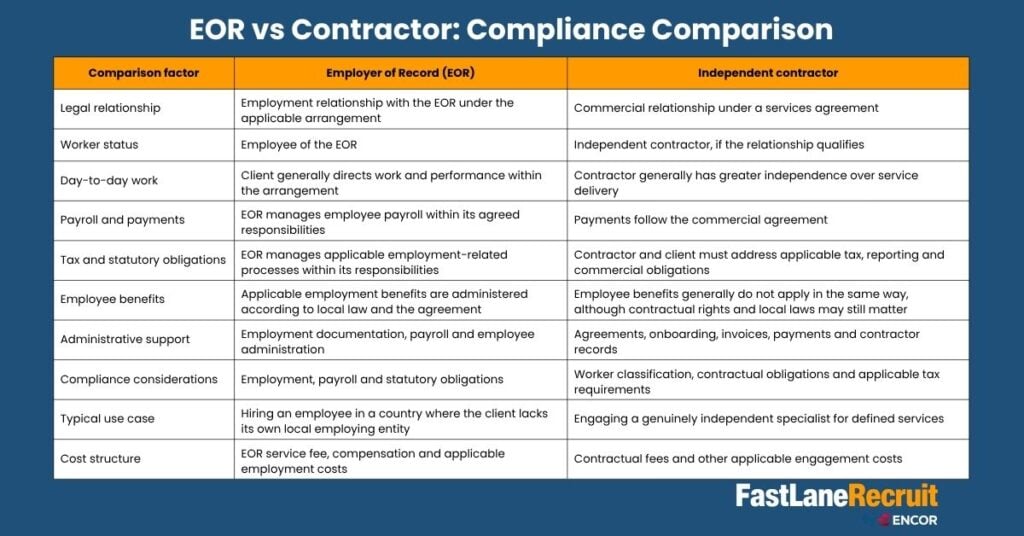
| Comparison factor | Employer of Record (EOR) | Independent contractor |
| Legal relationship | Employment relationship with the EOR under the applicable arrangement | Commercial relationship under a services agreement |
| Worker status | Employee of the EOR | Independent contractor, if the relationship qualifies |
| Day-to-day work | Client generally directs work and performance within the arrangement | Contractor generally has greater independence over service delivery |
| Payroll and payments | EOR manages employee payroll within its agreed responsibilities | Payments follow the commercial agreement |
| Tax and statutory obligations | EOR manages applicable employment-related processes within its responsibilities | Contractor and client must address applicable tax, reporting and commercial obligations |
| Employee benefits | Applicable employment benefits are administered according to local law and the agreement | Employee benefits generally do not apply in the same way, although contractual rights and local laws may still matter |
| Administrative support | Employment documentation, payroll and employee administration | Agreements, onboarding, invoices, payments and contractor records |
| Compliance considerations | Employment, payroll and statutory obligations | Worker classification, contractual obligations and applicable tax requirements |
| Typical use case | Hiring an employee in a country where the client lacks its own local employing entity | Engaging a genuinely independent specialist for defined services |
| Cost structure | EOR service fee, compensation and applicable employment costs | Contractual fees and other applicable engagement costs |
Neither model is automatically more compliant or less expensive in every situation. The appropriate arrangement depends on the actual work, the working relationship and the requirements of the country involved.
What Are the Compliance Risks of Hiring Contractors Internationally?
International contractor engagements can provide flexibility, but businesses must assess the relevant legal and administrative requirements before entering into an agreement.
1. Worker Misclassification
Worker misclassification occurs when someone is treated as an independent contractor even though the actual relationship meets the applicable legal test for employment.
Potential warning signs may include:
- The business exercises extensive control over how, when and where the individual works.
- The individual performs an ongoing role similar to that of an employee.
- The individual has limited independence over how the work is performed.
- The engagement operates like an employment relationship despite being described as a services agreement.
These factors are not a universal legal test. Different countries apply different classification rules, and the assessment depends on the complete circumstances.
How to manage the risk: Review the actual working arrangement before engagement and periodically reassess it when the individual’s responsibilities or working conditions change. If the role requires an employment relationship, consider an appropriate EOR arrangement where available.
2. Tax and Reporting Obligations
Cross-border contractor payments may create tax, withholding, reporting or other obligations depending on the countries involved, the contractor’s status and the nature of the services.
Businesses should not assume that engaging someone through a contractor agreement removes all tax responsibilities.
How to manage the risk: Establish clear contractual terms, maintain appropriate records and obtain jurisdiction-specific advice where necessary. Contractor management can help organise documentation and payment administration, but it does not replace required tax analysis.
3. Contractual and Payment Disputes
Unclear deliverables, payment milestones, intellectual property provisions or termination terms can create disputes between a business and its contractor.
These issues become more complicated when the parties operate in different jurisdictions.
How to manage the risk: Define the scope of work, deliverables, fees, payment terms, confidentiality obligations, intellectual property rights and termination provisions in the agreement.
4. Changes in the Working Relationship
A contractor arrangement that was appropriate for a short-term project may become less suitable when the individual takes on an ongoing role within the business.
For example, a specialist initially engaged to deliver a defined project may gradually become an integrated member of a team, working under arrangements that resemble employment.
How to manage the risk: Review the engagement when responsibilities, independence, working arrangements or the duration of the relationship change. Consider whether continued contractor engagement remains appropriate.
Also Read: What Is an Independent Contractor? Definition, Agreement, Taxes & Employee Differences
How Does an EOR Help Manage Employment Compliance?
An EOR provides a structured employment arrangement for businesses that need to employ workers in another country without immediately establishing their own local employing entity, where legally and operationally appropriate.
Local Employment Contracts
The EOR coordinates employment documentation for the local arrangement. This helps establish the employment relationship and document relevant terms according to applicable requirements.
Payroll and Statutory Administration
The EOR manages payroll-related processes and applicable employment contributions within the scope of the arrangement. This reduces the need for the client to coordinate every employment administration task independently.
Employee Onboarding and Ongoing Administration
An EOR can coordinate employment onboarding, documentation and ongoing administrative processes throughout the employment lifecycle.
A Structured Alternative to Contractor Engagement
If a business needs someone to perform an ongoing employee role, an EOR may provide a more suitable structure than continuing to engage the individual as a contractor.
However, using an EOR does not guarantee compliance in every respect. Responsibilities must be assessed according to the local legal framework, the arrangement and the parties’ actual conduct.
EOR vs Contractor: Which Hiring Model Should You Choose?
The right model depends on the role, the actual working relationship and your business objectives.
When Should You Choose Contractor Management?
Contractor management may be appropriate when:
- You are engaging a genuinely independent specialist.
- The work is defined by a project, deliverable or commercial service.
- The contractor has the independence expected of their legal status.
- You need help organising contractor agreements, onboarding, invoices and payments.
- You want a more structured process for managing contractors across multiple markets.
Example: A company engages an independent designer to deliver a defined branding project. The designer operates independently under an agreed scope of work and payment terms. Contractor management may help the business organise the associated administration.
The suitability of the arrangement still depends on the actual facts and applicable local law.
When Should You Choose an Employer of Record?
An EOR may be appropriate when:
- You need to hire an employee in another country.
- You do not have your own local employing entity.
- The role involves an ongoing employment relationship.
- You need support with local employment contracts, payroll and statutory administration.
- You want to enter a new market before deciding whether to establish a local entity.
Example: A growing technology company wants to hire a full-time regional sales manager in another country. The individual will work as an employee, and the business does not have its own local employing entity. An EOR may provide an appropriate employment structure, subject to local requirements.
What If You Are Unsure Which Model Fits?
Start by reviewing the actual relationship rather than choosing a model based solely on cost.
Ask these questions:
- Is the individual genuinely operating an independent business?
- Who controls how the work is performed?
- Is the engagement defined by independent deliverables or an ongoing employee role?
- What employment, tax and reporting requirements apply in the relevant country?
- Do you need contractor administration or a formal employment structure?
If the answers indicate that the role should be employment, explore an EOR arrangement. If the relationship genuinely qualifies as independent contracting, contractor management may be more appropriate.
FastLaneRecruit can help you assess your international workforce requirements and explore the relevant service options.
How Much Does an EOR Cost Compared With Contractor Management?
The cost difference depends on the engagement, country, service scope and applicable employment or commercial obligations.
An EOR arrangement generally involves a service fee alongside employee compensation and applicable employment costs. Contractor management costs depend on the agreed services and the complexity of administering the engagement.
| Cost consideration | EOR | Contractor management |
| Service fees | EOR service fees under the agreed arrangement | Contractor management fees, where applicable |
| Compensation | Employee salary and applicable employment costs | Contractor fees under the commercial agreement |
| Statutory costs | Applicable employer contributions and employment-related costs | Applicable contractor, client or business obligations |
| Benefits | Benefits required by law or included in the arrangement | Depends on the contract and applicable requirements |
| Administration | Employment and payroll administration | Contractor documentation, invoicing and payment administration |
| Potential compliance exposure | Depends on the arrangement, local law and actual conduct | Includes potential classification and contractual risks |
Which option is cheaper? There is no universal answer. A contractor arrangement may have lower direct engagement costs for a genuinely independent, project-based role. An EOR may be more appropriate for an employee role even if its direct service fees are higher.
The decision should balance total cost, the nature of the relationship, compliance requirements and operational needs rather than focus on the monthly fee alone.
Contractor Management vs EOR: How FastLaneRecruit Can Help
International workforce management becomes more complex when businesses engage both contractors and employees across multiple countries.
FastLaneRecruit provides contractor management and EOR services to support different workforce arrangements.
Contractor Management Services
Our contractor management services help businesses organise the administrative processes associated with international contractor engagements.
Support may include:
- Contractor onboarding and documentation.
- Contract administration.
- Invoicing and payment coordination.
- Contractor records and engagement administration.
- Support with relevant local requirements.
- Offboarding and engagement closure.
These services are intended for contractor relationships that genuinely qualify as independent engagements.
Employer of Record Services
Our EOR services support businesses that need to employ eligible workers internationally without establishing their own local employing entity, where the arrangement is appropriate.
Depending on the country and agreed service scope, support may include:
- Local employment contracts.
- Employee onboarding.
- Payroll administration.
- Applicable statutory contributions and employment-related filings.
- Employee benefits administration where included.
- Ongoing employment administration.
Our EOR service enables businesses to focus on managing their teams while we support the local employment processes covered by the arrangement.
Contractor-to-Employee Conversion
If an existing contractor’s responsibilities evolve into an employee role, the business should review whether the original arrangement remains appropriate.
FastLaneRecruit can help businesses explore contractor-to-employee conversion through EOR services in supported markets. The appropriate approach depends on the individual’s status, local requirements and the proposed employment arrangement.
Why Businesses Choose FastLaneRecruit
Support for Different Workforce Models
We provide contractor management and EOR services, helping businesses evaluate the appropriate approach for genuine independent contractor engagements and employee roles.
International Employment Administration
Our EOR services support employment contracts, payroll administration, onboarding and applicable statutory processes within the agreed scope.
Support Across Multiple Markets
FastLaneRecruit supports international workforce arrangements across selected markets in Asia Pacific, Europe, and the Middle East & Africa.
Our stated service markets include:
- Asia Pacific: Malaysia, Singapore, Hong Kong, China, India, Philippines, Taiwan, Vietnam, Australia,
- Europe: United Kingdom, Switzerland
- Middle East & Africa: UAE, Saudi Arabia, Qatar
Service availability, local delivery arrangements and the scope of support may differ by country and engagement. Confirm availability for your target market with our team.
Practical Guidance on Workforce Structure
We help businesses consider whether contractor management or an EOR arrangement better fits their planned workforce, rather than assuming that one model suits every engagement.
Support for International Growth
Whether you are engaging independent specialists or building an international employee team, we help you explore workforce arrangements that align with your operational needs and the requirements of the relevant markets.
Choose the Right International Hiring Model With FastLaneRecruit
Expanding internationally does not mean every worker should be hired under the same arrangement. The right decision depends on the role, the actual working relationship, local requirements and your long-term business objectives.
FastLaneRecruit provides contractor management support for genuine independent contractor engagements and EOR services for eligible employment arrangements across supported markets.
Not sure whether your next international hire should be a contractor or an employee?
Speak with our team to discuss your workforce requirements, review the available options and identify the service that best fits your planned expansion.
Book a Free Consultation with FastLaneRecruit and take the next step towards managing your international workforce with greater clarity.
Frequently Asked Questions
1. What Is the Difference Between EOR and Contractor Management?
An EOR provides a local employment structure for workers who are employees. Contractor management supports the administration of genuine independent contractor engagements, including agreements, documentation, invoices and payments.
The appropriate model depends on the actual working relationship and local law.
2. Is an EOR Better Than Hiring an Independent Contractor?
Neither model is universally better. An EOR may be suitable for an ongoing employee role, particularly when a business needs to hire internationally without establishing its own local employing entity. An independent contractor may be appropriate for genuinely independent services or project-based work.
The decision should reflect the actual relationship rather than the preferred cost structure alone.
3. What Are the Main Compliance Risks of Hiring Contractors Internationally?
Key considerations include worker misclassification, tax and reporting obligations, contractual disputes, payment administration and changes in the working relationship.
The specific risks depend on the countries involved and the circumstances of the engagement.
4. Can a Contractor Be Reclassified as an Employee?
Yes. Depending on the applicable legal framework, authorities may determine that an individual treated as a contractor is legally an employee based on the actual working relationship.
Potential consequences vary by jurisdiction and may include employment-related payments, tax adjustments, penalties or other liabilities.
5. Does an EOR Eliminate Worker Misclassification Risks?
No. An EOR provides an employment structure, but it does not eliminate every compliance risk. Businesses must ensure the arrangement is appropriate, meet their own applicable obligations and manage the relationship consistently with local law.
6. Is an EOR More Expensive Than a Contractor?
Not necessarily in every situation, but the cost structures differ.
An EOR arrangement generally includes a service fee, employee compensation and applicable employment costs. Contractor arrangements involve contractual fees and other relevant costs.
Compare the total cost and suitability of each arrangement rather than the service fee alone.
7. Can FastLaneRecruit Manage Both Contractors and Employees?
Yes. FastLaneRecruit provides contractor management support and EOR services for eligible international workforce arrangements. Our team can help you explore the appropriate model based on your hiring needs and target country.
8. Can I Convert an Existing Contractor Into an Employee?
Potentially. If the role requires an employment relationship, you can explore transitioning the individual to an appropriate employment arrangement, including EOR where available.
The process should account for the existing contract, the individual’s circumstances and local legal requirements.
9. Which Countries Does FastLaneRecruit Support?
FastLaneRecruit’s stated service markets include Malaysia, Singapore, Hong Kong, China, India, Philippines, Taiwan, Vietnam, Australia, the United Kingdom, Switzerland, UAE, Saudi Arabia and Qatar.
Availability differs by service and country. Contact our team to confirm the appropriate solution for your intended market.
10. How Can I Decide Between EOR and Contractor Management?
Start by reviewing the nature of the work, the individual’s independence, the intended duration of the engagement and the applicable local requirements.
If the relationship should be employment, explore EOR. If it genuinely qualifies as independent contracting, contractor management may help organise the administrative processes.
Our team can help you assess the options for your international workforce.