
Working independently can give professionals in the Philippines greater control over how they provide services, negotiate projects and work with local or international clients. For businesses, independent contractors can also provide access to specialized talent without creating a traditional employment relationship.
However, setting up and maintaining an independent contractor arrangement involves more than signing a contract. Depending on the circumstances, you may need to address business or professional registration, BIR registration, tax compliance, invoicing, social security contributions and the legal distinction between a contractor and an employee.
This guide explains how to set up as an independent contractor in the Philippines, what registration and tax requirements to consider, how contractor agreements work, and when a business should consider an alternative employment structure such as an Employer of Record (EOR).
Content Outline
Key Summary
Independent contractors are generally self-employed
An independent contractor provides services independently rather than working under a traditional employer-employee relationship. The exact legal classification depends on the actual working relationship, not simply the title written in a contract.
BIR registration is an important part of setting up
Individuals engaged in business or the practice of a profession may need to register with the Bureau of Internal Revenue (BIR). The BIR provides the Online Registration and Update System (ORUS) for taxpayer registration and updates.
Taxes depend on the contractor’s circumstances
Self-employed individuals may have income tax and other applicable tax obligations. Some qualified individual taxpayers may elect the 8% income tax option subject to the applicable requirements and limits, while others fall under the graduated income tax system.
A contract does not automatically make someone an independent contractor
Philippine jurisprudence looks at the substance of the relationship. Factors such as control over the means and methods of work can be important when determining whether an employer-employee relationship exists.
Businesses hiring contractors internationally need to assess classification
A contractor arrangement may be appropriate for genuinely independent project or service relationships. If a worker is effectively functioning as an employee, the business should assess whether an employment structure, including an EOR where appropriate, is more suitable.
What Is an Independent Contractor in the Philippines?
An independent contractor is an individual or business engaged to provide defined services independently rather than as an employee.
Unlike an employee, an independent contractor generally operates with greater independence over how the agreed work is performed. The contractor may negotiate fees, manage their own business activities and provide services to multiple clients.
However, the distinction is based on the actual relationship between the parties.
Independent contractor vs employee
| Factor | Independent Contractor | Employee |
| Relationship | Client and service provider | Employer and employee |
| Work arrangement | Generally independent | Generally subject to employer direction |
| Control | Greater independence over means and methods | Employer may control means and methods |
| Payment | Usually based on agreed fees or project terms | Salary or wages under employment terms |
| Benefits | Not automatically entitled to employee benefits simply because of the contract | Statutory and contractual benefits may apply |
| Tax responsibilities | Contractor generally manages applicable tax obligations | Employer generally handles applicable payroll withholding and remittance |
| Best suited for | Independent projects, specialist services and defined engagements | Ongoing roles forming part of the employer’s workforce |
The Philippine Supreme Court has emphasized the importance of the employer’s control over the means and methods of performing work when assessing employment relationships. Courts may also consider economic dependence and other circumstances.
Important: Calling someone a “contractor” in an agreement does not by itself determine their legal status.
How to Set Up as an Independent Contractor in the Philippines
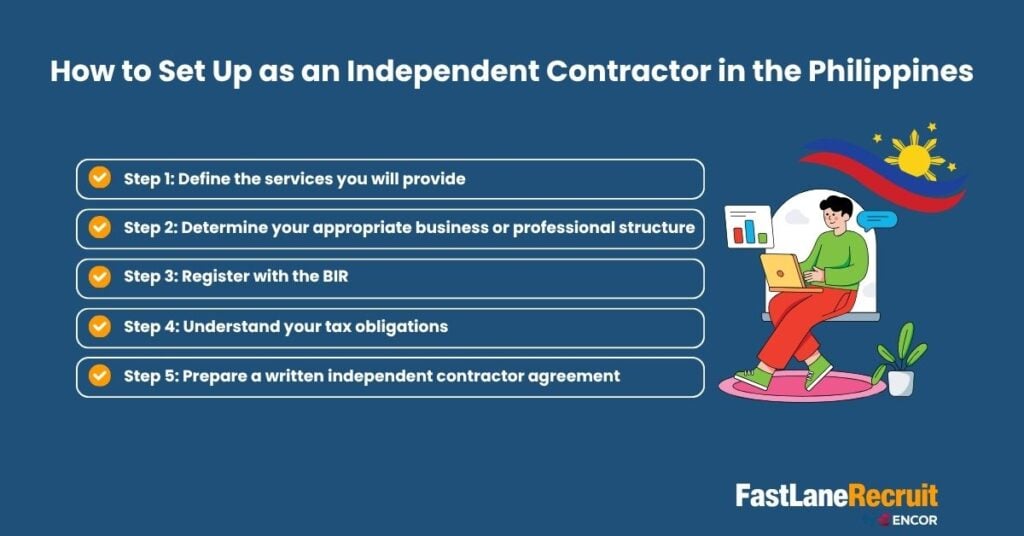
Setting up as an independent contractor is not simply a matter of finding a client and signing an agreement. A practical setup should cover your business identity, tax registration, documentation, payment process and ongoing compliance.
Step 1: Define the services you will provide
Start by clearly defining your professional services.
For example:
- Software development
- Graphic design
- Marketing and advertising
- Consulting
- Content writing
- Accounting or professional services
- IT support
- Business process services
- Project-based specialist work
Your service description should be specific enough to establish what you are being engaged to deliver.
Step 2: Determine your appropriate business or professional structure
An individual may operate as a self-employed professional or sole proprietor depending on the nature of the activity.
If you operate under a business name rather than your own legal name, additional business-name registration may be relevant.
The appropriate registration can depend on whether you are:
- Practising a regulated profession
- Operating as a sole proprietor
- Providing services under your personal name
- Operating under a registered business name
- Running a larger contracting or subcontracting business
The requirements should therefore be assessed based on your actual business model rather than assuming that every independent contractor follows exactly the same registration process.
Step 3: Register with the BIR
Individuals engaged in trade, business or the practice of a profession are generally required to register with the BIR under the applicable rules.
The BIR currently provides ORUS as an online registration and update system. BIR guidance states that self-employed individuals, including sole proprietors and professionals, may register through ORUS.
BIR registration may involve requirements such as:
- Taxpayer Identification Number (TIN)
- Valid identification
- Business or residence address information
- Registration details
- Applicable documentary requirements
- Books of accounts and invoicing requirements, as applicable
BIR registration rules also require persons engaged in business to register within the applicable timeframe, including on or before commencement of business under the relevant rules.
Step 4: Understand your tax obligations
Independent contractors should determine how their income will be taxed and which filing and payment obligations apply.
Depending on the taxpayer’s circumstances, taxation may involve:
- Individual income tax
- Percentage tax, where applicable
- VAT, where applicable
- Withholding tax considerations
- Required tax returns
- Invoicing and record-keeping requirements
Some qualified self-employed individuals may elect the 8% income tax rate on gross sales/receipts and other non-operating income instead of the graduated income tax rates and percentage tax under the applicable rules. Eligibility depends on requirements including the applicable VAT threshold and taxpayer classification.
Because tax treatment can change according to income level, taxpayer status and elections made, contractors should confirm their current obligations with the BIR or a qualified Philippine tax professional rather than applying a generic tax rate.
Step 5: Prepare a written independent contractor agreement
A written agreement helps both parties understand the scope and commercial terms of the engagement.
A well-structured contractor agreement should generally clarify:
- Services to be provided
- Deliverables
- Fees and payment schedule
- Invoicing requirements
- Project duration
- Intellectual property ownership
- Confidentiality
- Data protection responsibilities
- Expenses
- Equipment and tools
- Independent contractor status
- Termination provisions
- Dispute resolution
- Applicable law
However, the agreement should reflect the actual working relationship. A contract that describes someone as an independent contractor does not eliminate employment-classification risk if the day-to-day relationship operates like employment.
What Taxes Do Independent Contractors Pay in the Philippines?
Tax treatment depends on the contractor’s circumstances, income and registration status.
Income tax
Self-employed individuals generally need to report income from their business or professional activity and pay the applicable income tax.
Qualified taxpayers may potentially choose the 8% income tax option subject to the applicable rules. Otherwise, the graduated income tax system may apply.
VAT or percentage tax
Whether a contractor is subject to VAT, percentage tax or an exemption depends on factors such as gross sales or receipts, taxpayer classification and applicable tax rules.
Do not assume that every freelancer or contractor has the same tax treatment.
Invoicing and records
Contractors should maintain appropriate business records and comply with applicable BIR invoicing and bookkeeping requirements.
The BIR identifies registration of books of accounts and invoicing-related requirements among its registration services.
Do Independent Contractors Need SSS in the Philippines?
Self-employed individuals can fall under SSS self-employed coverage.
The Social Security System defines self-employed persons as individuals engaged in trade, business or occupation whose income is derived from their own physical or mental efforts rather than employment. SSS states that self-employed coverage is compulsory for covered individuals within the applicable age and coverage rules.
A person entering self-employment should register with SSS as a self-employed member. Contributions are based on the applicable contribution schedule and declared monthly earnings. This is separate from an employer’s obligations for employees.
What about PhilHealth and Pag-IBIG?
Depending on the person’s status and applicable rules, self-employed individuals may also have responsibilities relating to other government social protection and savings programs.
The important point is that an independent contractor should not automatically assume that the client will handle employee-style statutory contributions.
Do Independent Contractors Need to Register With DOLE?
This is an area where businesses and contractors should be careful.
Not every individual independent contractor should automatically be treated as a DOLE-registered contractor.
DOLE Department Order No. 174 covers legitimate contracting and subcontracting arrangements and establishes registration requirements for parties operating as contractors or subcontractors under that framework. DOLE lists requirements including business registration, local permits, financial documentation and other supporting documents.
Therefore, whether DOLE contractor registration applies depends on the nature and structure of the arrangement.
A freelance professional providing services independently should not automatically be treated as a contracting company simply because the person is called a “contractor.”
What Should an Independent Contractor Agreement Include?
A strong agreement should establish a clear commercial relationship without creating unnecessary ambiguity.
Core contract terms
| Contract element | What it should clarify |
| Scope of services | What the contractor is engaged to deliver |
| Deliverables | Expected outputs and milestones |
| Fees | Rate, currency and payment terms |
| Invoicing | How and when invoices are submitted |
| Term | Start date and expected duration |
| Independence | Contractor’s responsibility for how services are performed |
| Confidentiality | Protection of business information |
| Intellectual property | Ownership and permitted use of work |
| Expenses | Which costs are reimbursable |
| Termination | Notice and circumstances for ending the agreement |
| Dispute resolution | How disagreements will be handled |
A contract should be supported by actual working practices. If the business controls the worker’s means and methods in a manner characteristic of employment, simply inserting an “independent contractor” clause may not resolve the classification issue.
Can a Philippine Independent Contractor Work for a Foreign Company?
Yes, Philippine professionals may provide services to overseas clients, but the arrangement still needs to be assessed under the applicable Philippine rules.
For the contractor, considerations can include:
- BIR registration and tax reporting
- Invoicing
- Foreign-currency payments
- Contract terms
- Record keeping
- Applicable social protection contributions
- Nature of the services
- Whether the relationship remains genuinely independent
For the foreign business, the key question is different:
Is the person genuinely an independent contractor, or are they effectively functioning as an employee?
This distinction becomes increasingly important when the engagement is long-term and the worker becomes integrated into the company’s operations.
Also Read: Hire Independent Contractors in the Philippines Without Employment Complexity
Contractor vs Employee: When Does the Arrangement Need to Change?
A contractor arrangement may be appropriate when a business genuinely engages an independent service provider.
However, the risk profile can change when the worker:
- Works continuously for one business
- Performs a core ongoing function
- Has fixed working hours controlled by the company
- Requires close supervision
- Uses company-provided equipment and systems
- Is integrated into the company’s organizational structure
- Receives employee-like benefits
- Performs work under extensive company control
- Has limited economic independence
These factors do not automatically determine legal status individually. The overall relationship and applicable legal tests matter.
The Philippine Supreme Court has applied the four-fold test and economic dependence considerations in assessing whether an employment relationship exists.
The practical question for businesses
If your company wants to manage a person like an employee, but the person is formally engaged as a contractor, it may be time to reassess the workforce structure.
Aslo Read: Hiring Contractors vs Employees: How to Determine Worker Classification Correctly
What Is the Difference Between Contractor Management and EOR?
Contractor management and Employer of Record services solve different workforce problems.
| Independent Contractor | Employer of Record | |
| Worker status | Contractor | Employee |
| Legal employment | Generally no employment relationship with client | EOR is the legal employer |
| Payroll | Contractor manages applicable tax/payment obligations | EOR manages payroll administration |
| Employee benefits | Not automatically applicable | Managed according to local employment requirements |
| Business control | Client engages contractor for services | Client directs day-to-day work while EOR handles legal employment |
| Best suited for | Genuine independent service relationships | Employees hired in countries where the client lacks an employing entity |
| Main consideration | Maintaining genuine contractor status | Establishing compliant employment infrastructure |
An EOR should not be presented as a way to simply “convert” any contractor arrangement without assessment. The appropriate structure depends on the worker’s actual role, country and business requirements.
When Should a Business Consider an EOR in the Philippines?
An EOR can become relevant when a company wants to employ someone in the Philippines but does not have its own local employing entity.
An EOR may be worth evaluating when:
You want to hire an employee without establishing a local entity
Instead of immediately creating a subsidiary, an eligible business can use an EOR structure where legally appropriate.
The worker has become a long-term part of your team
If the relationship is moving beyond a project-based contractor engagement toward ongoing employment, reassessing the structure can help the company determine whether direct employment or an EOR is more appropriate.
You need local payroll and employment administration
Employment involves more than paying a monthly salary. Payroll, statutory requirements, benefits, contracts and employee lifecycle processes need to be managed appropriately.
You are testing the Philippine market
An EOR can provide a practical employment route for businesses hiring an initial employee or small team before deciding whether to establish their own local entity, subject to local requirements.
Also Read: 20 Best Employer of Record in the Philippines: EOR Philippines Guide 2026
How FastLaneRecruit Supports International Employment
FastLaneRecruit provides Employer of Record services for businesses that want to hire employees internationally without immediately establishing their own local employing entity.
Our EOR model can support key employment processes such as:
- Locally appropriate employment contracts
- Employee onboarding
- Payroll administration
- Statutory requirements
- Employee benefits coordination
- Ongoing employment administration
- Local compliance support
For businesses hiring in the Philippines, this provides an alternative to trying to build an employment infrastructure independently.
FastLaneRecruit also supports international employment across Malaysia, Singapore, Hong Kong, China, India, Philippines, Taiwan, Vietnam, Australia, United Kingdom, Switzerland, UAE, Saudi Arabia, Qatar, subject to country-specific requirements and availability.
Why Businesses Choose FastLaneRecruit
One EOR partner across multiple markets
Businesses expanding across several countries can work with one EOR provider rather than establishing separate employment processes from the beginning in every market.
Local employment and payroll support
Our EOR services are designed around country-specific employment, payroll and statutory requirements rather than applying one universal process to every jurisdiction.
Hire without immediately establishing a local entity
An EOR can provide an alternative employment structure for eligible hires when a company does not yet have its own local entity.
Support from hiring through ongoing employment
FastLaneRecruit can support the employment lifecycle, including contracts, onboarding, payroll, benefits and ongoing administration.
A practical route for market expansion
An EOR can be particularly useful when a company wants to hire its first overseas employee, build a small international team or evaluate a new market before committing to its own local infrastructure.
How FastLaneRecruit EOR Works
1. Identify your hiring requirement
Tell us where you want to hire, the role, salary expectations and intended employment arrangement.
2. Assess the employment structure
We help assess whether an EOR arrangement is appropriate for the proposed hire and target country.
3. Prepare employment documentation
The employment arrangement is structured around applicable local requirements.
4. Onboard the employee
FastLaneRecruit coordinates the local employment onboarding process.
5. Manage payroll and statutory administration
We support payroll and applicable employment-related administrative requirements.
6. Continue supporting the employment relationship
Ongoing administration can continue throughout the employee lifecycle, subject to the applicable country framework.
Ready to Hire in the Philippines Without Setting Up a Local Entity?
Setting up as an independent contractor can work well when the relationship is genuinely independent and the contractor manages the applicable business and tax responsibilities.
But if your business needs to hire and manage someone as an employee, continuing to use a contractor arrangement may not be the right structure.
FastLaneRecruit can help you assess the employment route for your Philippines hire and support compliant EOR-based employment without requiring you to establish your own local employing entity first.
Talk to FastLaneRecruit about your Philippines hiring plans and find the right employment structure for your international team.
Frequently Asked Questions About Setting Up as an Independent Contractor in the Philippines
How do I set up as an independent contractor in the Philippines?
Start by defining your services and business structure, determining whether additional business-name or professional registration applies, registering with the BIR, understanding your tax obligations, establishing compliant invoicing and records, and preparing a clear contractor agreement.
Do independent contractors need a BIR registration?
Individuals engaged in trade, business or the practice of a profession generally have BIR registration obligations. The BIR provides ORUS for online taxpayer registration and updates.
Do independent contractors pay taxes in the Philippines?
Yes. Self-employed individuals may have applicable income tax and other tax obligations. The exact treatment depends on factors such as income, taxpayer classification and the tax regime selected or applicable.
Can independent contractors use the 8% tax rate?
Some qualified self-employed individuals may elect the 8% income tax rate subject to applicable requirements, including the relevant VAT threshold and taxpayer classification. It is not automatically available to every contractor.
Do independent contractors need SSS?
Covered self-employed individuals are subject to SSS self-employed coverage under the applicable rules. SSS states that self-employed individuals should register under the self-employed membership category.
Does signing an independent contractor agreement make someone a contractor?
Not necessarily. Philippine courts can look at the actual working relationship, including the employer’s control over the means and methods of work.
Does every independent contractor need DOLE registration?
No blanket assumption should be made. DOLE registration under Department Order No. 174 applies to legitimate contracting and subcontracting arrangements covered by that framework. Whether it applies depends on the nature of the arrangement and business.
Can a foreign company hire an independent contractor in the Philippines?
A foreign company can engage a Philippine-based service provider, but both parties should assess the contractor’s classification, tax responsibilities, contractual arrangement and applicable Philippine requirements.
When should a company use an EOR instead of an independent contractor?
An EOR may be worth considering when the company wants an employee relationship, needs ongoing employment rather than project-based services, or wants to hire in the Philippines without establishing its own local employing entity.
Can FastLaneRecruit help hire employees in the Philippines?
Yes. FastLaneRecruit provides EOR services in the Philippines as part of its supported international markets. Our EOR model can help businesses manage the local employment process, including employment contracts, payroll, statutory requirements and ongoing employment administration.