

Hiring the right employee has never been more important, or more expensive. As labour markets become increasingly competitive and businesses expand across borders, recruitment costs continue to rise. What many employers fail to realize is that the true cost of hiring extends far beyond job advertisements and recruiter fees.
From sourcing candidates and conducting interviews to onboarding and employee turnover, recruitment expenses can significantly impact a company’s profitability and growth strategy.
Understanding recruitment costs is essential for businesses seeking to optimize hiring budgets, improve talent acquisition outcomes, and scale efficiently in new markets.
In this guide, we examine the true cost of hiring in 2026, explore hidden recruitment expenses, and discuss practical strategies that can help businesses reduce recruitment costs while maintaining access to quality talent.
Content Outline
Key Summary
Recruitment Costs Extend Beyond Hiring Fees
The true cost of hiring includes much more than job advertisements and recruitment agency fees. Businesses must also account for internal HR resources, candidate assessments, onboarding, training, compliance, and productivity losses caused by vacant positions.
Talent Shortages Are Driving Costs Higher
In 2026, competition for skilled professionals in technology, finance, healthcare, engineering, and digital marketing continues to push recruitment expenses upward. Employers often need to invest more in sourcing, employer branding, and compensation packages to secure top talent.
Hidden Costs Can Have the Biggest Impact
Vacant roles, poor hiring decisions, employee turnover, and lengthy onboarding processes can create significant financial losses that are often overlooked when calculating recruitment budgets.
Cost Per Hire Is a Critical Recruitment Metric
Tracking cost per hire helps businesses measure recruitment efficiency, evaluate hiring channels, improve return on investment (ROI), and identify opportunities to optimise recruitment spending.
Strategic Hiring Practices Reduce Recruitment Costs
Building talent pipelines, strengthening employee referral programmes, investing in internal mobility, and using recruitment technology can lower hiring expenses while maintaining candidate quality.
Employer of Record (EOR) Can Reduce Expansion Costs
For companies hiring in Malaysia, an Employer of Record (EOR) solution can be more cost-effective than establishing a local entity. EOR services simplify payroll, compliance, HR administration, and employment management while enabling faster market entry.
Recruitment Cost Optimisation Supports Business Growth
Organisations that understand and manage both direct and indirect recruitment costs are better positioned to scale efficiently, improve hiring outcomes, and allocate resources more effectively.
What Are Recruitment Costs?
Recruitment costs refer to all expenses associated with attracting, evaluating, hiring, and onboarding new employees.
These expenses include both direct and indirect costs incurred throughout the hiring process.
Direct costs are generally easier to identify and measure, while indirect costs often remain hidden but can have a greater impact on overall hiring budgets.
Common recruitment costs include:
- Job advertisements
- Recruitment agency fees
- Internal recruiter salaries
- Interview expenses
- Candidate assessment tools
- Background screening
- Recruitment software
- Employer branding campaigns
- Onboarding and training
- Productivity losses from vacant positions
For many organisations, recruitment costs represent one of the largest operational expenses associated with workforce expansion.
Why Recruitment Costs Continue to Rise in 2026
Several global trends are contributing to increased hiring expenses.
Talent Shortages Across Key Industries
Demand for highly skilled professionals continues to exceed supply in sectors such as:
- Technology
- Finance
- Healthcare
- Engineering
- Digital marketing
As competition intensifies, employers must invest more resources to attract qualified candidates.
Remote Work Has Expanded Competition
Remote hiring allows businesses to access international talent pools.
However, it also means employers compete with companies worldwide for the same candidates.
Top performers can now evaluate opportunities across multiple countries, resulting in increased recruitment spending and higher salary expectations.
Longer Hiring Processes
Many organisations have implemented:
- Multiple interview rounds
- Technical assessments
- Cultural fit evaluations
- Reference checks
While these measures may improve hiring quality, they also increase recruitment costs.
Also Read: Best Practices for Managing Remote Teams Effectively
Increased Investment in Recruitment Technology
Modern hiring increasingly relies on:
- Applicant Tracking Systems (ATS)
- AI-powered recruitment tools
- Candidate sourcing platforms
- Recruitment analytics software
These technologies improve efficiency but add recurring operational expenses.
How Much Are Recruitment Costs in 2026?
There is no universal recruitment cost because expenses vary based on:
- Industry
- Position seniority
- Location
- Recruitment method
- Hiring urgency
Industry research indicates that average cost-per-hire commonly exceeds USD 4,700 per employee and can rise substantially for specialised or executive positions.
For international hiring, costs can increase further when businesses establish local entities, engage legal advisors, manage payroll compliance, and administer employee benefits.
This is why many growing companies now evaluate alternative hiring models such as Employer of Record (EOR) solutions.
Also Read: 10 Best Employer of Record (EOR) Services To Consider in 2026
Direct Recruitment Costs Businesses Must Budget For
Job Advertising Expenses
Job advertisements remain one of the most visible recruitment costs.
Employers may advertise through:
- Indeed
- JobStreet
- Industry-specific job boards
- Social media campaigns
Premium placement options often require additional spending.
Recruitment Agency Fees
Many businesses rely on recruitment agencies to access qualified candidates faster.
Agency fees typically vary based on:
- Role complexity
- Candidate seniority
- Industry demand
- Geographic location
Although agency fees may seem significant, they often reduce time-to-hire and improve hiring outcomes.
Internal Recruitment Team Costs
Businesses should also consider:
- Recruiter salaries
- HR staff time
- Hiring manager involvement
- Administrative support
Internal recruitment costs can accumulate quickly, especially when positions remain open for extended periods.
Candidate Assessment Costs
Additional expenses often include:
- Skills testing
- Psychometric assessments
- Technical evaluations
- Background checks
- Employment verification
These tools help improve hiring decisions but add to overall recruitment costs.
Hidden Recruitment Costs Most Businesses Overlook
Many employers focus only on visible expenses while ignoring hidden costs that often have a greater financial impact.
Vacancy Costs
Every unfilled position can result in:
- Reduced productivity
- Delayed projects
- Lower customer satisfaction
- Missed revenue opportunities
The longer a vacancy remains open, the greater the business impact.
Employee Turnover Costs
Poor hiring decisions can be extremely expensive.
Replacing an employee often requires repeating the entire recruitment process while absorbing productivity losses and additional training costs.
Onboarding and Training Costs
New hires require:
- Orientation
- Compliance training
- Equipment setup
- Team integration
- Ongoing support
Employees may take several months before reaching full productivity.
Employer Branding Investments
To remain competitive, organisations increasingly invest in:
- Career websites
- Social media recruitment campaigns
- Employee advocacy initiatives
- Employer branding programmes
While beneficial, these activities contribute to overall recruitment spending.
What Is Cost Per Hire and Why Does It Matter?
Cost per hire is one of the most important recruitment metrics.
The formula is:
Cost Per Hire = Total Recruitment Costs ÷ Number of Hires
This metric helps organisations:
- Evaluate hiring efficiency
- Compare recruitment channels
- Measure recruitment ROI
- Improve workforce planning
Tracking cost per hire enables businesses to identify opportunities for cost optimization.
How to Reduce Recruitment Costs Without Compromising Talent Quality
Build a Strong Talent Pipeline
Maintaining a database of qualified candidates can reduce future sourcing costs and shorten hiring cycles.
Strengthen Employee Referral Programmes
Employee referrals often produce:
- Faster hires
- Better retention
- Lower recruitment costs
- Improved candidate quality
Invest in Internal Mobility
Promoting existing employees may reduce:
- Advertising expenses
- Recruitment fees
- Training requirements
Use Recruitment Technology Strategically
Automation can streamline:
- Resume screening
- Interview scheduling
- Candidate communication
This reduces administrative burden and hiring costs.
Partner with Recruitment Specialists
Working with experienced recruitment providers often delivers:
- Faster hiring
- Better candidate matching
- Reduced vacancy costs
- Lower overall recruitment expenses
Recruitment Costs vs Employer of Record (EOR): Which Is More Cost-Effective?
For companies expanding into Malaysia or hiring international employees, recruitment costs often represent only a portion of total workforce expenses.
Businesses must also consider:
- Company incorporation costs
- Payroll administration
- Employment contracts
- Statutory contributions
- Tax compliance
- HR administration
Traditional Company Incorporation
While incorporating a local entity offers full operational control, it typically involves:
- Higher setup costs
- Ongoing compliance obligations
- Administrative complexity
- Longer market entry timelines
Employer of Record (EOR)
An Employer of Record allows businesses to legally hire employees in Malaysia without establishing a local company.
Benefits include:
- Faster market entry
- Reduced compliance risks
- Lower administrative costs
- Simplified payroll management
- Scalable workforce expansion
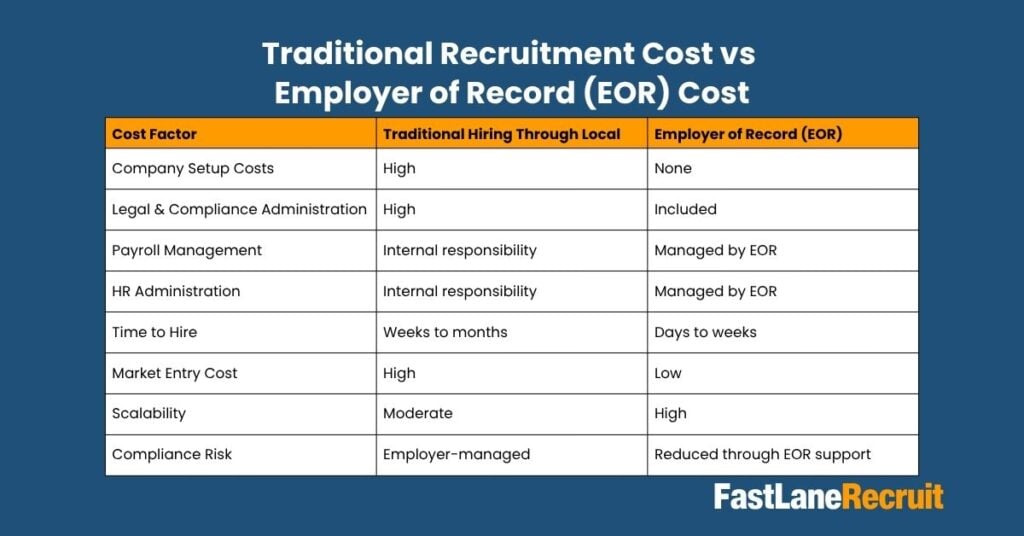
For many businesses testing a new market, hiring remote teams, or recruiting a small number of employees, EOR solutions provide a more cost-effective alternative to company incorporation.
Alternative Comparison Table
Why Businesses Choose FastLaneRecruit’s Employer of Record Services
FastLaneRecruit helps companies hire employees in Malaysia quickly and compliantly without the complexity of establishing a local entity.
Through Employer of Record services, businesses can:
- Hire talent faster
- Reduce recruitment and compliance costs
- Manage payroll efficiently
- Ensure labour law compliance
- Expand into Malaysia with minimal risk
Whether you need to hire one employee or build an entire team, FastLaneRecruit provides a streamlined solution that allows you to focus on growth while experts manage employment administration.
Ready to Reduce Recruitment Costs?
If your business is evaluating expansion into Malaysia, the most cost-effective hiring strategy may not be company incorporation.
FastLaneRecruit’s Employer of Record solution allows you to access local talent, maintain compliance, and significantly reduce the administrative burden associated with international hiring.
Speak with FastLaneRecruit today to discover how Employer of Record services can help your organization hire smarter, faster, and more cost-effectively.
Conclusion
Recruitment costs are no longer limited to job advertisements and recruiter fees. In 2026, businesses must account for a wide range of expenses, including sourcing candidates, conducting interviews, onboarding new hires, managing compliance, and mitigating productivity losses caused by vacant positions. When these direct and indirect costs are combined, the true cost of hiring can be significantly higher than many employers expect.
Understanding your cost per hire and identifying hidden recruitment expenses are essential steps toward building a more efficient hiring strategy. Businesses that invest in talent pipelines, employee referrals, recruitment technology, and workforce planning are often better positioned to control recruitment costs without compromising the quality of their hires.
For companies looking to expand into Malaysia, hiring costs extend beyond recruitment alone. Establishing a local entity, managing payroll, ensuring statutory compliance, and handling HR administration can add substantial time and expense to the hiring process. This is why many international businesses are turning to Employer of Record (EOR) solutions as a faster and more cost-effective alternative.
By partnering with FastLaneRecruit, businesses can hire talent in Malaysia without setting up a local company, while reducing administrative burdens and compliance risks. Whether you are hiring your first employee or building an entire team, FastLaneRecruit’s Employer of Record services provide a streamlined path to accessing talent while keeping recruitment and employment costs under control.
Frequently Asked Questions
What are recruitment costs?
Recruitment costs are the total expenses associated with attracting, hiring, and onboarding employees. These costs include job advertising, recruiter fees, HR labour, candidate assessments, onboarding, and productivity losses from vacant positions.
How much are recruitment costs?
Recruitment costs vary depending on industry, role complexity, and hiring method. Many organisations report average cost-per-hire figures exceeding USD 4,700, while specialised and executive positions may cost significantly more.
How can businesses reduce recruitment costs?
Businesses can reduce recruitment costs by improving referral programmes, building talent pipelines, investing in internal mobility, using recruitment technology, and partnering with experienced recruitment providers or Employer of Record services.
Are recruitment costs tax deductible?
In many jurisdictions, recruitment expenses incurred for business purposes may qualify as deductible business expenses. However, tax treatment varies by country, and businesses should consult a qualified tax advisor for specific guidance.
Is using a recruitment agency worth the cost?
For many organisations, recruitment agencies can reduce time-to-hire, improve candidate quality, and lower hidden vacancy costs. The overall return on investment often outweighs agency fees.
Is Employer of Record cheaper than company incorporation?
For businesses hiring a small team or entering a new market, Employer of Record services are often significantly more cost-effective than establishing and maintaining a legal entity. EOR solutions eliminate many setup, compliance, payroll, and administrative expenses.