The Philippines continues to be one of the most strategically important global hiring destinations for companies expanding remote or distributed teams. Its large English-speaking workforce, strong outsourcing ecosystem, and competitive labor cost structure make it a preferred location for customer service, finance operations, IT development, and administrative roles. However, hiring employees directly in the Philippines introduces significant legal and operational complexity. Employers must comply with strict labor regulations, mandatory benefits structures, payroll taxation rules, and government reporting obligations. These requirements often create barriers for foreign companies that do not have a registered legal entity in the country. This is where employer of record philippines comes in.
An Employer of Record (EOR) model solves this challenge by allowing companies to legally employ workers in the Philippines without establishing a local entity. This model is increasingly used by global businesses that require speed, compliance certainty, and operational flexibility when entering new markets.
Content Outline
Key Summary
Rapid Market Entry Without Entity Setup
Employer of Record (EOR) services in the Philippines allow companies to legally hire employees without establishing a local entity, significantly reducing setup time from months to days.
Full Compliance With Local Labor Law
An EOR ensures adherence to Philippine statutory requirements, including SSS, PhilHealth, Pag-IBIG contributions, tax withholding, and mandatory benefits such as 13th-month pay.
Clear Division of Responsibilities
The EOR becomes the legal employer responsible for contracts, payroll, and compliance, while the client retains control over day-to-day work, performance, and business direction.
Lower Compliance and Operational Risk
Using an EOR reduces exposure to misclassification risks, labor disputes, and regulatory penalties, particularly for foreign companies without local expertise.
Cost-Effective Alternative to Incorporation
Although EOR services include monthly fees, they remove the need for entity registration, local HR infrastructure, and ongoing corporate maintenance costs.
Scalable Solution for Distributed Teams
EOR enables flexible hiring and workforce scaling, making it suitable for companies building remote teams, regional support functions, or testing new markets.
Strategic Southeast Asia Hiring Approach
While the Philippines is a strong remote hiring hub, companies increasingly integrate Malaysia into broader regional workforce strategies for greater compliance stability and operational planning.
What Is an Employer of Record in the Philippines
An Employer of Record in the Philippines is a legal third-party organization that acts as the official employer of record for a worker, while the client company manages the employee’s daily responsibilities, performance, and operational direction.
The EOR becomes responsible for all statutory and legal employment obligations under Philippine labor law, while the client retains full functional control of the employee’s work output.
Core Legal Responsibilities of an EOR
An EOR in the Philippines typically manages the following obligations:
- Drafting and issuing compliant employment contracts under Philippine labor law
- Registering employees with government agencies such as SSS, PhilHealth, and Pag-IBIG
- Processing monthly payroll in compliance with tax withholding requirements
- Administering mandatory benefits including 13th-month pay
- Handling employee onboarding and termination procedures in accordance with labor regulations
- Managing statutory filings and regulatory compliance updates
Client Company Responsibilities
The client company retains:
- Recruitment and selection of talent
- Job scope definition and performance management
- Work assignment and operational supervision
- Business strategy and output control
This separation allows companies to legally employ staff in the Philippines without navigating entity registration or local employment law infrastructure.
Why Companies Use Employer of Record Services in the Philippines
Companies adopt Employer of Record services in the Philippines primarily to reduce market entry friction, accelerate hiring timelines, and eliminate compliance risk.
1. Elimination of Local Entity Requirement
Establishing a legal entity in the Philippines requires multiple steps including corporate registration, tax setup, and local licensing. This process can take several months and requires ongoing administrative maintenance.
An EOR eliminates this requirement entirely, allowing companies to hire immediately without legal incorporation.
2. Faster Time to Hire
Traditional hiring through entity setup introduces significant delays. With an EOR, onboarding timelines are significantly reduced, allowing companies to hire and deploy employees within days rather than months.
This speed advantage is particularly valuable for companies scaling distributed teams or entering new markets rapidly.
3. Full Compliance with Philippine Labor Regulations
Philippine labor law includes strict mandatory requirements that employers must follow, including:
- 13th-month salary requirement
- Government contributions (SSS, PhilHealth, Pag-IBIG)
- Structured termination processes
- Tax withholding and reporting obligations
- Statutory leave entitlements
EOR providers ensure these obligations are fully met, reducing legal exposure for foreign companies.
4. Cost Efficiency Compared to Entity Setup
While EOR includes service fees, it eliminates:
- Legal incorporation costs
- Local HR infrastructure costs
- Compliance staffing requirements
- Ongoing corporate maintenance expenses
This makes it more cost-efficient for companies testing or scaling operations in the Philippines.
5. Reduced Legal and Operational Risk
Hiring employees without proper legal structure exposes companies to risks such as misclassification penalties, labor disputes, and tax non-compliance issues. EOR providers assume legal responsibility for employment compliance, significantly reducing this exposure.
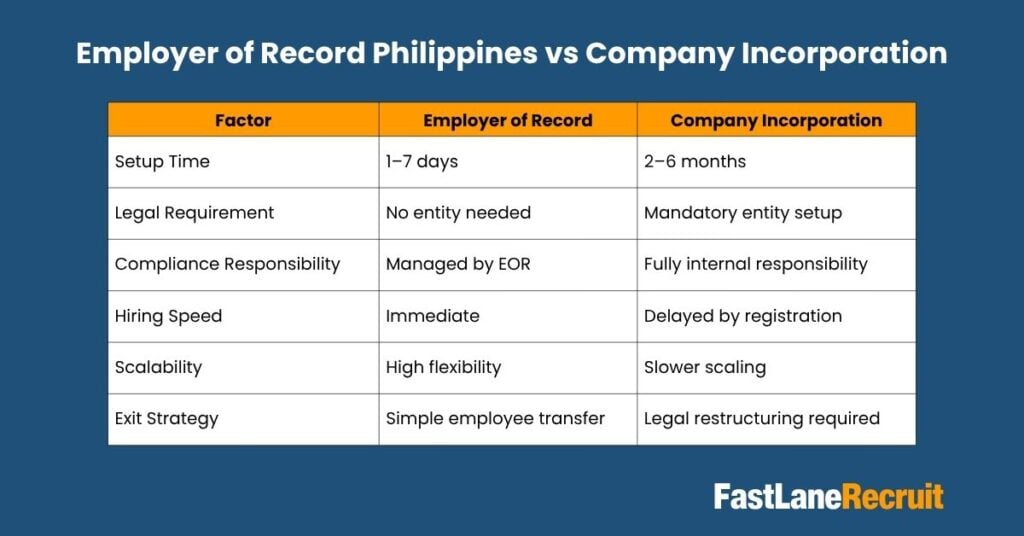
Employer of Record Philippines vs Company Incorporation in Asia
Companies often compare EOR models with traditional company incorporation when expanding into Southeast Asia, including Malaysia and the Philippines.
Key Structural Differences
Strategic Insight
EOR is generally more suitable for companies prioritizing speed, flexibility, and risk reduction. Company incorporation is more appropriate for long-term market establishment and operational control.
How Employer of Record Services Work in the Philippines
The EOR employment process follows a structured lifecycle designed to ensure compliance at every stage.
Step 1: Talent Selection and Hiring Decision
The client company identifies and selects the candidate based on internal recruitment processes.
Step 2: Employment Contract Structuring
The EOR issues a legally compliant employment contract aligned with Philippine labor laws, including compensation structure, benefits, and statutory obligations.
Step 3: Employee Onboarding
The onboarding process includes:
- Government registration (SSS, PhilHealth, Pag-IBIG)
- Tax identification setup
- Bank account verification for payroll
- Employment record documentation
Step 4: Payroll Management
The EOR manages monthly payroll execution, including:
- Salary disbursement
- Tax withholding and filing
- Statutory contributions
- Mandatory benefit allocations
Step 5: Ongoing HR and Compliance Management
Ongoing responsibilities include:
- Leave and attendance management
- Employee benefits administration
- Regulatory updates and compliance monitoring
- Termination and offboarding procedures
Cost Structure of Employer of Record in the Philippines
Understanding cost structure is critical for decision-making.
Total Employment Cost Components
- Employee gross salary
- Employer mandatory contributions
- Statutory benefits such as 13th-month pay
- EOR service fee
- Optional benefits (insurance, allowances, bonuses)
Typical Market Pricing
- Global EOR providers: USD 500–700 per employee per month
- Mid-tier providers: USD 400–600 per employee per month
- Local providers: USD 200–350 per employee per month
Lower pricing may not always include full compliance coverage, so total cost evaluation is essential.
Who Should Use Employer of Record Services in the Philippines?
Employer of Record (EOR) services are ideal for businesses that want to hire employees in the Philippines without establishing a local legal entity. By partnering with an EOR provider, companies can quickly access Filipino talent while ensuring full compliance with local employment, payroll, and tax regulations.
Global Companies Hiring Remote Filipino Employees
Many international businesses hire remote professionals in the Philippines to access a highly skilled, English-speaking workforce. An EOR allows these companies to legally employ Filipino workers without navigating complex local labor laws or setting up a Philippine subsidiary.
Example:
A UK-based marketing agency hires content writers, graphic designers, and digital marketers in the Philippines. Instead of establishing a local company, it uses an EOR to manage employment contracts, payroll, and statutory compliance.
Startups Expanding into Southeast Asia Without Legal Entities
For startups testing new markets or building international teams, establishing a local entity can be costly and time-consuming. An EOR provides a low-risk entry strategy by enabling immediate hiring without company incorporation.
Example:
A SaaS startup wants to hire a customer success team in the Philippines to support its growing Asian customer base. An EOR enables the company to onboard employees within weeks rather than spending months establishing a local presence.
Technology Companies Building Distributed Engineering Teams
The Philippines has become an attractive destination for software developers, QA engineers, IT support specialists, and cybersecurity professionals. EOR services allow technology companies to rapidly build distributed teams while maintaining compliance.
Example:
A US technology company recruits five software engineers in Manila to support product development. The EOR handles employment agreements, payroll processing, and statutory contributions while the company focuses on managing the team’s performance.
Customer Support and BPO Operations
The Philippines is one of the world’s leading destinations for customer support and business process outsourcing (BPO). Companies often use EOR solutions to establish support teams quickly without the administrative burden of creating a local entity.
Example:
An e-commerce business hires a 24/7 customer service team in the Philippines through an EOR to provide multilingual support to customers across different time zones.
Also Read: What Is Business Process Outsourcing (BPO) and How Does It Work?
Finance, Accounting, and Administrative Outsourcing Teams
Many businesses outsource finance, bookkeeping, payroll support, and administrative functions to the Philippines due to its strong accounting talent pool and competitive labor costs. An EOR simplifies workforce management while ensuring local employment compliance.
Example:
An Australian accounting firm hires offshore bookkeepers and finance assistants in the Philippines through an EOR arrangement, allowing it to scale operations while remaining compliant with local employment laws.
Key Advantages of Employer of Record Over Traditional Hiring Models
Compared to establishing a local entity or attempting direct international hiring, Employer of Record services offer several significant advantages.
Faster Market Entry
One of the biggest benefits of an EOR is the ability to hire employees almost immediately without waiting for company registration, business licensing, or tax setup.
Example:
Establishing a legal entity in a foreign country may take several months. An EOR can often onboard employees within a few weeks, allowing businesses to enter the market much faster.
Reduced Compliance Burden
Employment regulations, payroll requirements, tax obligations, and labor laws vary significantly between countries. EOR providers assume responsibility for managing these obligations and ensuring ongoing compliance.
This includes:
- Employment contracts
- Payroll administration
- Statutory contributions
- Tax withholding
- Labor law compliance
- Mandatory employee benefits
Businesses can focus on operations and growth while the EOR manages regulatory requirements.
Flexible Workforce Scaling
An EOR makes it easier to scale teams up or down based on business needs without restructuring corporate entities or establishing additional legal infrastructure.
Example:
A company launching a new product may quickly hire ten employees in the Philippines through an EOR and later expand the team to fifty as demand grows.
Lower Administrative Overhead
Without an EOR, businesses may need to establish local HR, payroll, finance, and legal functions to support employees. An EOR eliminates much of this complexity by providing a fully managed employment solution.
This reduces the need for:
- Internal HR teams
- Local payroll departments
- Legal advisors for employment matters
- Administrative staff for compliance management
As a result, businesses can significantly reduce operational costs while maintaining compliance.
Risks of Hiring Without an Employer of Record
While some companies attempt to hire workers directly in the Philippines without local support, doing so can expose the business to substantial legal, financial, and operational risks.
Misclassification Penalties
One of the most common risks is incorrectly classifying employees as independent contractors.
If authorities determine that a contractor should legally be treated as an employee, the company may face:
- Back payment of employee benefits
- Unpaid taxes and social contributions
- Government penalties and fines
- Legal disputes
Example:
A foreign company hires a full-time worker as a contractor, but the individual works exclusively for the company under direct supervision. Local authorities may reclassify the arrangement as employment and impose penalties.
Tax Compliance Violations
Foreign employers must comply with local payroll tax requirements and statutory contributions. Failure to do so can result in audits, fines, and reputational damage.
Potential issues include:
- Incorrect tax withholding
- Late tax filings
- Unpaid government contributions
- Non-compliance with reporting requirements
Incorrect Benefit Administration
Philippine employers are generally required to administer statutory benefits and contributions, including:
- Social Security System (SSS)
- PhilHealth
- Pag-IBIG Fund
- Mandatory leave entitlements
Failure to provide these benefits correctly may result in employee complaints and regulatory penalties.
Labor Disputes Due to Improper Termination Procedures
The Philippines has strong employee protection laws, particularly regarding termination.
Employers that fail to follow proper dismissal procedures may face:
- Wrongful termination claims
- Reinstatement orders
- Back pay obligations
- Labor tribunal proceedings
Example:
A company terminates an employee without following mandatory notice and due process requirements, resulting in a labor dispute and financial liability.
Delays in Payroll and Statutory Filings
Managing payroll in a foreign jurisdiction can be challenging without local expertise. Errors in payroll processing or delayed statutory filings can negatively impact both employees and regulatory compliance.
Common issues include:
- Late salary payments
- Incorrect deductions
- Missed contribution deadlines
- Payroll reporting errors
Industry Perspective on Employer of Record Philippines
From a compliance and global employment standpoint, the Philippines is considered a highly regulated labor market with strict statutory requirements. This makes direct hiring complex for foreign companies.
EOR services provide a structured compliance layer that ensures companies meet all legal obligations while maintaining operational control over employees.
This model has become a standard approach for international companies expanding into Southeast Asia, particularly in hybrid and remote-first workforce strategies.
Why Malaysia Matters in the EOR Strategy
While the Philippines is a strong hiring destination, Malaysia is increasingly positioned as a strategic alternative for regional workforce structuring.
FastLaneRecruit operates exclusively in Malaysia, making it a specialist partner for companies considering Southeast Asia expansion.
Why Malaysia Is Strategically Important
Strong Regulatory Framework
Malaysia offers a stable and well-defined employment law structure, making compliance more predictable for foreign employers.
Strategic ASEAN Business Hub
Malaysia acts as a gateway between Southeast Asia, China, and global markets, making it ideal for regional workforce coordination.
Cost-Effective Talent Pool
While slightly higher than the Philippines in some roles, Malaysia offers strong mid-to-senior level talent in:
- Finance
- Shared services
- Technology
- Business operations
High Compliance Predictability
Compared to fragmented regional hiring structures, Malaysia offers clearer employment governance and corporate compliance pathways.
Ideal for Regional HQ Hiring Models
Companies often centralize regional operations in Malaysia while hiring distributed teams across ASEAN.
Also Read: Top 15 Employer of Record (EOR) Services in Malaysia
Get Expert Assistance from FastLaneRecruit
FastLaneRecruit provides expert advisory and recruitment support for companies expanding their workforce in Malaysia.
Our experts help businesses:
- Design compliant hiring structures in Malaysia
- Build regional workforce strategies across Southeast Asia
- Optimize hiring models for cost, compliance, and scalability
- Transition from offshore hiring to structured regional operations
If your goal is to build a sustainable hiring strategy in Southeast Asia, Malaysia offers a strong compliance and operational base for long-term growth. Contact us to know more about the process.
Conclusion
The Philippines remains one of the most efficient global hiring destinations for remote teams, particularly for operational, support, and technical roles. The Employer of Record model enables companies to access this talent pool without the complexity of entity incorporation, significantly reducing time-to-hire and compliance risk.
However, hiring options in Southeast Asia should not be limited.Malaysia plays as one of the regional hubs for structured hiring, compliance stability, and business expansion planning.
For companies evaluating how to design or refine their Southeast Asia hiring structure, FastLaneRecruit provides expert advisory support focused on Malaysia-based hiring strategies and regional workforce planning.
FAQ: Employer of Record Philippines
What is an Employer of Record in the Philippines?
It is a legal arrangement where a third-party provider becomes the official employer while the client manages daily work operations.
Is Employer of Record legal in the Philippines?
Yes. It is a compliant employment structure when managed under Philippine labor and tax regulations.
How much does an Employer of Record cost in the Philippines?
Costs typically range from USD 200 to USD 700 per employee per month depending on service scope and provider.
What is the difference between EOR and outsourcing?
EOR maintains direct employment relationships, while outsourcing assigns work to a third-party service provider.
Can EOR replace company incorporation in the Philippines?
Yes, for hiring purposes. However, it does not replace full corporate establishment for long-term local operations.
Who should use Employer of Record services?
Companies hiring employees in the Philippines without establishing a legal entity.