
Malaysia’s employment and payroll compliance framework continues to evolve in 2026 with the full implementation and enforcement of mandatory Employees Provident Fund (EPF) contributions for non-Malaysian citizen employees.
Since the policy took effect from October 2025 wages (paid from November 2025 onward), employers in Malaysia are legally required to contribute EPF for eligible foreign employees who meet the statutory requirements. The objective of this policy is to improve social protection coverage, ensure fairer labour practices, and align Malaysia’s workforce system with international employment standards.
This guide provides a complete and updated explanation of EPF contributions for foreign employees in Malaysia, including eligibility rules, contribution rates, payroll processes, employer responsibilities, and compliance considerations for 2026.
Content Outline
Key Summary
EPF Contributions for Foreign Employees Are Now Mandatory
Malaysia now requires eligible non-Malaysian employees with valid work passes to contribute to EPF starting from October 2025 wages onward.
Both Employers and Employees Must Contribute 2%
The EPF contribution structure for foreign employees is fixed at 2% from employers and 2% from employees based on monthly wages.
Only Eligible Foreign Workers Are Covered
EPF applies to non-Malaysian employees with valid work authorization and payroll employment in Malaysia, excluding domestic workers.
Employers Must Meet Monthly Submission Deadlines
EPF contributions must be submitted before the 15th of the following month to avoid penalties and compliance risks.
EPF Registration Is Becoming More Automated
Malaysia has improved EPF registration through integration with immigration systems, making onboarding and verification faster for employers.
Accurate Payroll Management Is Essential
Employers should update payroll systems, automate EPF calculations, and monitor work pass validity to maintain compliance.
EOR and Payroll Services Can Simplify Compliance
Employer of Record (EOR) and payroll outsourcing services help global companies manage EPF registration, payroll processing, and statutory compliance efficiently.
What Is EPF for Foreign Employees in Malaysia?
The Employees Provident Fund (EPF), also known in Malay as Kumpulan Wang Simpanan Pekerja (KWSP), is Malaysia’s official retirement savings system. It is a mandatory savings scheme designed to help employees build long-term financial security for their retirement.
Under this system, both employers and employees contribute a small percentage of monthly salary into an individual savings account managed by EPF. These savings can later be withdrawn according to EPF withdrawal rules, typically during retirement or under approved conditions.
How EPF Used to Work
Traditionally, EPF was only required for:
- Malaysian citizens
- Permanent residents of Malaysia
Foreign employees were generally not included in the system, meaning they did not contribute to or build EPF savings during their employment in Malaysia.
What Has Changed
Under the updated policy framework, EPF coverage has been expanded to include non-Malaysian citizen employees who meet certain conditions.
This means that many foreign employees working in Malaysia are now required to participate in EPF contributions, just like local employees, as long as they:
- Hold a valid work pass approved by the Malaysian Immigration Department
- Are officially employed by a registered employer in Malaysia
- Fall within the eligibility criteria defined by EPF regulations
How EPF Works for Foreign Employees
If a foreign employee is eligible, EPF contributions are automatically deducted from their monthly salary, and the employer also contributes an additional amount on top of the salary.
The contributions are then deposited into the employee’s EPF account, which continues to grow throughout their employment in Malaysia.
This system ensures that foreign employees are also building retirement savings while working in the country.
Simple Example
Let’s say an employee named Daniel is working in Malaysia and earns a monthly salary of RM3,000.
Under the EPF contribution rules:
- Employee contribution (2%) = RM60
- Employer contribution (2%) = RM60
Total EPF contribution per month = RM120
This amount is deposited into Daniel’s EPF account each month. Over time, this becomes a savings fund that he can withdraw according to EPF withdrawal rules.
Key Purpose of This Expansion
The inclusion of foreign employees into EPF aims to:
- Ensure all workers in Malaysia have access to retirement savings
- Create a fair and consistent contribution system across the workforce
- Improve social protection for long-term foreign employees
- Strengthen Malaysia’s compliance with international labour standards
In Simple Terms
EPF for foreign employees means:
If you are a foreign worker legally employed in Malaysia, part of your salary (and your employer’s contribution) is saved every month in a government-managed retirement fund for your future use.
Also Read: Payroll Management: Payroll Processing and Compliance Services
Who Must Contribute EPF?
EPF contributions in Malaysia are mandatory for non-Malaysian employees who meet specific eligibility conditions set under the current regulatory framework. The requirement is designed to ensure that foreign employees working legally in Malaysia also receive structured retirement savings protection during their employment.
In simple terms, if a foreign employee is legally working and receiving a salary in Malaysia, they will likely fall under EPF contribution requirements unless they are explicitly exempt.
Eligibility Criteria
A non-Malaysian employee must contribute to EPF if all of the following conditions are met:
1. Valid Work Authorization
The employee must hold a valid work pass issued by the Immigration Department of Malaysia. This ensures that only legally employed foreign workers are included in the EPF system.
Common eligible passes include employment-related work permits approved under Malaysian immigration rules.
2. Age Requirement
The employee must be below 75 years of age.
This age threshold ensures that EPF contributions are aligned with retirement savings objectives while still allowing older working individuals to participate if they remain employed.
3. Employment Under a Malaysian-Registered Employer
The employee must be formally employed by a company that is registered in Malaysia and recognized under Malaysian employment law.
This includes:
- Private companies operating in Malaysia
- Local subsidiaries of international companies
- Businesses hiring foreign employees under valid employment arrangements
4. Monthly Wage Employment Structure
The employee must receive a regular monthly salary that is processed through payroll in Malaysia.
This means:
- Salary must be officially declared in payroll systems
- Payments must follow Malaysian payroll cycles
- Contributions are calculated based on gross monthly wages
Exemptions (Who Does NOT Contribute EPF)
Not all foreign employees are required to contribute. The following category is excluded from mandatory EPF contributions:
Domestic Workers
This includes roles such as:
- Maids
- Cleaners
- Cooks
- Gardeners
- Babysitters
- Drivers
Legal Basis for Exemption
This exclusion is based on provisions under Section 3 of the Workmen’s Compensation Act 1952, which classifies domestic servants separately from standard employment categories.
In practical terms, this means domestic household workers are not covered under the mandatory EPF contribution framework for foreign employees.
EPF Contribution Rate for Foreign Employees (2026)
The EPF contribution system for foreign employees in Malaysia follows a fixed and standardized rate. This makes it easier for employers to calculate payroll contributions without complex tier systems.
Contribution Structure
| Contributor | Rate | Description |
| Employer | 2% of monthly wages | Mandatory contribution paid by employer |
| Employee | 2% of monthly wages | Deducted from employee’s salary |
Both contributions are submitted together to EPF by the employer each month.
How the Contribution System Works in Practice
Once an employee is eligible:
- The employer calculates 2% of the employee’s monthly gross salary
- The employee’s 2% contribution is deducted from their salary
- The employer adds their own 2% contribution
- The total amount is submitted to EPF as a combined monthly payment
Key Characteristics of the EPF Contribution System
The EPF framework for foreign employees is designed to be simple and consistent across all industries.
1. Flat Rate Structure
There are no salary bands or tiered contribution percentages. Every eligible employee contributes at the same fixed rate of 2% + 2%.
2. Industry-Wide Applicability
The rule applies uniformly across all sectors, including:
- Technology
- Manufacturing
- Services
- Construction
- Professional services
No industry-specific exemptions are applied under the current framework.
3. No Job-Level Differentiation
Contribution rates are not affected by:
- Job title
- Seniority level
- Skill category
- Salary range
This ensures fairness and consistency across the workforce.
4. Payroll Simplicity for Employers
Because the rate is fixed and uniform, employers benefit from:
- Easier payroll calculations
- Reduced compliance complexity
- Standardized reporting across employee groups
Why This Structure Matters
This simplified EPF contribution model helps Malaysia achieve two key objectives:
- Ensuring foreign employees have access to structured retirement savings
- Making compliance easier for employers managing international workforces
It creates a more transparent and predictable payroll system while improving long-term social protection coverage.
Also Read: Guide to Efficient Payroll Processing in Malaysia
When Does EPF Contribution Apply?
The mandatory EPF contribution timeline for non-Malaysian employees in Malaysia follows a fixed monthly cycle. This structure ensures consistency in payroll processing and compliance across all employers.
From an operational perspective, EPF contributions are always based on the salary earned in the previous month, and payment must be submitted in the following month.
Key Timeline Overview (2026)
- Salary month: From October 2025 onwards
- Contribution month: From November 2025 onwards
- Payment deadline: On or before the 15th of the following month
This means that employers calculate EPF contributions based on wages earned in a specific month and then submit the payment in the next month within the required deadline.
Example Timeline for Better Understanding
To make this clearer, here is a practical payroll example:
| Payroll Item | Timeline |
| Salary Month | October 2025 |
| Contribution Month | November 2025 |
| Payment Deadline | 15 November 2025 |
Practical Explanation
If an employee works in October 2025 and receives their salary at the end of that month, the EPF contribution for that salary must be:
- Calculated in October payroll processing
- Submitted to EPF in November
- Paid no later than 15 November
Employers are responsible for ensuring that both employer and employee contributions are submitted together within the deadline.
Why This Deadline Matters
Timely submission is important because delays may lead to:
- Compliance penalties or fines
- Payroll reporting discrepancies
- Administrative follow-ups from EPF authorities
- Potential audit risks for employers
How EPF Contributions Are Calculated
EPF contributions for foreign employees are calculated using a simple and fixed percentage of gross monthly salary. This ensures a standardized approach that is easy for employers to apply across payroll systems.
Basic Formula
EPF Contribution = Monthly Gross Salary × 2% (Employer) + 2% (Employee)
Example Calculation
If an employee earns RM2,500 per month:
- Employer contribution = RM2,500 × 2% = RM50
- Employee contribution = RM2,500 × 2% = RM50
Total EPF contribution = RM100 per month
This amount is then submitted to EPF as a single combined payment by the employer.
EPF Calculation Rules
To ensure consistency across all employers and industries, EPF follows strict calculation and payment guidelines:
1. Based on Gross Monthly Salary
EPF contributions are calculated based on the employee’s total gross monthly wages before deductions. This includes fixed monthly salary and other applicable wage components as defined under payroll rules.
2. Rounding Rules
Contributions are subject to EPF rounding guidelines. In most cases, amounts are rounded according to EPF’s payroll submission standards to ensure uniformity in reporting.
3. Payment Currency Requirement
All EPF contributions must be submitted in Malaysian Ringgit (RM) only.
- Foreign currency payments are not accepted
- Conversion must be done before submission
4. No Cent Values Allowed
EPF does not accept cent-level values in payment submissions.
For example:
- RM50.75 must be rounded according to EPF rules before submission
This ensures clean and standardized accounting across all employers.
Also Read: Advantages of Payroll Outsourcing in Malaysia
EPF Registration Process for Foreign Employees (2026 Update)
In 2026, Malaysia continues to improve EPF compliance processes by strengthening automation and integrating systems with immigration data. This has significantly reduced manual onboarding steps for employers and improved registration accuracy.
Employer Registration Requirements
Before hiring or contributing for foreign employees, employers must ensure:
- The company is officially registered with EPF
- The business is authorized to employ foreign workers under Malaysian law
- Employee details are correctly recorded in payroll and EPF systems
- Monthly payroll submissions are aligned with EPF requirements
Employers are fully responsible for ensuring compliance, even when certain processes are automated.
Employee Registration Process
EPF registration for non-Malaysian employees depends on the type of work pass held.
1. Automated Registration (Simplified Process)
Employees holding the following passes are generally registered automatically:
- Employment Pass
- Temporary Employment Pass (Foreign Workers category)
How it works:
- Employee data is shared through Immigration Department integration
- EPF automatically creates or updates member records
- Employers can verify status through i-Akaun (Employer) portal
This automation reduces manual paperwork and speeds up onboarding.
2. Manual Registration (Specific Cases)
Some foreign employees may still require manual registration, depending on their pass type or system validation status.
In such cases:
- Employers must submit employee details directly to EPF
- This can be done via EPF offices or through the i-Akaun (Employer) system
- Supporting documents may be required for verification
Additional Verification Requirements (2026 Updates)
To further strengthen identity verification and reduce errors, EPF has introduced additional verification improvements.
Biometric Verification (Where Required)
From 2026 onward, selected employees may be required to:
- Visit an EPF office
- Complete biometric verification (such as thumbprint registration)
This helps ensure that employee records are accurate and securely linked to the correct individual.
Employer Monitoring and Tracking
Employers can:
- Track employee EPF registration status
- Monitor contribution history
- Verify submission records
through the i-Akaun (Employer) platform.
Why These Improvements Matter
The 2026 enhancements to EPF registration and contribution systems are designed to:
- Reduce manual administrative work for employers
- Improve accuracy in employee data matching
- Strengthen compliance with immigration and payroll systems
- Prevent errors in contribution reporting
- Speed up onboarding for foreign employees
Overall, these improvements support a more efficient and transparent payroll ecosystem in Malaysia.
Employer Responsibilities Under EPF Rules
Employers in Malaysia have direct legal obligations under the EPF framework.
Key Responsibilities
- Register all eligible non-Malaysian employees
- Ensure accurate monthly payroll contributions
- Deduct employee contribution correctly (2%)
- Submit payments before the 15th of the following month
- Maintain accurate payroll and employee records
- Ensure salary reporting aligns with statutory wage definitions
Minimum Wage Consideration
EPF contributions for foreign employees must align with Malaysia’s minimum wage framework where applicable, ensuring fair baseline contribution calculations.
Importance of EPF Contributions for Foreign Employees
The expansion of EPF coverage reflects broader labour and economic goals:
1. Social Protection Coverage
Foreign employees gain access to structured retirement savings during employment in Malaysia.
2. Labour Market Fairness
Ensures consistent contribution standards across local and foreign workers.
3. Compliance Alignment
Brings Malaysia closer to international social security frameworks.
4. Workforce Transparency
Improves payroll governance and reduces informal employment risks.
5. Economic Stability
Encourages savings accumulation and financial resilience among workers.
EPF for Foreigners Summary (2026)
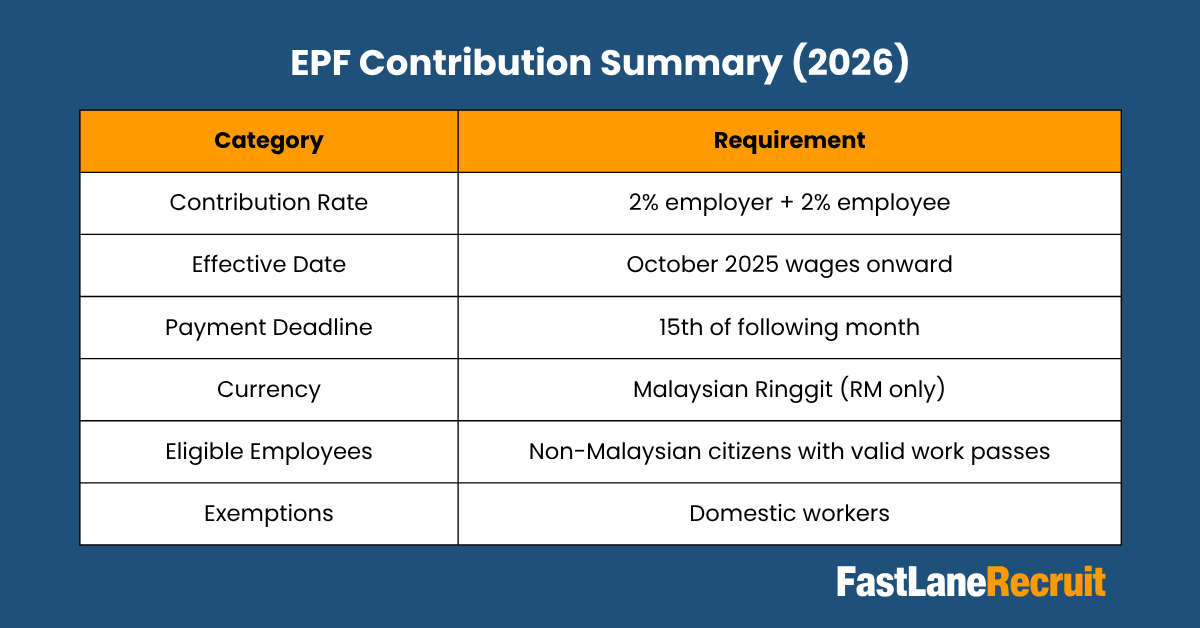
| Category | Requirement |
| Contribution Rate | 2% employer + 2% employee |
| Effective Date | October 2025 wages onward |
| Payment Deadline | 15th of following month |
| Currency | Malaysian Ringgit (RM only) |
| Eligible Employees | Non-Malaysian citizens with valid work passes |
| Exemptions | Domestic workers |
Example: How EOR Simplifies EPF Compliance
Many international companies hiring in Malaysia use an Employer of Record (EOR) model to manage compliance.
How it works:
- The EOR becomes the legal employer in Malaysia
- Handles EPF registration and monthly contributions
- Manages payroll processing and statutory deductions
- Ensures compliance with Malaysian employment law
Benefits:
- No need to establish a local entity
- Reduced administrative burden
- Lower compliance risk
- Faster hiring of foreign talent in Malaysia
For companies expanding into Southeast Asia, this model significantly simplifies cross-border workforce management.
Also Read: Comprehensive Guide to Payroll Management in Malaysia
Recommendations for Employers
To ensure smooth and compliant EPF implementation in 2026, employers should take a proactive approach rather than reacting to payroll issues after they occur. Since EPF contributions for non-Malaysian employees are tied closely to immigration status and payroll processing, even small administrative gaps can lead to delays or compliance risks.
Below are key practical recommendations to help employers manage EPF obligations more effectively:
1. Update Payroll Systems Before Processing Foreign Employee Salaries
Employers should ensure that their payroll systems are fully updated to reflect the latest EPF contribution rules for non-Malaysian employees.
This includes:
- Configuring the fixed 2% employer and 2% employee contribution rate
- Setting up correct employee categories for foreign workers
- Ensuring salary calculations align with EPF contribution rules
- Testing payroll runs before actual salary processing
Updating systems early helps avoid errors during monthly payroll cycles, especially when onboarding new foreign employees.
2. Validate Work Pass Details Regularly
Since EPF eligibility is directly linked to immigration status, employers must regularly verify that employees hold valid and active work passes.
This includes:
- Checking expiry dates of employment passes or work permits
- Ensuring job roles match approved immigration categories
- Updating employee records immediately after any visa changes
Regular validation helps prevent non-compliance situations where contributions are made for ineligible employees or missed due to expired documentation.
3. Automate EPF Calculations in Payroll Software
Manual calculation of EPF contributions increases the risk of errors, especially in companies with multiple foreign employees.
Employers are encouraged to:
- Use payroll software with built-in EPF automation features
- Enable automatic deduction and employer contribution calculation
- Reduce manual spreadsheet-based payroll processing
- Standardize contribution reporting across all employee groups
Automation improves accuracy, saves time, and ensures consistency across payroll cycles.
4. Train HR and Payroll Teams on Updated Statutory Requirements
EPF rules for foreign employees are relatively new and continue to evolve. HR and payroll teams must stay informed to avoid compliance gaps.
Training should cover:
- EPF eligibility criteria for foreign employees
- Contribution rates and calculation methods
- Payment deadlines and submission rules
- Registration procedures and documentation requirements
Regular training ensures that internal teams can confidently manage payroll changes and respond to regulatory updates.
5. Monitor EPF and Immigration Updates Regularly
Since EPF compliance is closely linked with immigration policy, employers should actively monitor updates from official authorities.
This includes:
- EPF announcements and policy updates
- Immigration Department of Malaysia changes
- Ministry of Human Resources (KESUMA) guidelines
- Payroll compliance circulars or system updates
Staying updated helps employers adapt quickly to regulatory changes and avoid last-minute compliance issues.
6. Consider Outsourcing Payroll or Using EOR Services for Multi-Country Hiring
For companies hiring across borders or managing a large number of foreign employees, compliance can become complex and time-consuming.
In such cases, employers may consider:
- Outsourcing payroll to a local provider
- Using an Employer of Record (EOR) service in Malaysia
- Centralizing compliance management under a specialized partner
An EOR solution can help manage:
- EPF registration and contributions
- Payroll processing and statutory filings
- Employment contracts and compliance documentation
- Ongoing regulatory updates
This approach is especially useful for global companies that want to hire in Malaysia without setting up a local legal entity.
Also Read: Types of Payroll Deductions and How They Work
Conclusion
The mandatory EPF contribution framework for non-Malaysian citizen employees represents a significant development in Malaysia’s payroll and employment compliance system in 2026.
Employers are now required to manage structured contributions, ensure timely payments, and maintain accurate payroll records for all eligible foreign employees.
While the system improves workforce protection and regulatory clarity, it also introduces additional compliance responsibilities that require careful payroll management.
Simplify EPF Compliance with FastLaneRecruit
Managing EPF contributions, payroll regulations, and foreign employee compliance in Malaysia can be complex, especially for global companies without local infrastructure.
FastLaneRecruit’s Employer of Record (EOR) and Payroll service in Malaysia helps businesses:
- Hire employees without setting up a local entity
- Manage EPF registration and monthly contributions
- Handle payroll processing and statutory compliance
- Ensure full adherence to Malaysian employment regulations
FastLaneRecruit enables companies to expand into Malaysia efficiently while staying fully compliant with local labor laws. Contact us for a FREE call!