
Employee tenure is a simple concept, but it plays a big role in how companies understand workforce stability, hiring decisions, and long-term business growth.
In today’s global hiring environment, especially with remote work and cross-border employment becoming more common, understanding employee tenure helps businesses make better decisions about recruitment, retention, and workforce planning.
In this guide, we’ll break down what employee tenure means, its types, why it matters, and how it impacts modern HR strategy. We’ll also connect it with global hiring practices, including outsourcing and Employer of Record (EOR) solutions.
Content Outline
Key Summary
Employee Tenure Definition
Employee tenure refers to the length of time an employee stays continuously with the same company, from joining until they leave or change jobs.
Tenure Reflects Workforce Stability
Longer tenure usually indicates a stable workforce and strong employee satisfaction, while shorter tenure may show frequent job changes or evolving industries.
Different Types of Tenure
Employee tenure is categorized into short-term (1–3 years), medium-term (3–5 years), and long-term (5+ years), each reflecting different career stages and stability levels.
Tenure Varies by Industry and Age
Industries like government and finance tend to have longer tenure, while hospitality has shorter tenure. Younger employees usually change jobs more often than senior professionals.
Tenure Helps HR Decision-Making
HR teams use tenure data for workforce planning, retention strategies, succession planning, and improving recruitment effectiveness.
Balance Between Long and Short Tenure Matters
Healthy organizations need both experienced employees for stability and new talent for innovation and fresh ideas.
Tenure Impacts Global Hiring Strategy
In global hiring and outsourcing models like BPO and EOR (including Malaysia), employee tenure plays a key role in improving productivity, compliance, and team stability.
What is Employee Tenure?
Employee tenure (also called job tenure) refers to the total length of time an employee continues working for the same employer.
In other words, it shows how long someone stays in a company from the day they are hired until they leave or change jobs.
It is one of the simplest ways to measure how stable or long-lasting an employee’s journey is within an organization.
In simple terms:
Employee tenure = The number of years, months, or days a person works in one company.
For example:
- If someone joins a company in 2020 and is still working there in 2026, their tenure is 6 years.
- If another employee leaves after 1 year, their tenure is 1 year.
Also Read: Understanding the Recruitment Process: Strategies for Success
Why Employee Tenure Matters
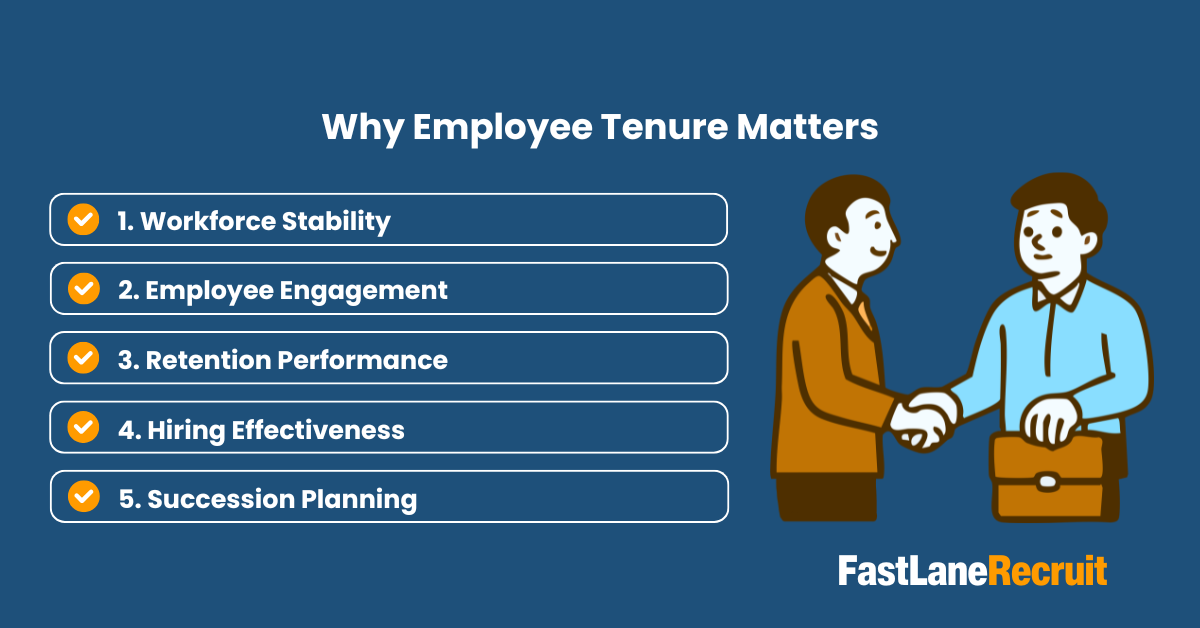
Employee tenure is not just a number. It helps HR teams and business leaders understand how employees behave inside the company and how healthy the organization is overall.
HR teams use tenure data to get insights into several important areas:
1. Workforce Stability
Tenure shows whether employees tend to stay long enough or leave quickly.
- Longer tenure = more stable workforce
- Shorter tenure = higher employee movement
2. Employee Engagement
If employees stay longer, it often suggests they feel:
- Comfortable in their role
- Connected to the company culture
- Satisfied with their work environment
3. Retention Performance
Tenure helps HR measure how well the company keeps its employees.
- High average tenure usually means strong retention strategies
- Low tenure may signal the need to improve workplace experience
4. Hiring Effectiveness
If new employees leave quickly, it may indicate:
- Hiring mismatch
- Unclear job expectations
- Need to improve recruitment quality
5. Succession Planning
Long-tenured employees often grow into senior roles.
HR teams use tenure data to:
- Identify future leaders
- Plan promotions
- Prepare replacements for key positions
Simple Example to Understand Employee Tenure
Think of two companies:
Company A
- Many employees stay 5–10 years
- Employees grow inside the company
- Strong internal relationships
This usually indicates:
- Stable workforce
- Strong company culture
- Good employee satisfaction
Company B
- Many employees leave within 1–2 years
- Constant hiring needed
- Teams change frequently
This may suggest:
- Fast-changing industry
- High turnover rate
- Possible gaps in retention or engagement
Key Idea to Remember
Employee tenure helps answer a very important question:
“How long do people actually stay with a company and why?”
Understanding this helps businesses improve hiring decisions, strengthen workplace culture, and build more stable teams over time.
Average Employee Tenure
Employee tenure is not the same across all companies or industries. It can change based on the type of job, the industry people work in, and even their age or career stage.
For example, some industries naturally have employees who stay longer because the work is stable and structured. In other industries, employees tend to move more often due to fast-changing skills, project-based work, or career growth opportunities.
According to the US Bureau of Labor Statistics (BLS), the median job tenure for private sector employees in the United States is around 4 years.
This means that, on average, many employees stay with one company for about four years before moving to a new role or employer.
Why Employee Tenure Differs
There are a few key reasons why tenure changes from one group to another:
- Industry structure (stable vs fast-moving industries)
- Career growth opportunities (how quickly people can move up or switch roles)
- Work environment and culture
- Skill demand in the market
- Age and experience level of employees
Younger professionals often explore different jobs early in their careers, while experienced professionals usually prefer stability and long-term growth in one organization.
Also Read: In-House Recruiter vs. Recruiting Agency
Example of Average Tenure by Industry
Below is a simple breakdown showing how employee tenure can differ depending on the industry:
| Industry | Average Employee Tenure | Explanation |
| Government | 6+ years | More stable roles with structured career paths |
| Finance | 4–5 years | Balanced between stability and career mobility |
| Education | 3–4 years | Moderate stability with long-term roles |
| Hospitality / Service | 2–3 years | High turnover due to seasonal or flexible work patterns |
How Age Affects Employee Tenure
Employee tenure is also closely linked to age and career stage:
- Younger employees (early career):
Usually have shorter tenure as they explore different roles, industries, and learning opportunities. - Mid-career professionals:
Tend to stay longer as they focus on career growth and stability. - Senior employees:
Often have the longest tenure due to experience, senior roles, and stronger alignment with company culture.
Key Insight
There is no “perfect” employee tenure. Instead, it reflects how people behave in different industries and stages of their careers.
A healthy organization is not just about long tenure or short tenure, it is about finding the right balance between experienced employees who provide stability and new employees who bring fresh ideas and innovation.
Types of Employee Tenure
Employee tenure is usually grouped into different categories based on how long an employee stays with a company. These categories help HR teams better understand workforce patterns, employee stability, and career progression.
While the exact time ranges can vary slightly by industry, employee tenure is generally divided into three main types: short-term, medium-term, and long-term. There is also a special case called permanent or academic tenure in certain fields.
1. Short-Term Tenure
Short-term tenure refers to employees who stay with a company for a relatively short period of time.
Time range:
Less than 1 to 3 years
Key characteristics:
- Employees are still exploring their career path
- Higher chance of job changes or role switching
- Common in fast-paced or competitive industries
Why it happens:
Short tenure is often linked to:
- Career exploration and learning new skills
- Better opportunities in other companies
- Lack of long-term role fit
- Fast-moving industries where job movement is normal
Simple example:
A marketing executive who joins a company and leaves after 18 months due to a new job opportunity would fall under short-term tenure.
2. Medium-Term Tenure
Medium-term tenure represents employees who stay long enough to gain solid experience but are still in a growth phase within the organization.
Time range:
Around 3 to 5 years
Key characteristics:
- Employees are more stable and settled
- They understand company processes well
- Often trusted with more responsibility
What it usually indicates:
- Good job fit between employee and company
- Growing confidence and skill development
- Increasing contribution to team performance
Simple example:
A software developer who has worked in the same company for 4 years, leading small projects and supporting junior staff, fits into this category.
Also Read: Bridging The Talent Gap in Australia’s Job Market: Hiring Trends In 2026
3. Long-Term Tenure
Long-term tenure refers to employees who have spent a significant period with the same organization.
Time range:
5 or more years in the same company
Key characteristics:
- Deep understanding of company culture and systems
- Strong institutional knowledge
- Often seen as reliable and experienced team members
Common roles and contributions:
Long-tenured employees often:
- Take leadership roles
- Mentor new employees
- Support decision-making processes
- Help maintain company culture and stability
Simple example:
An operations manager who has been with the company for 8 years and helps train new managers would be considered long-tenured.
Special Case: Academic or Permanent Tenure
In some sectors, especially education and research, tenure has a different meaning.
What it means:
Academic tenure refers to a system where a professor or academic staff member is given long-term job security after meeting specific performance and evaluation standards.
Key characteristics:
- Strong job protection after approval
- Based on research, teaching, and contribution quality
- Common in universities and research institutions
Why it exists:
Academic tenure is designed to:
- Encourage academic freedom
- Support long-term research work
- Reward consistent performance and contribution
Key Insight
Understanding different types of employee tenure helps organizations:
- Identify workforce stability levels
- Improve hiring and retention strategies
- Plan career development paths more effectively
- Balance experienced employees with new talent
A healthy organization usually has a mix of all tenure types, ensuring both stability and innovation in the workforce.
Tenured Meaning in BPO Context
In the BPO (Business Process Outsourcing) industry, the term “tenured employees” refers to team members who have stayed with a company for a longer period of time, usually more than 2–3 years.
In a sector where employee turnover can be relatively high due to shift-based work, performance pressure, and fast-paced operations, having tenured employees is especially valuable.
These are employees who have moved beyond the initial learning stage and are now experienced in handling processes, clients, and operational systems efficiently.
Why Tenured Employees Matter in BPO
Tenured employees are considered a strong asset in BPO operations because they bring both stability and expertise to the team.
They are valuable because they:
- Understand client processes deeply
They already know how different clients operate, including workflows, expectations, and service standards. - Require less training and supervision
Since they are already familiar with systems and tools, they can work independently with minimal guidance. - Improve service quality and efficiency
Experience allows them to handle tasks faster and with fewer errors, which improves overall output quality. - Help reduce onboarding time for new hires
They often support training and help new employees adapt quickly to the job. - Support team stability
Their presence reduces disruption caused by frequent employee turnover.
Impact on BPO Performance
In BPO environments, employee tenure is closely linked to overall business performance.
Companies with higher numbers of tenured employees often experience:
- More consistent service delivery
- Better client satisfaction scores
- Lower operational disruption
- Stronger team coordination
- Improved knowledge retention within teams
In simple terms, the longer employees stay in a BPO role, the more efficient and reliable the entire operation becomes.
Also Read: Singapore Job Market: Hiring Trends In 2026
Why Employee Tenure Matters in HR and Recruitment
Employee tenure is more than just a workforce statistic. For HR teams and recruiters, it provides meaningful insights that help improve hiring decisions, employee experience, and long-term business planning.
1. Workforce Stability Insight
Tenure helps HR understand how stable the workforce is.
- High average tenure usually means employees are staying longer and building experience
- Low tenure may indicate frequent job changes or retention challenges
This helps companies assess whether their work environment supports long-term employment.
2. Retention Planning
HR teams analyze tenure patterns to improve employee retention strategies.
This includes:
- Identifying why employees leave early
- Improving engagement programs
- Creating better career development opportunities
- Strengthening company culture
The goal is to help employees stay longer and grow within the organization.
3. Succession Planning
Long-tenured employees often become future leaders within the company.
They are valuable for:
- Training and mentoring new employees
- Taking on leadership or managerial roles
- Passing down company knowledge and best practices
This ensures smooth leadership transitions when senior staff move on.
4. Recruitment Strategy
Understanding tenure trends helps companies refine their hiring approach.
For example:
- If tenure is low in certain roles, recruitment strategies may need adjustment
- If certain industries naturally have shorter tenure, expectations can be set accordingly
- If employees stay longer in specific teams, those practices can be replicated
This helps improve hiring quality and workforce planning.
5. Cost Efficiency in Hiring
Employee turnover is expensive because it involves repeated:
- Hiring
- Training
- Onboarding
When employee tenure is longer, companies benefit from:
- Lower recruitment cycles
- Reduced training costs
- Better productivity from experienced staff
This helps improve overall operational efficiency.
Also Read: High-Demand Jobs in Malaysia 2026
Benefits of Long Employee Tenure
Long-term employees bring significant value to organizations beyond just experience.
Key benefits include:
- Deep company knowledge
They understand internal systems, processes, and history. - Strong internal relationships
They build trust and collaboration across teams over time. - Higher productivity over time
Experience allows them to work more efficiently and confidently. - Leadership development potential
Many long-tenured employees grow into managers and senior roles. - Lower onboarding requirements
They already know how the company operates, reducing training needs.
Cultural and Team Benefits
In addition to operational advantages, long-tenured employees also:
- Help maintain company culture
- Support smoother onboarding for new hires
- Act as mentors and role models
- Provide stability during organizational changes
Key Insight
Employee tenure is a powerful HR indicator that affects both performance and people strategy.
In industries like BPO and global outsourcing, having a healthy mix of tenured employees and new talent helps companies maintain:
- Stability
- Efficiency
- Innovation
- Strong service quality
A well-balanced workforce is not just about how long employees stay, it’s about how effectively their experience is used to support long-term business growth.
Challenges of Long Employee Tenure
While long employee tenure brings stability, experience, and strong company knowledge, it can also create certain challenges for both employees and organizations if not managed well.
The key is not to avoid long tenure, but to make sure employees continue to grow and stay engaged over time.
1. Reduced Exposure to New Ideas
Employees who stay in the same organization for many years may have fewer opportunities to experience different working styles, tools, or industry practices.
Over time, this can lead to:
- Limited external perspective
- Less exposure to industry innovation
- Familiar “this is how we do things” thinking
Without fresh input, creativity and innovation may slow down.
2. Risk of Skill Stagnation
When job roles remain the same for a long period, employees may stop learning new skills at the same pace.
This can result in:
- Skills becoming outdated in fast-changing industries
- Limited technical or professional growth
- Dependence on existing knowledge instead of continuous learning
In modern workplaces, continuous upskilling is important to stay competitive.
3. Resistance to Organizational Change
Long-tenured employees may sometimes find it harder to adapt to new systems, processes, or company direction.
This can happen because:
- They are comfortable with existing workflows
- They have seen past changes that did not work well
- They have strong attachment to established methods
While experience is valuable, adaptability is equally important in evolving business environments.
4. Possible Salary Imbalance Compared to New Hires
In some organizations, long-tenured employees may experience salary gaps compared to newer employees hired at current market rates.
This can lead to:
- Pay structure imbalance
- Internal dissatisfaction
- HR challenges in maintaining fairness and transparency
This is why companies need regular salary benchmarking and compensation reviews.
5. Burnout in Repetitive Roles
If employees stay in similar roles for many years without new challenges, they may experience burnout.
Common signs include:
- Reduced motivation
- Decreased engagement
- Feeling stuck in routine tasks
- Lower job satisfaction
Providing role rotation or new responsibilities can help reduce this risk.
Modern HR Approach
Because of these challenges, modern HR strategies focus on maintaining a balance between:
- Experienced, long-tenured employees
- New talent with fresh ideas and perspectives
This balance helps organizations stay stable while also remaining innovative and adaptable.
Also Read: Talent Expectation Gap In Job Market Hong Kong Hiring Trend 2026
What Causes Short Employee Tenure?
Short employee tenure refers to situations where employees stay in a company for a relatively brief period before moving on.
This is very common in today’s job market and can happen for several reasons.
1. Better Career Opportunities Elsewhere
One of the most common reasons for short tenure is when employees find:
- Higher salaries
- Better job roles
- Faster career progression
Career mobility is now a normal part of professional growth in many industries.
2. Limited Growth Inside the Company
Employees may leave if they feel there are not enough opportunities to grow.
This can include:
- Lack of promotions
- Limited skill development programs
- Few leadership opportunities
When growth is unclear, employees often look elsewhere.
3. Work-Life Balance Expectations
Modern employees place high importance on work-life balance.
Short tenure may happen when:
- Workload is too heavy
- Flexibility is limited
- Work environment is not aligned with personal needs
Companies that offer flexible work options often see better retention.
4. Industry Changes and Fast-Moving Roles
In some industries, short tenure is completely normal due to:
- Project-based work
- Contract roles
- Rapid technological change
Employees often move to stay updated with new skills and opportunities.
5. Role Mismatch
Sometimes employees leave early because:
- The job is not what they expected
- Skills do not match role requirements
- Work responsibilities differ from job description
A mismatch during hiring can lead to early exits.
Key Insight
Short employee tenure is not always a negative sign.
In many cases, it reflects:
- Career exploration
- Skill development
- Industry mobility
- Changing professional goals
A healthy organization understands both short and long tenure patterns and uses them to improve hiring quality, employee experience, and long-term workforce planning.
How Companies Can Improve Employee Tenure
Improving employee tenure is not just about keeping employees longer, it is about creating an environment where people want to stay, grow, and contribute meaningfully over time.
Modern HR strategies focus on building strong employee experiences that support both individual growth and business performance.
Below are some of the most effective ways companies can improve employee tenure:
1. Career Development Opportunities
Employees are more likely to stay with a company when they clearly see a future for themselves.
This includes:
- Clear career growth paths
- Regular performance reviews
- Internal promotion opportunities
- Training and upskilling programs
When employees understand how they can grow within the company, they are more motivated to stay long-term and build their careers internally rather than looking elsewhere.
2. Positive Work Environment
A healthy work environment plays a major role in employee retention.
A positive workplace includes:
- Respectful and supportive culture
- Open communication between teams and management
- Recognition of employee contributions
- A sense of belonging within the organization
When employees feel valued and respected, they are more likely to stay engaged and committed to the company.
3. Fair Compensation Structures
Compensation is one of the most important factors influencing employee tenure.
Companies that want to retain talent should ensure:
- Salaries are aligned with industry standards
- Compensation is reviewed regularly
- Bonus and incentive structures are transparent
- Employees understand how their performance impacts rewards
Fair and consistent pay practices help build trust and reduce the likelihood of employees leaving for better offers.
4. Strong Leadership & Communication
Leadership quality has a direct impact on how long employees stay in a company.
Good leadership includes:
- Clear communication of expectations
- Regular feedback and support
- Fair decision-making
- Approachability and transparency
When employees trust their managers and feel supported, they are more likely to stay with the organization for a longer period.
5. Flexible Work Models
Work flexibility has become a key factor in employee satisfaction, especially in global and digital work environments.
Companies that offer flexibility often see better retention through:
- Remote work options
- Hybrid work arrangements
- Flexible working hours
- Results-based performance systems instead of strict time-based control
Flexibility helps employees maintain a better work-life balance, which directly contributes to longer tenure.
Employee Tenure in Global Hiring
In today’s global workforce, employee tenure plays an even more important role, especially when companies are hiring across different countries and time zones.
When businesses work with distributed teams, they need to understand not only local labor markets but also how to retain talent in different regions.
Employee Tenure in Southeast Asia Hiring
In regions like Southeast Asia, including Malaysia, companies often use outsourcing models or Employer of Record (EOR) solutions to manage hiring and employment compliance more efficiently.
These models help businesses access skilled talent while ensuring smooth employment operations across borders.
Benefits of Using EOR for Employee Tenure Stability
When hiring Malaysian professionals through an EOR model, companies can benefit from:
- Managed payroll compliance locally
Ensures employees are paid correctly and in line with local regulations. - Reduced administrative workload
HR and legal processes are handled by the EOR provider, allowing companies to focus on core business. - Faster hiring and onboarding
Talent can be hired quickly without setting up a local entity. - Access to stable, skilled talent pools
EOR partners help connect companies with experienced professionals who are more likely to stay longer when properly supported.
How FastLaneRecruit Supports Employee Tenure
FastLaneRecruit helps businesses build stronger and more stable global teams.
Through its Employer of Record (EOR) service, FastLaneRecruit enables companies to:
- Hire talent in Malaysia compliantly
- Manage employment efficiently without local setup
- Support smoother employee experiences
- Improve long-term retention in global teams
By simplifying cross-border hiring, companies can focus more on building strong employee relationships, which naturally leads to better employee tenure and team stability.
Employee tenure improves when companies invest in:
- Career growth
- Work culture
- Fair compensation
- Strong leadership
- Flexible working models
In global hiring environments, especially across Southeast Asia, using EOR solutions helps businesses build more stable and long-lasting teams while reducing operational complexity.
Conclusion
Employee tenure is a key indicator of workforce health, stability, and organizational culture.
For modern businesses, especially those hiring globally, understanding tenure helps build stronger teams, reduce turnover risk, and improve long-term performance.
Instead of focusing only on how long employees stay, companies should focus on creating environments where employees want to stay longer.
Build Stronger Teams with FastLaneRecruit
Managing global hiring, retention, and compliance can be complex, especially when scaling across countries.
FastLaneRecruit helps companies hire and manage Malaysian talent through its Employer of Record (EOR) services, making it easier to build stable, long-term teams without operational friction.
If you want to build a more stable and globally distributed workforce, explore FastLaneRecruit’s EOR solutions today.