Hiring the right people can shape the future of a business. Whether you are expanding into a new market, replacing a key employee, or building a team from the ground up, a strong recruitment process helps you find people who can grow with your company.
Many businesses think recruitment starts when a vacancy appears. In reality, successful hiring begins much earlier, with workforce planning, clear job requirements, and a smart strategy to attract the right candidates.
For companies hiring internationally, this becomes even more important. Different markets have different talent expectations, salary benchmarks, and hiring regulations. That is why many growing businesses now work with recruitment specialists to improve hiring speed, quality, and long-term retention.
In this guide, we explain the recruitment process step by step, share proven hiring strategies for 2026, and explore why Malaysia has become one of Southeast Asia’s most attractive places to hire talent.
Content Outline
Key Summary
Structured Recruitment Drives Better Hiring Outcomes
A clear recruitment process helps businesses reduce hiring mistakes, improve decision-making, and consistently attract stronger candidates.
Planning Is the Foundation of Successful Hiring
Defining role requirements, salary expectations, and team needs early prevents rushed decisions and improves long-term hiring success.
Candidate Experience Directly Impacts Hiring Success
Outsourcing unlocks a host of advantages: accurate and on-time salary payments, secure handling of sensitive data, simplified benefits administration, and scalable support as your team grows across borders.
Skills-Based Hiring Improves Talent Quality
Focusing on real abilities rather than just degrees or job titles helps companies identify high-performing and adaptable candidates.
Faster Hiring Helps Secure Top Talent
Reducing unnecessary interview rounds and improving decision speed prevents losing strong candidates to competing employers.
Data and Technology Improve Recruitment Efficiency
Tracking hiring metrics and using AI tools helps companies optimize sourcing, screening, and overall recruitment performance.
Malaysia Is a Strategic Talent Hub in Southeast Asia
With multilingual talent, strong industry skills, and cost efficiency, Malaysia offers global companies a competitive hiring advantage.
What Is the Recruitment Process?
The recruitment process is the step-by-step method businesses use to find, assess, hire, and welcome new employees into the company. It is more than simply posting a job ad and choosing someone quickly. A well-planned recruitment process helps employers identify the right person for the role while giving candidates a professional and positive hiring experience.
Think of recruitment as a complete journey, from recognizing the need for a new employee to helping that person succeed after they join the business.
Also Read: Hybrid And Remote Work Trends in Malaysia
The Six Steps of the Recruitment Process
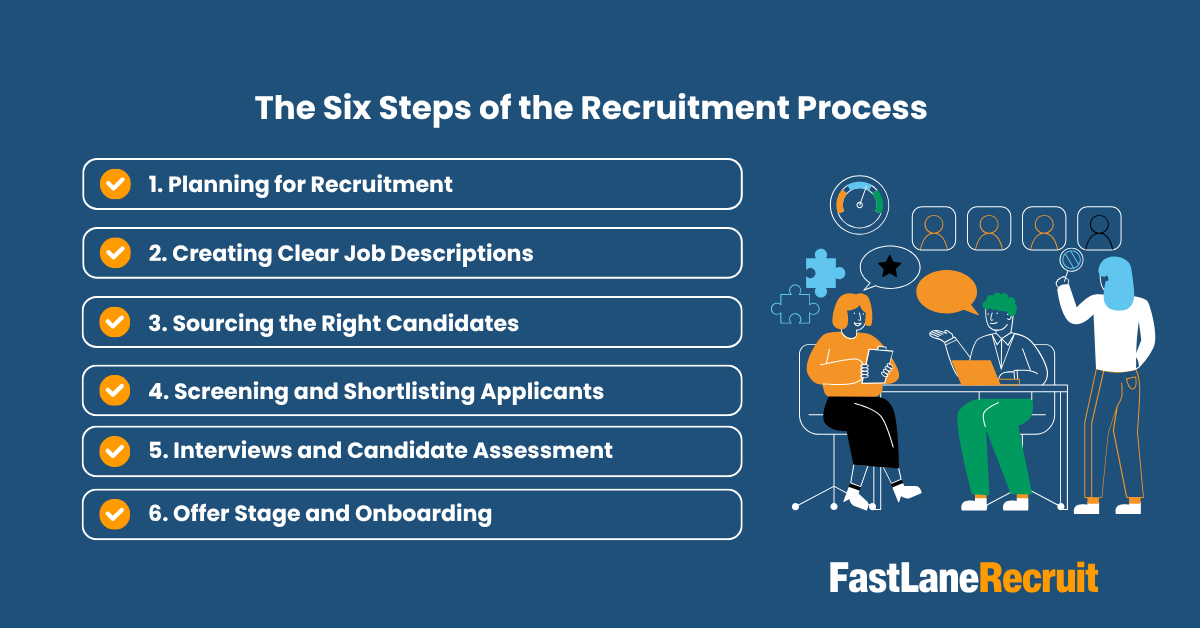
Many successful companies follow six key stages when hiring new employees. These steps create a more organized hiring journey, improve decision-making, and provide a better experience for both employers and job seekers.
When recruitment is handled properly, businesses reduce hiring mistakes, save time, and bring in people who can grow with the company.
1. Planning for Recruitment
Every great hire starts with proper planning. Before advertising a role, employers need to understand why they are hiring and what kind of person they truly need.
Recruitment planning helps companies avoid rushed decisions and unnecessary costs.
A hiring need usually happens when:
- The business is expanding
- An employee resigns
- New clients or projects increase workload
- Existing teams are overstretched
- New skills are required
- Internal promotions create backfill vacancies
What Employers Should Define First
| Hiring Area | Why It Matters |
| Skills Required | Helps target qualified candidates |
| Experience Level | Matches role complexity |
| Salary Range | Keeps hiring realistic and competitive |
| Team Structure | Clarifies reporting lines |
| Job Goals | Defines what success looks like |
| Growth Opportunity | Attracts ambitious candidates |
Example:
Instead of saying:
“We need someone urgently.”
A better planning approach is:
“We need a Digital Marketing Executive with SEO and content skills to support business growth in Southeast Asia.”
Why This Step Matters
Good planning improves hiring speed, reduces mismatched hires, and ensures the new employee adds real value.
Tip: Hiring too fast without planning often leads to rehiring later.
2. Creating Clear Job Descriptions
A job description is often the first interaction candidates have with your company. It acts like a sales page for the opportunity.
A strong job description attracts the right applicants while discouraging unqualified ones.
What to Include
- Clear job title
- Main responsibilities
- Required qualifications
- Preferred experience
- Salary range (if possible)
- Benefits and perks
- Work model (remote / hybrid / onsite)
- Career progression opportunities
- Company overview
Example:
Instead of writing:
Sales Rockstar Wanted
Use:
Business Development Executive – B2B SaaS Sales
This is clearer, more professional, and easier to find in job searches.
Why This Step Matters
Well-written job ads improve application quality and reduce irrelevant CVs.
Tip: Use simple language. Avoid buzzwords and vague terms.
3. Sourcing the Right Candidates
Once the role is ready, the next step is attracting qualified people.
Modern recruitment uses multiple channels instead of relying on one source.
Common Sourcing Channels
- Job boards
- LinkedIn and professional networks
- Company careers page
- Employee referrals
- Recruitment agencies
- University graduate hiring
- Social media campaigns
- Past candidate database
- Internal hiring opportunities
Tips for Better Sourcing
- Build a strong employer brand
- Use attractive and honest job ads
- Reply to applicants quickly
- Promote growth opportunities
- Showcase company culture
- Keep a talent pipeline for future roles
Example:
If hiring software engineers, posting only on one job board may limit results. Using LinkedIn, referrals, and developer communities increases success.
Why This Step Matters
Better sourcing creates a stronger talent pool, giving employers more quality choices.
Also Read: Operations Management Compliance in Malaysia
4. Screening and Shortlisting Applicants
Once applications come in, recruiters review candidates to identify the strongest matches.
This stage filters applicants before interviews begin.
What Recruiters Usually Review
- Relevant work experience
- Skills and qualifications
- Industry background
- Communication quality
- Career progression
- Achievements
- Motivation for applying
- Availability and notice period
Some companies also conduct short phone screening calls.
Why Phone Screening Helps
It can quickly confirm:
- Salary expectations
- Communication skills
- Interest level
- Availability
- Basic suitability
Why This Step Matters
Strong screening saves time, improves interview quality, and helps hiring teams focus on the best talent.
Tip: Fast screening is important. Strong candidates often receive multiple offers.
5. Interviews and Candidate Assessment
Shortlisted candidates move into interviews and evaluations.
This stage helps companies assess skills, attitude, and cultural fit.
Common Interview Types
| Interview Type | Main Purpose |
| HR Interview | Motivation, communication, values |
| Hiring Manager Interview | Experience and job fit |
| Technical Assessment | Practical ability |
| Panel Interview | Stakeholder alignment |
| Final Interview | Decision stage and team fit |
Good Interview Practices
- Ask structured questions
- Keep scoring consistent
- Share timelines clearly
- Respect candidate schedules
- Avoid unnecessary interview rounds
- Provide timely feedback
Example:
A marketing candidate may complete:
- HR interview
- Hiring manager interview
- Short case study
- Final discussion
Why This Step Matters
Interviews help predict performance, but overly long hiring processes often lose top talent.
Tip: Strong candidates may accept faster offers elsewhere.
Also Read: Ultimate Guide to Employee Onboarding Checklist
6. Offer Stage and Onboarding
Once the best candidate is selected, the company prepares an offer and begins onboarding.
A professional offer process improves acceptance rates.
A Good Offer Usually Includes
- Base salary
- Bonuses or commissions
- Benefits
- Leave entitlement
- Work arrangement
- Start date
- Working hours
- Contract terms
After Acceptance: Onboarding Begins
Strong onboarding helps employees become productive faster.
Effective Onboarding Includes
- Welcome orientation
- Team introductions
- System and tool setup
- Training roadmap
- Role expectations
- First 30/60/90 day goals
- Regular manager check-ins
Why This Step Matters
Many companies focus heavily on hiring but forget onboarding. A poor first month can cause early resignations.
Tip: Recruitment success is not complete until the new hire performs well and stays.
The six steps of recruitment are more than administrative tasks, they are a business growth strategy.
When companies improve each stage, they gain:
- Better hires
- Faster hiring
- Lower turnover
- Stronger employer reputation
- Better candidate experience
- Higher productivity
Recruitment is not just filling vacancies. It is building the future of the company.
Also Read: Workplace Dynamics and Their Impact on Your Organization
Why a Strong Recruitment Process Matters
A strong recruitment process does far more than simply fill an open position. It plays a direct role in shaping business performance, employee satisfaction, and long-term company growth. Hiring the right people through a structured and thoughtful process helps businesses build stronger teams, reduce unnecessary costs, and stay competitive in a fast-moving market.
When recruitment is rushed or poorly managed, companies may face delays, low productivity, frequent resignations, and repeated hiring costs. On the other hand, a strong recruitment system helps create consistency and better hiring outcomes.
Below are some of the key reasons why an effective recruitment process matters.
| Business Benefit | Why It Matters |
| Better hires | Stronger employee performance and long-term business growth |
| Faster hiring | Reduces delays, productivity gaps, and pressure on existing teams |
| Lower turnover | Better candidate fit leads to stronger retention |
| Strong employer brand | Attracts more qualified and motivated applicants |
| Better candidate experience | Improves offer acceptance rates and reputation |
1. Better Hires Lead to Better Results
The quality of your people often determines the quality of your business outcomes. A structured recruitment process helps identify candidates who have the right skills, experience, attitude, and potential.
When companies hire the right people:
- Teams perform better
- Managers spend less time correcting mistakes
- Customers receive better service
- Business goals are achieved faster
Strong hiring decisions also contribute to future leadership development and business stability.
2. Faster Hiring Reduces Delays
Leaving key positions vacant for too long can create operational problems. Existing employees may need to take on extra responsibilities, which can increase stress and lower morale.
An efficient recruitment process helps companies:
- Fill urgent roles faster
- Reduce overtime pressure on current staff
- Maintain service quality
- Keep projects moving on time
Speed matters especially in competitive industries where top candidates may receive multiple offers quickly.
3. Lower Turnover Saves Time and Cost
Hiring someone who is not the right fit can be expensive. Businesses may lose time, training resources, and momentum if a new hire leaves early.
A stronger recruitment process improves role fit by assessing:
- Skills match
- Work style compatibility
- Career motivation
- Team alignment
When employees feel they are in the right role, they are more likely to stay and grow with the company.
4. Strong Employer Brand Attracts Better Candidates
Today’s candidates often research employers before applying. They may review company websites, employee feedback, leadership reputation, and hiring experience.
A professional recruitment process helps strengthen employer branding by showing that the company is:
- Organized
- Respectful of candidates
- Growth-focused
- Transparent
- A desirable place to work
This can attract stronger applicants and reduce hiring difficulty over time.
5. Better Candidate Experience Improves Acceptance Rates
Candidates evaluate employers during the hiring process just as much as employers evaluate candidates.
A positive candidate experience includes:
- Clear communication
- Timely interview updates
- Respectful interactions
- Transparent expectations
- Smooth offer process
When candidates feel valued and informed, they are more likely to accept offers and speak positively about the company.
Why This Matters More Today
According to many global HR studies, candidate experience, communication speed, and employer reputation now strongly influence whether top talent accepts a job offer. Skilled professionals often have options, so businesses must compete not only on salary, but also on hiring experience.
A strong recruitment process is not just an HR function, it is a business advantage. Companies that hire well can grow faster, retain stronger talent, and build teams that support long-term success. Investing in better recruitment today often leads to better results tomorrow.
Also Read: RPO vs. In-House Recruitment: Which Hiring Strategy Works Best?
10 Recruitment Strategies for Success in 2026
In 2026, recruitment is no longer just about filling vacancies. It’s about building a future-ready workforce, improving hiring speed, and creating meaningful candidate experiences. Companies that succeed are those that combine people, process, and technology in a smart way.
Below are 10 essential recruitment strategies explained in a simple, practical way.
1. Skills-Based Hiring
Focus on What Candidates Can Do, Not Just Their Background
Traditional hiring often prioritizes degrees, job titles, or years of experience. Skills-based hiring shifts the focus to actual ability.
Why It Matters
- Expands your talent pool
- Reduces bias in hiring
- Improves job performance outcomes
- Helps identify hidden talent
How It Works
- Use practical tests or case studies
- Assess real-world problem-solving skills
- Focus on competencies needed for the role
- Reduce dependency on formal education requirements
Example
Instead of requiring a “Marketing Degree,” companies evaluate:
- SEO ability
- Content writing skills
- Campaign performance results
2. Employer Branding
Build a Company People Want to Join
Employer branding is how your company is perceived by job seekers. In 2026, candidates actively research companies before applying.
Why It Matters
- Influences application volume and quality
- Builds trust with candidates
- Improves offer acceptance rates
How to Strengthen It
- Showcase company culture on social media
- Share employee stories and testimonials
- Maintain a strong Glassdoor and LinkedIn presence
- Highlight benefits and growth opportunities
Example
Companies that show “real employee experiences” often attract more engaged applicants than those that only post job ads.
3. Faster Hiring Decisions
Reduce Delays in the Recruitment Process
Top candidates don’t stay available for long. Slow hiring processes often result in losing them to competitors.
Why It Matters
- Improves candidate conversion rates
- Reduces drop-offs during hiring
- Enhances employer reputation
How to Improve Speed
- Limit unnecessary interview rounds
- Use structured decision-making frameworks
- Align hiring managers early
- Set clear internal approval timelines
Example
A 5-stage interview process can often be reduced to 2–3 well-structured stages.
4. Better Candidate Experience
Treat Candidates Like Customers
Candidate experience refers to how applicants feel throughout the hiring process.
Why It Matters
- Strongly impacts offer acceptance
- Influences employer reputation
- Encourages future applications
Key Improvements
- Respond quickly to applications
- Provide clear hiring timelines
- Give feedback where possible
- Keep communication consistent
Example
A candidate who receives regular updates is more likely to accept an offer, even if another company pays slightly more.
5. Data-Driven Recruitment
Use Metrics to Improve Hiring Decisions
Modern recruitment relies heavily on data to identify what is working and what is not.
Key Metrics to Track
- Time to Hire: Measures how long it takes to fill a position.
- Source of Hire: Shows which channels bring the best candidates.
- Offer Acceptance Rate: Indicates how attractive your offers are.
- Retention Rate: Measures how long new hires stay.
Why It Matters
- Improves hiring efficiency
- Reduces recruitment costs
- Helps identify bottlenecks
- Supports better strategic planning
6. Employee Referral Programs
Turn Employees Into Talent Sources
Employee referrals are one of the most effective hiring methods.
Why It Matters
- Faster hiring process
- Higher quality candidates
- Better cultural fit
- Lower recruitment costs
How It Works
- Employees recommend candidates from their network
- Incentives encourage participation
- Referred candidates are prioritized in screening
Example
A referred candidate is often more likely to stay longer because they already understand company culture.
7. Talent Pipelines
Build Relationships Before You Need to Hire
A talent pipeline is a pool of potential candidates ready for future roles.
Why It Matters
- Reduces time-to-hire
- Ensures continuous hiring readiness
- Helps fill urgent roles faster
How to Build It
- Stay connected with past applicants
- Engage passive candidates on LinkedIn
- Collect resumes even when roles are not open
- Host webinars or talent events
Example
Companies that maintain pipelines can fill roles in weeks instead of months.
8. AI Support Tools
Use Technology to Automate Recruitment Tasks
AI is transforming recruitment by handling repetitive tasks and improving efficiency.
Common Uses
- Resume screening
- Interview scheduling
- Candidate matching
- Chatbots for FAQs
- Automated follow-ups
Why It Matters
- Saves recruiter time
- Reduces human error
- Speeds up hiring process
- Improves consistency
Example
AI tools can shortlist candidates based on job requirements within minutes.
9. Internal Mobility
Promote from Within Before Hiring Externally
Internal mobility means giving current employees opportunities to move into new roles.
Why It Matters
- Boosts employee motivation
- Reduces hiring costs
- Increases retention
- Preserves company knowledge
How to Support It
- Share internal job openings first
- Conduct regular skill assessments
- Offer training and development programs
- Create clear career paths
Example
An internal hire often performs faster because they already understand company systems and culture.
Also Read: Difference Between Talent Sourcer vs Recruiter
10. Recruitment Partners
Use Experts for Faster and Smarter Hiring
Recruitment partners (agencies or EOR providers) help companies scale hiring efficiently, especially in new markets.
Why It Matters
- Access to wider talent networks
- Faster hiring in specialized roles
- Support with compliance and local hiring rules
- Reduces internal HR workload
When to Use Them
- Entering a new country
- Hiring in large volumes
- Filling niche or technical roles
- Scaling quickly during growth phases
Example
Startups expanding internationally often rely on recruitment partners to avoid legal and operational complexity.
Modern recruitment is no longer about “posting and waiting.” It is about strategy, speed, and experience.
Companies that succeed in 2026 are those that:
- Hire based on skills
- Move fast and communicate clearly
- Use data and technology wisely
- Invest in employer branding
- Build long-term talent pipelines
Recruitment today is not just about filling jobs, it’s about building the future of your organization.
How Long Is a Typical Recruitment Process?
The length of a recruitment process can vary widely depending on factors such as the role level, industry, urgency of hiring, and the complexity of the selection process. While some companies move quickly, others take more time to ensure they find the right fit.
In general, entry-level roles tend to be filled faster, while senior or highly specialized roles take longer due to more detailed evaluations and multiple decision-makers.
Typical Recruitment Timelines by Position Level
| Position Level | Typical Hiring Timeline | Why It Takes This Long |
| Entry-Level | 2 to 4 weeks | Fewer interview rounds and simpler skill requirements |
| Mid-Level | 1 to 2 months | More experience evaluation and structured interviews |
| Senior Roles | 2 to 4 months | Multiple stakeholders, leadership assessment, and deeper screening |
Why Timelines Differ Across Roles
Recruitment speed is not the same for every job. Several key factors influence how long the process takes:
1. Role Complexity
More technical or leadership-heavy roles require deeper evaluation, including case studies, technical tests, or multiple interview rounds.
2. Hiring Urgency
If a role is urgent (for example, replacing a critical team member), companies often fast-track interviews and decision-making.
3. Number of Decision-Makers
Senior roles usually involve multiple stakeholders such as HR, department heads, and executives, which naturally extends the timeline.
4. Talent Availability
If the skill set is rare or in high demand, sourcing and screening suitable candidates takes longer.
5. Company Process Structure
Organizations with clear, structured hiring systems and fast approval workflows tend to hire significantly faster.
What Efficient Companies Do Differently
Companies with strong recruitment systems are often able to shorten hiring timelines without sacrificing quality.
They usually:
- Use pre-defined hiring criteria and scorecards
- Limit unnecessary interview rounds
- Maintain ready-to-use talent pipelines
- Communicate quickly with candidates
- Leverage automation tools for screening and scheduling
- Align hiring managers early in the process
Why Faster Hiring Matters
A longer recruitment process increases the risk of losing top candidates to competitors. Speed is especially important in competitive industries where talent is in high demand.
At the same time, speed should never replace quality. The best recruitment processes find the right balance between efficiency and careful evaluation.
Key Takeaway
A typical recruitment process can range from 2 weeks to 4 months, depending on the role. However, companies that are well-prepared, structured, and responsive often hire faster and attract stronger talent.
In modern recruitment, clarity + speed + structure = better hiring outcomes.
Also Read: Fixed-Term Employment Contracts: Pros and Cons for Employers
Common Recruitment Mistakes to Avoid
Even well-established companies make hiring mistakes that slow down recruitment, reduce candidate quality, or lead to early employee turnover. The good news is that most of these issues can be fixed with simple, structured improvements.
Below are some of the most common recruitment mistakes, and the better approach to avoid them.
1. Vague Job Ads
Mistake
Many companies write job descriptions that are unclear, overly generic, or filled with buzzwords. This confuses candidates and attracts the wrong applicants.
Better Approach
Use clear, specific, and realistic job descriptions.
What to Improve
- Clearly define day-to-day responsibilities
- List must-have vs nice-to-have skills
- Include reporting structure
- Explain career growth opportunities
- Use simple, searchable job titles
Example
Instead of “Marketing Ninja Wanted,” use “Digital Marketing Specialist – SEO & Paid Ads.”
Why It Matters
Clear job ads attract better-qualified candidates and reduce irrelevant applications, saving time in screening.
2. Slow Feedback
Mistake
Delays in responding to candidates, whether after applications, interviews, or assessments, often lead to losing strong talent to faster competitors.
Better Approach
Maintain fast, consistent communication throughout the hiring process.
What to Improve
- Acknowledge applications quickly
- Provide timelines upfront
- Give feedback after interviews
- Keep candidates updated even if there are delays
Why It Matters
Fast communication builds trust and improves candidate experience, increasing the chances of offer acceptance.
3. Too Many Interviews
Mistake
Long hiring processes with multiple unnecessary interview rounds often frustrate candidates and slow down decision-making.
Better Approach
Keep the process structured, focused, and efficient.
What to Improve
- Limit interviews to essential stages
- Combine interview rounds where possible
- Use structured scoring criteria
- Align decision-makers early
Example
Instead of 5–6 rounds, most roles can be effectively assessed in 2–3 well-designed interviews.
Why It Matters
Top candidates often receive multiple offers. A long process increases drop-off risk.
4. Hiring Only Based on Resume
Mistake
Relying only on CVs can be misleading, as resumes don’t always reflect real capability, problem-solving skills, or cultural fit.
Better Approach
Evaluate candidates beyond their resume.
What to Improve
- Use skills-based assessments
- Conduct practical case studies or tests
- Ask behavioral interview questions
- Assess communication and attitude
Example
A candidate with fewer years of experience may outperform others in a real task-based assessment.
Why It Matters
Skills and mindset often matter more than job titles or company names on a CV.
5. Ignoring Onboarding
Mistake
Many companies treat recruitment as finished once the offer is accepted, but fail to properly support new hires afterward.
Better Approach
Invest in structured onboarding and early-stage support.
What to Improve
- Create a 30/60/90-day onboarding plan
- Provide clear role expectations
- Introduce team members early
- Offer training and resources
- Schedule regular check-ins
Why It Matters
The first 90 days are critical. Poor onboarding increases the risk of early resignation and low performance.
Most recruitment problems don’t come from lack of talent, they come from weak processes.
By fixing these common mistakes, companies can:
- Hire faster
- Improve candidate quality
- Reduce turnover
- Strengthen employer reputation
- Create a smoother hiring experience
Great recruitment is not about doing more, it’s about doing the right things, consistently.
Why Malaysia Is an Attractive Place to Hire Talent in Southeast Asia
Malaysia has become one of the most appealing hiring destinations in Southeast Asia for global companies. Its combination of skilled talent, stable business environment, and strong regional connectivity makes it a strategic choice for organisations looking to expand efficiently. Key Advantages of Hiring in Malaysia include:
1. Skilled Multilingual Talent
Malaysia is known for its diverse and multilingual workforce, which is a major advantage for companies operating across multiple markets.
Language capabilities include:
- English (widely used in business and corporate settings)
- Bahasa Malaysia (national language)
- Mandarin (widely spoken in business communities)
- Tamil and other regional languages
Why this matters for employers:
- Easier communication with regional customers across Asia
- Strong advantage for customer support and sales teams
- Better cultural adaptability in cross-border teams
- Reduced need for translation or localisation costs
In today’s global economy, multilingual ability is not just a bonus, it’s a competitive advantage.
2. Strong Talent Across High-Growth Sectors
Malaysia has a well-developed education system and a growing pool of skilled professionals across multiple fast-expanding industries.
Key sectors include:
Finance and Accounting
- Strong pool of qualified accountants and finance professionals
- Experience in shared services and multinational environments
Technology and Digital Roles
- Software engineers, developers, and IT specialists
- Growing startup and fintech ecosystem
Digital Marketing and E-commerce
- Skilled in performance marketing, SEO, and content strategy
- Experience with regional and global campaigns
Engineering and Manufacturing
- Mechanical, electrical, and industrial engineering talent
- Strong manufacturing and industrial base
Customer Support and Shared Services
- Multilingual support teams for global companies
- Experience in BPO and outsourcing operations
Supply Chain and Logistics
- Expertise in regional distribution and operations
- Strong alignment with ASEAN trade routes
Why this matters for employers:
Companies can quickly build specialised teams without needing to relocate talent internationally, reducing hiring complexity and time-to-productivity.
3. Strategic Southeast Asia Hub
Malaysia is strategically located in the heart of Southeast Asia, making it an ideal base for regional operations.
Geographic and business advantages:
- Direct access to key ASEAN markets such as Singapore, Indonesia, Thailand, Vietnam, and the Philippines
- Well-connected transport and logistics infrastructure
- Strong trade and investment links across the region
Why this matters:
- Easier expansion into multiple markets from a single hub
- Lower operational friction for regional teams
- Ideal for companies setting up shared service centres or regional headquarters
In short, Malaysia acts as a gateway to one of the fastest-growing economic regions in the world.
4. Cost-Efficient and Scalable Workforce
One of Malaysia’s strongest advantages is its ability to support business growth in a cost-efficient way without compromising on talent quality.
Cost benefits include:
- Competitive salary expectations compared to Western markets
- Lower operational and infrastructure costs
- More flexibility in scaling teams up or down
Why this matters for businesses:
- Enables faster expansion with controlled budgets
- Improves ROI on hiring investments
- Allows companies to allocate savings into innovation and growth
This balance of affordability and capability makes Malaysia especially attractive for startups, scale-ups, and global enterprises.
5. Supportive Digital and Business Ecosystem
Malaysia has invested heavily in building a strong digital economy and talent development ecosystem, making it easier for companies to establish and grow operations.
Key ecosystem support includes:
- Malaysia Digital Economy Corporation (MDEC), which drives digital transformation initiatives
- Government-backed programs for upskilling and digital talent development
- Growing tech hubs and innovation zones
- Increased support for foreign direct investment (FDI)
Why this matters:
- Easier access to digitally skilled professionals
- Strong government support for tech-driven businesses
- A rapidly modernising workforce aligned with global standards
Malaysia’s combination of multilingual talent, strong industry expertise, strategic location, cost efficiency, and digital ecosystem support makes it one of the most reliable and future-ready hiring destinations in Southeast Asia.
For companies expanding regionally, it offers not just talent, but a complete foundation for sustainable growth.
How FastLaneRecruit Helps Global Companies Hire Malaysian Talent
Expanding into a new market like Malaysia can be highly rewarding, but it also comes with challenges such as understanding local hiring practices, identifying the right talent, and navigating salary expectations. FastLaneRecruit bridges this gap by acting as your local hiring partner, making the entire recruitment process faster, smoother, and more effective.
FastLaneRecruit helps by providing:
- Talent sourcing in Malaysia
- Candidate screening
- Market salary guidance
- Faster shortlisting
- Hiring process support
- Local market insights
- Scalable recruitment solutions
FastLaneRecruit helps global companies remove the complexity of hiring in Malaysia by combining local expertise with structured recruitment support. From sourcing and screening to salary insights and hiring strategy, it enables businesses to hire faster, smarter, and with greater confidence, whether for one key role or an entire team.
Conclusion
The recruitment process is no longer just about filling vacancies. It is about building a workforce that supports growth, innovation, and long-term success.
Businesses that combine clear hiring plans, strong candidate experience, faster decision-making, and market expertise are more likely to secure top talent. For companies exploring Southeast Asia, Malaysia stands out as a smart and strategic hiring destination.
Ready to Hire in Malaysia?
FastLaneRecruit helps global businesses connect with qualified Malaysian talent efficiently and confidently. Contact FastLaneRecruit today to build your next high-performing team in Malaysia.