A Guide for Employers
Managing operations in Malaysia can be exciting for global businesses but navigating compliance is key to staying efficient and risk-free. From labor laws to corporate governance, Malaysia has a well-established regulatory landscape designed to protect employees, investors, and the economy. This guide provides a practical overview of operations management compliance for employers, highlighting best practices, key authorities, risk management strategies, and how FastLaneRecruit can simplify hiring operations coordinators locally.
Content Outline
Key Summary
Compliance Safeguards Your Business
Following Malaysian labor, tax, and licensing rules reduces operational risks, avoids fines, and ensures smooth, uninterrupted operations.
Build Credibility and Trust
Adhering to governance and employment standards strengthens relationships with employees, investors, and business partners, enhancing your company’s reputation.
Core Regulatory Authorities to Know
Key bodies like SSM, IRBM, BNM, SC, MIDA, Department of Labour, and PDPA govern company registration, taxes, sector-specific licensing, labor laws, and data privacy.
Corporate Governance & Annual Filings
Appoint a resident director, maintain statutory books, hold AGMs on schedule, and file annual returns and audited statements to SSM to stay compliant.
Tax Obligations Made Clear
Ensure corporate income tax, SST, and employee deductions (EPF, SOCSO, EIS) are properly calculated and filed. Automation can simplify compliance and reduce errors.
Employment & Labor Compliance
Adhere to the Employment Act 1955: working hours, leave entitlements, overtime pay, maternity leave, and social security schemes are mandatory for all employees.
Risk Management & EOR Solutions
Integrate risk management into operations, monitor compliance, and leverage solutions like FastLaneRecruit’s EOR service to simplify hiring, payroll, and local compliance.
Why Compliance Matters for Employers in Malaysia
Compliance isn’t just a legal requirement, it’s a foundation for running a smooth, successful business in Malaysia. When employers follow the rules and regulations set by local authorities, they protect their business, their employees, and their long-term growth. For global companies, understanding Malaysia’s regulatory framework is particularly important because it helps navigate a business environment that may be different from their home country.
Here’s why compliance matters and how it benefits your operations:
1. Reduce Operational Risks
Following local laws and regulations ensures that your business avoids legal penalties, fines, or disruptions. This includes compliance with labor laws, payroll obligations, tax reporting, licensing, and sector-specific regulations. For example, ensuring correct employee benefits and payroll contributions (like EPF, SOCSO, and EIS) helps prevent disputes and workplace issues. By keeping your operations aligned with the law, you reduce the chances of costly mistakes that could disrupt your business.
Also Read: Why Businesses Outsource Corporate Services Functions
2. Enhance Business Credibility
Compliant businesses earn trust, both internally with employees and externally with investors, partners, and clients. Employees feel more secure when their rights, benefits, and workplace protections are respected. At the same time, investors and partners are more likely to work with businesses that demonstrate transparency, good governance, and accountability. This credibility can open doors to new opportunities, partnerships, and talent acquisition.
3. Support Sustainable Growth
Compliance is not just about avoiding risks; it’s also about building a strong foundation for growth. By aligning with corporate governance best practices and risk management frameworks, businesses can make informed decisions, plan for the future, and respond effectively to changes in the market. For instance, maintaining proper records, monitoring operations, and managing risks proactively allows companies to scale confidently in Malaysia without encountering regulatory hurdles.
Tip: Think of compliance as a roadmap for your business, helping you operate efficiently, protect your team, and grow sustainably while meeting local requirements.
Key Regulatory Authorities in Malaysia
Running a business in Malaysia means working within a framework of laws and regulations enforced by several government authorities. Each authority oversees specific aspects of operations, and understanding their roles helps employers stay compliant and avoid penalties. Here’s a detailed guide to the key regulatory bodies:
| Authority | Role | Key Focus & Practical Tips |
| Companies Commission of Malaysia (SSM) | Company registration & governance | SSM is the main body that oversees company registration, corporate governance, and annual filings. All companies must submit annual returns and financial statements to SSM. For example, private limited companies (Sdn Bhd) need to file audited accounts and notify SSM of changes in directors or shareholders. Staying up-to-date prevents fines and ensures your company’s legal standing. |
| Inland Revenue Board (IRBM) | Tax administration | IRBM manages corporate and employee taxation. Employers must handle monthly tax deductions (MTD), submit annual Form E for employees, and comply with the Sales and Service Tax (SST). Timely tax filings help avoid penalties and interest charges. Businesses operating cross-border should also monitor withholding taxes for payments to non-residents. |
| Bank Negara Malaysia (BNM) | Financial sector oversight | BNM regulates banking, financial institutions, and foreign exchange activities. Companies involved in financial transactions, international payments, or foreign investment must comply with BNM regulations. For instance, a business importing goods from abroad needs to follow foreign exchange administration rules to avoid violations. |
| Securities Commission (SC) | Capital market regulation | SC oversees publicly listed companies and the issuance of securities. Businesses planning to list shares, raise capital, or issue bonds must follow SC regulations. Compliance here ensures transparency and protects investors, building confidence in your company. |
| Malaysian Investment Development Authority (MIDA) | Industrial & investment development | MIDA focuses on promoting investment, especially in manufacturing and strategic sectors. Companies may require sector-specific licenses from MIDA before starting operations. For example, a manufacturing business will need approval for investment incentives or operational licenses. |
| Department of Labour | Employment law enforcement | The Department of Labour enforces employment regulations such as minimum wages, working hours, occupational safety, and benefits. Employers must comply with the Employment Act 1955 and related amendments. Proper adherence ensures employee satisfaction and reduces disputes. |
| Personal Data Protection Department (PDPA) | Data protection & privacy | PDPA governs how businesses collect, store, and process personal data. Employers must obtain consent from employees before processing personal data, secure the data, and limit retention periods. Registration with PDPA may be required for businesses in sectors like banking, healthcare, and education. Compliance builds trust with employees and customers. |
Practical Tip: Compliance isn’t just a one-time task. Regulatory rules in Malaysia can change frequently. Make it a habit to check each authority’s website regularly for updates, guidance, and announcements to keep your operations fully compliant.
Example in Practice:
A global company hiring operations coordinators in Malaysia might:
- Register the company and maintain records with SSM
- Handle payroll taxes via IRBM
- Ensure employee benefits meet Department of Labour standards
- Protect personal employee data under PDPA
By understanding the role of each regulatory body, employers can build a compliance system that is both robust and efficient, minimizing risks while supporting smooth operations.
Also Read: Why Malaysia Is a Corporate Services Hub for Regional Operations
Core Compliance Requirements for Employers in Malaysia
Operating in Malaysia comes with specific obligations that employers must follow to remain compliant and build a strong foundation for business growth. These requirements cover corporate governance, tax obligations, employment regulations, and more. Below is a detailed guide to the core compliance areas:
1. Corporate Governance & Annual Filings
Corporate governance is about ensuring your company operates responsibly, transparently, and in line with Malaysian laws. Key requirements include:
- Appoint at least one resident director: Every company must have at least one director who is ordinarily resident in Malaysia. This person is responsible for ensuring the company meets its statutory obligations.
- Maintain a registered office and statutory books: All companies must have a registered office in Malaysia where statutory records, financial statements, and other important documents are kept.
- Conduct Annual General Meetings (AGM): The first AGM must be held within 18 months of incorporation. After that, AGMs should take place every 15 months. These meetings allow shareholders and directors to review financial performance, approve statements, and make strategic decisions.
- File annual returns and audited financial statements with SSM: Companies must submit comprehensive financial and governance information to the Companies Commission of Malaysia (SSM). This includes details of directors, shareholders, share capital, and financial health.
Example: A global company setting up a subsidiary in Malaysia will need to appoint a local director, maintain an office with records of all company decisions, and file its first AGM and annual returns with SSM to stay compliant.
Tip: Use digital record-keeping and calendar reminders for filing deadlines to avoid penalties and ensure smooth corporate governance.
2. Tax Compliance
Tax compliance in Malaysia involves several layers, from corporate income tax to employee-related deductions. Here’s what employers need to know:
- Corporate Income Tax: The standard rate for companies is 24%. Small and Medium Enterprises (SMEs) benefit from a reduced rate on the first RM 600,000 of chargeable income. Tax returns must be filed within seven months from the end of the accounting period, with advance estimates submitted before the start of the basis period.
- Sales & Service Tax (SST): SST replaced the Goods and Services Tax (GST) in 2018. Businesses must charge 10% on taxable goods and 6% on taxable services. Registered companies with an annual turnover exceeding RM 500,000 must file SST returns every two months.
- Employer Responsibilities:
- Monthly Tax Deductions (MTD): Employers deduct income tax from employees’ salaries each month.
- Annual Form E Submission: A summary of all employee salaries and deductions must be submitted to IRBM.
- Issuing EA Forms: Employers provide employees with EA forms for personal tax filing.
Example: A company with 50 employees in Kuala Lumpur must calculate monthly payroll taxes, deduct the right amount for EPF and SOCSO, and file SST returns every two months. Automating payroll software can simplify these processes and reduce human error.
Tip: Automating payroll, tax calculation, and reporting not only ensures accuracy but also helps meet strict deadlines, freeing up time for strategic business planning.
3. Employment & Labour Laws
Employers in Malaysia must comply with employment and labour laws to protect employees’ rights and ensure smooth operations. The Employment Act 1955 is the primary legislation governing employee welfare, with additional obligations under statutory schemes such as EPF, SOCSO, and EIS.
Here’s a breakdown of the key requirements:
| Employee Benefit | Details | Practical Example / Tip |
| Working Hours | Maximum of 8 hours per day or 48 hours per week. | Employers should structure shifts and schedules to comply with these limits, ensuring overtime is correctly calculated. |
| Overtime Pay | 1.5× hourly rate on weekdays, 2× on rest days, 3× on public holidays. | For example, if an employee normally earns RM20/hour, overtime on a weekday is RM30/hour. Proper payroll systems help prevent errors. |
| Annual Leave | 8–16 days based on years of service. • Less than 2 years: 8 days • 2–5 years: 12 days • 5+ years: 16 days | Employers should maintain accurate leave records and remind employees of leave entitlements. |
| Sick Leave | 14–22 days based on years of service. • Less than 2 years: 14 days • 2–5 years: 18 days • 5+ years: 22 days | Include sick leave policies in employment contracts and track usage to stay compliant. |
| Maternity Leave | 60 days paid leave for female employees. | Employers must provide full salary during maternity leave and ensure smooth handovers of responsibilities. |
| Employees Provident Fund (EPF) | Mandatory contributions for Malaysian employees; optional for foreign employees. | Employers deduct and remit EPF contributions monthly. For foreign staff, voluntary participation can be offered as a benefit. |
| Social Security Organisation (SOCSO) | Compulsory protection for workplace injuries and invalidity. | Employers must register all employees and contribute to SOCSO. This protects staff in case of accidents at work. |
| Employment Insurance System (EIS) | Provides financial support to retrenched workers. | Contributions are shared between employer and employee. Helps employers meet legal obligations while supporting workforce welfare. |
Key Takeaways for Employers:
- Document Everything: Maintain clear employment contracts, leave records, and payroll calculations.
- Use Payroll Automation: Software can simplify MTD, EPF, SOCSO, and EIS contributions while ensuring compliance.
- Train HR Staff: Ensure HR teams understand statutory entitlements and employee rights to reduce disputes.
- Plan for Flexibility: Working hours, leave, and overtime must comply with the law while accommodating business needs.
Also Read: How to Build an Offshore Corporate Services Team in Malaysia
Example in Practice:
A global company hiring 20 operations coordinators in Malaysia should:
- Provide clear contracts outlining working hours, leave, and overtime rates.
- Register employees with EPF and SOCSO and remit contributions monthly.
- Track maternity and sick leave, ensuring employees receive the correct benefits.
- Ensure EIS contributions are submitted to support retrenched employees if needed.
Tip: Compliance isn’t just a legal obligation, it improves employee satisfaction, retention, and trust, which are crucial for a growing business.
4. Risk Management & Operations Oversight
Effective compliance in Malaysia is more than just following rules, it involves integrating risk management into daily business operations. This ensures that companies not only meet regulatory requirements but also protect their employees, reputation, and operational continuity.
Key steps include:
- Identify Risks:
Conduct regular assessments to identify labour, legal, financial, and operational risks. For example, ensure employee contracts comply with the Employment Act, tax obligations are met, and licensing deadlines are tracked. - Set Risk Appetite:
Define the level of operational errors, delays, or compliance lapses that the company can tolerate. For instance, a manufacturing company may set stricter thresholds for safety compliance than for minor administrative errors. - Monitoring Systems:
Implement systems to track compliance metrics such as payroll deductions, employee benefits, licensing renewals, and statutory filings. Automated dashboards or compliance software can provide real-time alerts for upcoming deadlines. - Board and Management Roles:
While day-to-day risk oversight can be delegated to committees or managers, ultimate responsibility rests with company directors. Boards must review and approve risk policies, monitor critical operational risks, and ensure corrective actions are taken when needed. - Disclosure & Reporting:
Maintain documented evidence of all compliance efforts and periodic reviews. This includes audit logs, risk assessments, internal memos, and reports for board meetings. Proper documentation protects the company during regulatory audits and builds trust with investors and partners.
Tip: Leverage technology solutions such as HR and compliance management software to track tasks, automate reporting, and provide transparency. This reduces manual errors, saves time, and allows management to focus on strategic growth.
Example: A global company operating in Malaysia can use software to automatically flag upcoming license renewals, monitor employee leave entitlements, and generate monthly compliance reports for the board.
5. Industry-Specific Regulations
Certain industries in Malaysia have additional compliance obligations beyond general corporate, tax, and labor requirements. Understanding these is crucial before launching or expanding operations:
| Industry | Regulatory Authority | Key Compliance Areas | Practical Tip |
| Financial Services | Bank Negara Malaysia (BNM) | Licensing, capital adequacy, AML/CFT compliance | Ensure licenses are obtained before starting operations; BNM regularly updates guidelines. |
| Capital Markets | Securities Commission (SC) | Compliance for public companies, issuance of securities, reporting obligations | Engage with SC early if planning investments or securities offerings. |
| Healthcare & Education | Ministry of Health / Ministry of Education | Facility approvals, staff licensing, curriculum compliance | Obtain all sector-specific permits before hiring staff or offering services. |
| Manufacturing | Malaysian Investment Development Authority (MIDA) | Manufacturing licenses, incentives, environmental compliance | Check MIDA requirements for sector-specific permits and incentives before production begins. |
Tip: Always consult the relevant regulatory authority for sector-specific requirements. Non-compliance can result in fines, operational delays, or revocation of licenses, so planning ahead is essential.
Example: A global education provider entering Malaysia must register its institution with the Ministry of Education, ensure all teachers have valid credentials, and comply with curriculum standards. Similarly, a fintech startup must obtain the correct license from BNM before offering financial services.
6. Data Protection & Privacy
The Personal Data Protection Act 2010 (PDPA) governs personal data collection and processing:
- Obtain consent before processing data
- Secure storage and limited retention of personal data
- Register as a data user if operating in regulated sectors
Tip: Even if voluntary for some businesses, adopting PDPA standards builds trust with employees and customers.
Also Read: Labour Law, Payroll & Compliance in Malaysia for Corporate Services Officer
How Employers Can Simplify Compliance
Managing Malaysia’s regulatory landscape can be complex, especially for international businesses operating across multiple jurisdictions. However, there are practical strategies that employers can adopt to make compliance more manageable, reduce risks, and ensure smooth operations.
1. Partner with Local Experts
Engaging corporate service providers or Employer of Record (EOR) services can significantly simplify compliance. These experts are familiar with Malaysian laws, tax requirements, employment regulations, and sector-specific rules.
- What they can do: Handle statutory filings, payroll management, EPF/SOCSO/EIS contributions, employment contracts, and licensing requirements.
- Benefits: Minimizes the risk of non-compliance, saves time for your management team, and ensures that your business operates according to local regulations.
- Example: FastLaneRecruit’s EOR service can employ Malaysian operations coordinators directly, manage payroll, benefits, and statutory filings, while your company maintains strategic control.
2. Centralize Compliance Records
Maintaining a single, organized repository for all regulatory documents is essential. This includes company registration documents, licenses, tax filings, employment contracts, internal audits, and risk management reports.
- Benefits: Makes it easy to retrieve documents during audits or inspections, ensures nothing is missed, and enhances transparency for management and investors.
- Tip: Use cloud-based document management systems with role-based access to ensure security while enabling collaboration across departments.
3. Leverage Technology
Automation can transform compliance from a manual, error-prone process into a streamlined workflow.
- Examples:
- Payroll and tax software that automatically calculates deductions, generates reports, and submits filings.
- HR systems to track working hours, leave balances, overtime, and statutory benefits.
- Compliance dashboards that monitor licensing renewals, audit schedules, and risk metrics.
- Benefits: Reduces manual effort, increases accuracy, ensures timely submissions, and provides real-time visibility into compliance status.
Also Read: Corporate Services Officer Salary Guide 2026
4. Regular Training & Updates
Regulations in Malaysia can change frequently, and staying informed is crucial for both HR teams and management.
- Strategies:
- Conduct periodic training sessions for HR and management on employment law, tax obligations, and industry-specific requirements.
- Subscribe to regulatory updates from SSM, IRBM, BNM, SC, and other relevant authorities.
- Encourage internal audits and compliance checks to identify gaps proactively.
- Benefits: Ensures your teams are well-prepared to implement new requirements and mitigates risks associated with outdated practices.
Practical Tip:
A combined approach, partnering with experts, centralizing records, leveraging technology, and training your team, creates a compliance ecosystem that is efficient, transparent, and adaptable. For global businesses, this not only reduces operational risks but also enhances credibility with employees, partners, and investors.
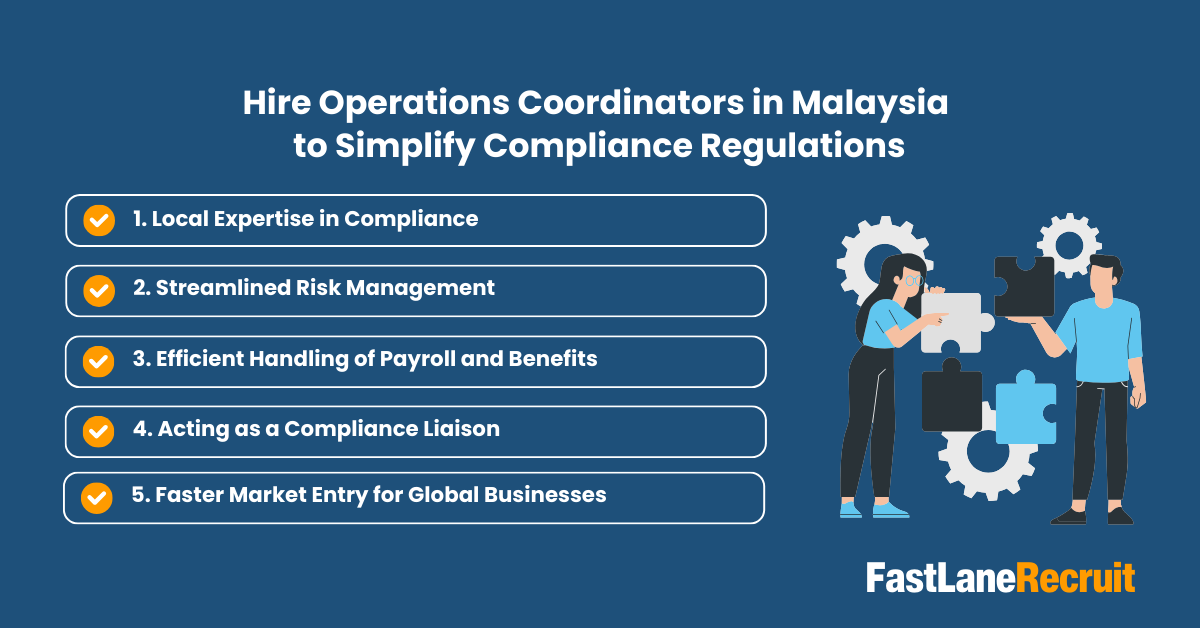
Hire Operations Coordinators in Malaysia to Simplify Compliance Regulations
Expanding your business in Malaysia requires careful navigation of corporate, labour, tax, and industry-specific regulations. Hiring skilled Operations Coordinators locally can help simplify compliance and ensure smooth operations. Here’s how:
1. Local Expertise in Compliance
Operations Coordinators understand Malaysian labour laws, statutory contributions (EPF, SOCSO, EIS), working hours, leave entitlements, and industry-specific requirements. By leveraging their knowledge, your business can:
- Avoid penalties for non-compliance
- Ensure timely filings of payroll, taxes, and statutory reports
- Maintain accurate employment records in line with regulatory requirements
2. Streamlined Risk Management
A local Operations Coordinator can monitor compliance across all departments, helping management:
- Identify potential operational and legal risks early
- Implement tracking systems for licensing, permits, and internal audits
- Ensure risk policies and procedures are consistently followed
3. Efficient Handling of Payroll and Benefits
Managing payroll and statutory benefits for employees in Malaysia can be complex. Operations Coordinators simplify this process by:
- Calculating accurate salaries and deductions
- Ensuring timely EPF, SOCSO, and EIS contributions
- Maintaining employee records and leave balances according to Employment Act 1955
4. Acting as a Compliance Liaison
Operations Coordinators serve as the bridge between your business and regulatory authorities like SSM, IRBM, BNM, SC, and PDPA. Their role helps ensure that:
- Annual filings, tax submissions, and sector-specific licenses are completed accurately
- Communication with authorities is prompt and efficient
- Internal audits and documentation meet statutory standards
5. Faster Market Entry for Global Businesses
Hiring local Operations Coordinators, especially through an Employer of Record (EOR) service like FastLaneRecruit, allows you to:
- Onboard qualified staff immediately without establishing a local entity
- Start operations while ensuring full compliance with Malaysian regulations
- Reduce administrative burden on your management team
Practical Tip: Even for small teams, having a dedicated Operations Coordinator ensures your company stays fully compliant with labor, tax, and industry regulations, minimizing risk and freeing leadership to focus on strategic growth.
Also Read: Recruiting Coordinator Salary Guide 2026
Why Consider FastLaneRecruit’s EOR Solution
Expanding your operations in Malaysia can be highly rewarding, but navigating the local regulatory and employment landscape can be complex, especially for global businesses. FastLaneRecruit’s EOR (Employer of Record) Service simplifies this process, allowing you to hire Malaysian talent quickly and compliantly.
1. Full Compliance with Local Labour Laws
FastLaneRecruit serves as the legal employer for your Malaysian operations coordinators, ensuring that all employment contracts, payroll, tax deductions, and statutory benefits comply with Malaysian laws. This includes:
- Employment Act 1955 requirements (working hours, leave entitlements, maternity/paternity leave, overtime pay)
- EPF, SOCSO, and EIS contributions
- Payroll tax reporting and filing
- Sector-specific regulatory compliance
By partnering with an EOR, you avoid the risk of non-compliance penalties and administrative errors, while still retaining strategic control over your team.
2. Streamlined Payroll and Benefits Administration
Managing payroll and benefits for international teams can be time-consuming. FastLaneRecruit handles:
- Accurate salary processing and deductions
- Timely remittance of statutory contributions
- Employee benefits administration and compliance reporting
This ensures your employees receive their salaries and benefits on time, boosting employee satisfaction and retention while reducing operational headaches.
3. Accelerated Market Entry
Hiring locally in Malaysia usually requires establishing a legal entity, which can take weeks or months. With FastLaneRecruit’s EOR service, you can:
- Onboard qualified Operations Coordinators immediately
- Begin business operations without waiting for entity registration
- Scale your Malaysian team flexibly as your business grows
4. Focus on Strategic Growth
By outsourcing compliance, payroll, and HR administration to FastLaneRecruit, your management team can focus on what matters most: growing your business, improving operations, and achieving strategic goals in Malaysia.
- Reduce administrative burden and internal resource allocation
- Maintain high operational efficiency and governance standards
- Gain peace of mind knowing all local employment and regulatory requirements are met
5. Trusted Expertise
FastLaneRecruit’s team has deep knowledge of Malaysian labour law, corporate governance, tax compliance, and sector-specific regulations. By leveraging our expertise, you can avoid common pitfalls that global businesses often encounter when hiring locally.
Practical Example:
A global company expanding its customer support operations in Kuala Lumpur can hire Malaysian Operations Coordinators through FastLaneRecruit’s EOR service within days, while we handle payroll, tax filings, benefits contributions, and employment law compliance, allowing the company to start operations immediately without creating a local entity.
Tip: Even if you plan to establish a local entity in the future, using an EOR initially allows your business to enter the market faster, test operational needs, and hire the right talent without long delays.
Conclusion
Operations management compliance in Malaysia covers corporate governance, labour laws, taxation, licensing, data privacy, and risk management. While navigating these requirements can seem daunting, proactive planning, proper monitoring, and leveraging external expertise, such as FastLaneRecruit’s EOR solution, can simplify the process and allow businesses to focus on growth.
By understanding regulatory expectations, implementing risk management frameworks, and maintaining accurate records, global employers can confidently expand in Malaysia while fostering a compliant, safe, and productive workplace.
Take the Stress Out of Compliance with FastLaneRecruit
Expanding your operations in Malaysia doesn’t have to be complicated. With FastLaneRecruit’s Employer of Record (EOR) solution, you can hire skilled Operations Coordinators quickly and confidently, while we handle all local compliance, payroll, taxes, and statutory benefits.
- Simplify employment compliance: Stay fully aligned with Malaysian labour laws, EPF, SOCSO, and EIS obligations.
- Reduce administrative burden: Let your team focus on strategic growth while we manage employee operations.
- Start operations faster: Onboard local talent immediately without the delays of entity registration.
Whether you’re scaling your team, testing the Malaysian market, or expanding existing operations, FastLaneRecruit ensures full regulatory compliance and smooth workforce management, so you can focus on growing your business.
Ready to streamline your Malaysian operations?
Get started with FastLaneRecruit’s EOR service today and take the first step toward compliant, efficient, and scalable operations.