Managing finances internally can be challenging, especially for small to mid-sized businesses or rapidly growing companies. Traditional in-house accounting, such as manual spreadsheets, siloed processes, and limited expertise, often slows down decision-making, increases costs, and adds risk.
Outsourcing accounting offers a smarter, flexible solution. It allows businesses to access experienced professionals, modern tools, and scalable services without the cost and overhead of a full internal finance team. But how do you know when the right time to outsource accounting is? This guide will answer that, outline the benefits, dispel common myths, and provide actionable tips for companies looking to optimize their financial operations.
Content Outline
Key Summary
Recognize the Right Time to Outsource
Rapid growth, cost constraints, or internal inefficiencies are signals your business may benefit from outsourcing accounting tasks.
Access Expert Financial Talent
Outsourced providers bring specialized skills across bookkeeping, payroll, tax compliance, FP&A, and strategic planning.
Reduce Costs Without Compromising Quality
Pay only for the services you need, avoiding full-time salaries, benefits, and infrastructure, while still receiving top-tier expertise.
Flexible and Scalable Services
Start small with bookkeeping or payroll and scale to full finance management, virtual CFO advisory, or advanced reporting as your business grows.
Enhanced Security, Accuracy, and Compliance
Reputable providers use modern cloud-based tools and follow global standards (SOC 2, ISO, GDPR) to ensure accurate reporting and secure data.
Seamless Integration with Your Team
Services like FastLaneRecruit’s EOR allow outsourced accountants to work alongside your internal staff, ensuring business continuity and strategic alignment.
What Is Outsourced Accounting?
Outsourced accounting is when a business hires an external team of finance experts to handle some or all of its accounting tasks instead of relying solely on an in-house team. These specialists can take care of everything from basic bookkeeping and payroll to more complex tasks like tax compliance, financial reporting, and strategic planning.
Think of it as having a ready-made finance department that you can tap into whenever your business needs it, without the cost and commitment of hiring full-time employees.
Key Advantages of Outsourced Accounting
- Access to Specialized Skills
Outsourced accountants bring experience across multiple areas, such as taxes, payroll, audits, or cash flow management. This means your business gets expert-level advice and support that would be expensive and time-consuming to build in-house. - Cost Efficiency
Instead of paying salaries, benefits, office space, and equipment for a full internal finance team, you pay only for the services you need. This helps businesses save money while still getting top-quality accounting support. - Flexible and Scalable Services
Outsourced accounting adapts to your business needs. For example, you can start with just bookkeeping and payroll, then scale up to financial reporting, forecasting, or even a virtual CFO as your business grows. This flexibility ensures you only pay for what you need, when you need it. - Enhanced Security, Accuracy, and Compliance
Reputable outsourced providers follow strict security standards, use modern accounting software, and implement thorough checks. This means your financial data is safe, reports are accurate, and regulatory requirements are met.
Integration With Your Existing Team
Outsourcing doesn’t mean you have to replace your internal staff. Instead, it works alongside your team. Modern providers, like FastLaneRecruit, can integrate seamlessly with your current processes, providing dedicated support and expertise while letting your internal team focus on core business activities.
In short, outsourced accounting is a smart, flexible, and cost-effective way to get expert financial management without the complexity of building a full in-house team.
Also Read: Offshore Vs Local: Accountants 2025 Salary Benchmark Report (Australia Vs Malaysia Edition)
How to Know When It’s the Right Time to Outsource Accounting
Deciding to outsource accounting isn’t about following a fixed rule; it’s about recognizing the signals your business is sending. Here are the key indicators that it might be time to bring in an outsourced finance team:
1. Rapid Growth or Contraction
If your business is growing quickly or facing periods of contraction, your accounting needs can change just as fast.
- Why it matters: Hiring a full-time team to match fluctuating workloads is expensive and inefficient.
- Practical Tip: Outsourced accountants can scale services up or down based on seasonal demands, such as managing increased payroll during peak sales periods or handling tax season requirements.
2. Focused Internal Team
Your core employees should spend their energy on revenue-generating work like product development, marketing, or customer service.
- Why it matters: Finance tasks can be time-consuming and distract from strategic goals.
- Practical Tip: Let an outsourced team handle bookkeeping, payroll, and reporting, while your internal team focuses on growth initiatives.
3. Cost Constraints
Hiring a full-time Finance Director or experienced accountants can be costly, especially for small and mid-sized businesses.
- Why it matters: Without outsourcing, you may end up stretching limited resources or overloading your CEO with financial duties.
- Practical Tip: Outsourcing gives access to top-level expertise at a fraction of the cost of full-time staff, without sacrificing quality.
4. Poor Financial Management
If you notice late reports, inaccurate data, or a lack of insights, it’s a sign your current accounting process isn’t keeping up with your business needs.
- Why it matters: Decisions made without timely and accurate data can put your business at risk.
- Practical Tip: Outsourced providers use cloud-based tools and standardized processes to deliver reliable, real-time reports that inform smart decision-making.
5. High Staff Turnover or Skills Shortage
When key accounting staff leave, knowledge and continuity are lost, creating gaps and delays.
- Why it matters: Small disruptions can snowball into missed deadlines, compliance risks, and financial errors.
- Practical Tip: Outsourced teams have multiple specialists covering each role, so transitions are seamless and operations continue without interruption.
6. Need for Operational Efficiency
If your finance team is bogged down by repetitive tasks or manual processes, it’s time to streamline operations.
- Why it matters: Inefficient accounting processes slow down reporting and decision-making.
- Practical Tip: Outsourced providers can automate routine tasks like payroll, invoicing, and reconciliations, freeing your team to focus on strategic activities.
Pro Tip: Outsourcing doesn’t mean replacing your team. You can start small, outsourcing tasks like bookkeeping or payroll, and gradually expand to full-service finance management as your business grows. This ensures you get the support you need without disrupting your existing operations.
Also Read: Building a High-Performing Offshore Accounting Team in Malaysia (Singapore Edition)
Why Businesses Outsource Accounting
Outsourced accounting is no longer just a cost-saving tool; it’s a strategic solution that helps businesses operate smarter, faster, and more efficiently. Here are the main reasons companies choose to outsource their finance functions, along with practical examples and tips:
| Benefit | What It Means | Example / Tip |
| Reduced Costs | Instead of paying full-time salaries, benefits, and office overhead for an in-house finance team, you only pay for the services you actually need. | A company outsourcing bookkeeping to Malaysia can lower operational costs significantly while still accessing highly skilled professionals. |
| Access to Expertise | Outsourced accounting teams bring diverse experience, industry-specific knowledge, and up-to-date understanding of tax laws, compliance, and modern accounting tools. | Hire a virtual CFO or tax specialist to guide strategy, optimize deductions, or manage complex reporting without hiring a full-time executive. |
| Scalability | Outsourced services can grow or shrink with your business. Start small with bookkeeping and payroll, and expand to financial reporting, FP&A, or strategic planning as needed. | Scale finance support during busy tax seasons or when launching new products without the stress of recruiting extra in-house staff. |
| Standardization & Accuracy | Expert providers streamline processes, implement standardized workflows, and use modern cloud-based accounting systems. This reduces errors, speeds up reporting, and ensures consistency. | Real-time dashboards allow managers to track cash flow and performance instantly instead of waiting weeks for reports. |
| Fraud Prevention & Security | Experienced outsourced teams implement controls, checks, and audit-ready processes to minimize financial risks. They often follow global security standards like SOC 2 or ISO 27001. | A Malaysian outsourcing provider ensures that sensitive data is encrypted, access is controlled, and financial reporting is reliable. |
| Seamless Turnover & Continuity | When an internal accountant leaves, knowledge and processes may go with them. Outsourced teams maintain continuity with shared documentation and multiple specialists for each role. | If one accountant becomes unavailable, another team member can immediately take over without interrupting operations. |
| Focus on Core Business | Internal teams can focus on revenue-generating work, like product development, sales, and customer service, instead of repetitive finance tasks. | Free your staff from tasks like payroll processing, invoice reconciliation, or month-end reporting, allowing them to drive growth. |
Key Takeaway: Outsourcing accounting is about more than cost savings. It provides expertise, reliability, flexibility, and efficiency that can help businesses scale, maintain accurate financial records, and focus on what truly drives growth.
Common Services in Outsourced Accounting
Outsourced accounting providers offer a wide range of services that go far beyond basic bookkeeping. These services are designed to help businesses run smoothly, stay compliant, and make smarter financial decisions. Here’s a breakdown of the most common services and how they can benefit your business:
| Service | What It Does | Practical Example / Tip |
| Bookkeeping & Transaction Management | Maintains accurate, up-to-date records of every financial transaction, including invoices, payments, and receipts. | A Malaysian outsourced team can reconcile accounts daily, ensuring your cash flow is always clear and accurate. This helps in preparing monthly financial summaries quickly. |
| Payroll Processing | Ensures employees are paid on time, taxes are withheld correctly, and compliance with labor laws is maintained. | Outsourcing payroll means your team doesn’t have to track employee hours, deductions, or compliance updates manually. Providers can handle complex payroll structures across multiple regions. |
| Tax Preparation & Compliance | Manages filing deadlines, tax calculations, and deductions while ensuring compliance with local and international tax regulations. | A provider can prepare tax returns for your business in Malaysia, claim eligible deductions, and avoid costly penalties for missed deadlines. |
| Accounts Payable & Receivable | Manages invoices, bills, and customer payments to optimize cash flow and reduce delays. | Outsourced teams can automate reminders for overdue invoices or schedule supplier payments, helping maintain positive cash flow and good vendor relationships. |
| Financial Reporting | Produces accurate financial statements, dashboards, and management reports to guide business decisions. | Monthly or quarterly reports help CEOs, investors, and stakeholders understand profitability, expenses, and cash flow trends. |
| FP&A (Financial Planning & Analysis) | Provides budgeting, forecasting, and scenario analysis to guide strategic growth decisions. | Outsourced specialists can create multi-year financial forecasts to help your business plan for expansions, new product launches, or fundraising rounds. |
| Virtual CFO Advisory | Offers strategic guidance on finances, investments, and long-term planning without the cost of a full-time CFO. | A virtual CFO can advise on cost reduction strategies, risk management, or business growth opportunities, providing expert insights for informed decisions. |
Key Takeaway: Outsourced accounting is flexible and customizable. You can start with basic bookkeeping and payroll, then add more advanced services like FP&A or virtual CFO advisory as your business grows. This ensures you pay only for what you need while accessing top-tier financial expertise.
Also Read: Building a High-Performing Offshore Accounting Team in Malaysia (Hong Kong Edition)
Common Myths About Outsourced Accounting
Despite its growing popularity, some business owners still have concerns about outsourcing their accounting. Let’s break down the most common myths and clarify the reality:
| Myth | Reality | Practical Example / Tip |
| Outsourcing Means Losing Control | Modern outsourced providers use cloud-based accounting tools that give you real-time visibility. You decide who can access data, what reports are generated, and when. | Even if your outsourced team is handling daily bookkeeping or payroll, you can log in anytime to see live financial data. This is often more control than with in-house staff. |
| Only for Large Corporations | Outsourcing is actually ideal for small and mid-sized businesses that want expert support without the cost of a full internal finance team. | A five-person startup can outsource bookkeeping, while a 50-person company can outsource tax compliance and financial reporting. Packages are flexible to fit any business size. |
| Data Isn’t Safe | Reputable providers follow strict security standards, including SOC 2, ISO 27001, and GDPR compliance. Financial data is encrypted, access is controlled, and backups are secure. | Using an outsourced provider can make your data safer than an internal system managed by a small team with limited IT resources. |
| Communication Will Be Difficult | Providers assign dedicated account managers and use structured workflows along with modern collaboration tools to ensure smooth communication. | You can schedule weekly check-ins, receive monthly reports, or even get on-demand updates—no miscommunication or delays. |
| Quality Is Affected | Outsourced accounting is handled by experts with experience across industries, which improves accuracy, consistency, and reporting quality. | Instead of relying on one internal accountant juggling multiple roles, you get specialized professionals for bookkeeping, tax compliance, FP&A, or virtual CFO services. This reduces errors and enhances financial insights. |
Key Takeaway: Most fears about outsourcing come from outdated assumptions. With the right provider, businesses gain better control, higher-quality reports, stronger data security, and smoother communication, all while saving costs and accessing expertise they might not afford in-house.
Also Read: Building a High-Performing Offshore Accounting Team in Malaysia (Australia Edition)
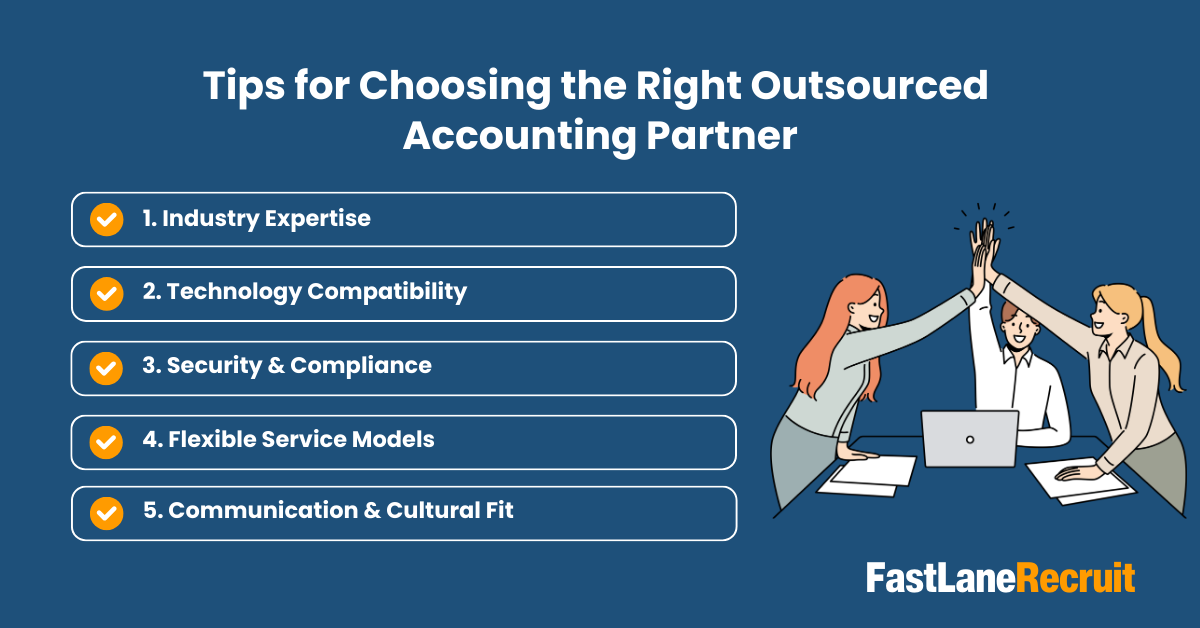
Tips for Choosing the Right Outsourced Accounting Partner
Selecting the right outsourced accounting provider can make a huge difference in the success of your partnership. Here are some key factors to consider, along with practical tips to help you make the best choice:
1. Industry Expertise
Not all accounting providers are equally experienced in every industry. Choose a partner who understands your sector and its unique financial challenges.
- Why it matters: Industry-specific knowledge ensures compliance with regulations and allows for more insightful financial advice.
- Practical Tip: Ask for case studies or references from businesses similar to yours. For example, if you’re in e-commerce, a provider familiar with inventory management and online sales tax is ideal.
2. Technology Compatibility
Your accounting provider should integrate smoothly with your existing software, whether it’s QuickBooks, Xero, NetSuite, or other ERP systems.
- Why it matters: Smooth integration saves time, reduces errors, and ensures data flows seamlessly between systems.
- Practical Tip: Confirm in advance that the provider can connect with your accounting tools and offer cloud-based dashboards for real-time insights.
3. Security & Compliance
Financial data is highly sensitive, so your provider must follow strict security protocols and comply with standards like SOC 2, ISO 27001, and GDPR.
- Why it matters: Protecting your data prevents breaches, fraud, and compliance penalties.
- Practical Tip: Ask about encryption, user access controls, backup procedures, and audit-ready reporting. A reputable provider should be transparent about their security practices.
4. Flexible Service Models
Look for a provider who can start small and scale their services as your business grows.
- Why it matters: Your accounting needs will change over time, and flexibility prevents overpaying or under-supporting your business.
- Practical Tip: Begin with basic services like bookkeeping or payroll, then expand to tax compliance, financial reporting, or even virtual CFO services as needed.
5. Communication & Cultural Fit
Strong communication is critical for smooth collaboration. Your provider should assign dedicated account managers who understand your workflow, time zone, and business culture.
- Why it matters: Misaligned expectations or slow communication can cause delays, errors, and frustration.
- Practical Tip: Set expectations upfront about reporting frequency, meetings, and preferred communication channels. Providers that align with your business culture often feel like an extension of your internal team.
Key Takeaway: Choosing the right outsourced accounting partner is about more than cost. Focus on expertise, technology, security, flexibility, and communication. The right partner can streamline operations, reduce risks, and provide strategic insights, all while seamlessly supporting your internal team.
Why Consider Malaysian Outsourcing
Malaysia has become a popular destination for businesses looking to outsource accounting. The country offers a combination of skilled professionals, advanced technology, and operational efficiency that makes it an attractive choice for global companies. Here’s why:
1. Skilled, English-Proficient Professionals
Malaysia has a large pool of accounting and finance professionals who are proficient in English and familiar with international accounting standards.
- Why it matters: Clear communication and knowledge of global practices reduce errors, ensure compliance, and make collaboration smooth for businesses operating internationally.
- Example: Your outsourced accountant can handle multi-currency transactions, cross-border tax compliance, or prepare reports in line with IFRS standards.
2. Advanced Technology Adoption
Many Malaysian outsourcing providers leverage cloud-based accounting tools and modern ERP systems.
- Why it matters: Real-time reporting, secure dashboards, and automated processes make financial data more accessible and accurate, improving decision-making.
- Example: Using cloud software, managers can monitor cash flow, payroll, and financial reports from anywhere, at any time.
Also Read: Types Of Accounting Services That Can Be Outsourced
3. Operational Efficiency
Outsourcing to Malaysia can reduce operational costs without compromising quality. Businesses pay only for the services they need, avoiding the overhead of full-time salaries, benefits, and office infrastructure.
- Why it matters: Cost optimization frees up resources for strategic initiatives, growth, and innovation.
- Example: Instead of hiring a full in-house team, a company can outsource bookkeeping, payroll, and tax compliance, while keeping high-level financial strategy in-house.
4. FastLaneRecruit’s EOR Service: A Seamless Solution
FastLaneRecruit’s Employer of Record (EOR) service makes Malaysian outsourcing easy and risk-free. With an EOR:
- You can hire Malaysian accountants without setting up a local legal entity.
- Payroll, taxes, compliance, and HR administration are managed by FastLaneRecruit, letting you focus on your business.
- Teams integrate seamlessly with your internal staff, providing full support for bookkeeping, payroll, reporting, and strategic finance functions.
Practical Tip: Companies can start by outsourcing select tasks, like payroll and tax compliance through FastLaneRecruit’s EOR service, then scale up to include full finance and accounting support as their business grows. This ensures you get expert support while keeping control of strategic decisions in-house.
Outsourcing to Malaysia offers skilled talent, technology-driven efficiency, and cost-optimized solutions. Using FastLaneRecruit’s EOR service allows businesses to access Malaysian accounting experts seamlessly, simplify compliance, and focus on growth, all without the complexity of setting up a local office.
Also Read: How to Hire an Offshore Accountant in Malaysia
Conclusion
Outsourced accounting is more than cost savings; it’s a strategic solution to streamline operations, improve financial visibility, and support business growth. Whether your company is scaling, managing limited internal resources, or seeking better accuracy and compliance, outsourcing provides the expertise and flexibility that in-house teams alone may not achieve.
For businesses looking to leverage Malaysian accounting talent without the hassle of direct employment, FastLaneRecruit’s EOR service offers a seamless solution. You gain access to skilled accountants, scalable support, and compliant operations, all integrated with your business goals.
Explore FastLaneRecruit’s EOR service today to outsource your accounting tasks to experienced Malaysian professionals while keeping your internal team focused on core business growth. Book a FREE consultation to get started.