
As Singapore continues to grow as a central business hub in Asia, companies are embracing hybrid work and hiring people across borders. That’s why collaboration tools matter more than ever. The right software helps teams talk to each other, manage projects, and share files without confusion or delay. In this article, we’ll walk you through the Top 15 collaboration tools that Singapore companies use most, especially those that support remote and distributed work environments.
Content Outline
Key Summary
Understanding Collaboration Software
Collaboration tools provide a shared digital workspace for communication, task management, file sharing, and real-time project tracking.
Top 15 Tools for Singapore Companies
Leading platforms like Microsoft Teams, Google Workspace, Slack, Asana, and Jira help teams stay aligned, productive, and compliant across locations.
Importance for Remote and Offshore Teams
Tools enable Singapore-based companies to manage remote and offshore teams in Malaysia, India, or other regional hubs effectively.
Compliance and Data Security
Collaboration platforms support secure information sharing and help organisations align with Singapore’s PDPA and other regulatory requirements.
Choosing the Right Tool
When selecting software, consider integration with existing systems, scalability, remote team support, and data security.
Example Setup for Offshore Teams
A typical workflow combines Slack or Teams for communication, Jira or ClickUp for task tracking, and Google Workspace or OneDrive for document collaboration.
When Tools Aren’t Enough: EOR Solution
FastLaneRecruit’s EOR service handles payroll, taxes, statutory compliance, and legal employment in Malaysia, letting teams focus on collaboration and productivity.
What Is Collaboration Software?
Collaboration software is a digital platform that brings teams together in one shared workspace. Instead of relying on scattered emails, spreadsheets, or messaging apps, these tools allow employees to communicate, manage tasks, share files, and track progress in real time, all from a single system.
Whether team members are working from the same office, remotely, or across different countries, collaboration software ensures everyone stays aligned, informed, and productive.
For companies operating in Singapore, collaboration tools are especially important because they support modern work models and strict compliance standards. These tools play a key role in:
Managing Remote and Offshore Teams
Many Singapore-based companies work with offshore teams in countries like Malaysia or India. Collaboration software helps bridge distance by enabling real-time communication, clear task ownership, and visibility into project progress, reducing misunderstandings and delays.
Also Read: Building a High-Performing Offshore Accounting Team in Malaysia (Singapore Edition)
Supporting Hybrid Work Policies
With hybrid work becoming standard across Singapore, collaboration platforms allow employees to work seamlessly between home and office. Teams can access the same documents, attend virtual meetings, and collaborate without disruption, regardless of where they are based.
Ensuring Secure Data Sharing and Compliance
Singapore has strict data protection requirements under the Personal Data Protection Act (PDPA). Most enterprise-grade collaboration tools offer features such as access controls, permission settings, data encryption, and audit logs to help businesses share information securely while staying compliant.
Top 15 Collaboration Tools Used by Singapore Companies
1. Microsoft Teams
Best for: Enterprises and Microsoft-centric teams
Microsoft Teams is one of the most widely used collaboration platforms among Singapore-based businesses, especially those already using Microsoft 365. It brings together team chat, video meetings, file sharing, and workflow automation in one secure environment. Teams integrates seamlessly with Outlook, SharePoint, OneDrive, and Microsoft Office apps, making it a strong choice for organizations that prioritize compliance, structured communication, and centralized data management.
Why Singapore companies use it: Strong security controls, enterprise-grade compliance features, and familiarity across corporate teams.
Official site: https://www.microsoft.com/microsoft-teams
2. Google Workspace
Best for: Cloud-first, fast-moving teams
Google Workspace provides a fully cloud-based collaboration ecosystem that includes Gmail, Google Docs, Sheets, Slides, Drive, and Google Meet. Teams can collaborate on documents in real time, leave comments, and track version history without needing multiple tools. It is especially popular among startups and regional teams across Southeast Asia due to its simplicity and ease of access.
Why Singapore companies use it: Real-time collaboration, minimal setup, and easy cross-border teamwork.
Official site: https://workspace.google.com
3. Slack
Best for: Real-time communication and integrations
Slack is designed for fast, transparent communication. It organizes conversations into channels, making it easier for teams to collaborate by project, department, or client. Slack also integrates with hundreds of third-party tools such as Jira, Google Drive, Zoom, and GitHub, making it a favorite among technology and product-driven companies.
Why Singapore companies use it: Ideal for managing outsourced developers and offshore support teams through instant communication and automation.
Official site: https://slack.com
Also Read: The Ultimate Playbook for Building and Integrating Offshore Teams (Singapore Edition)
4. Asana
Best for: Task and workflow management
Asana helps teams plan, organize, and track work from start to finish. Users can create tasks, assign responsibilities, set deadlines, and visualize progress through lists, timelines, or boards. It is commonly used by marketing, operations, and cross-functional teams that need clear accountability and structured workflows.
Why Singapore companies use it: Improves visibility and alignment across teams working in different locations.
Official site: https://asana.com
5. monday.com
Best for: Customizable project workflows
monday.com is a highly flexible work management platform that allows teams to build workflows tailored to their needs. With customizable boards, dashboards, and automation, it supports everything from project tracking to HR onboarding and sales operations.
Why Singapore companies use it: Adaptable for different departments and scalable as teams grow regionally.
Official site: https://monday.com
6. ClickUp
Best for: All-in-one work management
ClickUp combines tasks, documents, goals, time tracking, and collaboration into a single platform. This makes it attractive to growing teams that want to reduce tool sprawl and keep everything in one place. It supports multiple work views, allowing teams to choose how they track progress.
Why Singapore companies use it: Cost-effective, feature-rich, and suitable for scaling teams.
Official site: https://clickup.com
7. Confluence
Best for: Knowledge management and documentation
Confluence is designed to help teams create, organize, and share internal knowledge. It is commonly used to document processes, standard operating procedures (SOPs), and internal guidelines. When paired with Jira, it becomes a powerful tool for technical and operational documentation.
Why Singapore companies use it: Keeps knowledge centralized for distributed and outsourced teams.
Official site: https://www.atlassian.com/software/confluence
8. Jira
Best for: Agile and software development teams
Jira is a leading project tracking tool for agile and software development teams. It supports sprint planning, bug tracking, and roadmap management, making it ideal for engineering teams working across borders.
Why Singapore companies use it: Strong support for agile workflows and outsourced development teams in the region.
Official site: https://www.atlassian.com/software/jira
Also Read: Build Your Offshore Marketing Team in Malaysia (Singapore Edition)
9. Zoom Workplace
Best for: Video meetings and hybrid work
Zoom Workplace expands beyond video conferencing to include chat, scheduling, and collaboration features. It is widely used for internal meetings, client calls, and cross-border communication.
Why Singapore companies use it: Reliable video quality and ease of use for hybrid and remote teams.
Official site: https://www.zoom.com
10. Trello
Best for: Visual task management
Trello uses boards, lists, and cards to help teams organize tasks visually. Its simple interface makes it easy for non-technical teams to get started quickly, especially for smaller projects or teams.
Why Singapore companies use it: Lightweight and intuitive for quick collaboration.
Official site: https://trello.com
11. Dropbox Business
Best for: Secure file sharing
Dropbox Business provides cloud storage with secure file sharing, version control, and collaboration features. It is often used when teams need to share documents with external partners, vendors, or clients.
Why Singapore companies use it: Reliable file access across devices and locations.
Official site: https://www.dropbox.com/business
12. OneDrive
Best for: Microsoft-based file collaboration
OneDrive integrates directly with Microsoft 365, allowing teams to store, share, and collaborate on files securely. It supports access controls and version history, making it suitable for regulated industries.
Why Singapore companies use it: Seamless integration with Microsoft tools and strong data governance.
Official site: https://www.microsoft.com/onedrive
13. Basecamp
Best for: Simple, structured collaboration
Basecamp focuses on simplicity by keeping communication, tasks, and files in one place without complex features. It suits teams that want structure without the overhead of advanced project management tools.
Why Singapore companies use it: Clear communication and fewer distractions for small teams.
Official site: https://basecamp.com
14. Webex Suite
Best for: Enterprise-grade communication
Webex Suite offers secure messaging, meetings, and calling capabilities designed for large organizations. It is often used by enterprises that prioritize security, compliance, and reliability.
Why Singapore companies use it: Strong security features and enterprise-level controls.
Official site: https://www.webex.com
15. Zoho Projects
Best for: Budget-conscious teams
Zoho Projects delivers project management and collaboration features at competitive pricing. It integrates well with other Zoho applications, making it a good choice for small and mid-sized businesses.
Why Singapore companies use it: Cost-effective solution with solid functionality for growing teams.
Official site: https://www.zoho.com/projects
Also Read: Building a High-Performing Offshore IT Team in Malaysia (Singapore Edition)
Summary Table: Collaboration Tools at a Glance
| Tool | Best For | Team Size For | Core Use Case |
| Microsoft Teams | Enterprise | Mid–Large | Internal communication |
| Google Workspace | Cloud teams | Small–Large | Docs & collaboration |
| Slack | Tech teams | Small–Mid | Messaging & integrations |
| Asana | Ops & marketing | Small–Mid | Task management |
| monday.com | Custom workflows | Small–Large | Project tracking |
| ClickUp | Scaling teams | Small–Mid | All-in-one workspace |
| Jira | Developers | Mid–Large | Agile project tracking |
How to Choose the Right Collaboration Tool in Singapore
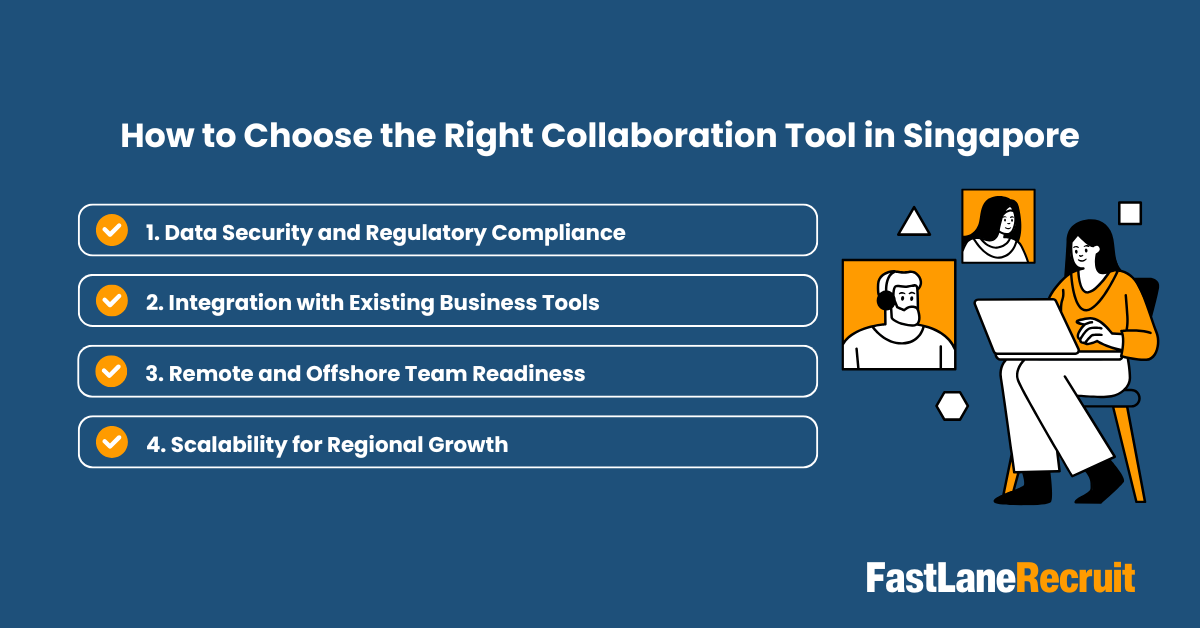
Choosing the right collaboration software is not just about features; it’s about ensuring your tools support compliance, productivity, and long-term growth. For companies operating in Singapore or managing teams across borders, the following factors are especially important.
1. Data Security and Regulatory Compliance
Singapore enforces strict data protection standards under the Personal Data Protection Act (PDPA). When evaluating collaboration tools, ensure the platform offers enterprise-grade security features such as role-based access controls, data encryption, audit logs, and administrative oversight. These features help protect sensitive business and employee data while ensuring compliance with local regulations.
Companies operating in regulated industries or handling personal data should also review where data is stored and how it is processed, as this can impact compliance obligations.
2. Integration with Existing Business Tools
A collaboration platform should work seamlessly with your existing technology stack. This includes payroll systems, HR platforms, CRM tools, accounting software, and development tools. Strong integrations reduce manual work, prevent data silos, and improve workflow efficiency.
For example, connecting collaboration tools with HR or payroll systems helps onboarding, approvals, and reporting run more smoothly, especially for remote or offshore employees.
3. Remote and Offshore Team Readiness
Many Singapore-based companies work with offshore teams in Malaysia, India, or other regional markets. Your collaboration tools should support distributed teams without friction by offering cloud-based access, mobile compatibility, reliable performance across time zones, and clear communication features.
Look for tools that support real-time updates, asynchronous collaboration, and multilingual environments so offshore teams can contribute effectively regardless of location or working hours.
4. Scalability for Regional Growth
As your business grows, your collaboration tools should be able to scale with you. This means supporting more users, additional teams, and more complex workflows without sacrificing performance or usability.
Scalable platforms allow companies to start small and expand gradually as they enter new markets or hire more employees across Southeast Asia. Choosing a flexible tool early helps avoid costly migrations later.
Example: Managing an Outsourced Team in Malaysia
Many Singapore-based companies choose to hire or build offshore teams in Malaysia due to strong technical skills, geographic proximity, and regional familiarity. However, managing an offshore team effectively requires the right combination of collaboration tools to maintain visibility, accountability, and smooth communication.
A typical setup for a Singapore company working with offshore or remote teams in Malaysia might look like this:
Daily Communication: Slack or Microsoft Teams
Slack or Microsoft Teams is commonly used for day-to-day communication between Singapore and Malaysia-based teams. These tools allow teams to organize conversations by project or function, reduce reliance on email, and enable quick decision-making through real-time chat, voice calls, and video meetings.
They also support asynchronous communication, which is helpful when teams are working slightly different hours or across multiple time zones.
Task and Project Tracking: Jira or ClickUp
To manage workloads and track progress, companies often rely on Jira or ClickUp. These platforms help define tasks, assign responsibilities, set deadlines, and monitor progress through dashboards and reports.
For software development teams, Jira supports agile methodologies such as sprint planning and bug tracking. ClickUp, on the other hand, offers flexibility for both technical and non-technical teams, making it suitable for broader project management needs.
Document Collaboration: Google Workspace or OneDrive
Shared documents, technical specifications, and internal guidelines are typically managed through Google Workspace or OneDrive. These platforms enable real-time document editing, version control, and secure access, ensuring everyone works from the most up-to-date information.
They are especially useful for onboarding offshore team members, sharing SOPs, and maintaining consistent documentation across borders.
Why This Setup Works
This combination of tools creates a structured yet flexible collaboration environment. Communication stays clear, tasks remain transparent, and documents are centralized, helping Singapore-based managers maintain control while allowing Malaysian teams to work independently and efficiently.
When paired with a compliant hiring or EOR solution, this setup allows companies to scale offshore teams with confidence while minimizing operational friction.
When Collaboration Tools Are Not Enough: Consider a Smarter Alternative with FastLaneRecruit’s EOR Service
Collaboration tools are essential for managing day-to-day work. They help teams communicate, track tasks, and share documents efficiently across borders. However, even the best collaboration software does not address the legal and administrative side of hiring offshore employees.
When a company in Singapore hires employees or builds offshore teams in another country, such as Malaysia, it must still comply with local employment laws. These responsibilities exist regardless of how well teams collaborate online.
That’s where an Employer of Record (EOR) becomes a smarter, lower-risk solution.
What Is an Employer of Record (EOR)?
An EOR is a third-party organization that legally employs workers on your behalf in a foreign country. While your company manages the employee’s daily tasks and performance, the EOR handles all employment-related compliance and administration.
FastLaneRecruit acts as the legal employer in Malaysia, allowing you to hire talent there without setting up a local entity.
How FastLaneRecruit’s EOR Service Helps
If you’re hiring employees or building offshore teams in Malaysia, FastLaneRecruit’s EOR service enables you to:
- Hire legally without establishing a local company
Avoid the time, cost, and complexity of setting up a Malaysian entity while still hiring top local talent. - Stay compliant with Malaysian labor laws
FastLaneRecruit manages employment contracts, working hours, leave entitlements, and termination processes in accordance with Malaysian regulations. - Manage payroll, taxes, and statutory contributions
All payroll processing, income tax deductions, and statutory payments are handled accurately and on time. - Focus on productivity and growth
Your internal teams can focus on collaboration, delivery, and performance while FastLaneRecruit manages compliance and administration behind the scenes.
Example: Combining Collaboration Tools with an EOR Model
A Singapore-based technology company wants to hire three software developers in Malaysia to support product development. The company uses:
- Slack for daily communication
- Jira for sprint planning and task tracking
- Google Workspace for documentation and collaboration
While these tools enable smooth collaboration, the company still faces challenges around employment contracts, payroll processing, and statutory compliance in Malaysia.
By partnering with FastLaneRecruit’s EOR service, the company can:
- Onboard Malaysian developers quickly and legally
- Ensure payroll, taxes, and statutory contributions are fully compliant
- Scale the team without opening a Malaysian entity
- Maintain seamless collaboration using existing tools
This approach reduces risk, speeds up hiring, and allows leadership to focus on product delivery rather than administrative complexity.
Also Read: Building a High-Performing Offshore HR and Payroll Management Team in Malaysia (Singapore Edition)
Scale with Confidence
Collaboration tools power how work gets done, but FastLaneRecruit’s EOR service ensures your hiring is compliant, efficient, and scalable. Together, they form a complete solution for managing offshore teams in Malaysia.
Explore FastLaneRecruit’s EOR solution to build and manage your regional workforce with confidence and compliance.
Conclusion
Collaboration tools are the backbone of modern work for Singapore-based companies operating globally. Whether you’re managing internal teams or remote employees in Malaysia, the right tools enable clarity, speed, and alignment.
However, true operational success comes from pairing the right collaboration stack with the right employment structure. By combining powerful collaboration software with FastLaneRecruit’s EOR services, businesses can scale across borders efficiently, without unnecessary risk.
Also Read: Building a High-Performing Offshore Sales Team in Malaysia (Singapore Edition)
Hire in Malaysia Easily with FastLaneRecruit’s EOR Solution
If you’re planning to hire talent in Malaysia, FastLaneRecruit’s Employer of Record (EOR) service makes cross-border expansion simple and compliant. We handle local employment, payroll, taxes, and statutory obligations, so you can focus on building high-performing teams using the collaboration tools you already trust.
Partner with FastLaneRecruit to hire legally, reduce risk, and scale your workforce in Malaysia without setting up a local entity. Talk to FastLaneRecruit today and discover a smarter way to grow your team.