

Malaysia vs Global Markets
Software Developers are the builders of modern digital ecosystems. From web and mobile applications to AI-driven platforms and secure cloud-native systems, they power innovation across industries. As companies accelerate digital transformation, demand for skilled developers continues to rise globally.
In 2026, Software Developers typically earn between USD 25,000 and USD 120,000 annually, depending on region, specialization, and seniority. Malaysia offers highly skilled developer talent with approximately 55–60% payroll efficiency compared to Western markets, while maintaining strong technical and delivery standards.
This guide compares 2026 salary benchmarks across Malaysia, the USA, Singapore, Hong Kong, and Australia to help employers plan hiring strategies and payroll budgets more effectively.
Content Outline
Key Summary
Malaysia Offers Cost-Effective Developer Talent
Software Developers earn MYR 110,000–180,000 annually (USD 25,000–40,000), positioning Malaysia as a high-value destination for offshore software development.
USA Pays Top Dollar
Senior Developers earn USD 100,000–120,000, especially in enterprise SaaS, fintech, and AI-driven companies.
Singapore Offers Competitive Packages
Salaries range from SGD 80,000–140,000 (USD 60,000–105,000), driven by demand in fintech, cybersecurity, and digital transformation.
Hong Kong Salaries Are Moderate
Developers earn HKD 350,000–600,000 (USD 45,000–77,000), driven by strong demand in finance, logistics, and e-commerce.
Australia Rewards Experience
Salaries range from AUD 95,000–140,000+ (USD 63,000–93,000+), especially in government, healthcare, and enterprise IT.
Outsourcing to Malaysia Maximizes ROI
Employers achieve around 55–60% payroll efficiency while accessing English-speaking, cloud-native, and certified developer talent.
Software Developer Salary Breakdown by Country (2026)
Malaysia
Malaysia’s developer talent is known for strong English proficiency, full-stack expertise, and certifications in cloud and agile frameworks.
| Level | Salary (MYR) | Salary (USD) |
| Entry (0–2 yrs) | 110,000–130,000 | 25,000–29,000 |
| Mid (3–5 yrs) | 140,000–160,000 | 32,000–36,000 |
| Senior (6+ yrs) | 170,000–180,000 | 38,000–40,000 |
Market Insight: Malaysia provides scalable developer talent with strong payroll efficiency compared to Western markets.
United States
| Level | Salary (USD) |
| Entry (0–2 yrs) | 70,000–85,000 |
| Mid (3–5 yrs) | 90,000–100,000 |
| Senior (6+ yrs) | 105,000–120,000 |
Market Insight: High salaries reflect demand for AI, cloud-native, and cybersecurity-driven development.
Singapore
| Level | Salary (SGD) | Salary (USD) |
| Entry (0–2 yrs) | 80,000–95,000 | 60,000–71,000 |
| Mid (3–5 yrs) | 110,000–125,000 | 82,000–94,000 |
| Senior (6+ yrs) | 130,000–140,000+ | 97,000–105,000+ |
Market Insight: Developers with fintech, SaaS, and cybersecurity expertise command premium pay.
Hong Kong
| Level | Salary (HKD) | Salary (USD) |
| Entry (0–2 yrs) | 350,000–420,000 | 45,000–54,000 |
| Mid (3–5 yrs) | 450,000–520,000 | 58,000–67,000 |
| Senior (6+ yrs) | 550,000–600,000 | 71,000–77,000 |
Market Insight: Developers gain exposure to multilingual environments and compliance-heavy industries.
Australia
| Level | Salary (AUD) | Salary (USD) |
| Entry (0–2 yrs) | 95,000–105,000 | 63,000–70,000 |
| Mid (3–5 yrs) | 115,000–125,000 | 76,000–83,000 |
| Senior (6+ yrs) | 135,000–140,000+ | 89,000–93,000+ |
Market Insight: Specialists with cloud, DevOps, and AI-driven development experience are in high demand.
Also Read: Outsourcing IT Support Specialists: Cost Savings & Service Quality
Comparing Software Developer Salaries Across Countries
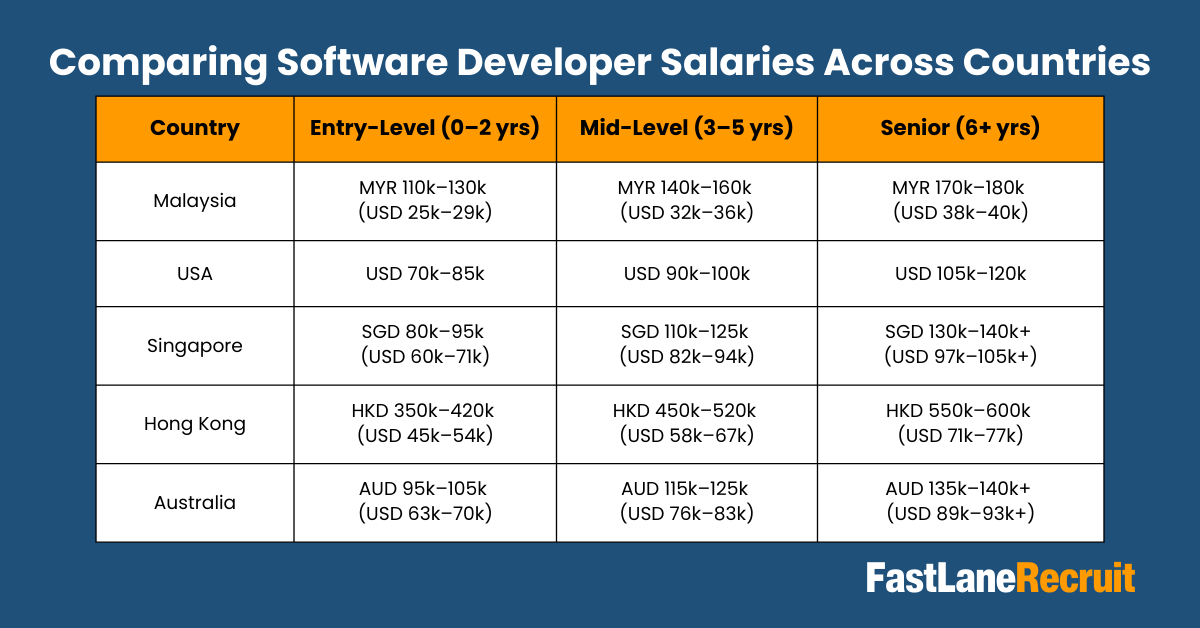
| Country | Entry-Level (0–2 yrs) | Mid-Level (3–5 yrs) | Senior (6+ yrs) |
| Malaysia | MYR 110k–130k (USD 25k–29k) | MYR 140k–160k (USD 32k–36k) | MYR 170k–180k (USD 38k–40k) |
| USA | USD 70k–85k | USD 90k–100k | USD 105k–120k |
| Singapore | SGD 80k–95k (USD 60k–71k) | SGD 110k–125k (USD 82k–94k) | SGD 130k–140k+ (USD 97k–105k+) |
| Hong Kong | HKD 350k–420k (USD 45k–54k) | HKD 450k–520k (USD 58k–67k) | HKD 550k–600k (USD 71k–77k) |
| Australia | AUD 95k–105k (USD 63k–70k) | AUD 115k–125k (USD 76k–83k) | AUD 135k–140k+ (USD 89k–93k+) |
Why These Salaries Differ
Software Developer salaries vary widely across regions, and compensation is driven by more than just technical skills. Factors such as cost of living, industry demand, specialization, and remote work trends all shape compensation levels. Below are the key factors that drive these salary differences.
1. Cost of Living
High salaries in countries like the U.S. and Singapore often reflect the steep cost of living rather than purely higher skill levels.
- United States & Singapore: A senior developer in San Francisco may earn USD 115,000 annually, but with rent and living expenses exceeding USD 4,000 per month, much of that income is absorbed. Similarly, in Singapore, developers earning SGD 130,000 face high housing and healthcare costs.
- Malaysia: By contrast, a mid-level developer earning USD 34,000 in Kuala Lumpur enjoys stronger purchasing power due to lower housing, transportation, and healthcare costs. This means employers can offer competitive packages without inflating payroll budgets.
Tip for Employers: Use location-adjusted salary frameworks to stay competitive while managing payroll effectively.
2. Industry Demand
Certain industries pay a premium for developer talent due to the complexity and business-critical nature of their systems.
- Fintech & SaaS: Developers in fintech firms often earn 20–30% more due to the need for secure coding, compliance with financial regulations, and real-time transaction systems.
- AI & Cybersecurity: In the U.S. and Singapore, developers specializing in AI-driven applications or cybersecurity frameworks command top-tier salaries.
- Logistics & Retail: Developers in logistics or retail may earn closer to average benchmarks, as their systems focus more on scalability and user experience rather than compliance-heavy environments.
Example: A developer at a fintech company in Singapore may earn USD 100,000, while a peer in retail earns closer to USD 70,000.
Tip for Employers: Prioritize domain-specific experience when hiring for regulated or high-uptime industries.
3. Skill Specialization
Not all developers are compensated at the same level. Salaries are closely tied to certifications, frameworks, and platform expertise.
- High-value skills: cloud-native development (AWS, Azure, Google Cloud), cybersecurity, and automation (CI/CD pipelines, Kubernetes) can increase salaries by 25–35%.
- Certifications: Developers with AWS Certified Developer, Microsoft Azure Developer, or Scrum Master credentials are more attractive to employers.
- Tools & Frameworks: Proficiency in React, Node.js, Docker, and Kubernetes often leads to higher pay compared to basic front-end or desktop development.
Example: A developer in Penang with AWS and Kubernetes expertise may earn MYR 160,000 (USD 36,000), while a peer focused only on basic front-end coding earns closer to MYR 110,000 (USD 25,000).
Tip for Employers: Use skill-based compensation models to attract and retain top-tier talent while encouraging certification and upskilling.
4. Remote Work & Global Hiring
Remote-first hiring has fundamentally reshaped the developer job market. Employers now focus on uptime, responsiveness, and collaboration tools rather than physical location.
- Hybrid Teams: Many companies keep strategic oversight in high-cost markets (e.g., U.S. or Singapore) while outsourcing execution to Malaysia.
- Payroll Efficiency: Offshore hiring in Malaysia enables 55–60% payroll efficiency while maintaining strong technical quality and delivery standards.
- Global Coverage: With Malaysia’s GMT+8 time zone, teams can provide real-time support for APAC and overnight development for Europe and the U.S.
Example: A U.K.-based SaaS company hired four developers in Kuala Lumpur for the cost of two London-based hires. This enabled 24/7 development cycles and reduced payroll costs by 58%.
Tip for Employers: Partner with an Employer of Record (EOR) to hire globally without navigating complex labor laws.
Why Outsource Software Development to Malaysia
Malaysia combines cost efficiency, certified talent, favourable time zone overlap, strong English proficiency, and simplified compliance via Employer of Record (EOR) model.
Strategic Advantages of Outsourcing to Malaysia
1. Lower Payroll Costs Without Sacrificing Quality
Hiring a Software Developer in Malaysia provides roughly 55–60% payroll efficiency compared to U.S. or Australian markets.
2. Certified Talent with Global Tools
Malaysia produces thousands of IT graduates annually, certified in AWS, Azure, and agile frameworks.
3. Time Zone Overlap with APAC & Partial Europe
Malaysia’s GMT+8 time zone enables real-time collaboration across Asia-Pacific and partial overlap with Europe.
4. Strong English Proficiency and Global Collaboration
Malaysian developers are fluent in English and experienced in working with global clients via GitHub, Jira, and Slack.
5. Simplified Payroll & Compliance with EOR
Hiring in Malaysia is straightforward with an Employer of Record (EOR), which handles contracts, payroll, and statutory contributions like EPF, SOCSO, and EIS.
Use Case: Scaling Software Development Teams Cost-Effectively
A U.S.-based SaaS company was preparing for a global product launch, requiring a dedicated software development team to manage backend systems, cloud integrations, and secure coding practices across time zones. Hiring locally proved costly and slow.
To accelerate delivery and manage costs, the company partnered with FastLaneRecruit to build an eight-person development team in Malaysia. The team included:
- Three mid-level developers handling API integrations and cloud-native applications
- Two junior developers managing front-end enhancements and bug fixes
- Two senior developers overseeing architecture, DevOps, and security compliance
- One team lead coordinating with the U.S. product team
Outcome 1: Payroll costs achieved approximately 60% efficiency compared to U.S. hiring benchmarks.
By hiring in Malaysia, the company saved over USD 300,000 annually in payroll expenses. Salaries were benchmarked to local market rates, and FastLaneRecruit ensured competitive packages that attracted certified talent.
Outcome 2: Compliance fully managed through EPF, SOCSO, and tax filings
FastLaneRecruit’s Employer of Record (EOR) model handled all statutory contributions and tax deductions, including EPF, SOCSO, EIS, and PCB. The client received monthly payroll reports and audit-ready documentation.
Outcome 3: 24/7 development coverage with faster release cycles
Thanks to Malaysia’s GMT+8 time zone, the offshore team provided real-time collaboration for APAC users and overnight development for U.S. operations. Release cycles improved by 40%, and bug resolution time was cut in half.
How to Hire Software Developers in Malaysia
Hiring Software Developers in Malaysia is straightforward once you understand the local talent market, salary benchmarks, and compliance requirements. Whether you’re building a remote-first team or expanding regional operations, a structured approach ensures success.
1. Define Role Requirements
Start by clearly outlining the role to attract the right candidates and avoid mismatches.
Key considerations:
Seniority Level
- Entry-level (0–2 years): Ideal for front-end tasks, bug fixes, and basic coding
- Mid-level (3–5 years): Suitable for API integrations, cloud-native development, and agile workflows
- Senior (6+ years): Best for architecture, DevOps, security, and mentoring junior staff
Tech Stack & Tools
- Languages: JavaScript, Python, Java, C#
- Frameworks: React, Angular, Node.js, .NET, Spring Boot
- Cloud: AWS, Azure, Google Cloud
- DevOps: Docker, Kubernetes, Jenkins
- Security: Secure coding, MFA, penetration testing
- Certifications: AWS Certified Developer, Microsoft Azure Developer, Scrum Master
Business Objectives
- Building scalable SaaS platforms
- Managing hybrid infrastructure and cloud-native applications
- Ensuring compliance and secure coding in regulated industries
Example:
A Singaporean fintech firm hired two mid-level developers in Malaysia to manage API integrations and endpoint security. Clear role definition reduced downtime and improved release metrics.
2. Choose a Hiring Model
Malaysia offers flexible hiring models depending on your setup and goals.
| Hiring Model | Description | Best For |
| Direct Hire via Local Entity | Requires a Malaysian company setup. You manage payroll and compliance. | Businesses with existing Malaysian operations |
| Contract via Outsourcing Firm | Developers hired as contractors. Limited control over retention. | Short-term projects, pilot teams |
| Employer of Record (EOR) | Third-party hires developers on your behalf, handling contracts and payroll. | Global companies without a local entity |
3. Set Competitive Salary Benchmarks
Software Developer salaries in Malaysia vary by location, seniority, and specialization. Developers in Kuala Lumpur and Penang often command higher pay due to demand from enterprise clients.
Tips:
- Benchmark against local hubs: Kuala Lumpur, Penang, Johor Bahru
- Adjust compensation for in-demand certifications like AWS or Scrum Master
- Offer training stipends or performance bonuses to attract top talent
Example:
A U.S.-based logistics company offered upper mid-level salaries and AWS certification support to attract top-tier developers.
4. Ensure Payroll Compliance
Malaysia has clear labor and tax regulations that employers must follow when hiring full-time Software Developers. Ensuring compliance from day one helps avoid fines, misclassification risks, and employee dissatisfaction.
Key statutory requirements:
- EPF (Employees Provident Fund): Mandatory retirement savings contributions
- SOCSO (Social Security): Coverage for workplace injury and disability
- EIS (Employment Insurance System): Protection against job loss
- PCB (Potongan Cukai Bulanan): Monthly income tax deductions
How FastLaneRecruit helps:
- Automates payroll and statutory contributions
- Provides monthly reports and audit-ready documentation
- Keeps you updated on labor law changes and compliance risks
Example:
A Canadian SaaS company hired Software Developers in Malaysia through FastLaneRecruit. Payroll automation and statutory filings were handled from day one, ensuring smooth onboarding and full compliance.
FastLaneRecruit’s EOR Solution
For companies without a Malaysian entity, FastLaneRecruit’s Employer of Record (EOR) service offers a fast, compliant way to hire Software Developers.
What FastLaneRecruit covers:
- Compliant employment contracts
- Monthly payroll with EPF, SOCSO, EIS
- Income tax (PCB) deductions and filings
- Compliance with Malaysian labor laws
- Onboarding and local HR support
Benefits:
- Hire in days, not months
- Full compliance with zero misclassification risk
- Transparent payroll reporting
- Seamless integration with global HR systems
Example:
A Singapore-based healthcare company used FastLaneRecruit’s EOR to hire four developers in Penang. Within two weeks, contracts were signed, payroll was active, and the team was fully operational without registering a Malaysian subsidiary.
Conclusion
As businesses scale globally, Software Developers remain essential to building secure, scalable, and innovative systems. Their expertise in cloud-native applications, DevOps, and secure coding makes them indispensable for modern operations.
While markets like the U.S., Singapore, Hong Kong, and Australia offer higher compensation, Malaysia provides a more strategic balance of capability, scalability, and cost efficiency. With a growing pool of certified professionals, strong English proficiency, and government-backed digital initiatives, Malaysia enables businesses to optimize payroll by up to 60% while sustaining world-class development standards.
For companies seeking to scale software development globally without the complexity of local compliance, Malaysia stands out as a strategic choice. By partnering with FastLaneRecruit, employers can seamlessly hire skilled Software Developers through a compliant Employer of Record (EOR) model, ensuring faster onboarding, transparent payroll, and full statutory compliance.
Malaysia is not just a cost-saving alternative; it is a long-term investment in innovation, resilience, and scalable growth.
Ready to Build a Smarter Development Team?
Hiring Software Developers doesn’t have to be slow, expensive, or complicated. With Malaysia’s growing pool of certified, English-speaking talent, global companies can expand their development capabilities while keeping payroll lean and compliant.
By partnering with FastLaneRecruit, you gain:
- Access to skilled Malaysian developers trained in cloud, agile, and secure coding practices
- Payroll savings of up to 60% compared to hiring in the U.S. or Europe
- Seamless compliance with EPF, SOCSO, EIS, and PCB fully managed
- Faster hiring timelines, with teams operational in days, not months
- Transparent payroll reporting that integrates with global HR systems
Whether you’re a SaaS provider scaling development, a fintech firm optimizing costs, or an enterprise expanding into APAC, FastLaneRecruit makes offshore hiring simple, compliant, and scalable.
Build a future-ready development function that is innovative, global, and built to last. Reach out to FastLaneRecruit today and start building your offshore software development team with confidence.