Technology is now the backbone of almost every business. From daily operations to customer experience, companies rely heavily on IT systems that must be fast, secure, and always available.
However, building and maintaining a full internal IT department is not always practical for growing companies. This is why many organizations are now turning to outsourcing IT support teams as a strategic way to manage their technology operations.
Instead of handling everything in-house, businesses can work with external IT specialists who provide help desk support, cybersecurity, infrastructure monitoring, cloud services, and more, on a flexible and scalable model.
In this guide, we explore how outsourced IT support works, its benefits, cost structure, and how companies can choose the right approach for long-term growth. We also include practical examples and insights relevant to global businesses, including companies expanding into Asia.
Content Outline
What is an Outsourced IT Support Team?
An outsourced IT support team is a group of external technology specialists or an IT service provider that a company hires to handle its IT needs instead of building a full in-house IT department.
In simple terms, it means your business partners with an outside team of IT experts who take care of your systems, tools, and technical issues, either remotely or sometimes on-site when needed.
These professionals act like your company’s IT department, but they are not direct employees. They work through a formal agreement that clearly defines what services they provide, how quickly they respond, and what responsibilities they handle.
This setup allows businesses to get professional IT support without needing to recruit, train, and manage a full internal team.
What does an outsourced IT support team actually do?
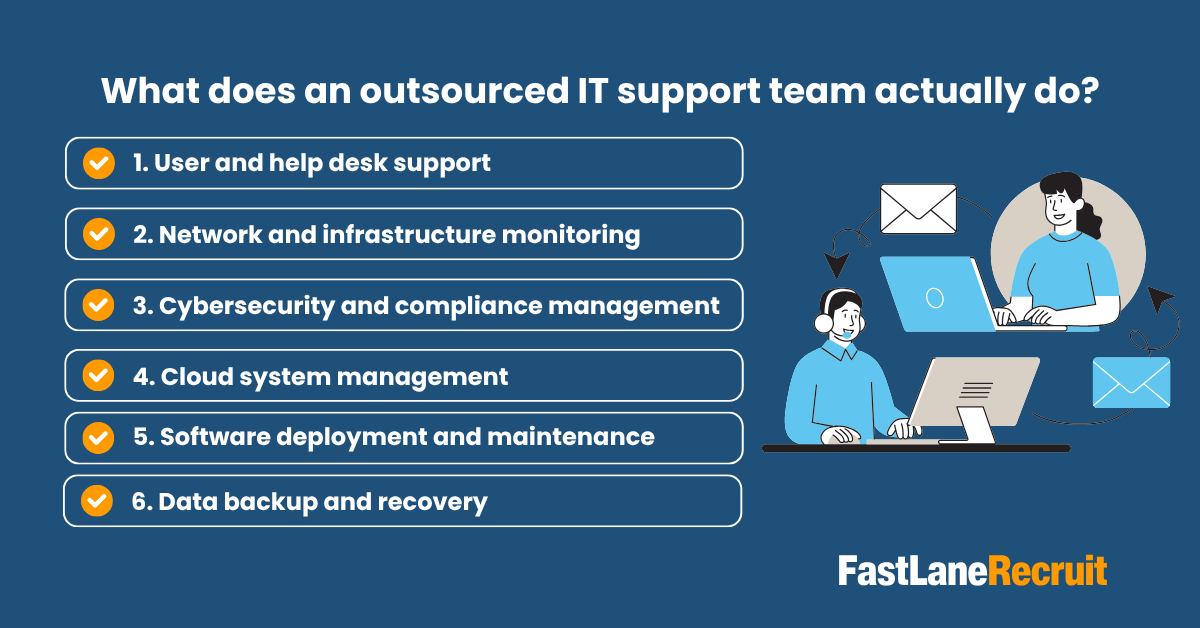
Depending on your business needs, an outsourced IT team can handle a wide range of responsibilities, such as:
1. User and help desk support
This is the first point of contact when employees face technical issues.
For example:
- Password resets
- Email or login problems
- Software troubleshooting
- General IT questions
It ensures employees can get quick help so their work is not interrupted.
2. Network and infrastructure monitoring
The IT team continuously checks your systems, servers, and networks to make sure everything is running smoothly.
They help:
- Detect system issues early
- Prevent downtime
- Improve network performance
- Ensure stable connectivity across teams
This is especially important for companies with remote or global teams.
Also Read: IT Support Specialist Salary Guide
3. Cybersecurity and compliance management
Security is one of the most critical parts of IT support.
Outsourced teams help protect your business by:
- Monitoring for cyber threats
- Installing security updates
- Managing firewalls and antivirus systems
- Supporting compliance with data protection rules (such as GDPR in Europe)
This reduces the risk of data breaches and security incidents.
4. Cloud system management
Many businesses now use cloud platforms like Microsoft 365, Google Workspace, or AWS.
Outsourced IT teams help with:
- Setting up cloud systems
- Managing access for employees
- Ensuring data is properly stored and backed up
- Improving cloud performance and security
This makes collaboration easier, especially for remote teams.
5. Software deployment and maintenance
Instead of manually installing software on every device, the IT provider manages this process centrally.
They handle:
- Software installation across teams
- Updates and patches
- License management
- Fixing software-related issues
This ensures all employees are using updated and secure tools.
6. Data backup and recovery
Data is one of the most valuable assets of any business.
Outsourced IT teams:
- Regularly back up important company data
- Store copies securely
- Help restore data if something is lost or damaged
- Reduce downtime during system failures
This protects the business from unexpected data loss.
How does it work in practice?
Instead of hiring an entire internal IT department, companies “delegate” (or assign) these responsibilities to an external IT provider.
This is done through a Service Level Agreement (SLA), which is a formal contract that clearly defines:
- What services are included
- How quickly issues must be resolved
- Working hours (for example, 24/7 support)
- Performance expectations
- Security responsibilities
The SLA helps ensure accountability and service quality.
Why do companies use outsourced IT support teams?
Many businesses choose this model because it helps them:
- Access skilled IT professionals without building a full internal team
- Improve system reliability and security
- Support employees across different locations and time zones
- Scale IT support easily as the company grows
- Focus internal resources on core business activities instead of technical management
Who usually uses this model?
Outsourced IT support is commonly used by:
- Startups that need fast setup without heavy hiring
- SMEs that want professional IT support without a large department
- Global companies with teams across multiple countries
- Fast-growing businesses that need scalable technology support
It is especially useful for companies with remote or hybrid teams where IT issues can happen anytime, anywhere.
Why Businesses Are Moving Toward IT Support Outsourcing
Global IT outsourcing continues to grow rapidly as businesses focus on efficiency, security, and scalability. According to industry research, the IT outsourcing market is expected to continue expanding significantly as companies shift toward flexible digital operations.
Key reasons include:
- Increasing demand for 24/7 IT support
- Rising cybersecurity risks
- Need for scalable global operations
- Cost predictability
- Access to specialized expertise
Key Benefits of Outsourced IT Support Teams
Outsourcing IT support is not just about reducing workload for your internal team. It is a strategic approach that helps businesses operate more efficiently, stay secure, and scale faster without unnecessary complexity. Below is a clearer and more detailed breakdown of the main benefits.
1. More Flexible Cost Structure
One of the most important advantages of outsourced IT support is flexibility in how costs are managed.
Instead of handling multiple fixed expenses such as:
- Employee salaries and benefits
- Continuous staff training
- Software licences and renewals
- Hardware and IT infrastructure investments
- Emergency repair or system upgrade costs
Businesses move to a more predictable service-based model.
In most cases, companies pay a structured monthly or usage-based fee depending on:
- Number of users supported
- Number of devices managed (laptops, desktops, servers, etc.)
- Level of service required (basic support or full IT management)
This approach helps businesses:
- Plan IT budgets more accurately
- Avoid unexpected technical expenses
- Scale IT spending up or down based on business needs
- Align IT costs directly with company growth
In short, IT becomes easier to manage financially because it adjusts with your business instead of staying fixed.
Also Read: Malaysia’s Labour Laws for Hiring IT Support Specialists: EPF, SOCSO & Compliance
2. Access to Specialized IT Expertise
Building a full in-house IT department often requires hiring multiple specialists, which can be complex and time-consuming. Outsourced IT support solves this by giving you immediate access to a complete team of experts.
These teams typically include professionals such as:
- Cybersecurity specialists who protect systems and prevent cyber threats
- Cloud engineers who manage platforms like Microsoft 365, AWS, or Google Workspace
- Network administrators who ensure stable connectivity and system performance
- IT support technicians who handle day-to-day troubleshooting and user requests
Instead of relying on one or two internal IT staff members to handle everything, businesses gain access to a broader range of expertise.
This means:
- Faster problem resolution
- More reliable systems
- Better technical decision-making
- Reduced dependency on a single internal IT hire
It is especially valuable for growing companies that need advanced IT skills but are not ready to build a large internal department.
3. 24/7 Support Across Time Zones
Modern businesses often operate beyond a single location or time zone. Teams may be spread across different countries, making IT support needs more complex and continuous.
Outsourced IT providers often offer 24/7 support coverage, meaning technical assistance is available at any time of day.
This is important because:
- IT issues can happen outside normal working hours
- Global teams may work at different times
- System downtime can directly impact productivity and revenue
With continuous monitoring and support, outsourced teams can:
- Detect issues early before they become serious problems
- Resolve technical incidents faster
- Provide immediate support to employees in different regions
The result is less downtime, smoother operations, and a more reliable working environment for all employees.
4. Improved Security and Compliance
Cybersecurity is now a top priority for businesses of all sizes. At the same time, companies must follow strict data protection and compliance regulations depending on where they operate.
Outsourced IT support providers are typically well-versed in global security frameworks such as:
- GDPR (General Data Protection Regulation) – protects personal data within the European Union
- ISO security standards – international benchmarks for information security management
- PCI DSS (Payment Card Industry Data Security Standard) – ensures secure handling of payment information
By working with experienced IT providers, businesses benefit from:
- Regular security updates and monitoring
- Stronger protection against cyberattacks
- Structured compliance processes
- Reduced risk of data breaches or regulatory penalties
This is especially important for companies handling customer data, financial transactions, or operating across multiple countries.
5. Scalability for Business Growth
As a business grows, its IT requirements naturally increase.
This includes:
- Onboarding new employees
- Setting up new devices and accounts
- Expanding software access
- Managing larger systems and networks
- Supporting new office locations or remote teams
With an outsourced IT support model, scaling becomes much easier.
Instead of hiring additional internal IT staff every time the company grows, businesses can simply adjust their service plan with their provider.
This allows companies to:
- Expand quickly without IT delays
- Maintain consistent support quality during growth
- Avoid overloading internal teams
- Support new markets or locations smoothly
In short, IT support grows alongside the business rather than becoming a limitation.
6. Improved Focus on Core Business Activities
When internal teams spend too much time handling technical issues, it can take attention away from more strategic priorities.
By outsourcing IT support, businesses can redirect internal resources toward areas that directly drive growth, such as:
- Product development and innovation
- Sales and revenue generation
- Marketing and brand development
- Customer experience improvement
- Business expansion and partnerships
This shift allows leadership and internal teams to focus on what matters most, while IT operations are handled by specialists.
The result is:
- Higher productivity across departments
- Better use of internal talent
- Faster business growth
- More strategic decision-making
Also Read: Why Malaysia Is an Attractive Hub for Operations Support
Types of Outsourced IT Support Models
Different businesses have different levels of IT needs. Some need full end-to-end support, while others only require help during specific issues or peak periods. Outsourced IT support is flexible, and it usually comes in a few key models depending on how much control, involvement, and coverage a company wants.
Below is a clearer breakdown of the main models and how they work in practice.
1. Fully Managed IT Support
A fully managed IT support model means the external provider takes complete responsibility for a company’s IT operations.
In this setup, the outsourced team essentially acts as your entire IT department.
What it typically includes:
- 24/7 system monitoring and maintenance
- Help desk and employee technical support
- Network and server management
- Cybersecurity protection and updates
- Cloud system management
- Software installation, updates, and troubleshooting
- Data backup and recovery planning
How it works:
The business hands over most or all IT responsibilities to the provider. The IT partner continuously monitors systems, fixes issues, and ensures everything runs smoothly without requiring daily involvement from internal staff.
Best suited for:
- Startups without internal IT teams
- Small and mid-sized companies
- Businesses scaling quickly
- Companies wanting a fully hands-off IT approach
Key advantage:
It provides a complete IT solution without the need to hire, train, or manage an internal IT department.
2. Co-Managed IT Support
Co-managed IT support is a shared responsibility model where internal IT teams and external providers work together.
Instead of replacing your internal IT staff, the outsourced provider supports and strengthens them.
What it typically includes:
- Support for specific technical areas (e.g. cybersecurity or cloud systems)
- Assistance during high workload periods
- Advanced technical expertise when needed
- Backup support for internal IT teams
- Strategic IT planning and consulting
How it works:
Your internal IT team continues to manage day-to-day operations, while the external provider steps in to handle more complex tasks or fill capability gaps.
For example:
- Internal team manages user requests
- External provider handles network security or infrastructure upgrades
Best suited for:
- Mid-sized to large companies
- Businesses with existing IT departments
- Organisations experiencing rapid growth
- Teams needing specialised expertise
Key advantage:
It strengthens your internal IT capabilities without replacing your existing team, making it a highly flexible and scalable approach.
3. Break-Fix Support
Break-fix support is a more traditional IT model where businesses only pay when something goes wrong.
There are no ongoing monthly contracts or continuous management services.
What it typically includes:
- Troubleshooting hardware or software issues
- Fixing system errors or outages
- Emergency technical support
- On-demand IT assistance
How it works:
When an IT issue occurs, the business contacts the provider, and the provider charges based on the time and work required to fix the problem.
Best suited for:
- Very small businesses
- Companies with minimal IT dependency
- Organisations with infrequent technical issues
- Businesses looking for basic, occasional support
Key advantage:
It keeps upfront costs low, but support is reactive rather than preventive.
4. Offshore / Nearshore IT Support Models
Offshore and nearshore IT support models refer to outsourcing IT services to providers in different geographic regions.
This model is widely used by global companies looking to balance cost efficiency, expertise, and time zone coverage.
Offshore IT Support
Offshore support involves working with IT teams located in distant countries.
For example:
- A UK company working with a team in Asia
- A US company working with providers in India or the Philippines
Benefits:
- Access to a large global talent pool
- Ability to operate around the clock due to time zone differences
- Flexible scaling of IT resources
- Efficient allocation of IT workloads across regions
Nearshore IT Support
Nearshore support involves outsourcing to nearby countries with similar time zones and cultural alignment.
For example:
- UK companies working with Eastern Europe providers
- US companies working with Latin American teams
Benefits:
- Easier real-time communication
- Minimal time zone challenges
- Strong cultural and working alignment
- Faster coordination and collaboration
Best suited for:
- Global enterprises
- Companies with distributed teams
- Businesses needing 24/7 support coverage
- Organisations looking to optimise operational efficiency across regions
Key advantage:
It allows businesses to balance cost, communication efficiency, and global coverage while maintaining strong service quality.
Summary
Each outsourced IT support model serves a different business need:
- Fully managed – complete IT outsourcing with minimal internal involvement
- Co-managed – shared responsibility between internal and external IT teams
- Break-fix – pay-per-issue, reactive support for basic needs
- Offshore/nearshore – geographically distributed support for scalability and coverage
Choosing the right model depends on your company size, internal IT capability, growth stage, and long-term digital strategy.
Also Read: Payroll and Statutory Compliance for Hiring Payroll Specialists in Malaysia
Cost Structure of Outsourced IT Support
IT outsourcing costs typically depend on the service model and scope of work.
Common pricing models:
| Model | Description |
| Per-user pricing | Monthly cost per employee |
| Per-device pricing | Based on number of devices managed |
| Fixed monthly package | Set services included |
| On-demand support | Pay per incident or request |
Cost factors include:
- Number of users or devices
- Support hours required
- Data storage needs
- Security requirements
- Service complexity
Instead of unpredictable IT expenses, businesses benefit from more structured monthly planning.
How to Choose the Right IT Support Provider
Choosing an IT support provider is an important business decision because it directly affects your daily operations, security, and long-term growth. The right partner can help your business run smoothly, while the wrong one can lead to delays, security risks, and inefficiencies.
Before selecting a provider, it is important to carefully evaluate a few key areas to ensure they are the right fit for your needs.
1. Technical Expertise
One of the first things to assess is the provider’s technical capability. Not all IT support companies offer the same level of skill or experience, so it is important to check whether they have qualified professionals who can handle your specific requirements.
What to look for:
- Industry-recognised certifications such as ITIL (IT service management best practices)
- Microsoft certifications for cloud and enterprise systems
- Cybersecurity certifications such as CompTIA Security+ or CISSP
- Experience with cloud platforms like AWS, Microsoft Azure, or Google Workspace
- Proven experience supporting businesses similar in size or industry
Why it matters:
A provider with strong technical expertise can resolve issues faster, reduce system downtime, and offer better long-term IT planning. It also ensures your systems are managed using up-to-date practices and technologies.
2. Service Coverage
Different businesses have different IT needs. Some may only require basic help desk support, while others need full infrastructure management, cybersecurity protection, and cloud services.
What to check:
- Do they offer end-to-end IT support or only specific services?
- Can they support both remote and on-site IT needs if required?
- Do they provide services such as cybersecurity, cloud management, and system monitoring?
- Can they support multiple locations or global teams?
Why it matters:
A provider with the right service coverage ensures you don’t need multiple vendors. This simplifies management, improves communication, and ensures consistency across all IT operations.
3. Response Time Guarantees (SLAs)
A Service Level Agreement (SLA) is a formal document that defines how the IT provider will deliver their services.
It is one of the most important parts of any IT support partnership.
What to look for in an SLA:
- Clear response time for support requests
- Defined resolution time for different issue levels (critical, medium, low)
- Availability (e.g. 24/7 or business hours support)
- Escalation process for urgent issues
- Performance reporting and monitoring
Why it matters:
Fast response times can significantly reduce downtime and prevent small issues from becoming major disruptions. A clear SLA ensures accountability and sets expectations from the beginning.
4. Security Standards and Compliance
Cybersecurity is one of the most important factors when outsourcing IT support, especially if your business handles sensitive customer data or operates in multiple regions.
What to verify:
- Compliance with global data protection regulations such as GDPR
- Adherence to ISO security standards (such as ISO 27001)
- Payment security compliance like PCI DSS (if applicable)
- Data encryption and secure access controls
- Regular security audits and monitoring processes
Why it matters:
A trusted IT provider helps protect your business from cyber threats, data breaches, and compliance risks. This is especially important for companies operating internationally, where regulations vary by region.
5. Scalability and Growth Support
As your business grows, your IT requirements will naturally increase. A good IT support provider should be able to grow with you, not limit you.
What to look for:
- Ability to onboard new users and devices quickly
- Flexible pricing models that adjust with usage
- Support for expanding into new locations or markets
- Ability to upgrade services as your needs become more advanced
- Experience supporting fast-growing businesses or global teams
Why it matters:
Scalable IT support ensures that your technology infrastructure can keep up with business growth without requiring major restructuring or delays.
When choosing an IT support provider, it is not just about cost or basic services. It is about finding a long-term partner who can support your operations, protect your systems, and grow alongside your business.
A strong provider should offer:
- Proven technical expertise
- Comprehensive service coverage
- Reliable response times
- Strong security and compliance standards
- Flexible scalability for future growth
Taking time to evaluate these factors carefully will help ensure a stable, secure, and efficient IT environment for your business.
Also Read: Top 15 IT Consulting Companies in the United Kingdom
Best Practices for Successful IT Outsourcing
Successfully outsourcing IT support is not just about choosing a provider. It is about building a structured partnership that aligns with your business goals, ensures smooth communication, and supports long-term growth. Below are key best practices to help businesses get the most value from their IT outsourcing strategy.
1. Conduct a Thorough Needs Assessment
Before engaging any IT support provider, it is important to clearly understand your current IT environment and future requirements.
This step helps you identify what should be outsourced and what should remain internal.
What to evaluate:
- Current IT challenges and recurring issues
- Skills available within your internal team
- Systems that require external expertise (e.g. cybersecurity or cloud management)
- Level of support required (basic help desk vs full IT management)
- Future business growth plans and IT expansion needs
Why it matters:
A clear needs assessment prevents overpaying for unnecessary services and ensures you select a provider that matches your actual requirements. It also reduces the risk of gaps in support later on.
2. Define Clear Service Level Agreements (SLAs)
A Service Level Agreement (SLA) is the foundation of any successful IT outsourcing partnership. It clearly defines what is expected from the provider and ensures accountability.
What should be included:
- Response time for different types of issues (critical, medium, low priority)
- Resolution time expectations
- Scope of services included (and excluded)
- Availability (e.g. 24/7 support or business hours only)
- Reporting structure and performance tracking
- Escalation procedures for urgent incidents
Why it matters:
A well-defined SLA ensures both parties have a shared understanding of performance standards. It helps maintain service quality and avoids misunderstandings.
3. Maintain Regular Communication and Reporting
Ongoing communication is essential to ensure your IT support provider continues to meet expectations and adapt to your evolving needs.
Best practices include:
- Scheduled monthly or quarterly review meetings
- Regular performance reports with key metrics (e.g. ticket resolution time, uptime, response speed)
- Clear communication channels for urgent issues
- Feedback loops between your internal team and the provider
- Periodic strategy discussions to improve IT efficiency
Why it matters:
Regular communication helps build trust, improves service quality, and ensures alignment between IT support and business objectives.
4. Choose a Scalable and Future-Ready Partner
Your IT needs today may look very different from your needs in one or two years. That is why scalability is a critical factor when choosing a provider.
What to look for:
- Ability to onboard new users and devices quickly
- Flexible service plans that can expand or reduce based on demand
- Experience supporting business growth and expansion
- Capability to support multiple locations or international teams
- Access to advanced technologies and tools as your business evolves
Why it matters:
A scalable partner ensures your IT support grows with your business instead of becoming a limitation. This reduces the need to switch providers as your company expands.
Successful IT outsourcing is built on preparation, clarity, and collaboration.
When businesses:
- Understand their IT needs
- Set clear expectations through SLAs
- Communicate regularly with providers
- And choose a partner that can scale
they are more likely to achieve stable, secure, and efficient IT operations that support long-term growth.
A well-structured outsourcing strategy turns IT support into a reliable business enabler rather than just a reactive service.
Also Read: Building a High-Performing Offshore IT Team in Malaysia (Singapore Edition)
Offshore IT Support and Malaysia as a Strategic Hub
Many global companies are now looking beyond traditional locations and expanding their IT and operational teams into offshore markets. One country that continues to stand out is Malaysia, thanks to its strong digital ecosystem, skilled workforce, and supportive business environment.
Instead of treating IT support as a purely local function, businesses are increasingly building distributed teams across regions like Asia to improve efficiency, coverage, and long-term scalability.
Malaysia has become a particularly attractive hub for this shift.
Malaysia offers a balanced combination of technical capability, infrastructure readiness, and business-friendly policies. This makes it a practical location for companies building offshore or shared IT support teams.
Below are some of the key advantages in more detail.
1. Strong English Proficiency and Global Communication Readiness
One of Malaysia’s biggest advantages is its strong English proficiency, especially within the professional and technical workforce.
This is important for IT support because:
- Clear communication is essential when resolving technical issues
- IT teams often support users from multiple countries
- Documentation, ticketing, and reporting are typically in English
- Real-time troubleshooting requires fast and accurate communication
Because of this, Malaysian IT professionals can easily work with global teams across the UK, US, Europe, and Asia without major language barriers.
2. Skilled and Growing IT Workforce
Malaysia has a rapidly developing talent pool in the technology sector, supported by strong education systems and continuous upskilling in digital fields.
The IT workforce typically includes expertise in:
- Software development and application support
- Cloud computing and infrastructure management
- Cybersecurity and data protection
- Network engineering and system administration
- Technical support and IT help desk services
This broad skill base allows companies to build full IT support functions in one location rather than spreading roles across multiple countries.
It also helps businesses scale faster without facing major talent shortages in key technical areas.
3. Established Digital Economy Initiatives
Malaysia has made consistent efforts to strengthen its digital economy through national-level initiatives and long-term development plans.
These initiatives focus on:
- Expanding digital infrastructure across the country
- Supporting cloud adoption and data centre growth
- Encouraging innovation in AI, cybersecurity, and automation
- Promoting digital skills development in the workforce
For example, agencies such as the Malaysia Digital Economy Corporation (MDEC) play an active role in supporting technology growth and attracting global investment.
These efforts create a stable environment for companies that rely heavily on digital systems and IT operations.
4. Government Support for Technology and Business Growth
Malaysia’s government actively encourages foreign investment and technology-driven business expansion.
Key areas of support include:
- Tax incentives for digital and technology companies
- Special economic zones for tech and service industries
- Support for shared services and global capability centres
- Policies that encourage foreign direct investment (FDI)
The Malaysian Investment Development Authority (MIDA) provides structured support for companies setting up regional operations or shared service functions in the country.
This level of support reduces operational complexity for international companies and makes it easier to establish offshore IT teams.
Why Global Companies Choose Malaysia for IT Support
When combined, these strengths make Malaysia a strategic choice for offshore IT support operations.
Companies benefit from:
- Reliable and skilled technical talent
- Strong communication capabilities
- Cost-efficient operational scaling without compromising quality
- Stable regulatory and business environment
- Strong alignment with global business hours (especially Asia-Pacific operations)
Malaysia is increasingly positioning itself as a regional hub for IT support and digital services. For global businesses, it offers a practical balance between talent availability, operational efficiency, and long-term scalability.
As companies continue to expand globally, Malaysia plays a growing role in supporting distributed IT teams, shared service centres, and remote technical operations that power modern digital businesses.
Also Read: Building a High-Performing Offshore IT Team in Malaysia (Hong Kong Edition)
Alternative Approach: Hire Malaysian IT Support Specialists via FastLaneRecruit’s EOR Model
For companies that want more control, flexibility, and direct oversight compared to traditional IT outsourcing, an Employer of Record (EOR) model offers a practical alternative.
Instead of fully outsourcing IT operations to a third-party service provider, businesses can hire IT support specialists directly and outsource an IT support team in Malaysia through FastLaneRecruit, while the EOR handles all employment, legal, and compliance responsibilities.
This approach is ideal for companies that want to build their own dedicated IT team in Malaysia without the complexity of setting up a local entity.
What is an EOR model in IT hiring?
An Employer of Record (EOR) is a service that legally employs staff on behalf of your company in Malaysia, while you retain full operational control of the team.
In simple terms:
- You hire and select the IT talent (for example, IT support specialists)
- FastLaneRecruit becomes the legal employer in Malaysia
- FastLaneRecruit manages payroll, taxes, employment contracts, and statutory compliance
- Your company manages daily work, KPIs, and team performance
This allows businesses to expand internationally without needing to establish a local legal entity or navigate complex employment regulations on their own.
Why use EOR to hire IT support specialists in Malaysia?
Using an EOR model allows companies to build a structured, dedicated IT support team in Malaysia while staying fully compliant with local labour laws.
Key benefits include:
- Ability to hire IT support specialists in Malaysia directly based on your requirements
- No need to set up a local company or branch office
- Full compliance with Malaysian employment laws and statutory requirements
- Simplified payroll, benefits, and HR administration handled locally
- Faster hiring and onboarding compared to traditional expansion methods
- Greater control over team structure, workflows, and performance management
This model combines the control of in-house hiring with the efficiency of international expansion support.
Example: Building an IT Support Team in Malaysia with FastLaneRecruit EOR
Let’s say a UK-based SaaS company wants to strengthen its IT support coverage for customers across Asia-Pacific.
Instead of outsourcing IT support to an external provider, the company chooses to hire IT support specialists in Malaysia using FastLaneRecruit’s EOR service.
The team structure could look like this:
- 1 IT Support Team Lead based in Kuala Lumpur
- 3 IT Support Specialists handling Tier 1 and Tier 2 technical support
- 1 Cloud Support Engineer managing system access and integrations
How FastLaneRecruit’s EOR supports this setup:
- FastLaneRecruit acts as the legal employer in Malaysia
- The company directly manages the IT team’s daily tasks and KPIs
- Employment contracts, payroll, and statutory contributions are handled locally
- Compliance with Malaysian labour laws is fully managed
- The IT team operates as a seamless extension of the company’s internal operations
Business outcomes:
- Faster response times for Asia-Pacific customers
- Stronger control over IT service quality and team structure
- Simplified international hiring and compliance management
- A scalable IT support function without establishing a local entity
EOR vs Traditional IT Outsourcing (Quick Comparison)
| Factor | IT Outsourcing | EOR Model (FastLaneRecruit) |
| Team control | Managed by provider | Fully controlled by your company |
| Hiring flexibility | Limited to provider’s team | You directly hire IT support specialists in Malaysia |
| Legal responsibility | Handled by provider | Handled by EOR partner |
| Operational control | Partial | Full control over team and workflow |
| Best suited for | Fully managed support | Dedicated in-house IT teams in Malaysia |
Why companies choose EOR for IT expansion
The EOR model is becoming increasingly popular among companies that want to scale globally while maintaining operational control.
Businesses choose this approach because they want to:
- Gain more control over their IT support teams
- Directly hire skilled IT professionals in Malaysia
- Expand into Asia without legal or administrative complexity
- Align IT teams more closely with business strategy and internal operations
It bridges the gap between full outsourcing and building a local entity, offering a balanced and flexible approach to global hiring.
While traditional IT outsourcing focuses on delegating responsibilities, the EOR model focuses on helping companies build their own global teams with ease and compliance support.
With FastLaneRecruit’s EOR solution in Malaysia, companies can confidently hire IT support specialists, manage their teams directly, and scale IT operations internationally, without the need to establish a local entity.
This makes it a powerful option for businesses that want long-term control, flexibility, and global expansion capability.
Conclusion
Outsourced IT support is no longer just a cost-saving measure; it is a strategic business decision that helps companies operate more efficiently, securely, and globally.
By working with the right IT support partner, businesses can access expert-level skills, improve system reliability, and scale operations without unnecessary complexity.
Whether you choose full IT outsourcing or build your own distributed team through an EOR model, the key is flexibility and long-term scalability.
FastLaneRecruit supports global companies in building and managing high-quality Malaysian talent through compliant hiring solutions designed for growth-focused organizations.
Ready to Build a Stronger, Scalable IT Support Team?
If your business is looking to improve IT efficiency, strengthen global support coverage, or expand into new markets, now is the right time to rethink how you build your IT team.
Whether you choose outsourced IT support or want more control through direct hiring, FastLaneRecruit helps you scale with confidence.
With our Employer of Record (EOR) solution in Malaysia, you can:
- Hire skilled IT support professionals quickly and compliantly
- Build your own dedicated IT support team without setting up a local entity
- Manage your team directly while we handle payroll, HR, and compliance
- Scale your IT operations smoothly as your business grows
This gives you the flexibility to expand faster while staying focused on your core business priorities.
Take the next step: Build your high-performing IT support team in Malaysia with ease and control. Contact our recruitment team now!