

Malaysia vs Global Markets
Front-end developers are the architects of user experience. From responsive design to seamless interactivity, they shape how users engage with digital platforms. As businesses prioritize intuitive interfaces and mobile-first strategies, demand for skilled front-end talent continues to rise globally. This guide compares salary benchmarks across Malaysia, the USA, Singapore, Hong Kong, and Australia, helping employers make smarter hiring and payroll decisions.
Content Outline
Key Summary
Malaysia Offers Scalable, Cost-Efficient Talent
Front-end Developers earn MYR 90,000–160,000 annually (USD 19,000–34,000), making Malaysia a strategic hub for offshore hiring.
USA Leads in Compensation
Mid-to-senior developers earn USD 110,000–150,000+, driven by demand in React, Vue, and performance engineering.
Singapore Pays Competitively
Developers earn SGD 85,000–160,000 (USD 62,000–117,000), especially in fintech, SaaS, and government digital services.
Hong Kong Salaries Are Rising
Developers earn HKD 300,000–480,000 (USD 39,000–62,000), with strong demand in finance and enterprise UX.
Australia Rewards Senior Talent
Salaries range from AUD 110,000–160,000+ (USD 73,000–106,000+), especially in mobile-first and accessibility-focused roles.
Outsourcing to Malaysia Maximizes ROI
Employers save up to 65% on payroll while gaining access to English-speaking, framework-savvy developers.
Front-end Developer Salary Breakdown by Country (2026)
Front-end Developers play a pivotal role in bridging design and functionality. Their expertise in HTML, CSS, JavaScript frameworks, and performance optimization ensures that websites and apps not only look great but perform flawlessly. With digital transformation accelerating across industries, from e-commerce and fintech to healthcare and SaaS, understanding regional salary trends is essential for building cost-effective, high-performing teams.
Malaysia
Malaysia’s front-end talent pool is expanding, with strong proficiency in React, Angular, Vue.js, and Tailwind CSS.
| Level | Salary (MYR) | Salary (USD) |
| Entry (0–2 yrs) | 90,000–110,000 | 19,000–23,000 |
| Mid (3–5 yrs) | 130,000–150,000 | 27,000–32,000 |
| Senior (6+ yrs) | 155,000–160,000 | 33,000–34,000 |
Market Insight: Malaysia offers affordable talent with modern front-end stacks, ideal for scaling global teams.
United States
The U.S. remains the highest-paying market, especially in tech hubs like San Francisco, Seattle, and Austin.
| Level | Salary (USD) |
| Entry (0–2 yrs) | 85,000–100,000 |
| Mid (3–5 yrs) | 110,000–130,000 |
| Senior (6+ yrs) | 140,000–150,000+ |
Market Insight: High salaries are offset by steep living costs. Many firms retain UX leadership locally and outsource execution.
Singapore
Singapore’s smart nation initiatives and fintech boom drive demand for front-end developers.
| Level | Salary (SGD) | Salary (USD) |
| Entry (0–2 yrs) | 85,000–100,000 | 62,000–73,000 |
| Mid (3–5 yrs) | 120,000–140,000 | 88,000–103,000 |
| Senior (6+ yrs) | 150,000–160,000+ | 110,000–117,000+ |
Market Insight: Developers with UX/UI specialization and mobile-first experience command premium packages.
Also Read: Top Professional SEO Services in the US
Hong Kong
Hong Kong’s finance sector increasingly relies on front-end developers for secure, scalable interfaces.
| Level | Salary (HKD) | Salary (USD) |
| Entry (0–2 yrs) | 300,000–350,000 | 39,000–45,000 |
| Mid (3–5 yrs) | 400,000–450,000 | 52,000–58,000 |
| Senior (6+ yrs) | 460,000–480,000 | 59,000–62,000 |
Market Insight: Salaries are moderate but offer exposure to high-compliance environments.
Australia
Australia offers strong pay and work-life balance, especially in Sydney and Melbourne.
| Level | Salary (AUD) | Salary (USD) |
| Entry (0–2 yrs) | 110,000–120,000 | 73,000–80,000 |
| Mid (3–5 yrs) | 130,000–150,000 | 86,000–99,000 |
| Senior (6+ yrs) | 155,000–160,000+ | 102,000–106,000+ |
Market Insight: Developers with accessibility, performance, and mobile-first skills are in high demand.
Comparing Front-end Developer Salaries Across Countries
Malaysia: High ROI Talent
Front-end Developers in Malaysia earn between USD 19,000 and 34,000 annually, substantially lower than peers in Western markets. But affordability doesn’t mean compromise. Malaysia offers a deep pool of English-speaking professionals skilled in React, Vue.js, Angular, and performance optimization. For global employers, this translates into up to 65% payroll savings and access to modern front-end capabilities. Many companies choose Malaysia to build scalable UI teams without inflating budgets.
United States: Top Salaries with High Costs
In the U.S., front-end developers remain among the highest-paid globally, with senior professionals earning USD 140,000–150,000+ per year. Compensation often includes stock options, bonuses, and health benefits. However, high living costs in cities like San Francisco and New York make scaling local teams expensive. As a result, many firms retain UX leadership in-house while outsourcing development to offshore teams in Malaysia to maintain velocity and reduce costs.
Singapore: Regional Tech Hub with Competitive Pay
Singapore offers USD 62,000–117,000 annually for front-end developers, making it one of Asia’s most competitive markets. The city-state’s push toward digital services and fintech innovation has created strong demand for responsive design, accessibility, and mobile-first development. While salaries are attractive, they can be challenging for companies building larger teams. A smart strategy is to base senior leadership in Singapore while scaling execution in Malaysia.
Hong Kong: Growing Demand in Finance
Front-end Developers in Hong Kong earn USD 39,000–62,000 per year, a moderate level compared to Singapore or the U.S. However, demand is rising due to the city’s finance-driven economy and increasing reliance on secure, user-friendly interfaces. Developers here gain valuable experience in compliance-heavy environments, which is a plus for global employers. Many companies use Hong Kong as a specialist hub for financial UX while building larger teams offshore in Malaysia.
Also Read: How to Successfully Outsource Data Engineering
Australia: Balanced Pay and Lifestyle
In Australia, front-end developers earn USD 73,000–106,000+ annually, with strong demand in government portals, enterprise platforms, and mobile-first applications. Salaries are attractive, and the country offers a balanced work culture, making it a popular destination for senior roles. However, higher payroll costs mean many companies adopt a hybrid model, keeping strategic oversight in Australia while outsourcing execution to Malaysian teams.
Comparing Front-end Developer Salaries Across Countries in 2026
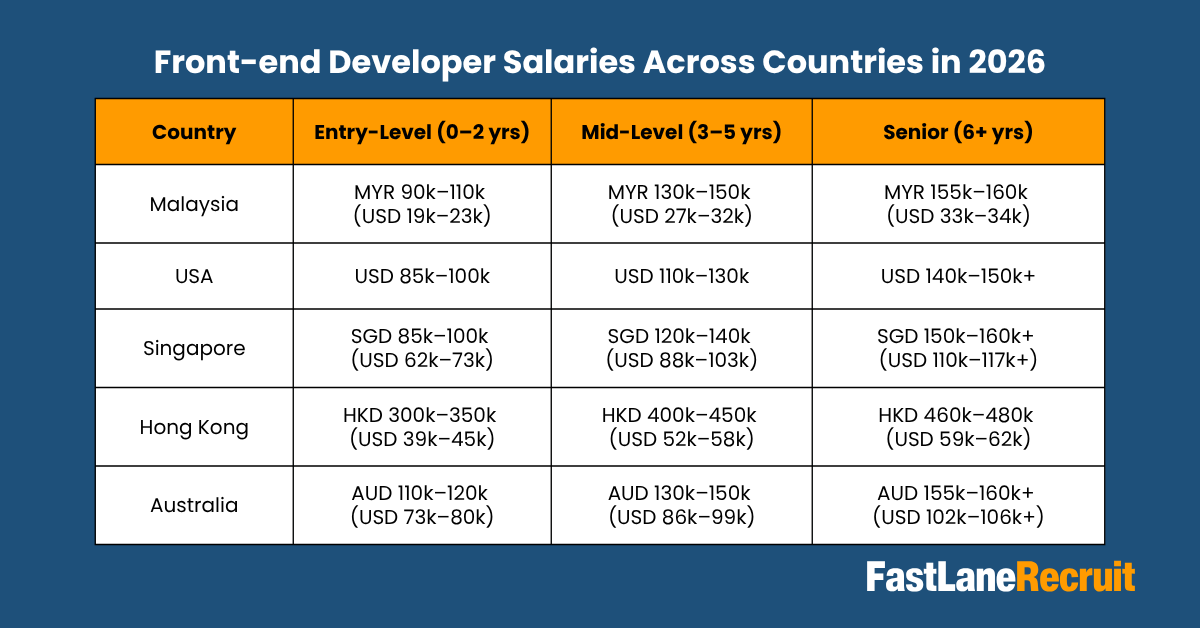
| Country | Entry-Level (0–2 yrs) | Mid-Level (3–5 yrs) | Senior (6+ yrs) |
| Malaysia | MYR 90k–110k (USD 19k–23k) | MYR 130k–150k (USD 27k–32k) | MYR 155k–160k (USD 33k–34k) |
| USA | USD 85k–100k | USD 110k–130k | USD 140k–150k+ |
| Singapore | SGD 85k–100k (USD 62k–73k) | SGD 120k–140k (USD 88k–103k) | SGD 150k–160k+ (USD 110k–117k+) |
| Hong Kong | HKD 300k–350k (USD 39k–45k) | HKD 400k–450k (USD 52k–58k) | HKD 460k–480k (USD 59k–62k) |
| Australia | AUD 110k–120k (USD 73k–80k) | AUD 130k–150k (USD 86k–99k) | AUD 155k–160k+ (USD 102k–106k+) |
Why These Salaries Differ
Front-end salaries vary widely across regions, and it’s not just about technical skills. Factors like cost of living, industry demand, specialization, and remote work trends all shape compensation. Let’s break down the key drivers.
1. Cost of Living
Countries like the U.S., Singapore, and Australia offer high salaries but they also come with steep living costs. In contrast, Malaysia’s lower cost of living allows developers to enjoy strong purchasing power even at modest salary levels.
Example:
A senior front-end developer in Sydney may earn USD 105,000 annually, but with rent and expenses exceeding USD 3,000/month, much of that income is absorbed. Meanwhile, a mid-level developer in Kuala Lumpur earning USD 30,000 annually enjoys comparable lifestyle benefits thanks to lower housing and healthcare costs.
Tip for Employers:
Use location-adjusted salary frameworks to stay competitive while managing payroll budgets effectively.
2. Industry Demand
Front-end Developers are essential in industries that prioritize user experience, accessibility, and responsive design.
- E-commerce & SaaS: Fast-loading interfaces and mobile optimization drive demand for React and Vue.js developers.
- Finance: Secure, compliant UI frameworks are critical for banking and fintech platforms.
- Healthcare: Front-end teams build HIPAA-compliant portals and patient dashboards with intuitive navigation.
Example:
A front-end developer at a fintech firm in Singapore may earn USD 115,000 due to the complexity of secure, real-time interfaces, while a peer in logistics earns closer to USD 85,000.
Tip for Employers:
Prioritize domain-specific experience when hiring for regulated or high-availability industries.
3. Skill Specialization
Front-end salaries are closely tied to technical depth and specialization. Developers with advanced skills in performance optimization, accessibility, and modern frameworks often earn 25–35% more than those with basic HTML/CSS experience.
High-value skills include:
- JavaScript Frameworks: React, Vue.js, Angular
- State Management: Redux, Pinia, Zustand
- Performance Optimization: Lighthouse audits, lazy loading, code splitting
- Accessibility (a11y): WCAG compliance, ARIA roles
- Tooling & CI/CD: Webpack, Vite, GitHub Actions
Example:
A developer in Penang with React and accessibility expertise may earn MYR 150,000 (USD 32,000), while a peer focused on basic jQuery earns closer to MYR 100,000 (USD 21,000).
Also Read: Data Engineering Salary Guide
Tip for Employers:
Use skill-based compensation models to attract and retain top-tier talent while encouraging upskilling.
4. Remote Work & Global Hiring
Remote-first hiring has reshaped front-end recruitment. Employers now focus on deliverables and user experience, not just location. This shift positions Malaysia as a prime destination for offshore front-end teams.
Global Trends:
- Hybrid Teams: UX leadership remains in high-cost markets; execution is outsourced to Malaysia.
- Offshore Hiring: Companies save 60–65% on payroll by hiring in Malaysia without sacrificing quality.
Example:
A U.K.-based SaaS company hired three front-end developers in Kuala Lumpur for the cost of one London-based hire. This enabled 24/7 UI testing and reduced payroll costs by 62%.
Tip for Employers:
Partner with an Employer of Record (EOR) to hire globally without navigating complex labor laws.
Why Outsource Front-end Roles to Malaysia?
Outsourcing front-end developers to Malaysia offers a rare blend of affordability, technical depth, and operational ease. With strong government support for digital transformation and a growing pool of framework-savvy engineers, Malaysia is a strategic choice for global hiring.
Strategic Advantages of Outsourcing to Malaysia
1. Lower Payroll Costs Without Sacrificing Skills
Hiring a front-end developer in Malaysia can cost 60–65% less than in the U.S. or Australia, while maintaining high technical standards.
Example:
A U.S.-based e-commerce firm hired four mid-level developers in Penang for the price of two U.S. hires, saving millions annually while maintaining release velocity.
2. Skilled Developers Trained in Modern Frameworks
Malaysia produces thousands of STEM graduates annually, many trained in React, Vue.js, and accessibility standards.
Example:
A Singaporean logistics company outsourced UI development to a Malaysian team with Vue.js and Tailwind CSS expertise, accelerating delivery cycles without additional training.
3. Time Zone Overlap with APAC & Partial Europe
Malaysia’s GMT+8 time zone enables real-time collaboration across Asia-Pacific and partial overlap with Europe, ensuring faster issue resolution and smoother workflows.
Example:
A German SaaS firm set up a front-end support team in Kuala Lumpur. With overlapping hours, they resolved UI bugs overnight and delivered updates by the next European business day.
4. Strong English Proficiency and Global Collaboration
Malaysian developers are fluent in English and experienced in working with global clients via Slack, Jira, GitHub, and Zoom, ensuring seamless onboarding and communication.
Example:
A Hong Kong-based bank outsourced front-end tasks to Malaysian developers. Their fluency and prior experience with global finance clients enabled smooth integration into cross-border teams.
5. Simplified Payroll & Compliance with EOR
Hiring in Malaysia is straightforward with an Employer of Record (EOR), which handles contracts, payroll, and statutory contributions like EPF, SOCSO, and EIS.
Example:
A Canadian SaaS company used FastLaneRecruit’s EOR service to hire three senior developers in Malaysia. Payroll and compliance were fully managed locally, eliminating the need for a subsidiary.
Also Read: Hiring Data Engineer in Malaysia
Use Case: Scaling Front-end Teams Cost-Effectively
A U.S.-based SaaS company was preparing for a major product redesign, a complete overhaul of its user interface to improve accessibility, mobile responsiveness, and performance across devices. The scope required a dedicated front-end team with expertise in React, Tailwind CSS, and accessibility standards. Hiring locally in the U.S proved challenging due to high salary expectations, limited availability of mid-level talent, and long onboarding timelines.
To accelerate delivery and manage costs, the company partnered with FastLaneRecruit to build a five-person front-end team in Malaysia. The team included two mid-level developers focused on component architecture and performance optimization, two junior developers handling UI implementation and bug fixes, and one senior developer overseeing UX strategy and mentoring.
Outcome 1: Payroll costs reduced by 62% compared to hiring in the U.S
By hiring in Malaysia, the company saved over USD 250,000 annually in payroll expenses. Salaries were benchmarked to local market rates, and FastLaneRecruit ensured competitive packages that attracted top-tier talent without inflating budgets.
Outcome 2: Compliance fully managed through EPF, SOCSO, and tax filings
FastLaneRecruit’s Employer of Record (EOR) model handled all statutory contributions and tax deductions, including EPF, SOCSO, EIS, and PCB. The client received monthly payroll reports and audit-ready documentation, eliminating the need to navigate Malaysian labor laws or set up a local entity.
Outcome 3: Product redesign completed ahead of schedule with 24/7 support
Thanks to Malaysia’s GMT+8 time zone, the offshore team provided real-time collaboration with the U.S. design team and overnight issue resolution. The redesign was completed two weeks ahead of schedule, with improved performance scores and accessibility compliance across all platforms.
This hybrid model enabled the company to scale quickly, maintain full compliance, and deliver a high-quality product without compromising on talent or timelines. By leveraging FastLaneRecruit’s offshore hiring solution, the SaaS firm turned a complex redesign into a cost-efficient, globally coordinated success.
How to Hire Front-end Developers in Malaysia
Hiring front-end developers in Malaysia is straightforward once you understand the local talent market, salary benchmarks, and compliance requirements. Whether you’re building a remote-first team or expanding regional operations, a structured approach ensures success.
1. Define Role Requirements
Start by clearly outlining the role to attract the right candidates and avoid mismatches.
Key considerations:
- Seniority Level
- Entry-level (0–2 years): Ideal for basic UI implementation and bug fixing
- Mid-level (3–5 years): Suitable for component architecture, performance tuning, and responsive design
- Senior (6+ years): Best for UX strategy, accessibility, and mentoring junior developers
- Tech Stack
- React, Vue.js, Angular
- Tailwind CSS, Sass, Bootstrap
- GitHub Actions, Webpack, Vite
- Accessibility tools and testing frameworks
- Business Objectives
- Redesigning a SaaS dashboard
- Building mobile-first e-commerce platforms
- Improving performance and accessibility for enterprise portals
Example:
A Singaporean fintech firm hired two mid-level developers in Malaysia to build secure, responsive dashboards. Clear role definition reduced onboarding time and improved delivery speed.
Also Read: Data Engineer Hiring Guide
2. Choose a Hiring Model
Malaysia offers flexible hiring models depending on your setup and goals.
| Hiring Model | Description | Best For |
| Direct Hire via Local Entity | Requires a Malaysian company setup. You manage payroll and compliance. | Businesses with existing Malaysian operations |
| Contract via Outsourcing Firm | Engineers hired as contractors. Limited control over retention. | Short-term projects, pilot teams |
| Employer of Record (EOR) like FastLaneRecruit | Third-party hires engineers on your behalf, handling contracts and payroll. | Global companies without a local entity |
3. Set Competitive Salary Benchmarks
Front-end salaries in Malaysia vary by location, seniority, and specialization. Developers in Kuala Lumpur and Penang often command higher pay due to demand from multinationals and startups.
Tips:
- Benchmark against local hubs: Kuala Lumpur, Penang, Johor Bahru
- Adjust compensation for in-demand skills like React or accessibility expertise
- Offer training stipends or performance bonuses to attract top talent
Example:
A U.S.-based healthcare company offered upper mid-level salaries and React certification support to attract top-tier developers.
4. Ensure Payroll Compliance
Malaysia has clear labor and tax regulations that employers must follow when hiring full-time developers. Ensuring compliance from day one helps avoid fines, misclassification risks, and employee dissatisfaction.
Key statutory requirements:
- EPF (Employees Provident Fund): Mandatory retirement savings contributions
- SOCSO (Social Security): Coverage for workplace injury and disability
- EIS (Employment Insurance System): Protection against job loss
- PCB (Potongan Cukai Bulanan): Monthly income tax deductions
How FastLaneRecruit helps:
- Automates payroll and statutory contributions
- Provides monthly reports and audit-ready documentation
- Keeps you updated on labor law changes and compliance risks
Example:
A Canadian AI company hired front-end developers in Malaysia through FastLaneRecruit. Payroll automation and statutory filings were handled from day one, ensuring smooth onboarding and full compliance.
FastLaneRecruit’s EOR Solution
For companies without a Malaysian entity, FastLaneRecruit’s Employer of Record (EOR) service offers a fast, compliant way to hire front-end developers.
What FastLaneRecruit covers:
- Compliant employment contracts
- Monthly payroll with EPF, SOCSO, EIS
- Income tax (PCB) deductions and filings
- Compliance with Malaysian labor laws
- Onboarding and local HR support
Benefits:
- Hire in days, not months
- Full compliance with zero misclassification risk
- Transparent payroll reporting
- Seamless integration with global HR systems
Example:
A Singapore-based SaaS company used FastLaneRecruit’s EOR to hire three developers in Penang. Within two weeks, contracts were signed, payroll was active, and the team was fully operational without registering a Malaysian subsidiary.
Also Read: Why Should You Hire Data Engineers in Malaysia?
Conclusion
As digital platforms evolve, front-end developers remain essential to delivering intuitive, high-performance user experiences. Their expertise in responsive design, accessibility, and modern frameworks makes them indispensable for scaling global products in 2026 and beyond.
While markets like the U.S., Singapore, Hong Kong, and Australia offer high compensation, Malaysia presents a compelling balance between affordability and capability. With a growing pool of skilled developers, strong English proficiency, and government-backed digital initiatives, Malaysia enables businesses to reduce payroll costs by up to 65% while maintaining world-class standards.
For companies seeking to scale front-end operations globally without the complexity of local compliance, Malaysia stands out as a strategic choice. By partnering with FastLaneRecruit, employers can seamlessly hire skilled front-end developers through a compliant Employer of Record (EOR) model, ensuring faster onboarding, transparent payroll, and full statutory compliance.
Malaysia isn’t just a cost-saving alternative; it’s a long-term investment in user experience, operational efficiency, and global growth.
Ready to Build a Smarter Front-end Team?
Hiring front-end developers doesn’t have to be slow, expensive, or complicated. With Malaysia’s growing pool of framework-savvy, English-speaking talent, global companies can expand their UI capabilities while keeping payroll lean and compliant.
By partnering with FastLaneRecruit, you gain:
- Access to skilled Malaysian developers trained in React, Vue.js, Tailwind CSS, and accessibility
- Payroll savings of up to 65% compared to hiring in the U.S. or Europe
- Seamless compliance with EPF, SOCSO, EIS, and PCB fully managed
- Faster hiring timelines, your team can be operational in days, not months
- Transparent payroll reporting that integrates with global HR systems
Whether you’re a startup scaling fast, an enterprise optimizing front-end costs, or a tech firm expanding into APAC, FastLaneRecruit makes offshore hiring simple, compliant, and scalable.
Let’s build a future-ready front-end function: intuitive, global, and built to last. Reach out to FastLaneRecruit today and start building your offshore front-end team with confidence.