Employee costs are the total expenses a business takes on to hire, pay, support, and retain a worker. Salary is only the visible starting point. The real employer cost also includes payroll taxes, benefits, paid leave, recruitment, onboarding, equipment, and operating overhead.
That is why the answer to “how much does an employee cost a company?” is almost always higher than the employee’s base salary. As a rough planning guide, the SBA has cited a rule of thumb of about 1.25 to 1.4 times salary, although employers should build a more detailed cost model for real budgeting decisions.
Content Outline
Employee Costs at a Glance
| Cost Layer | What It Includes |
| Direct compensation | Salary, hourly wages, overtime, bonuses |
| Employer payroll costs | Social Security, Medicare, FUTA, unemployment-related obligations |
| Benefits | Healthcare, retirement, insurance, allowances |
| Paid time away from work | Vacation, holidays, sick leave, personal leave |
| Hiring and ramp-up | Recruitment, screening, onboarding, training |
| Enablement and overhead | Devices, software, management, HR, payroll, workspace |
Quick Answer: How Much Does It Cost to Pay an Employee?
A practical formula is:
Total employee cost = Base pay + employer payroll costs + benefits + paid leave + recruitment + onboarding + tools + overhead
This is the clearest way to calculate cost per employee because it captures both direct compensation and the less visible business costs required to employ that person effectively.
What Are Employee Costs?
Base Salary or Wages
Base pay is the employee’s gross compensation before employer-side additions.
For an hourly employee:
Hourly rate x weekly hours x weeks worked per year
For a salaried employee, base pay is the annual salary figure. This is where employee cost calculations begin, but it is not where they end. (bls.gov)
Employer Payroll Costs
Employer payroll costs are mandatory costs paid on top of wages. In the United States for 2026, major federal employer-side payroll costs include:
- Social Security: 6.2% up to the $184,500 wage base
- Medicare: 1.45% with no wage cap
- FUTA: 6.0% on the first $7,000 of wages, often reduced to 0.6% after the maximum credit
- State unemployment taxes: vary by state
These are core employer costs and should never be omitted from a hiring budget. (irs.gov)
Employer Payroll Cost Table
| Cost Type | Employer Treatment |
| Social Security | 6.2% up to the annual wage base |
| Medicare | 1.45% with no wage cap |
| FUTA | 6.0% on first $7,000, often 0.6% after full credit |
| State unemployment | Varies by jurisdiction |
| Other statutory costs | May include workers’ compensation or local obligations |
Employee Costs vs. Employer Payroll Costs
These terms are related, but they are not identical.
| Term | Definition |
| Employer payroll costs | Employer-side taxes and statutory payroll obligations |
| Employee costs | Payroll costs plus benefits, leave, recruiting, onboarding, tools, and overhead |
If a business only calculates employer payroll costs, it still does not know the true cost per employee.
Benefits Are One of the Biggest Employee Cost Drivers
Benefits materially increase the true cost of employment. In December 2025, private industry employers averaged $46.15 per hour in total compensation costs, including $32.36 in wages and $13.79 in benefits. Benefits accounted for 29.9% of total private-industry compensation costs.
Common employee benefit costs include:
- Health insurance
- Dental and vision coverage
- Retirement contributions
- Disability and life insurance
- Supplemental pay and bonuses
- Paid leave
Why Benefits Change the Hiring Budget
Two employees with the same salary can have very different total employer costs if their benefit packages differ. Benefits are also tied to retention, hiring competitiveness, and workforce planning, not just expense control.
Paid Leave Is Part of the Real Cost of Employment
Paid leave raises total employee cost because the employer pays wages during time when the employee is not actively working.
This includes:
- Vacation leave
- Public holidays
- Sick leave
- Personal leave
In December 2025, paid leave represented 7.6% of total compensation costs for private industry workers.
Recruitment and Onboarding Add Hidden Cost
The true cost of an employee begins before day one. Employers often incur:
- Job advertising
- Recruiter or agency fees
- Candidate screening
- Interview time from managers
- Background checks
- Training materials
- Initial supervision
- Ramp-up time before full productivity
These costs are especially important in specialized roles or high-turnover functions because they can recur frequently.
Tools, Equipment, and Operating Overhead
Depending on the role, employers may also need to fund:
- Laptop or workstation
- Software licenses
- Communication tools
- Cybersecurity access
- Office or remote-work setup
- HR administration
- Payroll processing
- Finance, legal, and compliance support
These costs may sit outside payroll, but they still belong in a true employee cost model.
How to Calculate Cost Per Employee
Step 1: Start With Base Pay
Use the employee’s annual salary or annualized wages.
Step 2: Add Employer Payroll Costs
Include Social Security, Medicare, FUTA, state unemployment obligations, and any other employer-side payroll requirements that apply.
Step 3: Add Benefits
Include healthcare, retirement contributions, insurance, bonuses, and other employer-paid benefits.
Step 4: Add Paid Leave
Account for paid vacation, holidays, sick leave, and other compensated absences.
Step 5: Add Recruiting and Onboarding Costs
Capture hiring, screening, training, and ramp-up costs.
Step 6: Add Tools and Overhead
Allocate equipment, software, administrative support, and operating infrastructure.
Fully Loaded Cost Formula
Cost per employee = Salary + payroll taxes + benefits + paid leave + hiring/onboarding + tools + overhead
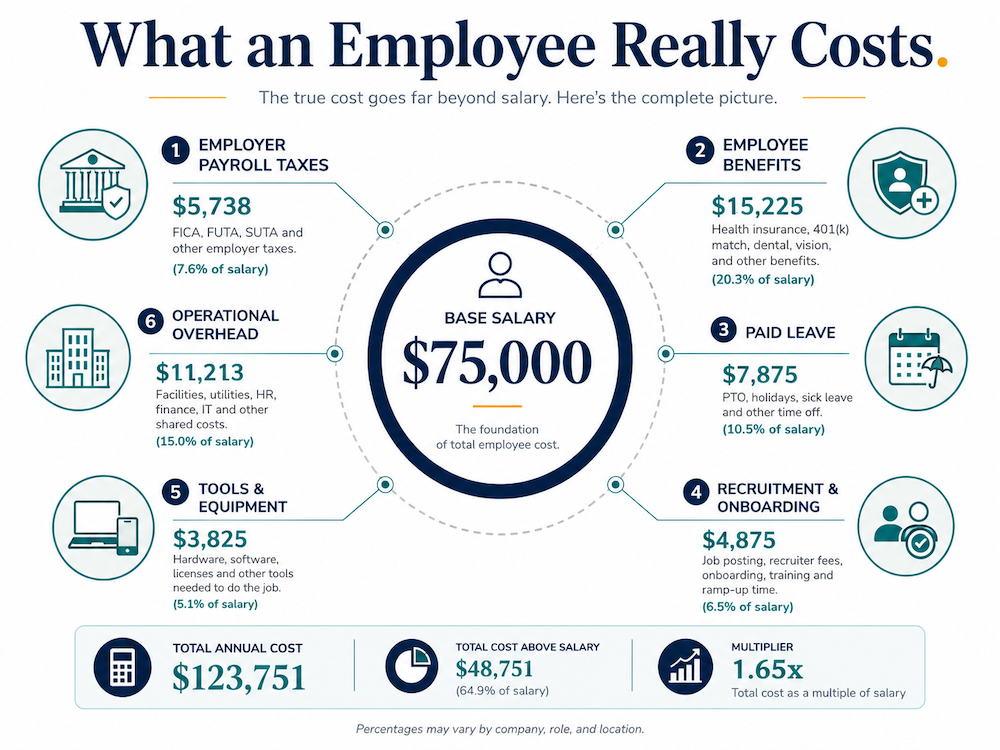
Example: How Much Does It Cost to Pay a $75,000 Employee?
Using selected 2026 federal employer payroll costs only:
| Cost Item | Estimated Amount |
| Base salary | $75,000 |
| Employer Social Security | $4,650 |
| Employer Medicare | $1,087.50 |
| FUTA after maximum credit | $42 |
| Subtotal before benefits and overhead | $80,779.50 |
This subtotal still excludes state unemployment taxes, workers’ compensation, benefits, leave, recruiting, onboarding, equipment, and overhead.
What Percentage Above Salary Should Employers Budget?
A planning multiplier can help during early budgeting:
| Base Salary | 1.25x Estimate | 1.4x Estimate |
| $40,000 | $50,000 | $56,000 |
| $60,000 | $75,000 | $84,000 |
| $80,000 | $100,000 | $112,000 |
| $100,000 | $125,000 | $140,000 |
This type of range is useful for directional planning, but it should not replace a role-specific employee cost calculation.
Why Employee Costs Vary So Much
Employee costs differ because employers face different cost environments. Key variables include:
- Salary level
- Location
- Benefit package
- State tax rules
- Industry risk profile
- Recruiting difficulty
- Turnover rate
- Office, hybrid, or remote setup
- Role seniority
- Productivity ramp-up period
This is why two employees with identical salaries may still create very different employer cost profiles.
Cost Per Employee Checklist for Budgeting
| Budgeting Question | Why It Matters |
| What is the base salary or wage? | Establishes direct compensation |
| Which payroll taxes apply? | Captures statutory cost |
| What benefits are included? | Measures recurring employer burden |
| What paid leave is provided? | Reflects paid non-working time |
| What does hiring cost? | Captures talent acquisition expense |
| What onboarding is needed? | Measures ramp-up investment |
| What tools are required? | Adds enablement cost |
| What overhead should be allocated? | Produces a realistic total |
The Most Common Mistakes Employers Make
They Budget Salary Instead of Total Employee Cost
A salary-only hiring plan often underestimates the cash required to add staff responsibly. Total employee cost is the more accurate management number.
They Treat Benefits as Optional Extras
Benefits are a substantial part of total compensation in practice, not a minor afterthought.
They Ignore Hiring Friction
Recruitment, training, and time to productivity all affect the true cost of building a team.
They Skip Workforce Model Questions
Employers often compare salary levels before comparing team structures, legal setup, payroll complexity, and long-term scalability. That can lead to poor strategic decisions even when the salary math looks acceptable.
When Employer Cost Becomes a Workforce Strategy Issue
Understanding employee costs helps leaders decide:
- Which roles to prioritize
- Which hires require a full-time structure
- Whether the organization can absorb more local headcount
- Whether cross-border hiring should be considered
- Whether payroll and compliance complexity is slowing expansion
This is especially relevant for companies in Hong Kong, Singapore, Australia, and other international markets reviewing how to expand teams more sustainably.
An Alternative to Outsourcing: Build Your Own Team in Malaysia
Some employers want more control than a traditional outsourcing arrangement provides. They want:
- Their own employees
- Their own workflows
- Their own culture and reporting lines
- A team that stays integrated with the business
- Support for recruitment, payroll, and legal employment
FastLaneRecruit helps companies build dedicated remote teams in Malaysia through recruitment, Employer of Record support, payroll, onboarding, HR administration, and compliance. Clients manage the day-to-day work, while FastLaneRecruit supports the employment and compliance layer.
Why Malaysia Can Fit Long-Term Team Planning
Malaysia can be attractive for employers building offshore teams because it offers:
- Skilled professional talent
- English proficiency
- Multilingual workforce capabilities
- Strong fit for regional business operations
- Time-zone compatibility with Asian markets
- Talent pools across accounting, IT, marketing, HR, customer service, and operations
For employers already studying employee costs and cost per employee, this provides a natural next question: not only what a role costs, but where and how that team should be built.
How FastLaneRecruit Supports Employers
FastLaneRecruit helps businesses:
- Recruit Malaysian professionals
- Hire without setting up a local entity
- Use Employer of Record support in Malaysia
- Manage payroll and HR administration
- Handle onboarding and employment documentation
- Build dedicated offshore teams for long-term workforce growth
This is a stronger answer to employer cost pressure than treating headcount as a one-line salary comparison.
Conclusion
The real cost of an employee is broader than base pay. To understand how much it costs to have an employee, businesses need to account for:
- Salary or wages
- Employer payroll costs
- Benefits
- Paid leave
- Recruitment and onboarding
- Tools and equipment
- Overhead
That full view creates better hiring decisions, stronger budgeting, and clearer workforce strategy.
For employers exploring a more scalable path to building teams, FastLaneRecruit can support recruitment, EOR, payroll, and compliance for Malaysia-based employees.
FAQ
How much does an employee cost a company?
An employee costs more than salary alone because employers also pay payroll taxes, benefits, paid leave, recruitment, onboarding, tools, and overhead. A broad planning estimate of 1.25 to 1.4 times salary is often used, but exact costs vary by role and business model.
What are employer payroll costs?
Employer payroll costs are the statutory costs paid on top of wages, including Social Security, Medicare, FUTA, state unemployment taxes, and other employer-side obligations where applicable.
How much does it cost to pay an employee beyond salary?
Beyond salary, employers should account for payroll taxes, benefits, paid leave, hiring costs, onboarding, equipment, and overhead.
What is cost per employee?
Cost per employee is the fully loaded cost of employing one person over a given period, usually one year. It includes both direct compensation and indirect support costs.
Are benefits a major part of employee costs?
Yes. Benefits accounted for 29.9% of total private-industry compensation costs in December 2025.
What is included in the true cost of an employee?
The true cost of an employee includes wages, employer payroll taxes, benefits, paid leave, recruiting, onboarding, equipment, and business overhead.
Why do employee costs vary by company?
Employee costs vary based on compensation level, state taxes, benefits, industry, hiring difficulty, turnover, work setup, and support requirements.