Staffing shortages have become one of the most persistent challenges facing businesses worldwide. From healthcare and hospitality to professional services, logistics, and technology, organizations are struggling to find and retain qualified talent fast enough to meet demand.
The issue is no longer temporary. It reflects deeper structural shifts in labor markets, including demographic changes, evolving skill requirements, employee mobility, and the rise of flexible work expectations.
For modern businesses, solving staffing shortages is not just about hiring more people. It requires a strategic approach to workforce management, stronger employee retention, and smarter use of contingent labor and global talent pools.
Content Outline
Key Summary
Staffing Shortage Is a Workforce Gap Issue
A staffing shortage happens when businesses cannot hire or retain enough skilled employees, leading to workload imbalance and operational strain.
Employee Retention Is the First Line of Defense
Strong employee retention strategies like feedback loops, recognition, and career growth opportunities help reduce turnover and stabilize teams.
Workforce Management Must Be Proactive, Not Reactive
Effective workforce management involves planning ahead with flexible staffing models, internal mobility, and continuous workforce optimization.
Skills Gaps and Market Changes Drive Shortages
Rapid industry changes, demographic shifts, and evolving job expectations often create mismatches between available talent and business needs.
Staffing Shortages Impact Productivity and Morale
Understaffing leads to burnout, reduced productivity, lower engagement, and higher turnover, creating a cycle that worsens over time.
Contingent Labor Improves Workforce Flexibility
Using contingent workers such as freelancers, contractors, and temporary staff helps businesses quickly fill gaps without long-term hiring pressure.
Offshore Hiring Expands Access to Global Talent
Building offshore teams in markets like Malaysia helps companies reduce costs, access skilled professionals, and maintain business continuity at scale.
What Is a Staffing Shortage?
A staffing shortage happens when a company simply doesn’t have enough qualified people to do the work that needs to be done.
This can mean the business is:
- Struggling to hire new employees fast enough
- Losing employees faster than they can replace them
- Unable to find candidates with the right skills
In simple terms, there are more job responsibilities than there are people available to handle them properly.
What it leads to in everyday business operations:
1. Increased workload on existing staff
Employees often need to take on extra tasks or cover multiple roles. Over time, this can lead to stress, fatigue, and burnout.
2. Reduced productivity and service quality
When teams are stretched too thin, work may take longer to complete, and mistakes are more likely to happen.
3. Delayed projects and business goals
Important deadlines can be pushed back because there aren’t enough people to move work forward efficiently.
4. Lower morale and higher turnover
Overworked employees may feel undervalued or exhausted, which increases the chance that they will leave the company.
Why this becomes a cycle
If staffing shortages are not addressed early, they often get worse over time.
Here’s how the cycle works:
- The team becomes understaffed
- Existing employees are given extra work
- Stress and burnout increase
- Some employees resign
- The shortage becomes even more severe
This is why staffing shortages are not just a hiring issue, they are also a workforce management problem that affects the entire organization.
Why Staffing Shortages Happen
Staffing shortages don’t happen for just one reason. They are usually caused by a combination of market changes, workforce behavior, and business challenges.
Understanding these causes helps companies build stronger long-term hiring and employee retention strategies.
1. Skills Mismatch
Today’s job market changes very quickly, especially with technology and digital transformation.
Many companies struggle because:
- New roles require advanced or specialized skills
- Existing training systems cannot keep up with industry changes
- Job seekers may not have the exact skills employers need
This creates a gap between what companies need and what candidates can offer.
2. Demographic Changes
In many countries, the workforce is shrinking due to long-term population trends.
This includes:
- An aging workforce retiring faster than new workers enter the market
- Lower birth rates leading to fewer future job seekers
- Certain industries losing experienced talent without enough replacements
As a result, there are simply fewer people available to fill open roles.
Also Read: Hybrid And Remote Work Trends in Malaysia
3. High Competition for Talent
When unemployment rates are low, more companies are hiring at the same time.
This creates intense competition where:
- Employers are all trying to hire from the same limited talent pool
- Salaries and benefits increase as companies compete for candidates
- Hiring becomes slower and more expensive
In this environment, attracting and retaining talent becomes much harder.
4. Employee Turnover and Changing Expectations
Today’s employees have different expectations compared to the past.
Many now prioritize:
- Flexible working arrangements (remote or hybrid work)
- Career growth and learning opportunities
- Better work-life balance
- Meaningful and supportive work environments
Because of this, companies that do not invest in employee retention may see higher turnover rates, even if salaries are competitive.
5. Structural Market Shifts
Major global events and long-term changes in how work is done have reshaped the labor market.
For example:
- Remote work has opened global job opportunities for employees
- Many workers now switch jobs more frequently than before
- Some industries have not fully recovered from disruptions like COVID-19
- Businesses now rely more on flexible or remote workforce models
These shifts mean that talent is no longer tied to one location or one employer, making workforce planning more complex than before.
The Real Impact of Staffing Shortages
Staffing shortages are often seen as a hiring challenge, but their impact goes much deeper than recruitment alone. When businesses operate with too few people for too long, it affects almost every part of the organization, from day-to-day performance to long-term stability and growth.
In reality, staffing shortages are not just an HR issue. They are a core workforce management challenge that can influence productivity, culture, and even business risk.
1. Burnout and Employee Retention Risks
One of the first and most serious effects of a staffing shortage is employee burnout.
When teams are understaffed, existing employees often need to:
- Take on additional tasks outside their normal role
- Work longer hours or handle heavier workloads
- Cover gaps left by unfilled or vacant positions
At first, employees may try to adapt and support the team. However, if this situation continues for too long, stress levels build up.
Over time, this leads to:
- Physical and mental exhaustion
- Decreased job satisfaction
- Higher levels of frustration and disengagement
- Increased turnover rates
This creates a difficult cycle for businesses, because as employees leave, the staffing shortage becomes even more severe, putting even more pressure on those who remain. This is why strong employee retention strategies are essential during staffing challenges.
Also Read: Operations Management Compliance in Malaysia
2. Reduced Productivity Across Teams
When a team is understaffed, it becomes almost impossible to maintain consistent productivity levels.
Even highly skilled employees can only handle a limited amount of work. As workloads increase, teams often experience:
- Slower turnaround times for tasks and projects
- Difficulty maintaining quality standards
- More frequent errors or rework
- Delays in meeting deadlines and business goals
In the short term, teams may try to “do more with less,” but over time, this approach becomes unsustainable. Productivity naturally drops as fatigue and workload pressure increase.
3. Lower Morale and Reduced Employee Engagement
A staffing shortage doesn’t just affect output, it also impacts how employees feel about their work and workplace.
When teams are constantly overloaded, it becomes harder to maintain a positive and motivated work environment. Employees may start to feel:
- Undervalued or unsupported
- Disconnected from company goals
- Frustrated by lack of resources or assistance
- Less motivated to go beyond basic responsibilities
This decline in morale can weaken overall team culture and reduce engagement levels across the organization. In the long run, it makes it harder to attract and retain talent, further complicating workforce management efforts.
4. Operational Disruptions and Safety Risks
In some industries, the impact of staffing shortages goes beyond productivity and morale; it can directly affect safety and operational reliability.
For example:
- In healthcare, understaffing can lead to delayed patient care or increased risk of medical errors
- In manufacturing, fewer staff on production lines can increase the likelihood of accidents or equipment misuse
- In retail and hospitality, limited staffing may result in longer service times or unsafe working conditions when employees are left to manage multiple responsibilities alone
These risks highlight why staffing shortages should never be treated as a temporary inconvenience. They can escalate into serious operational and compliance issues if not addressed early.
Why This Matters for Businesses
When viewed together, these impacts show that staffing shortages are not just about having fewer employees; they affect the entire business ecosystem.
Without proper planning and intervention, shortages can:
- Increase turnover and hiring pressure
- Lower productivity and service quality
- Damage the company culture and employee engagement
- Introduce operational and safety risks
This is why businesses need a proactive approach to workforce management, combining strong employee retention, flexible staffing models, and access to broader talent pools to maintain stability and growth.
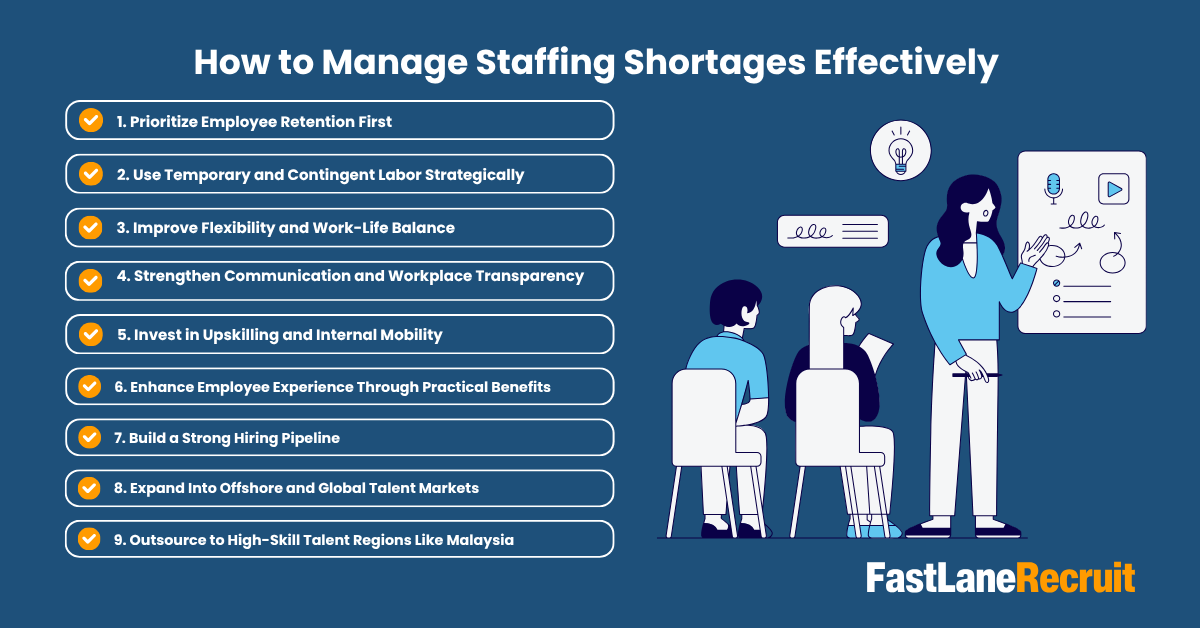
How to Manage Staffing Shortages Effectively
The most successful companies use a combination of retention strategies, flexible hiring models, and global workforce planning.
1. Prioritize Employee Retention First
Strong employee retention is the foundation of solving staffing shortages.
Effective strategies include:
- Regular check-ins and open feedback loops
- Transparent leadership communication
- Recognition and reward systems
- Clear career progression opportunities
- Acting on employee feedback consistently
When employees feel heard and valued, they are far more likely to stay, even during high-pressure periods.
2. Use Temporary and Contingent Labor Strategically
Not every role requires a permanent hire.
Using contingent labor helps businesses stay flexible during staffing gaps:
- Temporary staff for urgent workload spikes
- Freelancers for specialized short-term work
- Part-time or seasonal employees for coverage
- Contractors as skilled contingent workers for project-based needs
This approach ensures continuity without long-term hiring pressure.
3. Improve Flexibility and Work-Life Balance
Flexibility is now one of the strongest retention tools in modern workforce management.
Businesses should consider:
- Remote or hybrid work options
- Flexible scheduling systems
- Predictable shift planning where possible
- Reduced burnout through workload monitoring
Flexibility directly improves both retention and productivity.
Also Read: Ultimate Guide to Employee Onboarding Checklist
4. Strengthen Communication and Workplace Transparency
Clear communication reduces uncertainty and builds trust during staffing shortages.
Best practices include:
- Sharing hiring progress with teams
- Explaining workload expectations openly
- Encouraging internal role mobility
- Creating safe spaces for employee feedback
Transparent workplaces tend to maintain higher engagement even during shortages.
5. Invest in Upskilling and Internal Mobility
When hiring externally becomes difficult, internal development becomes essential.
Effective strategies include:
- Cross-training employees across roles
- Upskilling programs and certifications
- Internal promotions and job rotations
- Leadership development pipelines
This improves long-term workforce management and reduces dependency on external labor markets.
6. Enhance Employee Experience Through Practical Benefits
Retention is often influenced by small but meaningful improvements.
Examples include:
- Additional paid time off or mental health days
- Wellness and learning allowances
- Flexible benefits tailored to employee needs
- Performance-based incentives
- Workplace improvements and engagement activities
Even simple perks can significantly improve retention during shortages.
7. Build a Strong Hiring Pipeline
Instead of reactive hiring, companies should build continuous talent pipelines.
Key approaches:
- Employer branding on professional platforms
- Employee referral programs
- Talent communities for future hiring
- Data-driven recruitment tracking
This reduces time-to-hire and strengthens long-term workforce stability.
8. Expand Into Offshore and Global Talent Markets
One of the most effective long-term ways to solve staffing shortages is to move beyond the limits of local hiring and start thinking globally. When companies rely only on their home market, they are often competing for the same small pool of candidates, especially in industries where demand for talent is already high.
By expanding into offshore and global talent markets, businesses can access skilled professionals in regions where talent is more available, more cost-efficient, and often highly experienced in supporting international companies.
Building offshore teams gives organizations more flexibility in how they structure and scale their workforce, while also reducing pressure on internal hiring teams.
Access Wider and More Diverse Talent Pools
Offshore hiring opens the door to a much larger global workforce. Instead of being restricted to local candidates, companies can tap into professionals with specialized skills across different regions.
This is especially useful when:
- Local candidates are in short supply
- Certain technical or operational skills are hard to find
- Businesses need to hire quickly without compromising quality
A wider talent pool also increases the chances of finding candidates who are a strong cultural and operational fit.
Reduce Hiring Costs Without Sacrificing Quality
One of the key advantages of offshore hiring is cost efficiency. Many global talent markets offer highly skilled professionals at more competitive salary levels compared to major business hubs.
This allows companies to:
- Lower overall recruitment and payroll costs
- Reallocate budget to growth and innovation
- Hire additional support roles without increasing financial strain
Importantly, lower cost does not mean lower quality; many offshore professionals are experienced in working with global teams and international standards.
Also Read: Workplace Dynamics and Their Impact on Your Organization
Maintain Business Continuity and Reduce Hiring Pressure
Staffing shortages can disrupt operations when key roles remain unfilled for long periods. Offshore teams help solve this by ensuring that critical functions continue to run smoothly.
With the right structure, offshore teams can:
- Support core business operations in real time
- Fill urgent gaps in staffing quickly
- Reduce dependency on a limited local workforce
This creates more stability, especially during periods of high turnover or hiring freezes.
Scale Operations Faster and More Flexibly
Global talent markets allow companies to scale their workforce more quickly than traditional local hiring.
Instead of waiting months to fill roles, businesses can:
- Onboard offshore talent in shorter timeframes
- Adjust team size based on workload demands
- Expand into new markets without heavy infrastructure costs
This flexibility is especially valuable for growing companies that need to respond quickly to market changes.
Also Read: Difference Between Talent Sourcer vs Recruiter
Why Markets Like Malaysia Stand Out
Among offshore destinations, Malaysia has become a preferred choice for many global companies due to its strong combination of talent quality and business practicality.
Key advantages include:
- Strong English proficiency across the workforce
- A skilled talent base in finance, IT, HR, and business support roles
- Competitive and cost-effective hiring structures
- A stable business environment with good infrastructure
- Time-zone compatibility with Asia-Pacific markets
These strengths make Malaysia a reliable and scalable option for companies looking to build offshore teams without compromising on quality or communication.
The Bigger Picture
Expanding into offshore and global talent markets is not just a short-term fix for staffing shortages; it is a long-term workforce strategy.
It helps companies:
- Build more resilient hiring systems
- Reduce reliance on limited local labor markets
- Improve overall workforce management efficiency
- Create scalable, future-ready team structures
In today’s competitive hiring landscape, global talent access is becoming less of an advantage, and more of a necessity.
9. Outsource to High-Skill Talent Regions Like Malaysia
One of the most effective ways to ease staffing shortages is to look beyond local hiring markets and tap into global talent hubs. Malaysia has become one of the fastest-growing outsourcing destinations for companies that need skilled professionals without the high costs and limited availability found in many developed markets.
By outsourcing to Malaysia, businesses can quickly access experienced professionals while keeping operations flexible, scalable, and cost-efficient.
Skilled and Diverse Talent Pool
Malaysia has a strong and growing workforce across key business functions, including:
- Finance and accounting
- Information technology and software development
- Human resources and recruitment support
- Customer service and business operations
Many professionals also have experience working in international or regional companies, making them familiar with global business standards and expectations.
Strong English Communication Skills
English is widely used in Malaysia’s education system and corporate environment. This makes collaboration with global teams smoother and reduces communication barriers.
For companies managing remote or offshore teams, this is especially important for maintaining efficiency, clarity, and alignment across departments.
Time Zone Advantage for Seamless Collaboration
Malaysia’s time zone aligns closely with many Asia-Pacific business hubs and overlaps with working hours in regions such as Singapore, Hong Kong, China, and parts of Australia.
This allows teams to:
- Communicate in real time during working hours
- Reduce project delays caused by time differences
- Maintain faster turnaround for daily operations
For global companies, this makes Malaysia a highly practical offshore location.
Cost Efficiency Without Compromising Quality
One of the biggest advantages of outsourcing to Malaysia is the balance between cost and quality.
Companies benefit from:
- Lower hiring and operational costs compared to Western markets
- Access to highly capable and trained professionals
- Reduced overhead for office space and administration
This helps businesses scale their workforce without significantly increasing payroll pressure.
Flexible Workforce Models for Modern Businesses
Outsourcing to Malaysia is not limited to full-time roles. Companies can also build flexible workforce structures using:
- Project-based teams
- Part-time or contract professionals
- Long-term offshore support teams
- Contingent workers for specialized tasks
This flexibility helps businesses respond quickly to changing workloads and reduces dependency on local hiring conditions.
Why It Matters for Staffing Shortages
When local talent markets are tight, outsourcing helps companies:
- Maintain business continuity
- Reduce pressure on internal teams
- Fill skill gaps faster
- Improve overall workforce management efficiency
- Scale operations without long recruitment delays
In short, outsourcing to Malaysia provides a practical and sustainable way to overcome staffing shortages while keeping quality and control intact.
Also Read: RPO vs. In-House Recruitment: Which Hiring Strategy Works Best?
How FastLaneRecruit Helps Solve Staffing Shortages
At FastLaneRecruit, we help global businesses solve staffing shortages through practical hiring support and offshore workforce solutions.
Instead of relying only on local hiring markets that may be limited or highly competitive, we help companies expand their access to talent globally, especially in high-quality, cost-effective regions like Malaysia.
Our goal is simple: help you build reliable teams faster, reduce hiring pressure, and keep your business running smoothly even when local talent is scarce.
Here’s how we support you:
1. Building Offshore Teams in Malaysia
We help companies build dedicated offshore teams based in Malaysia to support their day-to-day operations.
These teams can include professionals across:
- Operations and administration
- Finance and accounting
- Marketing and content support
- IT and technical roles
- Customer support and back-office functions
By tapping into Malaysia’s skilled workforce, companies can quickly fill critical roles without being restricted by local hiring shortages.
This approach is especially useful for businesses that need to scale fast but want to maintain quality and consistency.
2. End-to-End Workforce Management Solutions
Managing hiring, onboarding, and compliance across different countries can be complex and time-consuming.
FastLaneRecruit simplifies this by handling the full process, including:
- Candidate sourcing and screening
- Interview coordination and hiring support
- Employee onboarding and documentation
- Payroll processing and administration
- Local employment compliance
This allows your internal team to focus on core business operations while we manage the operational side of workforce management.
The result is a smoother, faster, and more reliable hiring experience.
3. Employer of Record (EoR) Services
Our Employer of Record (EoR) solution allows you to hire talent in Malaysia without setting up a local company or legal entity.
This means you can:
- Hire full-time employees quickly
- Engage contingent workers for flexible or project-based needs
- Stay compliant with local employment laws
- Reduce administrative and legal setup costs
We act as the legal employer while you manage the employee’s day-to-day work and performance.
This model is ideal for companies that want to expand globally without the complexity of international entity setup. FastLaneRecruit helps businesses move beyond local hiring limitations by building strong offshore teams and providing full workforce support in Malaysia.
By combining:
- Strategic recruitment
- End-to-end workforce management
- Employer of Record (EoR) services
- Access to Malaysia’s skilled talent pool
We help companies stay productive, reduce hiring pressure, and scale confidently, even during ongoing staffing shortages.
Conclusion
Staffing shortages are not just a recruitment problem, they are a workforce management challenge that requires a long-term strategy.
Companies that succeed focus on:
- Strong employee retention
- Flexible workforce models
- Internal skill development
- Strategic use of contingent labor
- Access to global talent through offshore hiring
With the right approach, staffing shortages can shift from a business risk into a competitive advantage.
Ready to Solve Your Staffing Shortage?
If staffing shortages are slowing your business down, you don’t have to face them alone or rely only on a limited local talent pool.
FastLaneRecruit helps global companies build reliable, scalable teams through offshore hiring and Employer of Record (EoR) solutions in Malaysia. Whether you need to fill urgent gaps or build a long-term workforce strategy, we make it easier to hire the right talent quickly and compliantly.
From sourcing and onboarding to payroll and workforce management, we handle the heavy lifting so your team can stay focused on growth.
Let’s build your team, without the hiring stress.
Get in touch with FastLaneRecruit today to explore how offshore hiring in Malaysia can help you close talent gaps and strengthen your workforce. Talk to our recruitment team and start building your offshore team today.