Businesses across the globe are looking for smarter ways to scale their software development capabilities. One of the most efficient strategies is hiring offshore full-stack developers, professionals who can handle everything from front-end user interfaces to back-end systems.
Among global destinations, Malaysia stands out as a prime location for offshore tech hiring, offering a blend of skilled talent, cost efficiency, strong infrastructure, and English proficiency. Whether you’re a startup building an MVP or a growing enterprise expanding your tech team, Malaysia provides the perfect environment to build a reliable and cost-effective offshore development team.
Content Outline
Key Summary
Malaysia’s Skilled and Diverse Tech Talent
Malaysia’s Premier Digital Tech Institutions and growing tech ecosystem produce developers proficient in full-stack technologies, cloud computing, and DevOps.
Strong English Proficiency for Seamless Collaboration
Ranking 3rd in Asia for English skills, Malaysian developers enable smooth communication and effective teamwork across global projects.
Competitive Costs Without Compromising Quality
Businesses can save up to 60% on development costs compared to Western markets while maintaining strong technical standards.
Government Support and Business-Friendly Policies
Initiatives like MDEC and MSC Malaysia attract global investors and ensure a stable, innovation-driven environment for offshore teams.
Full Stack Developers Offer End-to-End Efficiency
These versatile professionals handle both frontend and backend development, streamlining workflows and reducing project turnaround time.
Strategic Time Zone and Digital Infrastructure
Malaysia’s GMT+8 time zone aligns with key APAC markets and its strong infrastructure supports reliable, real-time collaboration.
Flexible Hiring Through EOR Model
FastLaneRecruit’s EOR service enables global companies to hire Malaysian developers legally and efficiently without setting up a local entity.
Why Malaysia Is Emerging as an Offshore Tech Hub
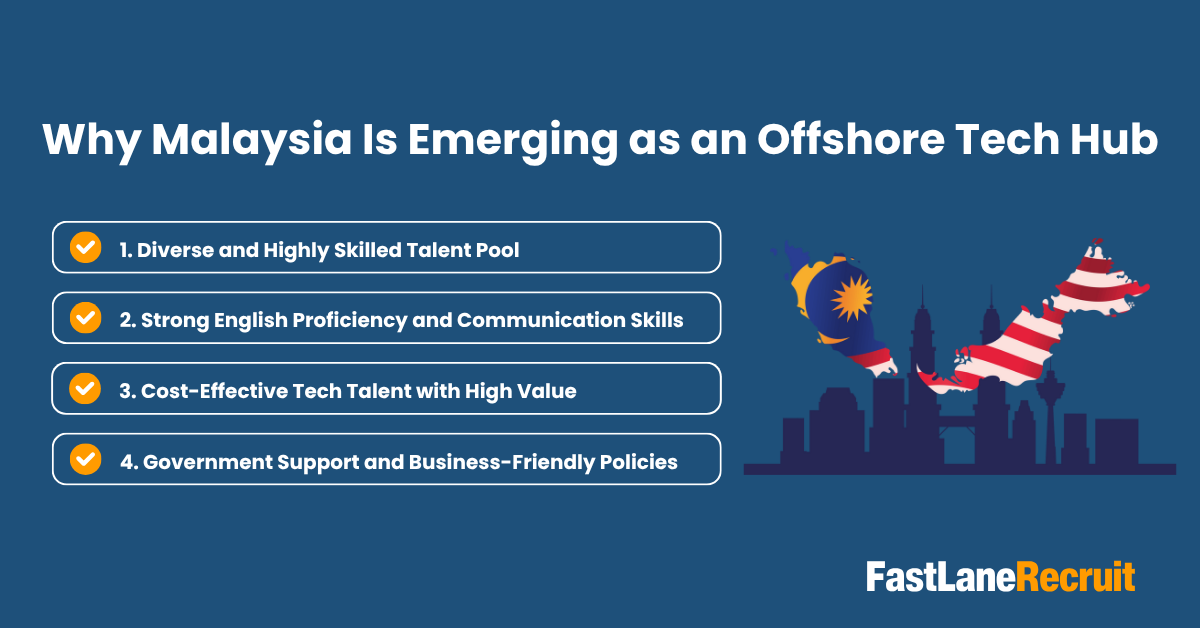
1. Diverse and Highly Skilled Talent Pool
Malaysia has evolved into one of Asia’s fastest-growing technology hubs. According to MDEC, over 150 tech companies operate within Malaysia’s Technology Park Malaysia (TPM), employing over 10,000 professionals in roles spanning software development, cybersecurity, and data science.
The country’s Premier Digital Tech Institutions (PDTI) initiative, launched in collaboration with the Ministry of Higher Education, ensures that universities produce graduates with industry-ready tech skills, from Java and Python to cloud computing and DevOps.
This focus on education and skill-building gives global employers access to a large pool of versatile, full stack developers capable of managing both front-end and back-end systems efficiently.
2. Strong English Proficiency and Communication Skills
One of the biggest advantages of hiring Malaysian developers is communication. English is a compulsory subject throughout Malaysia’s education system, and the country ranks 3rd in Asia on the EF English Proficiency Index.
For global teams, this means fewer communication barriers, smoother collaboration, and faster integration into international projects.
3. Cost-Effective Tech Talent with High Value
Hiring offshore developers in Malaysia offers substantial savings without compromising quality.
Here’s a comparison of average annual salaries for full-stack developers across regions:
| Region | Average Annual Salary (USD) | Estimated Cost Savings vs US |
| United States | $97,000 | — |
| Western Europe | $70,000 | 25–30% |
| Eastern Europe | $50,000 | 45–50% |
| Malaysia | $41,000–$60,000 | Up to 60% |
Source: World Bank, SalaryExpert, MDEC
The combination of lower living costs, affordable salaries, and strong technical proficiency makes Malaysia one of the most financially attractive locations for offshore development.
Also Read: Why Malaysia Is Becoming a Hotspot for Offshore DevOps Engineers
4. Government Support and Business-Friendly Policies
Malaysia’s government has actively fostered a digital ecosystem that encourages foreign investment and tech innovation.
Key initiatives include:
- Malaysia Digital Economy Corporation (MDEC) – Supports digital transformation and investment in ICT industries.
- PIKOM – National ICT Association of Malaysia – A hub connecting over 1,000 ICT companies to foster collaboration and industry growth.
- Malaysia Bill of Guarantee – A commitment to ensure a business-friendly environment for tech companies operating in the Multimedia Super Corridor (MSC).
With a stable political climate, reliable infrastructure, and strong IP protection laws, Malaysia provides a secure environment for long-term offshore development.
Why Full Stack Developers Are Ideal for Offshore Teams
Full stack developers are often called the “Swiss Army knives” of software development and for good reason. They have the skills to build an entire digital product from start to finish, making them a perfect fit for offshore teams that need efficiency, versatility, and quality.
A strong full-stack developer can manage both:
| Development Area | What They Handle | Common Tools & Frameworks |
| Frontend (User Experience) | Everything users see and interact with, from buttons to dashboards | HTML, CSS, JavaScript, React, Angular, or Vue.js |
| Backend (Server Logic & Databases) | Behind-the-scenes operations like data storage, authentication, and APIs | Node.js, Python, Java, PHP, Django, or Spring Boot |
But modern full stack developers go even further. Many also have experience in cloud infrastructure and DevOps, using tools such as AWS, Microsoft Azure, and Docker to ensure smooth, scalable, and secure deployments.
Example:
Imagine you’re building an e-commerce platform.
- A front-end developer might only design the website interface, the product catalog, shopping cart, and checkout page.
- A back-end developer might handle the payment system, order database, and customer management logic.
- A full stack developer, however, can do both, designing the user experience and ensuring the back-end systems communicate seamlessly.
That’s why hiring full stack developers offshore in Malaysia allows you to:
- Build complete applications faster: One skilled developer can move a project from concept to completion without relying on multiple handoffs.
- Maintain consistent quality across the stack: When one developer understands the entire architecture, they can troubleshoot and optimize the system more effectively.
- Scale projects flexibly: Whether you need to develop a new module or scale to handle more traffic, offshore full-stack developers can quickly adapt without adding extra specialists.
Pro Tip:
When working with Malaysian full-stack developers, look for candidates who have experience with agile development practices. Many Malaysian teams are well-versed in agile and remote collaboration tools like Jira, Slack, and GitHub, which helps offshore projects stay organized and on schedule.
Also Read: DevOps Engineer Salary Guide 2025
Key Benefits of Hiring Offshore Full-Stack Developers in Malaysia
When it comes to offshore software development, Malaysia has become one of Asia’s best-kept secrets, a rising tech hub that offers high-quality talent, cost efficiency, and a business-friendly environment. Whether you’re a startup or a growing enterprise, hiring full-stack developers in Malaysia can give you a significant strategic edge.
Here are some of the key benefits:
1. Cost-Effective Without Compromising Quality
Hiring full-stack developers in Malaysia can reduce development costs by 30–60% compared to hiring in Western markets like Australia, the UK, or the US. Yet, Malaysian developers maintain strong quality standards thanks to the country’s robust education system and English fluency.
Example:
A company in Sydney can hire a Malaysian full-stack developer at roughly USD 2,500–3,500/month, compared to USD 6,000–9,000/month locally, without sacrificing expertise or communication clarity.
2. Skilled, Multilingual, and Culturally Aligned Workforce
Malaysia’s workforce is known for being highly educated and multilingual, often fluent in English, Malay, and Mandarin — a valuable asset for global teams.
Moreover, Malaysian developers are familiar with international work cultures, particularly from Australia, Singapore, and the UK, due to long-standing business ties and education exchange programs.
According to TalentCorp Malaysia, over 50% of Malaysia’s tech professionals have experience collaborating with international teams.
3. Strong Government Support for the Tech Industry
Malaysia’s government actively supports the tech ecosystem through initiatives like:
- Malaysia Digital (MD) by MDEC – promotes digital investment and innovation.
- MSC Malaysia – offers tax incentives and world-class infrastructure for tech companies.
- InvestKL – assists foreign companies in setting up regional hubs in Greater Kuala Lumpur.
This pro-business environment gives offshore employers the confidence to hire long-term and scale operations smoothly.
Learn more at: InvestKL
4. Strategic Location and Time Zone Advantage
Malaysia’s time zone (GMT+8) overlaps perfectly with key markets in Asia-Pacific, including Singapore, Hong Kong, and Australia, making real-time collaboration easy.
For Western teams, Malaysia’s workday overlaps partially with Europe and early U.S. hours, enabling a “follow-the-sun” development model where work continues around the clock.
Example:
A UK-based team can hand off tasks to Malaysian developers at the end of their day, allowing progress to continue overnight. This helps reduce project turnaround time significantly.
5. Stable Infrastructure and Digital Readiness
Malaysia consistently ranks among the top Southeast Asian countries for internet speed and digital infrastructure. The government’s MyDIGITAL Blueprint aims to make Malaysia a regional leader in digital transformation by 2030.
This ensures offshore teams enjoy:
- Reliable internet and cloud connectivity
- Modern office and coworking facilities
- Secure, compliant digital ecosystems
Source: Malaysia Digital Economy Blueprint (MyDIGITAL)
6. Ease of Hiring Through FastLaneRecruit’s EOR Services
Hiring Malaysian developers can be effortless when you work with an Employer of Record (EOR) like FastLaneRecruit.
With our EOR and offshore recruitment services, we help global businesses:
- Hire Malaysian full-stack developers legally and compliantly
- Handle payroll, contracts, and local labor law compliance
- Onboard remote employees quickly without setting up a local entity
This means you can focus on building your offshore team, while FastLaneRecruit manages the paperwork and compliance seamlessly.
Pro Tip:
When hiring in Malaysia, consider developers experienced with Xero, AWS, or React, as these tools are in high demand among international clients and show adaptability to global standards.
Also Read: Hiring DevOps Engineers in Malaysia: Skills, Tools, and Best Practices
Cost and Hiring Models in Malaysia
When it comes to building an offshore software team in Malaysia, businesses have several hiring options, from working with freelancers to hiring full-time staff or leveraging an Employer of Record (EOR) like FastLaneRecruit. Each model has its advantages depending on your goals, budget, and management style.
Let’s explore each one in detail:
1. Freelancers: Ideal for Short-Term or Specialized Tasks
Best for: Small projects, startups, or businesses needing temporary support (e.g., bug fixes, UI updates, or short app modules).
Freelancers in Malaysia are easy to find through platforms like Upwork or Toptal, and they offer affordable hourly rates compared to Western markets.
Pros:
- Highly flexible, hire as needed, no long-term contracts
- Lower costs, perfect for small projects or testing new ideas
- Wide range of skill levels available
Cons:
- Reliability can vary; freelancers may juggle multiple clients
- Less control over schedules, communication, and deadlines
- Limited accountability for long-term product maintenance
Example:
A startup in London could hire a Malaysian React developer for a quick UI redesign at USD 20–35/hour, saving nearly 50% compared to UK rates.
Tip: Always request a short technical test or project sample before committing to a freelancer.
2. In-House Hire: Great for Long-Term, High-Control Projects
Best for: Established businesses building large or ongoing software products where full-time collaboration is essential.
Hiring Malaysian developers as in-house staff provides strong control over project direction, team culture, and workflow. However, it comes with higher fixed costs, such as salaries, benefits, and office space.
Pros:
- Full oversight and collaboration
- Better alignment with company goals and culture
- Consistent communication and real-time feedback
Cons:
- Expensive when factoring in salaries, office setup, and taxes
- Time-consuming recruitment and onboarding
- Complex HR and legal compliance for foreign employers
Example:
If you plan to establish a permanent tech team in Malaysia, you’ll need to register a local entity, comply with the Malaysian Employment Act 1955, and manage payroll, which can be resource-intensive for small or mid-sized foreign companies.
3. Employer of Record (EOR) via FastLaneRecruit: The Simplest Way to Hire in Malaysia
Best for: Global companies wanting to hire Malaysian developers without setting up a local branch or worrying about compliance.
An EOR model like FastLaneRecruit allows your company to legally employ Malaysian talent while we handle all administrative and legal requirements including contracts, payroll, tax filing, and HR compliance.
Pros:
- Fast, compliant global hiring, no local entity required
- All HR, payroll, and legal processes are managed by FastLaneRecruit
- Seamless onboarding and consistent employment experience for staff
Cons:
- Slightly less direct control over HR processes (managed by EOR partner)
Example:
A Singaporean fintech company hires five Malaysian full-stack developers through FastLaneRecruit’s EOR service. Within a week, the developers are legally onboarded, paid locally in MYR, and compliant with Malaysia’s employment laws, all while the parent company remains free from local incorporation or payroll administration.
Also Read: How to Outsource a DevOps Engineer Team Successfully
Why EOR Is the Smarter Choice
With FastLaneRecruit’s EOR service, your company can hire skilled Malaysian developers quickly, legally, and efficiently without the complexity of setting up a local entity.
We handle:
- Employment contracts and onboarding
- Monthly payroll processing and benefits administration
- Compliance with Malaysian tax and labor laws
So you can focus on project success, while we take care of the rest.
Learn more about FastLaneRecruit’s EOR Service for Hiring in Malaysia and start building your offshore team today.
Tips for Hiring Offshore Full Stack Developers in Malaysia
Building a successful offshore tech team isn’t just about hiring top talent; it’s about creating the right environment for collaboration, compliance, and long-term growth. Here are some practical tips and recommendations to help you get the most out of your offshore full-stack developers in Malaysia.
1. Evaluate Technical and Soft Skills Together
A great full-stack developer should be as strong in communication and problem-solving as they are in coding. When assessing Malaysian developers, look beyond the technical resume, focus on how they work in teams, manage time, and approach challenges.
What to look for:
- Proficiency in frontend tools (React, Angular, Vue.js) and backend frameworks (Node.js, Django, Spring Boot).
- Familiarity with DevOps and cloud environments (AWS, Azure, Docker).
- Solid English communication and teamwork skills.
Recommendations:
- Review GitHub repositories or past project portfolios to assess real-world coding quality.
- Conduct pair programming or live coding tests to evaluate problem-solving in action.
- Ask scenario-based questions such as “How would you handle performance bottlenecks in an API-heavy web app?”
Tip: Many Malaysian developers participate in hackathons and university tech competitions; reviewing these achievements can help identify proactive and innovative talent.
2. Leverage Trusted Hiring Networks
Finding reliable developers starts with using trusted local and international hiring platforms. Malaysia has a growing digital ecosystem supported by strong professional networks.
Where to look:
- LinkedIn Malaysia – ideal for sourcing mid- to senior-level developers.
- JobStreet Malaysia – one of the largest local job portals for IT talent.
- PIKOM (The National Tech Association of Malaysia) – connects you with tech professionals and companies through community events and digital summits.
Recommendations:
- Use specific job keywords like “Full Stack Developer (React + Node.js)” to attract the right candidates.
- Join Malaysian tech groups on LinkedIn or attend PIKOM TechFest to meet potential hires.
- Verify credentials through MDEC’s Digital Talent Portal (mdec.my).
Tip: Collaborating with an EOR partner like FastLaneRecruit gives you instant access to pre-vetted Malaysian developers, saving you weeks of screening and compliance setup.
3. Mind Time Zones and Use the Right Collaboration Tools
One of the biggest advantages of hiring in Malaysia is its favorable time zone (UTC+8). It overlaps comfortably with business hours across Singapore, Australia, Hong Kong, and even parts of Europe, making real-time collaboration much easier.
Recommended collaboration tools:
- Slack or Microsoft Teams – for daily communication and quick updates.
- Jira or Trello – for agile sprint management and project tracking.
- Zoom or Google Meet – for weekly standups and reviews.
Example:
If your HQ is in Sydney (UTC+11) or Singapore (UTC+8), your Malaysian developers can work in near real-time, ensuring fast response cycles and agile development workflows.
Tip: Schedule a fixed “collaboration overlap”, such as 2–3 hours of shared working time daily, to keep projects aligned and feedback loops short.
4. Ensure Compliance and Data Security
When hiring offshore, compliance with local laws and data protection must be top priorities. Malaysia has clear employment and data governance standards that foreign companies must follow.
Key compliance areas:
- Adherence to Malaysia’s Employment Act 1955 and Income Tax Act 1967.
- Proper worker classification and local contract registration.
- Compliance with Personal Data Protection Act (PDPA) Malaysia 2010 for handling employee or project data.
Recommendations:
- Always issue local employment contracts that align with TalentCorp Malaysia’s guidelines (talentcorp.com.my).
- Use secure file-sharing tools and implement two-factor authentication (2FA) for all project access.
- Partner with a trusted EOR provider like FastLaneRecruit, which manages tax, payroll, and compliance ensuring full legal protection for your business.
Tip: FastLaneRecruit ensures your hires are legally employed under Malaysian labor law and your intellectual property remains secure.
Also Read: A Guide to Hiring DevOps Engineers in Malaysia
5. Focus on Long-Term Retention and Engagement
Offshore teams perform best when they feel connected to the company’s mission and culture. Treat your Malaysian developers as core team members, not just remote resources.
Recommendations:
- Provide ongoing learning opportunities such as cloud certifications or language courses.
- Foster open communication — include offshore developers in sprint reviews, virtual town halls, and recognition programs.
- Offer performance-based bonuses or career progression paths to maintain motivation.
Example:
A Hong Kong SaaS startup working with a Malaysian offshore team noticed a 30% boost in retention after offering online training through Coursera and quarterly recognition shoutouts.
Tip: Schedule virtual team-building activities, even something as simple as “Friday Wins” sessions on Slack helps strengthen team cohesion.
Final Recommendation
Malaysia offers a rich mix of affordability, skill, and professionalism, making it one of the most strategic offshore destinations for full stack development.
However, success depends on strategic hiring, clear communication, and legal compliance and this is where FastLaneRecruit helps global companies excel.
Partner with FastLaneRecruit’s EOR service to hire, onboard, and manage talented Malaysian full-stack developers legally, efficiently, and at scale while we take care of HR, payroll, and compliance for you.
Challenges to Consider and How to Solve Them
While Malaysia offers many advantages for offshore hiring, from skilled talent to cost efficiency, global employers should also prepare for a few common challenges when managing distributed development teams. The good news is that with the right approach and local support, these challenges can be easily addressed.
1. Time Zone Gaps with North American Teams (Up to 12–14 Hours)
Malaysia operates on UTC+8, which aligns well with Asia-Pacific and Australian business hours but can present a challenge for North American teams, where time differences may stretch up to 12–14 hours.
This can make real-time communication, stand-ups, and sprint reviews harder to coordinate.
How to Solve:
- Set up overlapping working hours: Schedule at least a 2-hour daily overlap, for example, early morning in Malaysia and late evening in California, for key meetings or progress updates.
- Use asynchronous collaboration tools: Platforms like Notion, Confluence, and Loom allow teams to share updates, documentation, and recorded demos, ensuring transparency even across time zones.
- Establish clear communication protocols: Use tools like Slack with dedicated channels for urgent queries and regular project updates.
- Example: A San Francisco-based SaaS company set up “Malaysia Morning Syncs” every Monday (their Sunday evening), using asynchronous video updates for daily check-ins, achieving a 95% on-time sprint completion rate.
Tip: Use scheduling tools like World Time Buddy to quickly identify overlapping working hours across regions.
2. Remote Management and Motivation for Distributed Teams
Managing offshore teams remotely requires more than just assigning tasks, it demands clear leadership, structured processes, and intentional engagement. Without in-person interaction, offshore developers may feel disconnected, leading to slower progress or lower morale.
How to Solve:
- Set clear expectations: Define deliverables, deadlines, and quality benchmarks at the start of every sprint.
- Foster team engagement: Include offshore developers in company meetings, online training sessions, and social channels to build inclusion and belonging.
- Use agile tools effectively: Platforms like Jira, ClickUp, or Asana help track tasks and measure productivity transparently.
- Recognize achievements: Regular recognition through Slack or virtual team meetings builds motivation and loyalty.
- Example: A UK-based fintech firm working with a Malaysian offshore team introduced monthly “Show & Tell Fridays,” where developers demo their work — boosting engagement and ownership across time zones.
Tip: Treat your offshore developers as strategic team members, not just contractors. Recognition and communication go a long way in building trust and performance.
3. Ensuring Consistent Work Quality and Delivery Standards
Quality assurance is often a top concern when outsourcing development offshore. Differences in technical training, work processes, or expectations can occasionally lead to inconsistencies in project outcomes.
How to Solve:
- Partner with vetted providers: Collaborate with trusted partners like FastLaneRecruit, who pre-screen and onboard skilled Malaysian full stack developers under strict vetting criteria.
- Set measurable KPIs: Use metrics like sprint velocity, code review scores, and bug rates to evaluate performance objectively.
- Implement continuous feedback loops: Schedule weekly code reviews and retrospective meetings to identify improvements early.
- Provide standardized documentation: Use shared repositories and version control systems (e.g., GitHub, Bitbucket) to maintain code quality and uniformity.
- Example: A Singaporean startup using FastLaneRecruit’s EOR service saw a 40% improvement in code quality consistency within three months due to structured onboarding and KPI-based monitoring.
Tip: Establish shared coding standards and use automated testing pipelines (CI/CD) to ensure reliability and maintainability across all environments.
4. Legal Compliance and Data Security
Navigating local labor laws, tax regulations, and data privacy requirements can be complex for global employers. Mistakes in compliance, from misclassifying workers to overlooking tax obligations, can lead to penalties.
How to Solve:
- Partner with an Employer of Record (EOR): FastLaneRecruit handles legal hiring, payroll, and tax compliance for your Malaysian team, ensuring full adherence to Malaysia’s Employment Act 1955 and Income Tax Act 1967.
- Protect sensitive data: Malaysia’s Personal Data Protection Act (PDPA) 2010 sets strict standards for handling personal data. FastLaneRecruit ensures all employment and payroll data is securely managed.
- Use secure infrastructure: Adopt encrypted communication tools (e.g., ProtonMail, Google Workspace) and limit system access based on roles.
The Bottom Line
While offshore hiring in Malaysia comes with some logistical and management considerations, these challenges are easily solvable with the right strategy and support.
By partnering with FastLaneRecruit, you can confidently hire, onboard, and manage offshore full stack developers in Malaysia — with full legal compliance, streamlined HR processes, and performance-driven team management.
Start building your offshore team in Malaysia today with FastLaneRecruit’s EOR Service and turn challenges into opportunities for global growth.
Also Read: How to Successfully Outsource Data Engineering
Conclusion
Malaysia’s strong education system, government support, English proficiency, and cost efficiency make it a top-tier destination for hiring offshore full stack developers.
Whether you’re scaling your tech team, launching a new platform, or looking for affordable yet skilled developers, Malaysia provides the ideal blend of talent, value, and reliability.
By partnering with FastLaneRecruit’s Employer of Record (EOR) service, global companies can hire Malaysian developers with zero legal risk, manage payroll seamlessly, and focus entirely on project innovation.
Ready to Build Your Offshore Tech Team?
Let FastLaneRecruit help you hire skilled Malaysian full-stack developers with ease.
We handle compliance, payroll, and HR, you get the best talent.