Expanding into a new country often starts with a few employees, a promising business opportunity or a small team testing the local market. Establishing a legal entity immediately may not be necessary, especially when the long-term potential of the market is still uncertain.
An Employer of Record (EOR) provides a practical way to hire internationally without setting up a local company. It allows businesses to employ local talent while an EOR manages employment contracts, payroll, statutory contributions and other employment administration.
However, as operations grow, the right employment structure may change. A larger workforce, increasing operational costs, local commercial requirements or long-term expansion plans may make establishing your own entity worth considering.
So, when should you move from EOR to a local entity?
There is no universal employee threshold or fixed timeline. The decision depends on your workforce size, expected market commitment, business activities, financial position and local regulatory requirements.
This guide explains the signs that your business may be ready to move from EOR to its own entity, how the two employment models compare, and what to consider before transitioning. It also explains how businesses can continue using EOR services while evaluating their next stage of international expansion.
Content Outline
Key Summary
Consider an entity when operations become long-term
A growing workforce, sustained local revenue and established market demand may justify setting up a local company.
Evaluate the total cost, not just EOR fee
Compare monthly EOR charges against incorporation, accounting, payroll, tax, HR and ongoing corporate administration costs.
Assess permanent establishment (PE) exposure
Employee activities and the way your business operates locally may create tax obligations, regardless of whether employees are hired through an EOR.
Review operational requirements
Local banking, commercial contracts, licensing, invoicing and direct business activities may require your own legal presence.
Plan employee migration carefully
Employment contracts, service continuity, benefits, payroll registrations and statutory obligations must be addressed before changing employers.
EOR can remain a suitable solution
Businesses can continue using EOR where establishing and maintaining a local entity is not commercially justified or where they need employment support during incorporation.
When Should You Move From EOR to Your Own Entity?
Moving from EOR to your own entity becomes worth considering when your business needs more than an outsourced employment arrangement to support its local operations.
An EOR is particularly useful during early market entry, when businesses need to hire employees without immediately establishing a local company. However, as the workforce and commercial activities expand, the financial and operational benefits of direct local establishment may become more relevant.
Consider these factors before deciding:
| Business consideration | EOR may be more suitable when | Own entity may be more suitable when |
| Workforce size | Hiring a small or variable team | Maintaining a substantial, stable workforce |
| Market commitment | Testing market demand | Planning sustained local operations |
| Employment costs | Avoiding initial incorporation and administration | Long-term cost modelling supports direct employment |
| Business activities | Primarily hiring and managing local employees | Conducting substantial local commercial operations |
| Operational control | Outsourcing employment administration | Requiring direct local infrastructure |
| Compliance | Seeking local employment administration support | Having the resources to manage corporate and employment obligations directly |
The decision should be assessed separately for each country. A company may benefit from establishing an entity in one market while continuing to use EOR in others.
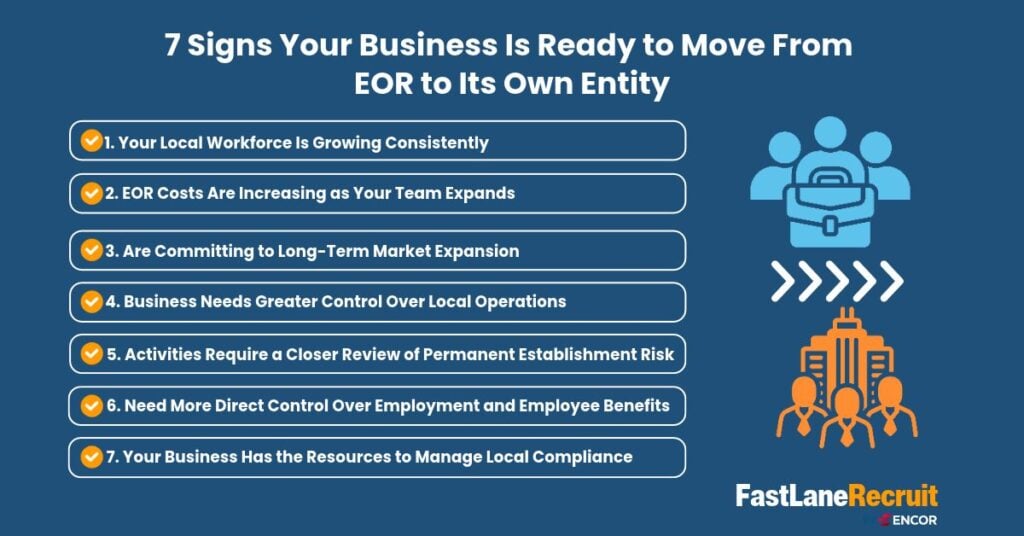
7 Signs Your Business Is Ready to Move From EOR to Its Own Entity
Not every growing business needs to establish a local company. However, the following indicators can help determine whether your existing EOR arrangement still supports your expansion objectives.
1. Your Local Workforce Is Growing Consistently
One of the first indicators is sustained workforce growth in a particular country.
When a company initially hires one or two employees, establishing a local entity may involve unnecessary administrative and financial commitments.
However, maintaining a larger team over several years can change the cost and operational equation.
Consider establishing your own entity when:
- Your local headcount is increasing consistently.
- You expect to maintain the workforce for several years.
- Hiring needs are becoming more predictable.
- Your business requires dedicated local HR and payroll infrastructure.
- Your long-term workforce budget supports direct employment.
Important: There is no universal employee threshold at which an entity automatically becomes more economical. The break-even point depends on local incorporation costs, recurring administration, EOR pricing, employee numbers and internal resources.
2. Your EOR Costs Are Increasing as Your Team Expands
EOR services generally involve recurring service fees, often calculated per employee. As your workforce grows, these costs can become a significant part of your international employment budget.
By comparison, operating your own entity involves incorporation expenses and ongoing fixed or variable costs, including accounting, tax filings, payroll, corporate secretarial services and local compliance.
The important question is whether direct employment would provide a better total cost structure over your expected period of operation.
Compare these expenses before making a decision:
| EOR costs | Own entity costs |
| Monthly EOR service fees | Company incorporation |
| Employment administration | Corporate secretarial services |
| Payroll processing | Payroll systems and administration |
| Statutory contribution administration | Accounting and tax compliance |
| Included or additional HR services | Internal HR or outsourced HR support |
| Contracted benefits and additional services | Employee benefits and insurance |
A practical way to evaluate the financial difference is:
Total EOR cost
Monthly EOR fees × Number of employees × Number of months, plus additional service charges.
Total entity operating cost
Initial incorporation costs + recurring corporate administration + payroll and HR expenses + tax and compliance costs.
Include internal management time, minimum capital requirements, banking costs and potential closure expenses where applicable.
An entity may become more economical at scale, but a lower monthly cost per employee does not automatically mean a lower total operating cost.
3. You Are Committing to Long-Term Market Expansion
EOR is particularly useful when businesses want to test a foreign market before committing to a permanent operating structure.
However, once a market becomes an established part of your growth strategy, maintaining an owned entity may offer greater flexibility.
Consider incorporation when:
- You have a consistent customer base in the country.
- Your local revenue and business pipeline are becoming more predictable.
- You plan to expand local operations.
- You intend to build a long-term management team.
- You require a permanent commercial presence.
For example, a technology company may initially use EOR to hire local sales and technical employees while assessing market demand. Once the business establishes a sustainable customer base and plans to expand its operations, it may evaluate incorporating a local subsidiary.
Decision point: If you are confident about maintaining a long-term presence, compare the benefits of an owned entity against the cost and administrative requirements of continuing with EOR.
4. Your Business Needs Greater Control Over Local Operations
An EOR manages the employment relationship and associated administration, while your company generally directs employees’ day-to-day work under the agreed arrangement.
However, an EOR is not a substitute for every form of local business infrastructure.
Your business may need its own entity when it requires:
- Local commercial contracts in its own name.
- A local corporate bank account.
- Direct invoicing and commercial transactions.
- Certain business licences or registrations.
- Local procurement or import and export arrangements.
- A dedicated office or local management structure.
These requirements depend on the country’s regulations and the nature of the proposed activities.
If your business needs to operate as a direct local commercial entity rather than simply employ local talent, incorporation may become a strategic requirement.
5. Your Business Activities Require a Closer Review of Permanent Establishment Risk
Permanent establishment (PE) is an important tax consideration when expanding internationally.
A foreign company may create a taxable presence in another country through certain business activities, a fixed place of business or the activities of qualifying dependent agents.
Importantly, using an EOR does not automatically eliminate permanent establishment risk.
Tax authorities generally assess the actual business activities and applicable domestic tax rules and tax treaties, rather than relying solely on the identity of the legal employer.
Potential considerations include:
- Whether employees perform core revenue-generating activities.
- Whether local representatives negotiate or conclude contracts.
- Whether the company maintains a fixed place of business.
- Whether local management functions are being performed.
- How frequently and regularly business activities take place in the country.
For example, a company using an EOR to employ a local market researcher may have a different tax exposure from a company whose local representative regularly concludes commercial contracts on its behalf.
The OECD Model Tax Convention provides an international framework for assessing permanent establishment, but the applicable tax treaty and local legislation must be reviewed.
What businesses should do:
- Review local employee responsibilities.
- Assess where commercial decisions are made.
- Examine contract negotiation and signing authority.
- Evaluate local office and management arrangements.
- Obtain professional cross-border tax advice before changing the employment structure.
Establishing an entity does not automatically eliminate existing PE exposure or other tax obligations. The overall operating model must be assessed.
6. You Need More Direct Control Over Employment and Employee Benefits
As your international workforce develops, employee experience and retention may become increasingly important.
Businesses with established local teams may want to design employment arrangements that align more closely with their internal HR policies and long-term workforce strategy.
This may include:
- Customised employee benefits.
- Direct employment policies.
- Internal performance and career development frameworks.
- Local compensation structures.
- Direct HR administration.
- Workforce planning across departments.
An owned entity can provide greater direct control over these arrangements, subject to local employment requirements.
However, an EOR can also support employment contracts, statutory benefits and payroll administration. Establishing a local entity is not automatically necessary to provide a compliant and competitive employee experience.
7. Your Business Has the Resources to Manage Local Compliance
Establishing an entity creates additional responsibilities that businesses must be prepared to manage.
These may include:
- Corporate registration and annual filings.
- Accounting and financial reporting.
- Corporate tax returns.
- Payroll tax and statutory contributions.
- Employment contracts and labour law compliance.
- Employee benefits and insurance.
- Work permits and immigration administration, where applicable.
- Corporate governance and recordkeeping.
Before moving from EOR to your own entity, assess whether your business has the internal resources or external professional support required to manage these obligations.
The right time to incorporate is when the business can support both the financial and administrative responsibilities of operating locally.
EOR vs Your Own Entity: Which Is Better for International Expansion?
Both employment models can support international hiring, but they serve different business requirements.
An Employer of Record allows a company to hire employees through an existing local employment structure without establishing its own employing entity.
With an owned entity, the business establishes a local legal presence and directly assumes responsibility for employment and relevant corporate obligations.
EOR vs Own Entity Comparison
| Consideration | Employer of Record (EOR) | Own legal entity |
| Company incorporation | Not required for the client to employ through the EOR arrangement | Required |
| Legal employer | EOR | Your local company |
| Hiring speed | Generally faster, subject to local onboarding requirements | Depends on incorporation and employer registration |
| Employment contracts | Issued through the EOR arrangement | Issued by your company |
| Payroll | Managed through the EOR service | Managed internally or by an outsourced provider |
| Statutory contributions | Administered under the agreed EOR scope | Your entity assumes employer obligations |
| Corporate administration | No separate client entity required for that employment arrangement | Ongoing corporate administration required |
| Employee benefits | Administered according to the service arrangement | Designed and administered by your company, subject to local rules |
| Commercial operations | Limited to the EOR’s legal and contractual scope | Greater direct operational flexibility, subject to local licences |
| Cost structure | Recurring service fees | Incorporation and ongoing operating costs |
| Market exit | Usually simpler employment-service termination, subject to employment obligations | May involve formal entity closure and settlement procedures |
When Should You Choose EOR?
EOR may be the more practical option when:
- You are entering a new market for the first time.
- You need to hire a small or flexible workforce.
- You want to avoid immediate incorporation costs.
- You are testing market demand.
- You need local employment and payroll administration.
- You want to maintain international hiring flexibility.
When Should You Establish Your Own Entity?
An owned entity may be more suitable when:
- You have a stable, long-term workforce.
- You require a direct local commercial presence.
- Your business needs local licences or registrations.
- You need to conduct commercial activities in your own name.
- Your cost analysis supports direct employment.
- You have the resources to manage corporate and employment compliance.
The best employment structure depends on your business objectives, not simply the number of employees you hire.
Also Read: Owned Entities EOR Compliance: Why Entity Ownership Matters for Global Hiring
How Much Does It Cost to Move From EOR to Your Own Entity?
Cost is one of the most important factors when deciding whether to switch from EOR to a local entity.
However, businesses should avoid comparing only monthly EOR fees with incorporation fees. The full cost of maintaining a company can be significantly different from its initial registration expense.
1. Costs of Continuing With EOR
Depending on the provider and service agreement, expenses may include:
- Monthly EOR service fees.
- Employment administration.
- Payroll processing.
- Statutory contribution administration.
- Employee benefits and insurance.
- Additional HR or compliance services.
- Onboarding and offboarding charges.
The main advantage is that businesses can access local employment infrastructure without independently maintaining a separate employing entity.
2. Costs of Establishing Your Own Entity
Entity establishment and maintenance may involve:
- Company registration and government fees.
- Legal and professional incorporation services.
- Minimum paid-up capital, where required.
- Registered office and company secretary expenses.
- Accounting and bookkeeping.
- Corporate tax and annual filings.
- Payroll administration and employer registrations.
- Insurance and employee benefits.
- Internal HR and finance resources.
Costs vary considerably between countries, entity types, ownership structures and regulatory requirements.
3. How to Calculate Your EOR-to-Entity Break-Even Point
A simple financial assessment can help identify when establishing an entity may become more economical.
Consider the following example:
| Cost component | EOR arrangement | Own entity |
| Initial setup | Generally no client entity incorporation for the EOR employment arrangement | Incorporation and professional fees |
| Monthly costs | Per-employee EOR fees | Recurring corporate and employment administration |
| Workforce growth | Fees generally increase with employee numbers | Additional payroll and HR costs |
| Internal resources | Lower direct administration requirements | Greater internal or outsourced management requirements |
| Exit costs | Contract termination and employment obligations | Entity closure and outstanding liabilities |
Break-even calculation:
Estimated monthly EOR costs compared with estimated monthly entity operating costs, adjusted for initial setup expenses and the expected operating period.
For a more accurate assessment:
- Obtain an itemised EOR quotation.
- Request an incorporation and ongoing administration estimate.
- Calculate expected headcount over the next 24–36 months.
- Include internal HR, finance and management costs.
- Account for minimum capital and potential closure expenses.
- Compare the total costs over the same period.
Do not assume that an entity becomes cheaper after a fixed number of employees. The financial crossover point differs by market and business structure.
What to Consider Before Moving From EOR to Your Own Entity
Incorporation is only one part of the transition. Businesses should review the following areas before deciding to change their employment structure.
1. Local Incorporation and Ownership Requirements
Each country has its own rules governing foreign investment, company ownership and registration.
Check:
- Whether foreign ownership is permitted.
- Whether local directors or representatives are required.
- Minimum capital requirements.
- Registered office requirements.
- Business licensing and sector restrictions.
- Expected registration timelines.
For example, Singapore, Malaysia, Hong Kong and the UAE have different incorporation and foreign ownership frameworks. Requirements should be verified against the current regulations before selecting an entity structure.
2. Corporate Tax and Permanent Establishment
Review your existing tax position before establishing the new entity.
Important considerations include:
- Corporate income tax registration.
- Applicable tax treaties.
- Permanent establishment exposure.
- Transfer pricing requirements, where applicable.
- Intercompany transactions.
- Withholding tax obligations.
- Tax treatment of cross-border services.
Seek qualified local and international tax advice to understand how the new entity will interact with your existing corporate structure.
3. Employment and Payroll Compliance
Your new entity will become responsible for the relevant employer obligations.
These may include:
- Employment registration.
- Local employment contracts.
- Payroll processing.
- Income tax withholding.
- Social security contributions.
- Mandatory insurance.
- Statutory leave and benefits.
- Employment termination procedures.
The exact obligations depend on the country and employee circumstances.
4. Employee Contracts and Benefits
Existing employees should not be moved to a new employment structure without reviewing their contractual rights.
Determine:
- Whether employee consent is required.
- Whether a formal business transfer mechanism applies.
- Whether new contracts are necessary.
- How previous service will be recognised.
- How accrued leave and other entitlements will be handled.
- Whether existing benefits can continue.
- Whether notice or termination procedures apply.
A change of legal employer can have important implications for employment continuity. The appropriate transfer mechanism must be confirmed under local employment law.
5. Payroll and Banking Readiness
Your entity should be operationally ready before the first employee transfer.
Confirm that:
- Corporate banking arrangements are available.
- Employer payroll registrations are completed.
- Tax and statutory contribution accounts are active.
- Payroll software or outsourced payroll support is configured.
- Employee payment details are verified.
- Benefits and insurance arrangements are in place.
Delays in banking or payroll registration can affect the transition timeline.
How to Move From EOR to Your Own Entity: A Step-by-Step Transition Checklist
A successful EOR-to-entity transition requires coordination between legal, HR, finance, payroll and employees.
Businesses should prepare the new employment structure before ending the existing EOR arrangement.
Step 1: Assess Your Business Requirements
Start by confirming why you want to move away from EOR.
Review:
- Current and projected employee numbers.
- Expected market commitment.
- Employment and administrative costs.
- Local commercial activities.
- Tax and regulatory considerations.
- Long-term expansion objectives.
Determine whether establishing an entity will address a genuine business requirement.
Step 2: Select the Appropriate Entity Structure
Evaluate the available legal structures in your target country.
Depending on local regulations, options may include:
- A subsidiary.
- A branch office.
- A representative office, where permitted.
- Another eligible local business structure.
Consider ownership restrictions, liability, taxation, licensing and operational requirements before choosing.
Step 3: Complete Company Incorporation and Registration
Prepare the required documentation and complete the local registration process.
Depending on the jurisdiction, this may involve:
- Company name approval.
- Constitutional documents.
- Shareholder and director information.
- Registered office arrangements.
- Capital requirements.
- Business registrations and licences.
Allow sufficient time for regulatory reviews, document authentication and banking arrangements.
Step 4: Register for Employment and Payroll Obligations
Before employing staff directly, complete the required employer registrations.
Prepare:
- Employer tax registrations.
- Social security and statutory contribution accounts.
- Payroll processes.
- Local employment documentation.
- Employee benefits and insurance arrangements.
Confirm that the new entity can legally and operationally employ the relevant workforce.
Step 5: Review and Prepare Employee Contracts
Coordinate with the EOR and qualified local advisers to determine the appropriate employment transfer mechanism.
Depending on local law, this may involve a formal transfer, novation, termination and rehire, or another permitted arrangement.
Address:
- New employment terms.
- Salary and benefits.
- Employment start dates.
- Recognition of previous service.
- Accrued leave and entitlements.
- Notice and termination requirements.
- Employee consent and communication.
Avoid assuming that all countries require employees to resign and sign entirely new contracts. The legal mechanism varies.
Step 6: Coordinate Employee and Payroll Migration
Plan the payroll transition around an appropriate pay cycle.
Important tasks include:
- Collecting and verifying employee information.
- Transferring authorised payroll records.
- Confirming salary and deduction calculations.
- Aligning statutory contribution responsibilities.
- Arranging benefit continuity.
- Testing the new payroll process.
- Confirming the final payroll with the EOR.
Where practical, conduct a parallel payroll review before the new entity processes its first live payroll.
Step 7: Communicate the Changes to Employees
Employees should understand how the transition affects their employment.
Explain:
- Why the employer structure is changing.
- Who their new legal employer will be.
- Whether their salary or benefits will change.
- How service continuity will be treated.
- Whether they need to provide documents or sign agreements.
- When the new arrangement takes effect.
- Who they can contact with questions.
Clear communication helps minimise uncertainty and protect employee confidence.
Step 8: Complete the EOR Offboarding and Compliance Handover
Once the new entity is ready and the transition has been completed, coordinate the EOR offboarding process.
Confirm:
- Final salary and statutory payments.
- Outstanding employee entitlements.
- Required tax and employment filings.
- Benefits termination or transfer.
- Return of company property, where applicable.
- Employment records and documentation.
- Final account reconciliation.
- Contractual termination requirements.
Retain relevant employment and payroll records in accordance with local recordkeeping requirements.
Transition tip: Do not terminate the existing EOR arrangement simply because the new company has been incorporated. Wait until the new entity is registered as an employer, payroll is operational and the employee transition can be completed lawfully.
Can You Continue Using EOR While Establishing Your Own Entity?
Yes. Businesses may be able to maintain EOR employment while incorporating a local company, subject to local regulations and contractual arrangements.
This can be useful when the company needs to continue hiring or paying employees while completing incorporation, banking, payroll registration and other administrative requirements.
For example, a business expanding into Malaysia may initially employ local staff through an EOR. As its workforce grows, it may begin establishing a Malaysian entity while maintaining the existing EOR arrangement until the new employment structure is ready.
Benefits of using EOR during incorporation:
- Maintain employment continuity while the entity is being established.
- Avoid delaying recruitment unnecessarily.
- Keep payroll and statutory administration running.
- Reduce pressure to rush incorporation.
- Allow time to prepare employee contracts and benefits.
- Coordinate the transition around operational readiness.
However, the company should review any overlapping costs, contractual obligations and potential tax implications. Using an EOR during incorporation does not automatically remove the need to assess PE exposure.
This approach allows businesses to plan their transition carefully rather than treating incorporation and employee migration as a single administrative event.
Why Businesses Choose FastLaneRecruit for International Employment
Expanding internationally requires more than finding the right employees. Businesses must also establish appropriate employment arrangements, manage payroll and understand local regulatory responsibilities.
FastLaneRecruit helps businesses hire and manage international employees through Employer of Record services across selected global markets.
Our approach combines regional employment expertise, local market knowledge and employment administration to support businesses entering new markets or expanding existing teams.
Local Employment Support Across Multiple Markets
Employment requirements vary between countries. Our EOR services help businesses navigate local employment contracts, payroll administration, statutory contributions and relevant employment requirements.
Faster International Hiring
Hire eligible employees in supported markets without first establishing your own employing entity in every country.
This can help businesses enter new markets, recruit specialised talent and evaluate expansion opportunities.
Employment and Payroll Administration
We support key employment processes, including:
- Locally appropriate employment contracts.
- Employee onboarding.
- Payroll processing.
- Statutory contribution administration.
- Employee benefits administration, where included.
- Ongoing HR administration.
- Employment offboarding.
The exact service scope depends on the country and agreed service arrangement.
Regional HR and Compliance Expertise
Our team understands that employment regulations, payroll obligations and statutory benefits differ across markets.
We help businesses navigate country-specific employment requirements and coordinate the relevant administrative processes.
Transparent Service Scope
We help clients understand the proposed employment arrangement, responsibilities and associated costs before proceeding.
This allows businesses to evaluate their international hiring requirements and make informed employment decisions.
FastLaneRecruit’s International EOR Coverage
FastLaneRecruit operates in
- Asia Pacific: Malaysia, Singapore, Hong Kong, China, India, Philippines, Taiwan, Vietnam, Australia,
- Europe: United Kingdom, Switzerland
- Middle East & Africa: UAE, Saudi Arabia, Qatar
Our multi-country coverage allows businesses to explore international hiring through one EOR partner rather than coordinating multiple employment providers independently.
Service availability, employment structure and scope are subject to the relevant country’s regulations and individual hiring requirements.
Plan Your International Employment Strategy With FastLaneRecruit
Moving from EOR to your own entity is an important business decision. The right time depends on your workforce, expansion plans, operational requirements, employment costs and local compliance responsibilities.
For some businesses, establishing a local entity may provide the infrastructure needed for sustained operations. For others, continuing with EOR offers a more practical way to hire internationally without taking on additional corporate administration.
You do not have to establish a local entity in every country to build an international workforce.
FastLaneRecruit helps businesses hire and manage employees across supported markets through EOR services, including locally appropriate employment contracts, payroll administration, statutory contributions and ongoing employment support.
Whether you are entering a new market, expanding an existing team or evaluating your next stage of international growth, our team can help you explore suitable employment arrangements.
Ready to expand internationally without the complexity of immediate entity establishment?
Speak with FastLaneRecruit about your hiring requirements and discover how our EOR services can support your international workforce.
Book a Free Consultation with an EOR Expert.
Frequently Asked Questions About Moving From EOR to Your Own Entity
1. When should a company move from EOR to its own entity?
A company should consider moving from EOR to its own entity when it has a stable long-term workforce, established local operations, increasing commercial requirements or a financial case for direct employment.
The decision should also consider incorporation expenses, ongoing compliance responsibilities, tax exposure and local employment regulations.
2. How many employees justify setting up a local entity?
There is no universal employee threshold. The financial break-even point depends on local EOR fees, incorporation costs, recurring administration expenses, employee numbers and the expected operating period.
A company with a smaller team may justify incorporation if it needs a direct commercial presence, while a larger team may still benefit from EOR depending on its business objectives.
3. Is having your own entity cheaper than using an EOR?
It can be cheaper over the long term, particularly when a business maintains a substantial workforce in one country.
However, an owned entity involves incorporation, accounting, tax, payroll, HR and corporate administration expenses.
Businesses should compare total operating costs over the same period rather than comparing EOR service fees with company registration fees alone.
4. Does using an EOR eliminate permanent establishment risk?
No. An EOR does not automatically eliminate permanent establishment risk.
Tax authorities may assess the foreign company’s actual business activities, local management functions, fixed business presence and employee authority under applicable domestic law and tax treaties.
Businesses should obtain professional tax advice when expanding internationally.
5. How long does it take to move from EOR to your own entity?
The timeline depends on the country, entity structure, registration requirements, banking arrangements and employer registrations.
Company incorporation may take days or weeks in some jurisdictions, while completing all employment and payroll preparations can take longer.
Businesses should plan the transition around regulatory requirements and operational readiness rather than relying on a universal timeline.
6. Do employees need to sign new contracts when moving from EOR to an owned entity?
Not necessarily. The process depends on local employment law and the legal mechanism used to change the employer.
Some jurisdictions provide formal employee transfer arrangements, while others may require an agreed termination and new employment contract or another legally permitted process.
Businesses should confirm employee consent, service continuity, accrued entitlements and contractual obligations before proceeding.
7. Can employees retain their original employment service dates after the transition?
Prior service may be recognised through applicable statutory transfer rules, contractual arrangements or the new employment agreement.
However, continuity is not automatic in every jurisdiction.
Businesses should review how previous service affects annual leave, severance, notice periods, benefits and other employment entitlements.
8. Can a company use EOR and its own entity in the same country?
Potentially, yes. A company may use an EOR for certain employees while directly employing others through its own entity, subject to local regulations and the applicable service arrangements.
This can be useful when transitioning an existing workforce gradually or maintaining different employment structures for different business requirements.
9. Can I continue using EOR instead of establishing my own entity?
Yes. EOR can remain suitable when a business has a small or flexible workforce, is testing a new market, or does not require a direct local commercial presence.
It can also support hiring in countries where maintaining a separate entity is not commercially justified.
10. What happens to payroll and employee benefits during an EOR transition?
Payroll and benefits must be coordinated between the existing EOR and the new entity.
Businesses should arrange final payroll, outstanding statutory payments, benefit continuity, employee records and new payroll registrations before the transition date.
Where practical, testing the new payroll process before the first live payment can help reduce errors and payment disruptions.
11. Can FastLaneRecruit help businesses that are still deciding whether to establish a local entity?
Yes. FastLaneRecruit helps businesses evaluate their international employment requirements and explore EOR arrangements across our supported markets.
Our team can discuss hiring plans, local employment administration, payroll requirements and the appropriate next steps for your expansion strategy.
12. Which countries does FastLaneRecruit support for EOR services?
FastLaneRecruit supports EOR services across selected markets:
- Asia Pacific: Malaysia, Singapore, Hong Kong, China, India, Philippines, Taiwan, Vietnam and Australia.
- Europe: United Kingdom and Switzerland.
- Middle East & Africa: UAE, Saudi Arabia and Qatar.
Service availability and scope should be confirmed based on the country and specific employment requirements.