
Hiring talent across borders gives businesses access to wider talent pools, new markets, and more flexible workforce structures. However, allowing an employee to work remotely from another country can introduce employment obligations that did not exist under the original working arrangement.
An employee working from home in Singapore, relocating to Malaysia, or performing their role from the United Kingdom may be subject to different employment protections, working-time requirements, tax rules, and statutory contributions. Even when the employee continues working for the same company, their physical work location can change the legal and administrative requirements employers need to consider.
For businesses building international teams, understanding remote work laws by country is essential to maintaining compliant employment arrangements. A clear international remote work policy can help establish where employees may work, how overseas requests are assessed, and which responsibilities must be addressed before approving cross-border arrangements.
This guide explores the employment regulations, country-specific considerations, and compliance risks employers should understand when managing remote employees internationally. It also explains how an Employer of Record (EOR) can support businesses hiring employees in other countries without immediately establishing their own local entities, where legally available.
Content Outline
Key Summary
Remote Work Laws Differ Across Countries
There is no universal remote work law governing every international employee. Each country may have different requirements covering employment agreements, working hours, equipment, expense reimbursement, health and safety, and employee protections.
An International Remote Work Policy Is Essential
Employers should establish clear rules for approved work locations, overseas relocation requests, working hours, data security, equipment, expenses, and reporting responsibilities.
Working Remotely Abroad Can Create Additional Compliance Obligations
Allowing an employee to work from another country may affect payroll registration, income tax, social security, immigration status, employment rights, and corporate tax exposure.
Employment Compliance Depends on the Actual Working Arrangement
A short-term overseas work arrangement, permanent relocation, and hiring a new employee in another country are different situations. Employers should assess each arrangement rather than assume the same rules apply.
EOR Provides an Alternative to Establishing a Local Entity
An Employer of Record can employ eligible international workers through an appropriate local employment structure while managing agreed employment administration, payroll, and statutory obligations.
Local Employment Expertise Helps Reduce Cross-Border Risks
Working with an experienced EOR provider can help businesses navigate country-specific employment requirements, onboarding procedures, payroll administration, and ongoing workforce management.
Understanding Remote Work Laws and International Employment Requirements
Remote work laws refer to the legal rules and employment requirements governing work performed outside an employer’s conventional workplace. Depending on the jurisdiction, these rules may cover home-based employment, hybrid arrangements, teleworking, and employees working remotely from another country.
For international employers, it is important to distinguish between two arrangements:
| Arrangement | Description | Main compliance consideration |
| Domestic remote work | An employee works remotely within the country where they are employed | Local employment laws, working conditions, equipment, and expenses |
| Cross-border remote work | An employee performs work from a country different from the employer’s or original work location | Employment jurisdiction, payroll, tax, immigration, and social security |
Domestic Remote Work vs. International Remote Work
Domestic remote work generally involves an employee performing their existing role from home or another approved location within the same country.
International remote work introduces additional considerations because more than one jurisdiction may have a legitimate connection to the employment arrangement.
For example, an employee employed by a Singapore-based business who permanently relocates to Malaysia may create questions about:
- Whether Malaysian employment requirements apply.
- Whether the existing employment arrangement remains appropriate.
- Whether local payroll or tax registration is required.
- Whether the employee has permission to work in Malaysia.
- Whether the employer creates additional corporate tax exposure.
The employer should assess the employee’s actual work location and the nature and duration of the arrangement before approving the move.
Why Remote Work Laws Matter to International Employers
Remote working arrangements can affect more than an employee’s daily working location.
Businesses may need to review:
- Employment law: Applicable employment rights, contracts, leave, termination, and working conditions.
- Payroll and taxation: Local payroll registration, income tax withholding, and employer reporting obligations.
- Social security: Mandatory contributions and applicable social insurance arrangements.
- Immigration: Whether the employee has the right to work in the destination country.
- Health and safety: Employer responsibilities for safe working environments.
- Data protection: Rules governing employee information and cross-border data transfers.
- Corporate taxation: Whether the employee’s activities create a permanent establishment or other tax presence.
Understanding these requirements before international hiring helps businesses avoid unexpected liabilities and administrative complications.
Remote Work Laws by Country: What Employers Must Know
Remote work regulations vary significantly across jurisdictions. Some countries have specific telework legislation, while others regulate remote arrangements through existing employment laws, flexible working provisions, occupational safety requirements, and employment contracts.
The following examples highlight important considerations in selected markets.
Singapore: Flexible Work Arrangement Requests
Singapore regulates formal flexible work arrangement requests through its Tripartite Guidelines on Flexible Work Arrangement Requests (TG-FWAR).
The guidelines took effect on 1 December 2024 and establish a formal process for employees to request flexible arrangements, including flexible work locations.
Key employer requirements:
- Establish a process for receiving and assessing formal flexible work arrangement requests.
- Consider requests properly based on business grounds.
- Provide a written decision within two months.
- Explain the business reasons if a request is rejected.
- Consider alternative arrangements where appropriate.
Important distinction: Employers are not required to approve every flexible work arrangement request. The guidelines establish a process for proper consideration rather than an automatic right to work remotely.
Employer consideration: Companies hiring employees in Singapore should distinguish between domestic flexible working requests and employees seeking permission to work from another country. Cross-border arrangements require additional legal, tax, and immigration assessments.
Malaysia: Flexible Working Arrangements Under the Employment Act 1955
Malaysia introduced statutory flexible working arrangement provisions through Sections 60P and 60Q of the Employment Act 1955.
These provisions allow employees to apply for changes to their:
- Working hours.
- Working days.
- Place of work.
Key employer requirements:
- Employees must submit a formal written application.
- Employers must approve or refuse the application within 60 days.
- If an application is refused, the employer must provide the reason in writing.
These provisions establish a formal application process but do not mean employees have an automatic right to choose any remote working location.
Employer consideration: Businesses employing remote workers in Malaysia should review employment terms, working arrangements, payroll obligations, statutory contributions, and applicable workplace requirements.
Hong Kong: Employment Ordinance and Remote Work Arrangements
Hong Kong does not rely on a single comprehensive remote-work statute to regulate every work-from-home arrangement. Employers should consider the existing Employment Ordinance and applicable employment requirements.
Important considerations include:
- Employment contract terms and agreed work arrangements.
- Wage payment and employment records.
- Statutory holidays and annual leave.
- Rest-day entitlements.
- Mandatory Provident Fund (MPF) obligations, where applicable.
- Occupational safety and data security.
Under the Employment Ordinance, employees employed under a continuous contract are generally entitled to at least one rest day in every period of seven days.
Employer consideration: An employee working remotely in Hong Kong does not lose applicable employment protections simply because they work outside the employer’s office. Employers should ensure employment terms and statutory administration remain appropriate.
China: Labour Contracts and Local Employment Requirements
China’s employment framework places importance on written labour contracts, employment terms, working hours, remuneration, social insurance, and workplace protections.
When establishing remote working arrangements, employers should consider:
- Whether the agreed work location needs to be reflected in employment documentation.
- Applicable working-hour and overtime requirements.
- Salary payment and statutory social insurance.
- Occupational safety and employment protections.
- Local implementation requirements.
For example, Shanghai’s official employment guidance identifies job descriptions, work locations, working hours, remuneration, social insurance, and labour protection as essential labour contract matters.
Employer consideration: Remote employment in China should be structured with appropriate local employment documentation and payroll administration. Employers should not assume that an overseas employment contract automatically satisfies Chinese employment requirements.
United Kingdom: Flexible Working and Home-Working Responsibilities
The United Kingdom provides employees with a statutory right to request flexible working from their first day of employment.
Under the statutory process:
- Employees can make up to two flexible working requests within a 12-month period.
- Employers must consult with employees before refusing a request.
- Employers must make a decision within two months, unless a longer period is agreed.
- Approved changes must be reflected in the employment terms.
The UK’s Health and Safety Executive also confirms that employers retain health and safety responsibilities for employees working from home.
Employers should consider:
- Display screen equipment and workstation safety.
- Mental health and work-related stress.
- Working environment risks.
- Appropriate risk assessments.
- Communication and employee wellbeing.
Employer consideration: A statutory right to request flexible working is not an unconditional right to work remotely from any country. Overseas working arrangements need separate consideration.
Australia: Flexible Work and the Right to Disconnect
Australia’s Fair Work framework includes statutory flexible working request rights for eligible employees and a right to disconnect.
The right to disconnect commenced on:
- 26 August 2024 for non-small-business employers.
- 26 August 2025 for small-business employers.
The right generally allows employees to refuse to monitor, read, or respond to employer or third-party contact outside working hours when that refusal is not unreasonable.
Factors relevant to whether a refusal is unreasonable include:
- The reason for the contact.
- How the contact is made.
- Whether the employee is compensated for availability or additional work.
- The employee’s role and responsibilities.
- Their personal circumstances.
Employer consideration: Companies managing Australian remote employees across different time zones should establish clear communication expectations, working-hour arrangements, and after-hours contact policies.
United Arab Emirates: Remote Working Hours and Employment Conditions
The UAE’s private-sector employment framework addresses working arrangements, including employees performing work remotely.
The UAE Government’s official guidance states that where an employee requests to work remotely, either within the UAE or from abroad, the employer must stipulate specific working hours.
Employers should also review:
- Applicable working-hour limits.
- Overtime requirements.
- Rest periods.
- Employment contract terms.
- Work authorization and residency requirements.
- Payroll and wage protection obligations, where applicable.
Employer consideration: An employee’s ability to work remotely from abroad should not be assumed solely because remote work is permitted under the employment arrangement. Destination-country requirements must also be assessed.
Other International Markets: Local Requirements Still Apply
Businesses hiring across multiple markets should avoid assuming that remote working rules in one jurisdiction apply elsewhere.
For example:
| Country | Important employer consideration |
| India | Applicable labour legislation, employment terms, payroll, social security, and work-location requirements |
| Philippines | Labour standards, working conditions, occupational safety, and applicable work-from-home arrangements |
| Taiwan | Labour Standards Act requirements and occupational safety guidance for work-from-home arrangements |
| Vietnam | Labour Code requirements, employment contracts, working time, and social insurance |
| Switzerland | Employment contract terms, working time, expense reimbursement, and applicable cantonal or sector-specific requirements |
| Saudi Arabia | Labour Law, employment documentation, working conditions, and applicable Saudisation requirements |
| Qatar | Labour Law, employment contracts, wage protection, and applicable work authorization requirements |
These are areas employers should investigate, not a statement that every country has identical or dedicated remote-work legislation.
The key point: Before approving an international remote work arrangement, employers should verify the latest legislation and administrative requirements in the employee’s actual work location.
What Should an International Remote Work Policy Include?
An international remote work policy establishes how a business approves, manages, and monitors remote working arrangements across different locations.
It should define employee eligibility, approved locations, compliance responsibilities, and procedures for international relocation.
A policy should be practical enough for employees to understand and detailed enough for HR and management teams to apply consistently.
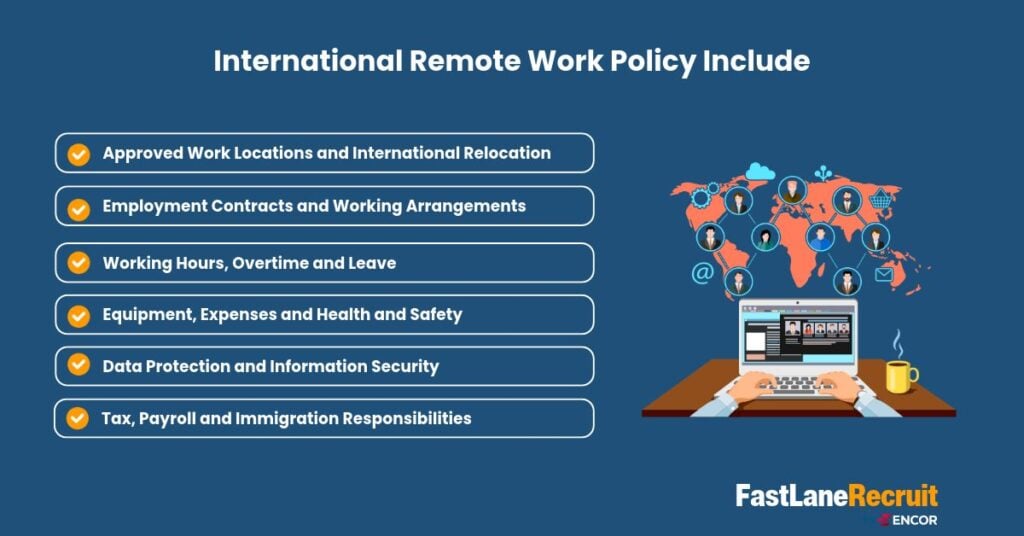
Approved Work Locations and International Relocation
Employers should clearly identify where employees are permitted to work.
A policy should address:
- Approved countries and locations.
- Domestic and international remote working permissions.
- Temporary overseas work requests.
- Permanent relocation procedures.
- Prior approval requirements.
- Notification of changes to an employee’s residential or work location.
Employees should not independently relocate to another country for work without the employer assessing the legal and operational implications.
Employment Contracts and Working Arrangements
Remote work agreements should establish the responsibilities and expectations of both parties.
Important provisions include:
- Employee job title and responsibilities.
- Official work location.
- Working hours and time zone.
- Reporting arrangements.
- Compensation and applicable benefits.
- Equipment and expense responsibilities.
- Confidentiality and data security.
- Conditions for changing or ending remote arrangements.
Where required, employers should update employment contracts or prepare additional remote working agreements.
Working Hours, Overtime and Leave
International remote teams may operate across different time zones, making working-hour management particularly important.
An international remote work policy should clarify:
- Standard working hours.
- Core collaboration hours.
- Overtime approval and payment.
- Rest periods and weekly rest days.
- Public holidays.
- Annual and statutory leave.
- After-hours communication expectations.
Employers must ensure that working arrangements comply with the applicable local employment framework.
Equipment, Expenses and Health and Safety
Remote employees may require additional equipment and workplace support.
Depending on local requirements, employers may need to provide or reimburse:
- Computers and work equipment.
- Internet and communication expenses.
- Office furniture or ergonomic equipment.
- Other necessary work-related expenses.
Employers should also establish procedures for home-working risk assessments, accident reporting, and employee wellbeing.
Data Protection and Information Security
International remote working can increase the complexity of protecting confidential business and employee information.
A policy should address:
- Approved devices and software.
- Secure network access.
- Multi-factor authentication.
- Access to company systems.
- Confidential information handling.
- Data storage and transfer.
- Incident reporting.
- Employee cybersecurity training.
Businesses should also assess applicable data protection and cross-border data transfer requirements before allowing employees to access sensitive information from overseas.
Tax, Payroll and Immigration Responsibilities
The policy should explain that international work-location changes require advance review.
Employers should establish procedures to assess:
- Employee tax residency.
- Employer payroll withholding obligations.
- Local social security contributions.
- Work permits and visa requirements.
- Potential permanent establishment exposure.
- Any required registrations or notifications.
An international remote work policy should not be treated as a substitute for local employment, tax, or immigration compliance.
What Are the Biggest Compliance Risks of International Remote Work?
Allowing employees to work across borders without proper assessment can expose businesses to employment, financial, and regulatory risks.
The following are among the most important areas employers should monitor.
Permanent Establishment and Corporate Tax Exposure
An employee working in another country may create corporate tax considerations for the employer, depending on the nature of their activities and the applicable tax treaty.
Potential risk factors include:
- Employees negotiating or concluding contracts.
- Employees performing core revenue-generating activities.
- Employees exercising significant management authority.
- The business having a fixed place of business or other taxable presence.
- The commercial reasons for maintaining the employee’s work location.
The OECD’s 2025 Model Tax Convention update provides additional guidance on when cross-border home-office arrangements may create a permanent establishment.
How employers can reduce risk:
- Assess the employee’s role and authority.
- Review the commercial purpose of the overseas arrangement.
- Evaluate applicable tax treaty provisions.
- Obtain country-specific tax advice.
- Reassess arrangements when job responsibilities or work locations change.
Important: Using an EOR does not automatically eliminate permanent establishment exposure. Corporate tax analysis should be conducted separately.
Payroll and Social Security Non-Compliance
An employee’s physical work location may affect where payroll withholding and social security obligations arise.
Potential problems include:
- Failure to register with the appropriate authorities.
- Incorrect income tax withholding.
- Missed employer contributions.
- Incorrect employee benefit calculations.
- Late statutory reporting.
- Inaccurate payroll records.
Employers should determine the applicable payroll jurisdiction before the employee begins working internationally.
Employee Misclassification
Businesses sometimes engage international workers as independent contractors to avoid establishing local employment infrastructure.
However, contractual labels do not necessarily determine employment status.
Authorities may assess the actual working relationship, including:
- The degree of supervision and control.
- Whether the individual works exclusively for one business.
- How the individual is integrated into company operations.
- Whether they operate an independent business.
- How compensation and working arrangements are structured.
If the relationship is legally employment rather than independent contracting, misclassification can result in backdated contributions, employment claims, penalties, and other liabilities.
Where the working relationship should be employment, an EOR may provide a more suitable structure than contractor engagement.
Immigration and Work Authorization Violations
A visa that allows an individual to visit a country does not necessarily authorize them to perform employment activities there.
Employers should confirm:
- Whether the employee has permission to work.
- Whether the visa permits the intended activity.
- Whether sponsorship is required.
- Whether the work arrangement is compatible with the employee’s immigration status.
- Whether local employer registration is necessary.
Inconsistent Employment Benefits and Employee Protections
International remote employees may be entitled to different statutory protections depending on their applicable employment framework.
These can include:
- Paid annual leave.
- Sick leave.
- Parental leave.
- Public holidays.
- Minimum wage protection.
- Social insurance.
- Termination entitlements.
- Mandatory employee benefits.
Employers should review local requirements before finalising compensation and employment packages.
How to Hire Remote Employees Internationally Without Setting Up a Local Entity
Expanding into another country does not always require establishing a subsidiary immediately.
For businesses that need to hire local employees without creating their own employing entity, an Employer of Record (EOR) can provide an alternative employment structure where legally available.
An EOR is a third-party organisation that legally employs a worker on behalf of a client company.
Under an EOR arrangement:
- The EOR enters into the local employment relationship.
- The client company manages the employee’s day-to-day work and business responsibilities.
- The EOR handles agreed employment administration.
- Payroll and applicable statutory contributions are managed through the local employment structure.
- Employment documentation and employee lifecycle processes are administered according to local requirements.
How an EOR Helps With International Employment Compliance
An EOR can help businesses address several employment-related responsibilities when hiring internationally.
| Employer challenge | How EOR can help |
| No local employing entity | Provide an appropriate local employment structure where available |
| Local employment contracts | Prepare employment agreements aligned with applicable requirements |
| Payroll administration | Manage salary processing and applicable statutory deductions |
| Social security | Administer required employer and employee contributions |
| Employee benefits | Coordinate applicable statutory and agreed benefits |
| Onboarding | Coordinate employment documentation and local onboarding |
| Ongoing compliance | Support employment administration throughout the employee lifecycle |
| Offboarding | Assist with required employment termination and administrative procedures |
EOR vs. Establishing Your Own Local Entity
The right employment structure depends on the company’s expansion objectives, workforce size, operating model, and long-term investment plans.
| Consideration | Employer of Record | Own local entity |
| Local company setup | Not generally required for the EOR employment arrangement | Required |
| Market entry | Can provide a faster route to eligible hiring | Requires entity establishment |
| Legal employment | Managed by the EOR | Managed directly by the company |
| Payroll administration | Handled through the EOR arrangement | Managed by the company’s local operation or provider |
| Statutory contributions | Administered through the EOR | Managed by the company |
| Corporate presence | Does not itself establish the client’s own subsidiary | Creates a local legal presence |
| Operational control | Client directs day-to-day work under the agreed structure | Company manages its own employment operation |
| Best suited for | Initial hiring, market testing, and smaller international teams | Established operations and long-term local investment |
When should businesses choose EOR?
An EOR may be suitable when:
- Hiring the first employee in another country.
- Testing a new market before committing to entity setup.
- Building a small or distributed international team.
- Replacing an unsuitable contractor arrangement with employment.
- Reducing the administrative burden of local employment management.
When should businesses establish their own entity?
An owned entity may be more appropriate when:
- The business plans substantial long-term local operations.
- It needs a direct corporate presence.
- It requires greater control over its local business infrastructure.
- Its local revenue, headcount, or operating activities justify the investment.
- Corporate, licensing, or regulatory requirements make an owned entity necessary.
EOR and entity establishment should not be treated as interchangeable solutions. Businesses should evaluate employment, corporate tax, immigration, and licensing considerations before deciding.
Also Read: Global EOR Providers Compared: How to Choose the Right Partner
How to Implement an International Remote Work Policy: A Practical Employer Checklist
A clear implementation process helps employers prevent compliance issues before international working arrangements begin.
Step 1: Identify the Employee’s Actual Work Location
Confirm where the employee will physically perform their work.
Record:
- Country of residence.
- Intended work location.
- Duration of the arrangement.
- Whether the move is temporary or permanent.
- Any additional countries where work will be performed.
Step 2: Review Local Employment Requirements
Assess the relevant employment framework before approving the arrangement.
Review:
- Employment contract requirements.
- Working hours and overtime.
- Statutory leave.
- Health and safety.
- Equipment and expense reimbursement.
- Social security.
- Termination and employee protections.
Step 3: Assess Tax, Payroll and Immigration Implications
Work with appropriate local specialists to determine:
- Payroll registration requirements.
- Tax withholding obligations.
- Employee tax residency.
- Employer tax exposure.
- Social insurance contributions.
- Work authorization requirements.
Step 4: Choose the Appropriate Employment Structure
Determine whether the existing employment arrangement can continue or whether a different structure is needed.
Consider:
- Existing local entity.
- Employer of Record.
- Independent contractor engagement, where genuinely appropriate.
- Establishing a new local entity.
Step 5: Update Employment Documentation and Policies
Ensure the employee and employer understand the approved arrangement.
Prepare or update:
- Employment contracts.
- Remote working agreements.
- International remote work policy.
- Confidentiality provisions.
- Data security requirements.
- Working-hour and reporting arrangements.
Step 6: Establish Payroll and Ongoing Compliance Procedures
Before the employee starts working in the new location, confirm that the required employment administration is in place.
Set up:
- Payroll processing.
- Statutory deductions.
- Benefits administration.
- Employee records.
- Compliance reporting.
- Ongoing regulatory reviews.
Step 7: Monitor Changes in Regulations and Work Arrangements
International employment compliance is an ongoing responsibility.
Employers should review arrangements when:
- An employee relocates.
- A temporary overseas arrangement becomes permanent.
- Job responsibilities change.
- Working hours or compensation change.
- Local employment regulations are updated.
- The business expands its activities in the destination country.
How FastLaneRecruit Helps Businesses Hire Globally Through EOR
Managing remote employees across different countries requires more than a remote working policy. Businesses need an appropriate local employment structure, reliable payroll administration, and a clear understanding of statutory obligations.
FastLaneRecruit helps businesses hire and manage international employees through Employer of Record services across selected markets in Asia Pacific, Europe, and the Middle East & Africa.
Instead of establishing a separate employing entity in every target market, eligible businesses can use our EOR services to manage local employment arrangements while retaining control over their employees’ day-to-day responsibilities.
Locally Compliant Employment Contracts
Employment agreements must reflect the applicable requirements of the employee’s country.
We support local employment documentation and onboarding arrangements to help businesses establish appropriate employment relationships.
International Payroll and Statutory Contributions
Managing payroll across different jurisdictions can create administrative challenges.
Our EOR services support:
- Monthly salary processing.
- Applicable tax deductions.
- Social security contributions.
- Statutory payroll administration.
- Employee benefits coordination.
Employee Onboarding and Administration
International hiring involves documentation, employment registration, and local onboarding procedures.
We coordinate the agreed employment administration to help businesses onboard international employees efficiently.
Ongoing Employment Compliance Support
Employment obligations continue after an employee has been onboarded.
We support the administration of employment arrangements, payroll, statutory requirements, and applicable employee lifecycle processes throughout the engagement.
Employee Offboarding Support
When an employment relationship ends, the process must follow applicable local requirements.
We assist with employment administration and offboarding procedures, helping businesses manage the process with greater clarity.
Why Businesses Choose FastLaneRecruit
International expansion requires a partner that understands the practical requirements of employing people across different jurisdictions.
Businesses work with FastLaneRecruit for:
Local Employment Infrastructure
We operate through local entities in key Asian markets, supporting appropriate local employment arrangements rather than relying exclusively on third-party partner networks.
Regional Employment Expertise
Our understanding of different employment frameworks helps businesses navigate country-specific contracts, payroll, statutory contributions, and employee administration.
Multi-Market EOR Support
Businesses can work with one EOR provider across selected international markets, helping simplify the administration of distributed teams.
Flexible International Hiring
Whether hiring the first employee in a new country or building a larger regional workforce, we help assess an appropriate employment structure based on business requirements.
Transparent Service Scope
We provide clear service arrangements so businesses can understand the employment administration and support included in their EOR engagement.
9. FastLaneRecruit’s International EOR Coverage
FastLaneRecruit supports international employment across selected markets in Asia Pacific, Europe, and the Middle East & Africa.
Our team operates in
- Asia Pacific: Malaysia, Singapore, Hong Kong, China, India, Philippines, Taiwan, Vietnam, Australia,
- Europe: United Kingdom, Switzerland
- Middle East & Africa: UAE, Saudi Arabia, Qatar
Our multi-market coverage helps businesses explore international hiring through an EOR employment structure without immediately establishing their own local company in every target market.
The appropriate service model, onboarding requirements, and employment arrangements depend on the destination country and individual hiring circumstances. Contact our team to confirm current availability and requirements for your target market.
Hire Globally Without Navigating Employment Compliance Alone
International hiring creates opportunities to access new talent and expand into different markets. However, every new work location brings employment, payroll, and regulatory considerations that businesses need to address.
Understanding remote work laws by country and establishing a clear international remote work policy are important first steps. Choosing an appropriate employment structure is equally important when hiring employees across borders.
With FastLaneRecruit’s Employer of Record services, businesses can access local employment support, payroll administration, statutory contributions, and employee management across selected international markets without immediately establishing their own local entity, where permitted.
Planning to hire remote employees internationally?
Talk to FastLaneRecruit about your target countries, workforce requirements, and the right EOR structure for your international expansion.
Book a Free Consultation with an Expert.
Frequently Asked Questions About Remote Work Laws and International Hiring
What are remote work laws?
Remote work laws are the employment regulations and legal requirements governing employees who perform their duties outside a traditional workplace. They may cover working hours, employment agreements, equipment, expenses, health and safety, employee rights, and other workplace obligations.
The applicable rules depend on the country and the nature of the working arrangement.
Do remote employees follow the laws of the country where they live?
The employee’s physical work location can trigger local employment, tax, immigration, and social security requirements. However, the applicable legal framework depends on several factors, including the employment relationship, contractual arrangements, duration of work, and relevant international rules.
Employers should assess the destination country before approving overseas work.
Can employees work remotely from another country without employer approval?
Employees should not assume that permission to work remotely within their home country automatically allows them to work internationally.
Employers should establish an approval process covering work location, immigration, payroll, taxation, and local employment requirements.
What should an international remote work policy include?
An international remote work policy should cover:
- Approved countries and work locations.
- Eligibility and approval procedures.
- Employment contracts and working hours.
- Equipment and expense reimbursement.
- Health and safety responsibilities.
- Data protection and cybersecurity.
- Tax, payroll, and immigration considerations.
- Reporting and ongoing compliance reviews.
Can a company hire remote employees in another country without opening a local entity?
Yes, an Employer of Record can provide an alternative employment structure in supported jurisdictions where legally available.
The EOR acts as the local legal employer under the agreed arrangement and manages applicable employment administration, payroll, and statutory responsibilities. The client company generally directs the employee’s day-to-day work.
Does using an EOR eliminate international employment compliance risks?
No. An EOR can help manage agreed local employment responsibilities, but it does not automatically eliminate every compliance risk.
Businesses may still need to assess corporate tax, permanent establishment, immigration, licensing, data protection, and other obligations based on their activities.
What is the difference between EOR and remote work management?
Remote work management focuses on how employees perform their duties outside a traditional office, including policies, productivity, communication, and cybersecurity.
EOR focuses on the legal employment structure and associated employment administration, including contracts, payroll, statutory contributions, and employee lifecycle processes.
A business may need both to manage an international remote workforce effectively.
Is EOR better than hiring international contractors?
It depends on the actual working relationship.
Contractor engagement may be appropriate when an individual genuinely operates an independent business. EOR may be more suitable when the individual should be employed under a local employment relationship.
Businesses should assess classification requirements instead of choosing a contractor arrangement solely to avoid employment obligations.
When should a company switch from EOR to its own local entity?
A company may consider establishing its own entity when it develops substantial long-term operations, expands its local workforce, or needs a direct corporate presence.
The decision should account for setup costs, ongoing administration, corporate taxation, employment obligations, and long-term business objectives.
Which countries does FastLaneRecruit support for EOR services?
FastLaneRecruit’s published international coverage includes Malaysia, Singapore, Hong Kong, China, India, Philippines, Taiwan, Vietnam, Australia, the United Kingdom, Switzerland, the UAE, Saudi Arabia, and Qatar.
Contact our team to confirm the current EOR service availability, local employment structure, and onboarding requirements for your target country.