Your startup has found the right person. They have the skills, experience and potential to help your business grow. There’s just one complication: they’re in another country.
For an early-stage company, hiring internationally can open access to specialised talent, new markets and a more competitive workforce. However, employing someone abroad involves more than agreeing on a salary and sending an employment contract. You also need to consider local employment laws, payroll administration, statutory contributions, employee benefits and ongoing HR responsibilities.
Establishing a foreign company for a single employee may not be practical, particularly when your startup is still testing a market or building its first distributed team.
So, how do you hire an international employee without creating unnecessary operational complexity?
The answer starts with choosing the right employment arrangement. Startups can consider establishing a local entity, engaging a genuinely independent contractor or using an Employer of Record (EOR) to employ eligible workers in supported countries.
FastLaneRecruit helps startups hire internationally through global hiring and EOR services, coordinating local employment arrangements, contracts, payroll administration and ongoing HR requirements across supported markets.
This guide explains how to hire your first overseas employee, compare your options and determine which approach makes sense for your startup.
Content Outline
Key Summary
You Can Hire International Employees Without Establishing a Local Entity
An Employer of Record can provide an alternative to incorporating a foreign subsidiary. The EOR becomes the legal employer under the local employment arrangement, while your startup manages the employee’s daily responsibilities, objectives and work.
Choose the Employment Model Before Making an Offer
Your options generally include:
Employer of Record: For employing workers in another country without establishing your own local employing entity.
Independent contractor: For genuinely self-employed professionals providing services independently.
Local entity: For businesses planning substantial, long-term operations in another country.
Local Employment Laws Apply Where the Employee Works
An overseas employee may be entitled to locally mandated minimum wages, paid leave, statutory contributions, employment protections and termination benefits.Your domestic employment policies may not satisfy the requirements of another country.
International Hiring Involves Ongoing Responsibilities
Recruitment is only the beginning. Startups must consider employment contracts, onboarding, payroll, tax-related administration, employee benefits, leave and offboarding.
An EOR Can Make a First International Hire More Manageable
For startups hiring one or a small number of employees in a supported market, an EOR can provide an employment structure without the immediate administrative commitment of establishing a local company.
Why Should Startups Hire International Employees?
A startup does not need to limit recruitment to its domestic talent market. International hiring allows founders to find the right skills, build distributed teams and access expertise that may be difficult or expensive to source locally.
However, the decision should be based on business requirements rather than simply the availability of overseas talent.
Access a Wider Global Talent Pool
Some startup roles require specialised skills that may be difficult to find locally.
International recruitment can expand access to professionals in:
- Software engineering and development.
- Digital marketing and SEO.
- Finance and accounting.
- Customer support and operations.
- Data analytics and business intelligence.
- Product design and technology.
Business consideration: Evaluate candidates based on qualifications, experience, communication and role requirements rather than assuming that international recruitment automatically delivers better talent.
Manage Recruitment and Workforce Costs
Hiring internationally may provide access to different labor markets and salary structures.
For example, a startup may recruit a qualified software developer in Malaysia or a digital marketing specialist in the Philippines rather than restricting recruitment to a higher-cost domestic market.
However, salary differences should not be the only consideration.
Calculate the total employment cost, including:
- Gross employee compensation.
- Employer-paid statutory contributions.
- Mandatory insurance and benefits.
- Payroll administration.
- EOR service fees, where applicable.
- Recruitment and onboarding expenses.
Business consideration: Compare total employment costs rather than comparing salaries alone. Local wage requirements and mandatory benefits still apply.
Build a Distributed Team Across Time Zones
International employees can help startups extend operational coverage and serve customers in different regions.
For example:
- A customer support employee can cover additional service hours.
- A regional marketing specialist can adapt campaigns to local audiences.
- An overseas operations professional can coordinate regional suppliers.
However, distributed teams need clear communication practices, documented responsibilities and appropriate management systems.
Support International Market Expansion
Hiring locally can help a startup understand a new market before making a larger investment.
An employee with local market knowledge may support:
- Customer and competitor research.
- Local business development.
- Regional marketing.
- Supplier and partner coordination.
- Customer relationship management.
An EOR can be considered when the startup needs to employ someone in a supported country without immediately establishing its own local employing entity.
Important: Hiring through an EOR does not automatically establish that the startup has no permanent establishment or corporate tax obligations. Those risks depend on the company’s activities, the employee’s authority and the relevant country’s tax rules.
Scale Your Team Without Building Multiple HR Departments
A startup hiring in several countries may otherwise need to coordinate separate employment contracts, payroll arrangements and local administrative processes.
An EOR can consolidate agreed employment administration through one service relationship, helping the startup focus on recruitment, operations and growth.
What Should You Consider Before Hiring Your First Overseas Employee?
Before deciding how to hire international employees, assess the role, country, working relationship and long-term business requirements.
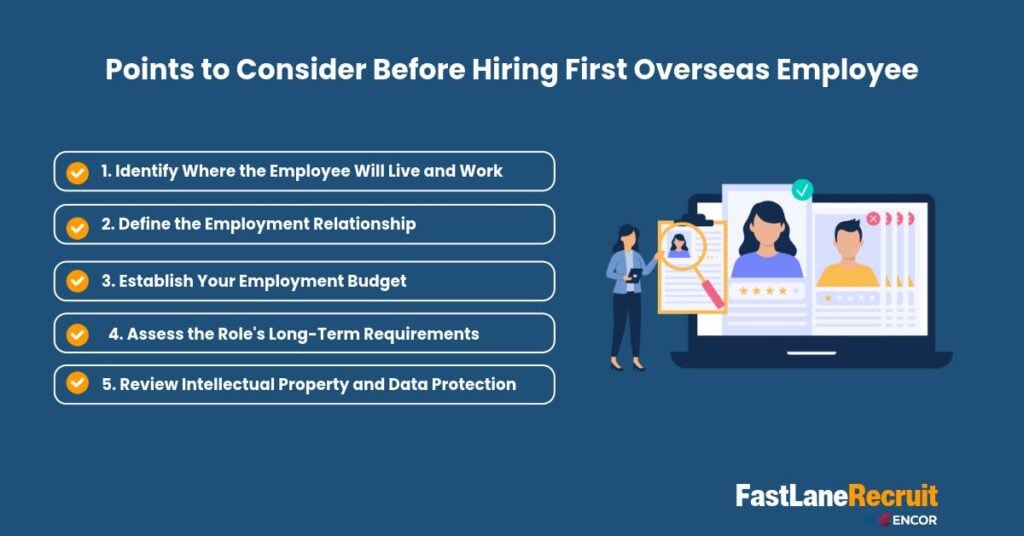
1. Identify Where the Employee Will Live and Work
The employee’s actual work location is one of the most important considerations.
Employment laws, payroll requirements and statutory obligations generally depend on the country where the employee works.
Confirm:
- Country of residence and work location.
- Whether the employee will work remotely or from an office.
- Whether the role involves travel to other countries.
- Whether the employee needs immigration or work authorisation.
- Whether the proposed employment structure is available locally.
Professional recommendation: Do not assume that using a foreign employment contract or paying an employee from your domestic bank account removes local employment obligations.
2. Define the Employment Relationship
Decide whether the role requires an employee or an independent contractor.
An employee typically works within the company’s organisational structure, performs ongoing responsibilities and operates under the employer’s direction.
A genuine independent contractor generally operates an independent business and has greater control over how services are delivered.
Consider:
- Who determines working hours?
- Who controls how the work is performed?
- Is the individual integrated into regular business operations?
- Does the individual serve other clients?
- Is the engagement ongoing or project-based?
- Who provides the equipment and resources?
Misclassification can lead to back payments, penalties, employment claims and other legal exposure.
3. Establish Your Employment Budget
Your budget should reflect the full cost of employing someone in the target country.
| Cost component | What to account for |
| Base salary | Agreed gross compensation |
| Employer contributions | Applicable social security, pension or other statutory contributions |
| Employee benefits | Mandatory insurance, leave and other entitlements |
| Payroll administration | Local payroll processing and reporting |
| EOR fees | Provider charges under the agreed service scope |
| Onboarding | Documentation, checks and setup |
| Offboarding | Notice, final pay, accrued leave and applicable termination entitlements |
Do not assume that the salary is the total employment cost.
4. Assess the Role’s Long-Term Requirements
Ask whether this is a one-person hire or the beginning of a larger international operation.
An EOR may be suitable for an initial hire or a smaller team. A local subsidiary may become more appropriate when your business plans substantial, sustained operations, requires a local corporate presence or needs broader operational capabilities.
5. Review Intellectual Property and Data Protection
International employment can introduce additional considerations around ownership of work and access to company information.
Before onboarding, establish:
- Confidentiality obligations.
- Intellectual property assignment arrangements.
- Ownership of software, designs, research and other work products.
- Data access and security policies.
- Cross-border personal data handling requirements.
Do not rely exclusively on a generic domestic employment agreement. Contractual protections should be reviewed for enforceability under the relevant local law.
How to Hire an International Employee: 6 Essential Steps for Startups
Hiring your first overseas employee becomes easier when you approach it as a structured process rather than treating it as a standard domestic recruitment exercise.
Step 1: Identify the Country and Role You Need to Hire
Start by defining the business need.
Determine:
- What responsibilities will the employee handle?
- What qualifications and experience are required?
- Which country offers access to suitable talent?
- Does the role require local market knowledge?
- Will the employee work remotely or from a physical location?
For example, a startup looking to expand into Southeast Asia may recruit a local business development specialist who understands regional customers and business practices.
Decision point: Choose the country based on talent availability, operational requirements, employment costs and the company’s expansion objectives.
Step 2: Recruit and Evaluate International Candidates
Once the hiring location is established, begin sourcing and evaluating candidates.
Your recruitment process should include:
- Clearly defined job descriptions.
- Relevant experience and qualification checks.
- Structured interviews.
- Technical or practical assessments.
- Reference checks where appropriate.
- Clear salary and employment expectations.
International recruitment should use consistent evaluation criteria while allowing for local differences in qualifications, compensation expectations and recruitment practices.
Practical tip: Explain the proposed work arrangement early. Candidates should understand their work location, employment structure, compensation, benefits and reporting responsibilities before accepting an offer.
Step 3: Choose the Right International Employment Model
This is one of the most important decisions for a startup hiring abroad.
There are three common approaches:
- Establish your own local legal entity.
- Engage a genuine independent contractor.
- Hire through an Employer of Record.
Each option serves a different business requirement.
The appropriate structure should be determined before finalising the employment offer, as it affects who legally employs the individual, how payroll is managed and which local obligations apply.
Step 4: Review Local Employment Requirements and Costs
Before onboarding, identify the employment obligations applicable to the target country.
These may include:
- Minimum wage and salary requirements.
- Working hours and overtime.
- Employment contract provisions.
- Statutory leave entitlements.
- Employer social security contributions.
- Mandatory insurance and benefits.
- Payroll deductions and reporting.
- Probation and termination requirements.
For example, employment arrangements in Malaysia, Singapore and Hong Kong have different statutory frameworks. A contract prepared for one country should not automatically be reused in another.
Professional recommendation: Have the employment structure and local requirements reviewed before the employee starts work.
Step 5: Prepare the Employment Contract and Onboarding Process
Once the employment arrangement is confirmed, prepare the necessary documentation.
A locally appropriate employment agreement should address:
- Job title and responsibilities.
- Compensation and payment frequency.
- Working hours and work location.
- Probation arrangements, where applicable.
- Leave and benefits.
- Confidentiality and intellectual property.
- Termination and notice provisions.
- Applicable employment requirements.
The onboarding process should also establish:
- Employee identity and required documentation.
- Payroll information.
- Benefits enrolment, where applicable.
- Company policies and security access.
- Reporting lines and performance expectations.
For EOR hiring, the EOR generally enters into the local employment contract with the employee, while the client company retains responsibility for managing the employee’s day-to-day work under the agreed arrangement.
Step 6: Establish Ongoing Payroll and HR Administration
Your responsibilities continue after the employee’s first day.
Plan for:
- Regular payroll processing.
- Salary payments and applicable deductions.
- Employer statutory contributions.
- Benefits and leave administration.
- Employment documentation updates.
- HR support and employee queries.
- Performance management.
- Lawful termination and offboarding procedures.
Why this matters: Inconsistent payroll or employment administration can affect employee trust and expose the business to compliance issues.
For startups without local HR infrastructure, an EOR can help coordinate these ongoing employment processes.
Which Hiring Model Is Right for Your Startup?
There is no single international hiring arrangement that works for every business. The right choice depends on how the person works, how many employees you plan to hire, your target market and whether you intend to establish a permanent local operation.
1. Employer of Record (EOR)
An Employer of Record is a third-party organisation that legally employs a worker on behalf of another business in a particular country.
Under an EOR arrangement:
- The EOR enters into the local employment contract.
- The EOR manages agreed employment administration and payroll responsibilities.
- The EOR coordinates applicable statutory contributions and employment requirements.
- Your startup directs the employee’s daily work, responsibilities and performance.
- Both parties operate according to their agreed contractual responsibilities.
Best for: Startups hiring their first overseas employee, testing a new market or building a small international team without immediately establishing a local entity.
Main advantage: Access local employment infrastructure without first incorporating your own company in the target country.
Consideration: EOR availability, permitted arrangements, service fees and employment responsibilities vary by country. An EOR does not remove every corporate tax, immigration or regulatory obligation.
2. Independent Contractor
An independent contractor provides services under a commercial agreement rather than an employment relationship.
This arrangement may suit startups that need:
- Project-based expertise.
- Specialist consulting.
- Temporary professional services.
- Independent creative or technical work.
- Defined deliverables rather than an ongoing employee role.
Best for: Businesses engaging genuinely independent professionals with control over how they deliver their services.
Main advantage: A flexible arrangement for work that is genuinely independent.
Consideration: Calling someone a contractor does not automatically make them one. Actual working conditions, control, economic dependence and local legal tests matter.
3. Establishing a Local Entity
A local entity, such as a subsidiary or registered company, allows a startup to employ workers directly through its own local legal structure.
This typically involves:
- Company incorporation and registration.
- Local corporate administration.
- Tax registration and reporting.
- Employer and payroll registration.
- Local accounting and compliance.
- Ongoing corporate maintenance.
Best for: Startups planning substantial, long-term operations, larger teams or a permanent business presence in another country.
Main advantage: Direct local operations and greater control over the company’s legal and administrative infrastructure.
Consideration: Establishment and ongoing costs can be disproportionate when hiring only one employee.
EOR vs. Contractor vs. Local Entity: Comparison
| Consideration | EOR | Contractor | Local entity |
| Employment relationship | Employee | Genuine independent contractor | Employee |
| Local entity required for your startup | Generally not for the EOR employment arrangement | Depends on local rules and circumstances | Yes |
| Local employment contract | Through EOR | Commercial services agreement | Through your entity |
| Payroll administration | EOR coordinates | Contractor invoices; business pays | Your company or payroll provider |
| Statutory employment benefits | Applicable employee entitlements coordinated | Not automatically employee benefits | Applicable employee entitlements |
| Day-to-day work direction | Client company | Subject to genuine independence | Your company |
| Administrative commitment | Provider-managed employment administration | Contract and payment administration | Direct local administration |
| Typical application | First overseas employee or small team | Independent project-based work | Established local operation |
Which should you choose?
- Choose EOR when you need to employ someone as a regular employee in a supported country without immediately setting up your own local entity.
- Choose contractor management when the individual genuinely operates independently.
- Choose a local entity when your business requires a substantial and sustained local presence.
FastLaneRecruit specialises in EOR services rather than traditional PEO services. We can help assess whether EOR is appropriate for your international hiring requirements.
Also Read: EOR Employment Contracts: What Must Be Included?
How Much Does It Cost to Hire an International Employee?
The cost of hiring overseas employees depends on the employee’s location, compensation, statutory obligations, employment arrangement and the level of administrative support required.
For startups, the important distinction is between the employee’s salary and the total cost of employment.
What Makes Up the Total Cost of International Employment?
| Cost factor | What startups should budget for |
| Employee salary | Gross monthly or annual compensation |
| Employer statutory contributions | Country-specific social security, pension and other required contributions |
| Employee benefits | Mandatory insurance, leave and other applicable benefits |
| Payroll administration | Payroll processing and local reporting |
| EOR service fees | Monthly provider fees and any additional agreed charges |
| Recruitment | Candidate sourcing, assessments and hiring expenses |
| Onboarding | Employment documentation and employee setup |
| Offboarding | Final salary, accrued entitlements and applicable termination costs |
EOR Costs vs. Setting Up a Local Entity
An EOR usually involves a recurring service fee in addition to the employee’s compensation and applicable employment costs.
Setting up a local entity may involve:
- Incorporation and registration expenses.
- Legal and professional fees.
- Local accounting and tax services.
- Payroll infrastructure.
- Corporate secretarial administration.
- Ongoing regulatory filings.
For a startup hiring one employee, an EOR may be a more practical option than maintaining a separate company and administrative infrastructure.
However, the most cost-effective arrangement depends on hiring volume, expected employment duration, local fees and long-term business plans.
How to Estimate Your International Hiring Budget
Before making an offer, request a country-specific employment cost breakdown covering:
- Proposed gross salary.
- Employer statutory contributions.
- Mandatory employee benefits.
- Payroll and administration costs.
- EOR service fees, if applicable.
- Additional onboarding or offboarding charges.
Our recommendation: Compare the full cost of each employment model over your expected hiring period, rather than choosing based on the lowest initial setup cost.
What Employment Compliance Requirements Should Startups Know?
Hiring an international employee means dealing with employment requirements that may differ significantly from those in your home country.
Compliance is not limited to preparing an employment contract. It continues throughout the employee’s employment lifecycle.
1. Employment Contracts and Local Labor Laws
Employment agreements should reflect the requirements of the country where the employee works.
Depending on the jurisdiction, contracts may need to specify:
- Job title and responsibilities.
- Salary and payment arrangements.
- Working hours and overtime.
- Probation provisions.
- Paid leave and employee benefits.
- Notice periods and termination conditions.
- Confidentiality and intellectual property provisions.
Generic contracts should not be reused without reviewing local legal requirements.
2. Payroll, Tax and Statutory Contributions
Employers may need to manage local payroll registration, salary deductions, employer contributions and reporting.
Requirements vary by jurisdiction and may include:
- Income tax withholding.
- Social security contributions.
- Pension contributions.
- Mandatory insurance.
- Payroll reporting and recordkeeping.
- Local salary payment requirements.
For example, HMRC’s guidance on employees working abroad explains that payroll tax and National Insurance treatment depends on where employees work and how long they work there. This illustrates why domestic payroll assumptions should not automatically be applied internationally.
3. Employee Benefits and Statutory Leave
Employees may be entitled to legally mandated benefits even when the startup’s domestic benefits policy is different.
Depending on the country, these can include:
- Annual leave.
- Public holidays.
- Sick leave.
- Maternity and paternity-related leave.
- Social security and pension benefits.
- Medical or other mandatory insurance.
Startups should distinguish between statutory entitlements and additional benefits offered voluntarily.
4. Worker Classification and Misclassification
One of the most important international hiring risks is treating an employee as an independent contractor.
The International Labour Organization’s Employment Relationship Recommendation, 2006 (No. 198), emphasises that employment status should be determined by the actual facts of the working relationship rather than simply the contractual label.
Relevant indicators can include:
- Whether the business controls how work is performed.
- Whether the individual is integrated into the organisation.
- Whether the individual must work personally.
- Whether working hours are specified.
- Whether remuneration is paid regularly.
- Whether the individual bears genuine business or financial risk.
The precise legal tests differ between countries.
Professional recommendation: Assess employment status before signing an agreement and review it if the working relationship changes.
5. Intellectual Property and Data Protection
International employees may create software, designs, marketing materials, inventions and other business assets.
Startups should establish:
- Appropriate intellectual property ownership and assignment terms.
- Confidentiality obligations.
- Access control and cybersecurity policies.
- Personal data handling procedures.
- Cross-border data transfer requirements where applicable.
A domestic IP clause may not automatically provide the protection expected in another jurisdiction.
6. Permanent Establishment and Corporate Tax Exposure
Hiring an employee overseas can also raise corporate tax questions for the startup.
Depending on the employee’s responsibilities, activities, location and applicable tax treaty, the company’s presence in another country may create permanent establishment concerns.
The OECD’s 2025 Model Tax Convention update, with further explanation published in May 2026, addresses how cross-border remote working can affect the assessment of a taxable business presence.
Importantly, an employee working remotely in another country does not automatically create a permanent establishment. The circumstances and applicable tax rules must be assessed.
Professional recommendation: Review employment compliance and corporate tax exposure separately before establishing an international working arrangement.
How Can an EOR Help Startups Hire Their First Overseas Employee?
For startups that have identified the right overseas candidate but do not have a local employing entity, an Employer of Record can provide a practical employment arrangement.
Instead of incorporating a foreign company immediately, your startup can work with an EOR that legally employs the individual in the relevant country.
How Does the EOR Hiring Process Work?
- Your startup selects the candidate
You remain responsible for recruitment, candidate evaluation and the hiring decision. - The EOR reviews the employment requirements
The provider assesses the relevant country’s employment framework, documentation and proposed arrangement. - The local employment contract is prepared
The EOR facilitates the employment agreement according to applicable local requirements and agreed terms. - The employee completes onboarding
Required employee information and documentation are collected for employment and payroll setup. - Payroll and employment administration begin
The EOR coordinates agreed payroll processing, statutory requirements and applicable employee benefits. - Ongoing HR support continues
The employment relationship is administered throughout its lifecycle, including relevant leave, documentation and offboarding processes.
What Responsibilities Does the Startup Retain?
Using an EOR does not mean handing over control of your employee’s role or business activities.
| Startup responsibilities | EOR responsibilities |
| Recruitment and candidate selection | Local employment arrangement |
| Job responsibilities and objectives | Employment contract administration |
| Daily supervision and work direction | Agreed payroll administration |
| Performance management | Applicable statutory employment administration |
| Business strategy and operations | Employment documentation and HR processes within the agreed scope |
| Role-specific training | Employee onboarding coordination |
The exact allocation of responsibilities should be documented in the EOR service agreement and assessed against local legal requirements.
When Should a Startup Consider EOR?
An EOR may be appropriate when:
- You have found your first overseas employee but do not have a local entity.
- You want to test a new market before making a substantial investment.
- You need to hire a small international team.
- You want to avoid building separate payroll and HR infrastructure in each country.
- You need support coordinating local employment requirements.
- Your startup wants to expand internationally while keeping its internal team focused on core operations.
When might EOR not be the right choice?
An EOR may be less suitable when your business needs a permanent corporate presence, has substantial local operations, requires activities beyond the EOR’s permitted scope or plans to employ a large workforce where maintaining its own entity may be more practical.
The decision should be based on your long-term expansion plans and the requirements of the target country.
Also Read: EOR Arrangement: Who Legally Employs Your Staff?
How to Manage Your First International Employee After Hiring
Your first overseas hire should have the same clarity, support and access to resources as employees working at your headquarters.
An effective international employment strategy should include the following practices.
1. Establish Clear Communication and Reporting Structures
Distributed employees need clear expectations about how work is assigned, reviewed and communicated.
Establish:
- Reporting lines and management responsibilities.
- Regular team meetings.
- Asynchronous communication practices.
- Performance expectations and KPIs.
- Escalation and support procedures.
Avoid making employees in different time zones attend unnecessary meetings outside reasonable working hours.
2. Create a Consistent Onboarding Experience
Prepare an onboarding process that introduces employees to your company’s culture, systems and expectations.
Include:
- Company policies and procedures.
- Role-specific training.
- Access to internal tools.
- Data security guidelines.
- Team introductions.
- Performance review arrangements.
Local employment documentation and statutory onboarding requirements should also be completed.
3. Establish Local Payroll and Benefits Administration
Employees should receive accurate and timely compensation according to the agreed employment terms and applicable local requirements.
Your startup should have a clear process for:
- Salary review and adjustments.
- Payroll approval.
- Expense reimbursement.
- Leave requests.
- Benefits administration.
- Employee payroll queries.
An EOR can coordinate agreed local payroll and employment administration, reducing the need for your startup to manage every country-specific process independently.
4. Review Performance and Employment Requirements Regularly
International employment is an ongoing responsibility.
Review:
- Employee performance and development.
- Changes in compensation.
- Employment contract updates.
- Local regulatory changes.
- Benefits and leave entitlements.
- Changes in the employee’s working location.
If an employee relocates to another country, the employment and payroll arrangement should be reassessed before the move takes place.
How FastLaneRecruit Helps Startups Hire International Employees
Finding the right international candidate is an important milestone. Establishing the right employment structure is what allows your startup to move forward with confidence.
FastLaneRecruit helps businesses hire employees across supported international markets without requiring them to establish their own local legal entity solely for the EOR employment arrangement.
Through our global hiring and Employer of Record services, we coordinate essential employment administration so your business can focus on building its team and managing operations.
Hire Your First Overseas Employee Without Setting Up a Local Entity
Your startup does not necessarily need to establish a foreign subsidiary before hiring its first employee in a supported market.
Our EOR arrangement provides a local employment structure for eligible hires, helping businesses avoid the immediate administrative commitment of establishing their own employing entity.
This is particularly useful for startups that:
- Have identified a candidate in another country.
- Want to employ one or a small number of international workers.
- Need to enter a market before establishing a permanent presence.
- Want to simplify local employment administration.
Local Employment Contracts and Documentation
Employment agreements need to reflect the relevant country’s employment requirements.
We help facilitate locally appropriate employment documentation and coordinate the necessary employment setup based on the agreed arrangement.
International Payroll Administration
Managing employees across countries can involve different payroll schedules, currencies, deductions and statutory contributions.
We support agreed payroll administration according to the applicable requirements of each supported employment market.
Employee Onboarding and HR Administration
International onboarding requires more than issuing a contract.
We help coordinate employment documentation, employee information and onboarding processes to support a structured start.
Our agreed employment administration support can also cover relevant HR processes throughout the employee lifecycle.
Ongoing Employment and Compliance Support
Employment requirements continue after an employee joins your startup.
We help coordinate applicable local employment administration, statutory processes, employee benefits and other agreed HR requirements.
This allows your startup to maintain a more consistent employment process across its international workforce.
Why Businesses Choose FastLaneRecruit
International hiring requires a partner that understands the practical requirements of employing people across different markets.
FastLaneRecruit combines regional employment knowledge with EOR and global hiring support to help businesses manage international workforce expansion.
1. One EOR Partner Across Multiple Markets
Manage international employment across selected countries in Asia Pacific, Europe and the Middle East & Africa through one service partner.
This can reduce the complexity of coordinating separate employment administration providers for every market.
2. International Hiring Without Immediate Entity Setup
Hire eligible employees in supported markets without first establishing your own local employing entity.
An EOR can provide a practical starting point for startups testing international markets or hiring their first overseas employee.
3. Local Employment and Payroll Expertise
Employment requirements differ between jurisdictions.
We help coordinate employment documentation, payroll administration, applicable statutory requirements and other agreed HR processes according to the employee’s country of employment.
4. Support Throughout the Employment Lifecycle
Our support extends beyond the initial employment contract.
We help coordinate essential employment administration, including:
- Employment contracts.
- Employee onboarding.
- Payroll processing.
- Statutory employment requirements.
- Employee benefits administration.
- Leave administration.
- Ongoing HR support.
- Employment offboarding.
5. Flexible Support for Growing Businesses
Whether you are hiring one international employee or developing a distributed team, we can help assess the appropriate employment arrangement for your expansion plans.
Our goal is to make international employment easier to manage while your business focuses on recruitment, performance and growth.
Where Does FastLaneRecruit Operate?
FastLaneRecruit provides EOR services across selected markets in Asia Pacific, Europe and the Middle East & Africa.
Our regional coverage allows startups and established businesses to explore international hiring opportunities across multiple employment markets.
FastLaneRecruit operates in
- Asia Pacific: Malaysia, Singapore, Hong Kong, China, India, Philippines, Taiwan, Vietnam, Australia,
- Europe: United Kingdom, Switzerland
- Middle East & Africa: UAE, Saudi Arabia, Qatar
Planning your first international hire? The appropriate employment structure, service scope and availability should be confirmed for your specific country and role.
Ready to Hire Your First International Employee?
Your first overseas hire can be the beginning of a much bigger opportunity for your startup. But before making an offer, ensure you have the right employment arrangement, local payroll setup and ongoing HR support in place.
FastLaneRecruit helps businesses hire internationally through EOR solutions designed to simplify local employment administration without requiring an immediate local entity setup in supported markets.
Whether you are hiring one overseas employee, building a distributed team or exploring a new international market, our team can help you evaluate your options.
Let’s make your first international hire easier to manage.
Book a Free Consultation with FastLaneRecruit to discuss:
- Your target hiring country.
- Your first international employee’s role.
- Local employment and payroll requirements.
- EOR suitability and service scope.
- Estimated employment costs.
- Your longer-term international expansion plans.
Book a Free Consultation with an Expert
Frequently Asked Questions About Hiring International Employees
1. How do I hire an international employee for my startup?
To hire an international employee, first identify the country where the person will work, define the role, recruit and evaluate candidates, and determine the appropriate employment arrangement.
Your options generally include establishing a local entity, engaging a genuine independent contractor or using an Employer of Record.
Before the employee starts, ensure that the employment contract, payroll setup, statutory contributions and applicable benefits comply with local requirements.
2. Can a startup hire international employees without setting up a local company?
Yes. An Employer of Record can provide an alternative to establishing your own local employing entity in countries where the arrangement is available and legally appropriate.
The EOR becomes the legal employer under the local employment arrangement and manages agreed employment administration, while the startup directs the employee’s day-to-day work.
3. Is an EOR suitable for hiring just one overseas employee?
Yes. An EOR can be suitable for a business hiring just one employee in another country.
It allows startups to access local employment infrastructure without immediately establishing a separate company and payroll operation.
However, the decision should consider the country’s requirements, EOR fees, employment duration and future hiring plans.
4. What is the difference between hiring an international employee and hiring an independent contractor?
An international employee is engaged through an employment relationship and receives applicable employment protections and entitlements.
An independent contractor operates under a commercial services arrangement and is generally responsible for independently delivering agreed services.
The distinction depends on the actual working relationship and local legal tests, not simply the contract title.
5. How much does it cost to hire an overseas employee?
The cost depends on the employee’s country, salary, employer statutory contributions, benefits, payroll administration and employment arrangement.
If using an EOR, the total cost will generally include employee compensation, applicable employer costs and the provider’s service fees.
Startups should request a country-specific cost breakdown before committing to an employment arrangement.
6. What documents are needed to hire an international employee?
Requirements vary by country, but common documentation includes:
- Employee identification documents.
- Employment agreement.
- Personal and payroll information.
- Tax and social security registration information, where applicable.
- Benefits and insurance documentation, where required.
- Relevant work authorisation, where applicable.
An EOR can help coordinate the employment documentation required for the agreed arrangement.
7. Who handles payroll when hiring through an EOR?
Under an EOR arrangement, the EOR generally coordinates local payroll processing and related employment administration according to the agreed service scope.
This can include salary processing, applicable deductions, employer contributions and required payroll documentation.
The startup remains responsible for providing accurate compensation information and approving relevant employment decisions under the agreed arrangement.
8. Can startups hire overseas employees as remote workers?
Yes. Startups can employ people who work remotely from another country.
However, remote working does not remove local employment requirements. The business must consider the employee’s work location, employment status, payroll obligations and applicable corporate tax exposure.
9. Does hiring an overseas employee create permanent establishment risk?
It can, depending on the employee’s activities, authority, working location, business arrangements and applicable tax treaty.
An employee working remotely in another country does not automatically create a permanent establishment. However, businesses should assess whether the employee’s activities or the company’s operations create a taxable presence.
An EOR does not automatically eliminate this risk.
10. What happens if my startup establishes a local entity after hiring through an EOR?
A business may transition employees from an EOR arrangement to its own local entity when its operations expand.
However, the transition requires planning around employment contracts, employee consent where required, continuity of service, accrued entitlements, payroll, benefits and applicable local employment laws.
The change should be structured carefully to avoid disrupting the employee’s rights or employment arrangements.
11. Which countries does FastLaneRecruit support for international hiring?
FastLaneRecruit provides EOR services across selected markets:
- Asia Pacific: Malaysia, Singapore, Hong Kong, China, India, Philippines, Taiwan, Vietnam and Australia.
- Europe: United Kingdom and Switzerland.
- Middle East & Africa: UAE, Saudi Arabia and Qatar.
Service availability and the appropriate employment structure should be confirmed for the intended hiring country.