
Entering a new market is a significant business decision. But before opening an office, building a local team, or committing substantial resources, companies need someone on the ground who understands the market, knows how to build relationships, and can turn expansion plans into commercial results.
That is where the right country manager makes a difference.
A capable country manager can help businesses navigate local business practices, develop customer relationships, identify opportunities, and establish the foundations for sustainable growth. However, finding the right executive is only part of the challenge. Companies must also determine how to employ that person legally when they do not yet have a registered entity in the target country.
Country manager recruitment and cross-border hiring therefore need to be planned together.
FastLaneRecruit helps businesses approach international expansion through Executive Search and Employer of Record (EOR) services. We support the search for qualified leadership talent and provide employment administration in supported markets, allowing businesses to prepare for market entry without immediately establishing their own local employing entity where an EOR arrangement is suitable.
Content Outline
Key Summary
Recruit your country manager before committing to a full market setup
Early recruitment gives businesses access to local market knowledge, potential customers, industry networks, and commercial opportunities before making larger investments.
Define the country manager’s mandate before starting recruitment
Determine whether the position focuses on market entry, revenue generation, business development, or managing an established operation. Each requires a different candidate profile and performance expectations.
Assess local expertise alongside international leadership experience
The ideal candidate should combine commercial judgment, local market knowledge, cross-cultural communication, stakeholder management, and the ability to execute your expansion strategy.
Choose an appropriate employment structure
Companies can establish a local entity, use an EOR for eligible employment arrangements, or engage a genuine independent contractor where the working relationship supports that classification.
EOR can simplify cross-border hiring
An Employer of Record can act as the local legal employer, managing agreed employment contracts, payroll, statutory contributions, and employment administration while your business directs the country manager’s day-to-day work.
Recruitment and employment are two different requirements
FastLaneRecruit Executive Search supports leadership recruitment, while our EOR service supports the local employment process in our available markets.
Why Hire a Country Manager Before Entering a New Market?
Hiring a country manager before market entry allows businesses to establish local leadership before committing to a full operational infrastructure.
Rather than relying exclusively on headquarters to understand an unfamiliar market, companies can appoint someone with relevant local knowledge and commercial experience.
A country manager can help turn market research into actionable business plans and provide a clearer understanding of the opportunities and challenges involved.
1. Gain First-Hand Knowledge of the Local Market
Market conditions can differ significantly from one country to another. Customer expectations, pricing strategies, distribution channels, business practices, and regulatory environments may not align with the assumptions made at headquarters.
A locally experienced country manager can help businesses:
- Assess customer demand and purchasing behaviour.
- Identify competitors and potential market gaps.
- Understand local business customs and negotiation practices.
- Identify potential distributors, suppliers, and strategic partners.
- Evaluate market opportunities and commercial risks.
- Adapt the company’s positioning to local customer expectations.
Business consideration: Do not evaluate a country manager solely on their previous job titles. Prioritise candidates who can demonstrate how they have developed market opportunities and translated local insights into measurable commercial outcomes.
2. Establish Local Business Relationships Before Launch
Market entry often depends on relationships that take time to develop.
A country manager with an established professional network may help businesses build connections with:
- Potential customers and enterprise accounts.
- Local distributors and business partners.
- Industry associations and professional networks.
- Suppliers and service providers.
- Relevant business stakeholders.
These relationships can help companies understand the market and establish commercial opportunities before launching full operations.
However, an existing network should be assessed for relevance, credibility, and actual business outcomes rather than treated as a guarantee of new revenue.
3. Build a Local Market Entry Strategy
A country manager can translate headquarters’ expansion objectives into a practical local operating plan.
Typical responsibilities include:
| Business area | Country manager’s contribution |
| Market research | Assess demand, competition, and customer segments |
| Business development | Identify prospects and commercial opportunities |
| Sales strategy | Develop local sales plans and revenue targets |
| Partnerships | Establish relationships with distributors and strategic partners |
| Operations | Coordinate local business activities and launch preparation |
| Recruitment | Identify future staffing requirements and local talent |
| Performance management | Report progress against agreed business objectives |
The precise responsibilities depend on the company’s industry, operating model, and stage of expansion.
4. Reduce the Risk of Costly Market Entry Decisions
Hiring the wrong country manager can create significant financial and operational consequences.
A poor appointment may result in:
- Delayed market entry.
- Weak customer acquisition.
- Inappropriate pricing or positioning.
- Ineffective local partnerships.
- Misalignment between headquarters and local operations.
- Additional executive recruitment and replacement costs.
To reduce these risks, companies should define the role’s commercial objectives, assess candidates against evidence of previous performance, and establish clear decision-making authority before making an offer.
5. Prepare for Expansion Without Immediately Establishing a Local Entity
Hiring a country manager does not automatically mean a business must incorporate a subsidiary before recruiting.
For eligible employment arrangements, an Employer of Record can provide an alternative employment structure.
Under this model:
- FastLaneRecruit acts as the legal employer under the agreed EOR arrangement.
- The country manager signs a locally appropriate employment contract.
- We manage agreed payroll and employment administration.
- Your business directs the employee’s day-to-day responsibilities and business objectives.
This can help businesses hire their first employee in a supported market while evaluating whether a permanent local entity is necessary.
Important: EOR does not eliminate every market-entry or corporate tax obligation. The activities of a country manager, their authority to negotiate or conclude contracts, and the company’s wider activities may create local tax, regulatory, or permanent establishment considerations. These should be reviewed separately before hiring.
What Does a Country Manager Do During Market Entry?
A country manager is generally responsible for developing and managing a company’s business activities within a particular country.
For a company entering a new market, the position may initially focus on commercial development and market establishment rather than managing an established local organisation.
Core Responsibilities of a Country Manager
| Responsibility | Key activities | Expected outcome |
| Market assessment | Research customers, competitors, and demand | Informed market entry decisions |
| Business development | Identify leads and develop commercial relationships | Qualified opportunities |
| Sales management | Build sales strategies and manage pipelines | Revenue growth |
| Strategic partnerships | Identify and negotiate appropriate partnerships | Local business connections |
| Operational planning | Coordinate market launch requirements | Structured market entry |
| Team development | Identify and recruit local employees | Local workforce readiness |
| Financial management | Monitor budgets, costs, and commercial performance | Financial accountability |
| Headquarters coordination | Report progress and align local execution | Consistent international strategy |
Country Manager vs General Manager: Which Should You Hire?
These positions may overlap, but their responsibilities are not necessarily the same.
The right appointment depends on whether your business is entering a new market or managing an established local operation.
| Criteria | Country Manager | General Manager |
| Primary focus | Country-level market development and business performance | Overall management of an operation |
| Typical business stage | Market entry or regional expansion | Established or developing operation |
| Market knowledge | Strong local industry and customer understanding | Strong operational and commercial management |
| Key responsibilities | Market development, sales, partnerships, local execution | Operations, financial performance, people, and strategy |
| Performance measures | Market traction, pipeline, revenue, partnerships | Profitability, operational efficiency, overall business performance |
| Leadership scope | Depends on local market maturity | Often broader operational authority |
Which one should you choose?
- Choose a Country Manager when you need someone to establish your presence, develop local commercial opportunities, and lead country-level expansion.
- Choose a General Manager when you need an executive to oversee an established business operation, including broader financial and operational responsibilities.
Do not rely on job titles alone. Define the actual responsibilities, decision-making authority, and expected outcomes before beginning executive recruitment.
How to Define Your Country Manager Recruitment Strategy
A successful country manager recruitment process starts with a clearly defined business mandate, not simply a list of qualifications.
Wide and Wise’s mandate-led recruitment approach offers a useful principle here: companies should establish what the new executive must achieve before comparing candidate CVs.
1. Define the Purpose of the Appointment
First, determine why your business needs a country manager.
There are several common recruitment scenarios:
| Recruitment mandate | Primary objective | Candidate experience to prioritise |
| Market entry | Establish the company’s initial market presence | Market-entry planning and business development |
| Revenue generation | Develop customers and commercial opportunities | Sales leadership and account acquisition |
| Strategic partnerships | Build distribution and industry relationships | Negotiation and partnership development |
| Local operations | Coordinate business activities and resources | Operational and people management |
| Business expansion | Grow an existing market operation | P&L management and commercial leadership |
A candidate who excels at establishing new customer relationships may not necessarily have the experience required to manage an established operation.
Define the mandate before preparing the job description.
2. Develop a Country Manager Job Description
A clear job description helps attract relevant candidates and establishes expectations from the beginning.
Your job description should include:
Position overview
- Target country and business location.
- Reporting line and headquarters location.
- Employment arrangement and expected start date.
- Scope of the market-entry project.
Key responsibilities
- Develop and execute local market-entry plans.
- Identify customers and business opportunities.
- Establish strategic partnerships.
- Manage commercial pipelines and sales targets.
- Coordinate local operational requirements.
- Support future recruitment and team development.
- Report performance and market developments to headquarters.
Required qualifications
- Relevant experience in the target market.
- Proven commercial or leadership experience.
- Strong understanding of the relevant industry.
- Demonstrated business development capabilities.
- Financial and strategic decision-making skills.
- Professional communication and stakeholder management abilities.
Preferred experience
- Previous country manager or general management experience.
- Experience launching a business in a new market.
- Cross-border or multinational business exposure.
- Relevant language skills and professional networks.
3. Identify the Right Candidate Profile
The strongest country manager is not necessarily the candidate with the longest executive experience.
For early-stage market entry, companies should prioritise demonstrated ability to operate in uncertain environments, build relationships, and generate commercial traction.
| Competency | What to evaluate | Evidence to look for |
| Local market knowledge | Understanding of industry and customer behaviour | Previous market research and commercial achievements |
| Business development | Ability to identify and convert opportunities | Revenue growth and new client acquisition |
| Strategic leadership | Ability to execute business objectives | Successful market launches or expansion projects |
| Financial management | Ability to manage budgets and commercial performance | P&L responsibility and cost management |
| Communication | Ability to work with headquarters and local stakeholders | Cross-cultural leadership experience |
| Adaptability | Ability to operate in unfamiliar or changing environments | Experience managing market uncertainty |
| Compliance awareness | Understanding of relevant local business requirements | Experience working with local professional advisers |
4. Establish a First-Year Performance Scorecard
Do not assess a country manager solely on whether they have successfully launched a business before.
Define measurable objectives that reflect the company’s actual market-entry strategy.
An illustrative first-year scorecard could include:
| Performance area | Example KPI |
| Market intelligence | Completion of target market and competitor assessment |
| Business development | Number and quality of qualified opportunities |
| Sales | Pipeline value and revenue against agreed targets |
| Partnerships | Strategic partnership opportunities developed |
| Operational readiness | Completion of approved launch milestones |
| Team development | Recruitment and onboarding of approved local roles |
| Reporting | Regular performance updates and budget tracking |
Important: Set targets according to your industry, sales cycle, available resources, and market maturity. A country manager entering an unfamiliar market should not be evaluated using the same immediate revenue expectations as an executive managing an established business.
5. Define Decision-Making Authority Between Headquarters and the Country Manager
One common source of friction in cross-border leadership is unclear authority.
Before hiring, establish which decisions the country manager can make independently and which require headquarters approval.
| Decision area | Suggested arrangement |
| Local business development | Country manager leads within approved strategy |
| Customer relationships | Country manager manages local engagement |
| Pricing | Subject to agreed commercial approval limits |
| Recruitment | Propose and coordinate hiring within approved headcount |
| Budget | Manage approved local budget |
| Contracts | Subject to delegated signing authority and legal approval |
| Strategic investments | Headquarters approval |
| Regulatory matters | Coordinate with qualified local advisers and internal compliance teams |
This is particularly important when the country manager is the company’s first employee in a jurisdiction.
Delegated authority, signing powers, and contract negotiation responsibilities should be reviewed carefully because they may have legal and tax implications.
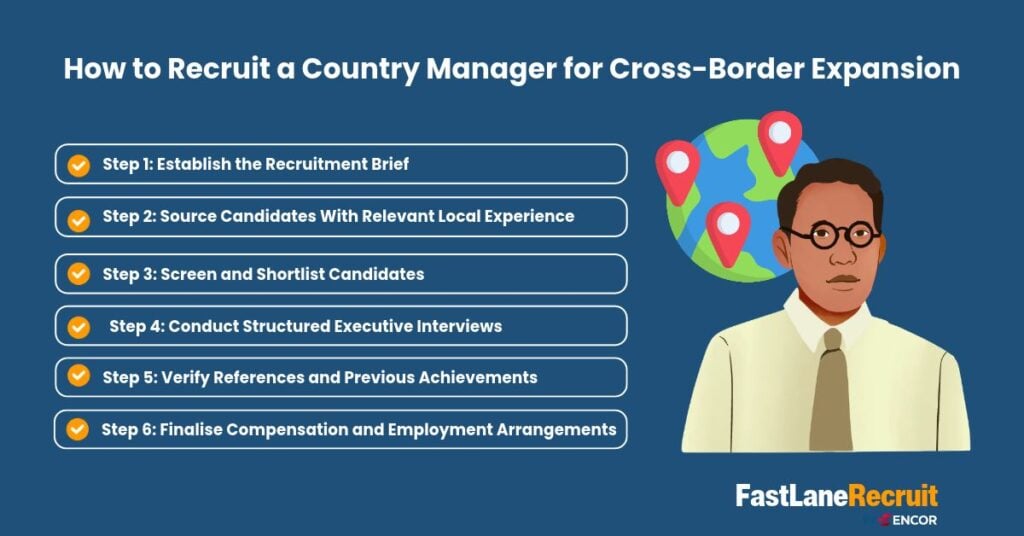
How to Recruit a Country Manager for Cross-Border Expansion
Country manager recruitment requires a different approach from filling a standard management vacancy. The selected executive must understand the target market while being capable of representing the company’s commercial interests and coordinating with an international headquarters.
A structured recruitment process helps businesses evaluate candidates against the actual requirements of market entry.
Step 1: Establish the Recruitment Brief
Start by aligning the recruitment team and hiring managers on the role’s objectives.
The recruitment brief should specify:
- Target country and industry.
- Business expansion objectives.
- Required leadership experience.
- Local market and language requirements.
- Sales and business development responsibilities.
- Reporting structure and decision-making authority.
- Expected compensation and employment arrangement.
- Target recruitment and onboarding timeline.
A clearly defined brief reduces unsuitable applications and helps recruiters focus on candidates who meet the company’s actual requirements.
Step 2: Source Candidates With Relevant Local Experience
Country manager recruitment should consider both active and passive candidates.
Potential sourcing channels include:
- Executive recruitment networks.
- Industry-specific professional associations.
- LinkedIn and professional networks.
- Referrals from trusted local business contacts.
- Existing regional leadership networks.
- Specialist executive search consultants.
Prioritise candidates who have worked in the target country or managed commercial activities there.
A candidate with experience in a neighbouring market may also be suitable, but their understanding of the target country’s regulations, customers, and business environment should be assessed separately.
Step 3: Screen and Shortlist Candidates
Evaluate candidates against a consistent selection framework rather than relying exclusively on CVs or personal impressions.
A practical screening checklist includes:
- Relevant country and industry experience.
- Previous market-entry or expansion projects.
- Demonstrated revenue and business development results.
- Leadership and team management experience.
- Financial and operational accountability.
- Language and cross-cultural communication skills.
- Professional reputation and reference history.
- Ability to work with an international headquarters.
Shortlisting should focus on evidence of achievements, not just years of experience or seniority.
Step 4: Conduct Structured Executive Interviews
Interview questions should test how candidates think, make decisions, and execute commercial strategies.
The following questions can help evaluate their suitability.
| Interview question | What it assesses |
| How would you approach entering this market during your first 90 days? | Strategic planning |
| Which customer segments would you prioritise and why? | Market understanding |
| How have you generated revenue in a new market previously? | Commercial execution |
| How would you develop local partnerships? | Relationship building |
| How would you manage limited resources during market entry? | Financial judgment |
| How do you balance headquarters’ expectations with local market realities? | Cross-border leadership |
| What local employment or regulatory considerations should the business investigate? | Compliance awareness |
Ask candidates to provide specific examples, explain their individual contribution, and quantify results wherever possible.
Step 5: Verify References and Previous Achievements
Reference checks are particularly important for senior leadership appointments.
Before making an offer, verify:
- Previous job titles and employment history.
- Actual responsibilities and reporting authority.
- Revenue, growth, or market-entry achievements.
- Leadership and team management capabilities.
- Professional conduct and stakeholder relationships.
- Reasons for leaving previous positions.
For senior commercial roles, consider asking former supervisors or business stakeholders how the candidate performed under pressure and handled difficult market conditions.
Step 6: Finalise Compensation and Employment Arrangements
Country manager compensation should reflect the target market, seniority, industry, responsibilities, and expected business outcomes.
Consider the following components:
| Compensation component | What to consider |
| Base salary | Local executive salary benchmarks |
| Performance bonus | Revenue, profitability, and strategic milestones |
| Benefits | Healthcare, leave, insurance, and statutory entitlements |
| Allowances | Travel, relocation, accommodation, or transport where applicable |
| Long-term incentives | Equity or other retention arrangements, where appropriate |
Use current country-specific salary data rather than applying headquarters’ compensation structure automatically.
FastLaneRecruit’s 2026 salary guides can also provide relevant regional benchmarking context where available.
Employment planning should begin before the final offer. Confirm the intended legal employer, contract terms, payroll arrangements, statutory contributions, benefits, work authorisation requirements, and applicable local restrictions.
Cross-Border Hiring: How to Employ a Country Manager Without a Local Entity
Finding a suitable executive is only half of the market-entry process.
Once a company selects its first country manager, it must determine how to employ that individual legally in the target jurisdiction.
For companies without a local subsidiary or branch, establishing an employment arrangement can become a significant operational challenge.
Can You Hire a Country Manager Without Setting Up a Local Company?
Yes, in many situations. An Employer of Record can provide a way to employ eligible workers in a country where your business does not have its own local employing entity.
An EOR acts as the legal employer under the employment arrangement, while your business generally retains responsibility for directing the employee’s daily work and performance.
This means a company can appoint a local country manager without necessarily incorporating its own subsidiary as the first step.
However, the arrangement must be permitted under the relevant country’s laws and suitable for the role and actual operating model.
What Is an Employer of Record?
An Employer of Record (EOR) is an organisation that legally employs an individual on behalf of another business in a particular jurisdiction.
The EOR manages agreed local employment responsibilities, while the client business directs the employee’s day-to-day work.
For a company hiring its first country manager, this can provide a structured way to manage local employment without immediately establishing its own employing entity.
How EOR Supports Country Manager Employment
| Employment responsibility | EOR’s role | Your company’s role |
| Employment contract | Prepare and administer the local employment agreement | Confirm role, terms, and expectations |
| Onboarding | Coordinate employment documentation and onboarding | Provide business orientation |
| Payroll | Process agreed salary payments | Fund payroll and approve compensation |
| Statutory contributions | Manage applicable employer and employee contributions | Provide required information and funding |
| Benefits | Administer agreed employment benefits | Determine business requirements and approved package |
| Employment administration | Support agreed HR processes | Manage business priorities and performance |
| Offboarding | Coordinate local employment termination processes | Make and communicate business decisions in accordance with the agreed arrangement |
The exact division of responsibilities depends on local law and the EOR service agreement.
EOR vs Local Entity vs Independent Contractor: Which Is Right for Your Market Entry?
Not every international expansion requires the same employment structure.
The right option depends on your long-term plans, hiring requirements, business activities, and local regulations.
| Consideration | Employer of Record | Local entity | Independent contractor |
| Local employing entity | EOR employs the worker | Your company employs the worker | Depends on the contractor’s business structure |
| Initial setup | No separate client employing entity required where EOR is permitted | Incorporation or registration required | Contractual engagement |
| Payroll | Managed through EOR | Managed by your company or provider | Contractor invoices according to agreement |
| Employment obligations | EOR manages agreed local employment responsibilities | Your company assumes employer obligations | Depends on genuine independent status |
| Management | Client directs day-to-day work under the arrangement | Direct employer management | Contractually agreed independent deliverables |
| Best suited for | Eligible employees and early-stage market entry | Established, substantial, or long-term operations | Genuine independent service providers |
When Should You Choose EOR?
EOR may be appropriate when:
- You need to hire one country manager before establishing a local entity.
- You want to assess a market before making a larger investment.
- Your business needs local employment without building its own HR infrastructure immediately.
- You are expanding into several countries with relatively small initial teams.
- You want support with local employment contracts, payroll, and statutory administration.
When Should You Establish a Local Entity?
A local subsidiary or branch may be more appropriate when:
- You plan to build a substantial permanent operation.
- You need direct control over local contracting and commercial infrastructure.
- Your activities require a locally registered or licensed entity.
- You expect significant local headcount or long-term investment.
- You need a local legal presence for banking, invoicing, licensing, or regulatory purposes.
When Is an Independent Contractor Arrangement Suitable?
Contractor engagement may work when the individual genuinely operates independently and provides services under a commercial agreement.
However, a full-time country manager who works under your company’s direction, represents your business continuously, and is integrated into its operations may be more appropriately classified as an employee.
The International Labour Organization’s Employment Relationship Recommendation No. 198 emphasises that employment status should be assessed based on the actual working relationship, rather than simply the label used in a contract.
Also Read: Global EOR Providers Compared: How to Choose the Right Partner
Important Compliance Considerations Before Hiring a Country Manager Abroad
A country manager can represent a business in important commercial activities, making employment and corporate compliance planning particularly important.
An EOR can support local employment administration, but it does not automatically remove every legal or tax obligation associated with operating in another country.
1. Employment Contracts and Local Labour Laws
Employment requirements differ across jurisdictions.
Before onboarding, confirm:
- Applicable employment legislation.
- Contract language and mandatory terms.
- Probation and notice requirements.
- Working hours and statutory leave.
- Minimum wage and salary payment requirements.
- Termination procedures and severance obligations.
- Employee benefits and social contributions.
Employment contracts should reflect the applicable local requirements rather than simply adapting the headquarters’ standard employment agreement.
2. Permanent Establishment and Corporate Tax Exposure
Important market-entry consideration
Hiring a country manager does not automatically create a permanent establishment (PE), but the executive’s activities may create corporate tax exposure depending on local law and applicable tax treaties.
Pay particular attention to whether the individual:
- Habitually concludes contracts on behalf of the foreign company.
- Plays a principal role leading to contracts that are routinely concluded.
- Negotiates important commercial agreements.
- Exercises significant authority over local business activities.
- Manages a fixed place of business through which the company operates.
The OECD Model Tax Convention’s Article 5 addresses permanent establishment, including dependent-agent situations. The applicable treaty, domestic legislation, and facts of the arrangement must be assessed in each jurisdiction.
Professional recommendation: Obtain local tax advice before granting the country manager authority to conclude contracts or make binding commercial commitments.
3. Immigration and Work Authorisation
If the selected country manager is a foreign national rather than a local resident, additional immigration requirements may apply.
Depending on the jurisdiction, the company may need to consider:
- Appropriate work authorisation.
- Employment visa eligibility.
- Sponsorship requirements.
- Residence permits.
- Local qualification or licensing requirements.
- Restrictions on foreign workers in specific roles.
An EOR arrangement should not be assumed to provide automatic visa sponsorship or immigration approval. Confirm the available immigration pathway separately before making a relocation or start-date commitment.
4. Payroll, Tax and Statutory Contributions
Country managers may receive higher compensation, bonuses, allowances, and additional benefits.
Businesses should clarify how these components are treated under local payroll and tax rules.
Consider:
- Personal income tax withholding.
- Employer social security contributions.
- Mandatory insurance.
- Pension or retirement contributions.
- Bonus and incentive taxation.
- Expense reimbursement.
- Local reporting and filing deadlines.
5. Data Protection and Confidentiality
Country managers may access customer information, financial data, commercial strategies, and employee records.
Cross-border hiring should therefore include appropriate arrangements for:
- Confidentiality obligations.
- Intellectual property ownership.
- Personal data handling.
- Access permissions and information security.
- Customer and commercial information protection.
- Post-employment confidentiality requirements.
Employment agreements and internal policies should be reviewed for local enforceability.
6. Corporate Authority and Local Representation
A country manager’s employment title does not automatically grant them the authority to act as a statutory director, legal representative, or authorised signatory.
Before appointing the individual, establish:
- Whether they need formal director or representative status.
- Who can sign commercial contracts.
- Whether they can open or operate bank accounts.
- What powers can be delegated.
- Which decisions require board or headquarters approval.
Some jurisdictions require specific local appointments or registrations. An EOR employment arrangement does not automatically satisfy those requirements.
Also Read: Employer of Record Agreement: 12 Questions to Ask Before Signing
How FastLaneRecruit Supports Country Manager Recruitment and International Employment
Finding the right executive and employing that person locally require different expertise.
FastLaneRecruit helps businesses address both requirements through our recruitment and Employer of Record services.
1. Executive Search: Find the Right Country Manager
A successful market entry depends on appointing someone who understands the local business environment and can execute your expansion strategy.
Our recruitment support helps businesses approach executive hiring with a clearer understanding of the required candidate profile and role expectations.
For country manager recruitment, the search should focus on:
- Relevant local market and industry experience.
- Commercial leadership and business development capabilities.
- Previous international expansion exposure.
- Strategic partnership and stakeholder management.
- Financial and operational accountability.
- Cultural alignment with headquarters.
A structured recruitment process can help identify candidates whose experience matches the company’s expansion objectives.
When to engage Executive Search: When you need specialist support finding, assessing, and shortlisting experienced country managers or other senior executives in your target market.
2. Employer of Record: Employ Your Selected Country Manager
Once you identify the right candidate, the next step is establishing an appropriate local employment arrangement.
FastLaneRecruit’s EOR service can support eligible hires in countries where our service is available.
Our agreed employment administration may include:
- Local employment contract preparation.
- Employee onboarding.
- Payroll processing.
- Statutory contributions and employment-related filings.
- Benefits administration where included.
- Ongoing HR and employment administration.
- Offboarding support.
Your business continues to manage the country manager’s commercial responsibilities, performance expectations, and daily work under the EOR arrangement.
When to engage EOR: When you have selected a candidate and need a local employment arrangement without immediately establishing your own employing entity, subject to local requirements.
3. Combine Executive Search and EOR for a More Coordinated Hiring Process
Recruitment and employment planning should not operate independently.
A coordinated approach can help businesses address the candidate search, employment structure, and onboarding requirements before the planned market-entry date.
| Stage | Business requirement | FastLaneRecruit support |
| 1. Planning | Define the country manager role | Recruitment requirement alignment |
| 2. Candidate search | Identify suitable executives | Executive Search |
| 3. Candidate selection | Evaluate and shortlist candidates | Recruitment coordination and selection support |
| 4. Employment planning | Determine the appropriate local arrangement | EOR suitability assessment |
| 5. Onboarding | Prepare local employment documentation | EOR onboarding and contract administration |
| 6. Ongoing employment | Manage payroll and employment administration | EOR support |
This approach helps businesses plan the leadership appointment and employment structure together rather than addressing compliance only after selecting a candidate.
Why Businesses Choose FastLaneRecruit
International expansion requires more than finding a candidate. Businesses need a recruitment partner that understands talent requirements and an employment partner that can support local hiring arrangements.
FastLaneRecruit combines recruitment expertise, regional employment knowledge, and international workforce support to help businesses approach cross-border hiring more efficiently.
1. Recruitment and Employment Support
We help businesses address two important stages of international hiring:
- Finding suitable talent through recruitment support.
- Managing local employment through EOR services in supported markets.
This provides a coordinated approach to candidate selection and employment planning.
2. Regional Market Knowledge
Employment requirements, compensation structures, and recruitment conditions vary between countries.
Our regional experience helps businesses consider local employment requirements and workforce arrangements when planning international expansion.
3. Local Employment Infrastructure
FastLaneRecruit operates through local entities in strategic Asian markets and provides EOR support across selected international markets.
This gives businesses access to local employment administration rather than having to establish a separate HR and payroll infrastructure immediately in every target country.
FastLaneRecruit+1
4. Employment Administration and Payroll Support
We support agreed employment processes, including:
- Employment contract administration.
- Employee onboarding.
- Payroll processing.
- Statutory contributions.
- Benefits administration where included.
- Ongoing employment administration.
Our service scope is aligned with the relevant country requirements and agreed service arrangements.
FastLaneRecruit’s International Market Coverage
Expanding into another country requires an understanding of local employment requirements and access to appropriate employment infrastructure.
FastLaneRecruit supports international hiring across selected markets in Asia Pacific, Europe, and the Middle East & Africa.
FastLaneRecruit operates in
- Asia Pacific: Malaysia, Singapore, Hong Kong, China, India, Philippines, Taiwan, Vietnam, Australia,
- Europe: United Kingdom, Switzerland
- Middle East & Africa: UAE, Saudi Arabia, Qatar
Our multi-market coverage helps businesses explore international employment solutions through one workforce partner rather than coordinating employment administration independently in every jurisdiction.
Country availability note: EOR eligibility, service scope, local employing arrangements, and onboarding requirements should be confirmed for the specific role and country before recruitment is finalised. The available employment model may differ depending on local regulations and the nature of the proposed work.
Find the Right Country Manager Before You Enter Your Next Market
Your first international leadership appointment can influence how successfully your business enters a new market.
The right country manager brings local knowledge, commercial relationships, and the leadership needed to turn expansion plans into measurable business opportunities. But finding the right person is only the beginning. You also need an appropriate employment structure that supports local hiring requirements.
FastLaneRecruit helps businesses approach both challenges through recruitment and international employment solutions.
Recruit the Right Executive With FastLaneRecruit
Whether you are entering a new market, expanding an existing regional operation, or recruiting your first international executive, our team can help you plan your recruitment requirements.
Our Executive Search support helps businesses:
- Identify suitable country managers and senior executives.
- Define leadership requirements and candidate profiles.
- Access relevant talent markets.
- Evaluate candidates against business objectives.
- Coordinate recruitment and selection requirements.
Once you have selected the right candidate, our EOR team can help assess the appropriate local employment arrangement in supported markets.
Ready to recruit your first country manager?
Discuss your target market, executive hiring requirements, and international employment plans with FastLaneRecruit.
Find the Right Leader. Prepare for Market Entry.
Book a Free Consultation with an Expert
Talk to our team about Executive Search and EOR solutions for your international expansion.
Frequently Asked Questions About Country Manager Recruitment and EOR
These questions address common decision-stage concerns for companies planning international recruitment and market entry.
1. Should I hire a country manager before entering a new market?
Hiring a country manager before market entry can help businesses understand local customer expectations, identify commercial opportunities, build strategic relationships, and prepare an expansion strategy.
It is particularly useful when local expertise is important to validating market demand and establishing an initial business presence.
However, the appointment should align with your market-entry objectives, available resources, and operational readiness.
2. How do I recruit a country manager in another country?
Start by defining the role’s responsibilities, target market, required experience, and expected commercial outcomes.
A typical country manager recruitment process includes:
- Define the recruitment mandate.
- Establish the candidate profile.
- Source local and international executive talent.
- Screen and shortlist candidates.
- Conduct structured interviews.
- Verify references and previous achievements.
- Finalise compensation and employment arrangements.
Working with an executive search specialist can help businesses identify and evaluate candidates with relevant local market and leadership experience.
3. Can I hire a country manager without setting up a local entity?
In many jurisdictions, yes.
An Employer of Record can legally employ an eligible country manager on behalf of your business without requiring you to establish your own local employing entity first.
The EOR manages agreed local employment responsibilities, including contracts, payroll, and statutory administration, while your business manages the employee’s day-to-day work.
However, local restrictions, corporate tax exposure, licensing, and permanent establishment considerations must be assessed separately.
4. Can an EOR employ a senior executive or country manager?
An EOR may be suitable for employing senior professionals, including country managers, where the arrangement is permitted under local regulations.
However, the position’s responsibilities must be reviewed carefully.
If the executive requires statutory director status, local legal representation, specific licensing, or authority that cannot be accommodated under the EOR arrangement, another employment or corporate structure may be necessary.
5. What is the difference between executive search and EOR?
Executive Search and EOR address two different stages of international hiring.
| Executive Search | Employer of Record |
| Finds suitable candidates | Legally employs eligible candidates |
| Focuses on talent sourcing and assessment | Focuses on employment administration |
| Supports candidate shortlisting | Supports employment contracts and onboarding |
| Helps businesses recruit leadership talent | Supports payroll and statutory employment obligations |
Businesses may use both services when they need to recruit a country manager and employ that person in a foreign market without immediately establishing their own local entity.
6. How long does it take to recruit and onboard a country manager internationally?
There is no universal timeline.
Executive recruitment depends on the seniority of the position, candidate availability, industry specialisation, compensation expectations, and interview requirements.
Employment onboarding also varies according to the country, documentation, work authorisation, and local statutory requirements.
For planning purposes, businesses should treat recruitment and employment onboarding as separate workstreams and confirm realistic timelines with their recruitment and EOR providers before setting a launch date.
7. What should I consider when setting a country manager’s salary?
Consider the target country’s executive salary benchmarks, industry, company size, role responsibilities, and candidate experience.
A compensation package may include:
- Base salary.
- Performance bonuses.
- Healthcare and other benefits.
- Relocation or travel allowances.
- Long-term incentives.
The package should also reflect local statutory requirements and the company’s budget for market entry.
8. Does hiring a country manager through an EOR prevent permanent establishment?
No. Using an EOR does not automatically prevent a company from creating a permanent establishment or other taxable presence.
Tax exposure depends on the company’s activities, the employee’s authority, applicable domestic legislation, and relevant tax treaties.
Businesses should obtain jurisdiction-specific tax advice before allowing a country manager to negotiate or conclude contracts, or perform other activities that may create a taxable presence.
9. Can I transition from an EOR arrangement to my own local entity later?
Yes, subject to local law and the relevant contractual arrangements.
A business may initially employ a country manager through an EOR while evaluating the market and later establish its own subsidiary or branch.
The transition should be planned carefully to address:
- Employment transfer or termination requirements.
- New employment contracts.
- Continuity of service and accrued benefits.
- Payroll and statutory registrations.
- Tax and corporate compliance.
- Employee consent and notification requirements.
10. Which countries does FastLaneRecruit support for international hiring?
FastLaneRecruit supports international hiring across selected markets:
- Asia Pacific: Malaysia, Singapore, Hong Kong, China, India, Philippines, Taiwan, Vietnam, and Australia.
- Europe: United Kingdom and Switzerland.
- Middle East & Africa: UAE, Saudi Arabia, and Qatar.
The specific EOR arrangement and service availability should be confirmed for the intended country and employee position.
11. Can FastLaneRecruit help recruit and employ the same country manager?
FastLaneRecruit provides recruitment and EOR services that can support different stages of international hiring.
Our Executive Search service helps businesses identify and recruit suitable leadership talent, while our EOR service supports the local employment arrangement in eligible markets.
Businesses can discuss both requirements with our team to determine the appropriate recruitment and employment approach.