Hiring employees in another country can open the door to new markets, customers, and talent. But it can also create tax and compliance obligations that businesses may not anticipate when expanding internationally.
One important consideration is permanent establishment (PE). A company may create a taxable presence in another country through its business activities, physical locations, or certain employee and agent activities, even when it does not operate a traditional foreign office.
For businesses hiring internationally or managing remote employees, understanding what is permanent establishment, what can trigger PE risk, and how to manage that exposure is an important part of global workforce planning.
Content Outline
Key Summary
Permanent Establishment Can Create Taxable Presence
Permanent establishment (PE) is an international tax concept that can give a country taxing rights over profits attributable to a business presence within its jurisdiction.
PE Can Arise in Several Ways
A PE may arise through a fixed place of business, certain dependent-agent activities, or other circumstances determined by applicable domestic tax law and tax treaties.
Remote Work Does Not Automatically Create PE
Hiring or allowing an employee to work remotely from another country does not automatically create permanent establishment. However, the employee’s activities, working location, authority, and business purpose can affect the PE assessment.
OECD Provides Updated Guidance on Remote Work
The OECD’s 2025 update provides additional guidance on when a home or other remote workplace may constitute a fixed place of business. It introduces a 50% working-time reference point for assessing certain home-office arrangements, but this is not an automatic PE threshold. Other facts and circumstances must still be considered.
PE Can Create Additional Tax and Compliance Obligations
If a business has a PE, it may face additional considerations involving corporate income tax, tax registration, reporting, compliance, and attribution of profits to the PE.
An EOR Can Support International Employment
An Employer of Record (EOR) can help businesses manage local employment, payroll, benefits, and employment compliance when hiring internationally. However, an EOR should not be treated as an automatic way to eliminate permanent establishment risk.
Assess PE Risk Before Hiring Abroad
Before hiring internationally, businesses should evaluate the employee’s location, role, authority, activities, working arrangement, business purpose, and applicable tax treaty to understand potential PE exposure.
What Is Permanent Establishment?
Permanent establishment is a concept used in international taxation to determine when a business has a sufficiently established presence in another country for that country to potentially tax business profits attributable to that presence.
Under the OECD Model Tax Convention, a traditional fixed-place PE generally involves a fixed place of business through which the business of an enterprise is wholly or partly carried on. Examples can include an office, branch, factory, workshop, or place of management.
However, PE is not limited to having a formal office or registered branch.
Depending on the applicable tax treaty and domestic rules, PE considerations can also involve:
- Employees working from another country
- A dependent agent acting on behalf of the business
- Employees or representatives negotiating or concluding contracts
- Business activities conducted regularly from a foreign location
- A location being used as part of the company’s core business activities
The exact PE test varies by country and treaty. Therefore, businesses should assess the specific facts, applicable domestic legislation, and relevant tax treaty rather than relying on a single global rule.
How Does Permanent Establishment Affect Global Hiring?
Global hiring can change where and how a company conducts its business.
For example, a company headquartered in the United Kingdom may hire an employee who works permanently from Singapore. If that employee performs substantive business activities from Singapore, the company may need to consider whether those activities create a taxable presence under Singaporean law and the applicable tax treaty.
This does not mean that hiring one overseas employee automatically creates a PE.
Instead, businesses should consider factors such as:
| Factor | Why it matters |
| Employee location | Regular business activity in another country may create additional tax considerations. |
| Nature of the role | Revenue-generating or core business activities can be more significant than purely preparatory activities. |
| Contract authority | Employees who habitually conclude or play a principal role in concluding contracts may increase PE exposure. |
| Fixed workplace | A location used with sufficient permanence may be relevant to a fixed-place PE analysis. |
| Commercial reason | Business-driven presence in another country may carry greater PE significance. |
| Duration and frequency | The pattern of activity over time can affect whether a presence is considered sufficiently permanent. |
| Local customers or suppliers | Regular business interactions in the country can be relevant to the overall assessment. |
The OECD’s 2025 update specifically expands the commentary on home-office situations, making the analysis more relevant to today’s cross-border workforce models.
What Can Create Permanent Establishment Risk?
PE risk is generally assessed based on the substance of a company’s activities, rather than simply whether it has registered an office.
1. A Fixed Place of Business
A company may have PE exposure when it conducts business through a fixed location in another country.
Traditional examples include:
- Offices
- Branches
- Places of management
- Factories
- Workshops
- Certain other business premises
The key question is whether the location is sufficiently fixed and whether the company’s business is carried on through that location.
2. Employees Working From a Foreign Location
Remote employees can introduce another layer of complexity.
The fact that an employee works from home abroad does not automatically mean the employer has a PE. The circumstances surrounding the arrangement matter.
The OECD’s 2025 commentary provides a new framework for home-office situations. In general, where an individual works from a home or other relevant location in another jurisdiction for less than 50% of their total working time for the enterprise over a relevant 12-month period, that location will generally not be considered a place of business of the enterprise solely on that basis. If the 50% reference point is met or exceeded, further facts and circumstances must be considered, including whether there is a commercial reason for the person’s presence in that jurisdiction.
Important: The 50% figure is not a universal “safe harbor” that guarantees no PE, nor does exceeding 50% automatically create one. The applicable treaty and facts remain important.
3. Employees Negotiating or Concluding Contracts
Employee activities can be particularly relevant where an individual acts on behalf of a foreign enterprise.
Under the OECD Model, a dependent-agent PE can arise where a person acting for an enterprise habitually concludes contracts, subject to the applicable treaty provisions and exceptions. The post-BEPS framework also considers situations where a person habitually plays the principal role leading to contracts that are routinely concluded without material modification.
This means companies should look beyond an employee’s formal job title and examine what the employee actually does.
4. Core Business Activities Performed Abroad
PE analysis can become more significant when employees abroad perform activities that form an important part of the company’s business.
For example:
- Sales and business development
- Client-facing services
- Contract negotiations
- Management activities
- Revenue-generating operations
- Product or service delivery
The more closely an activity is connected to the company’s core business, the more carefully the arrangement should be reviewed.
Does Working Remotely Create Permanent Establishment?
Not automatically.
This is one of the most important distinctions for businesses managing international remote teams.
A remote employee working from another country may create PE considerations, but PE status depends on the applicable legal and treaty framework and the specific circumstances.
The OECD’s 2025 guidance recognizes that cross-border remote work can involve a home or other location that may potentially become a fixed place of business. It also distinguishes between remote work driven primarily by personal circumstances and arrangements that have a stronger commercial connection to the employer’s business.
A practical PE risk assessment
Before allowing an employee to work abroad, consider:
Where is the employee working?
How frequently do they work there?
What percentage of their working time is spent there?
Why is the employee working from that country?
Do they meet customers or suppliers there?
Do they negotiate or conclude contracts?
Do they perform core revenue-generating activities?
Does the company provide or control the workplace?
Does the business have other activities or personnel in that country?
These questions do not determine PE by themselves, but they help identify when professional tax advice may be appropriate.
What Are the Tax Implications of Permanent Establishment?
If a company is considered to have a PE in another country, the host jurisdiction may obtain taxing rights over the business profits attributable to that PE, subject to the applicable tax treaty and domestic law.
Potential consequences can include:
- Corporate income tax obligations
- Tax registration
- Corporate tax filings
- Additional reporting requirements
- Profit attribution
- Transfer pricing considerations
- Increased tax administration
- Potential penalties or interest for non-compliance
- Additional professional and compliance costs
PE should therefore be treated as more than a technical tax definition. For companies expanding internationally, it can become a financial, operational, and compliance issue.
Permanent Establishment vs. Tax Residency: What’s the Difference?
Permanent establishment and tax residency are related but different concepts.
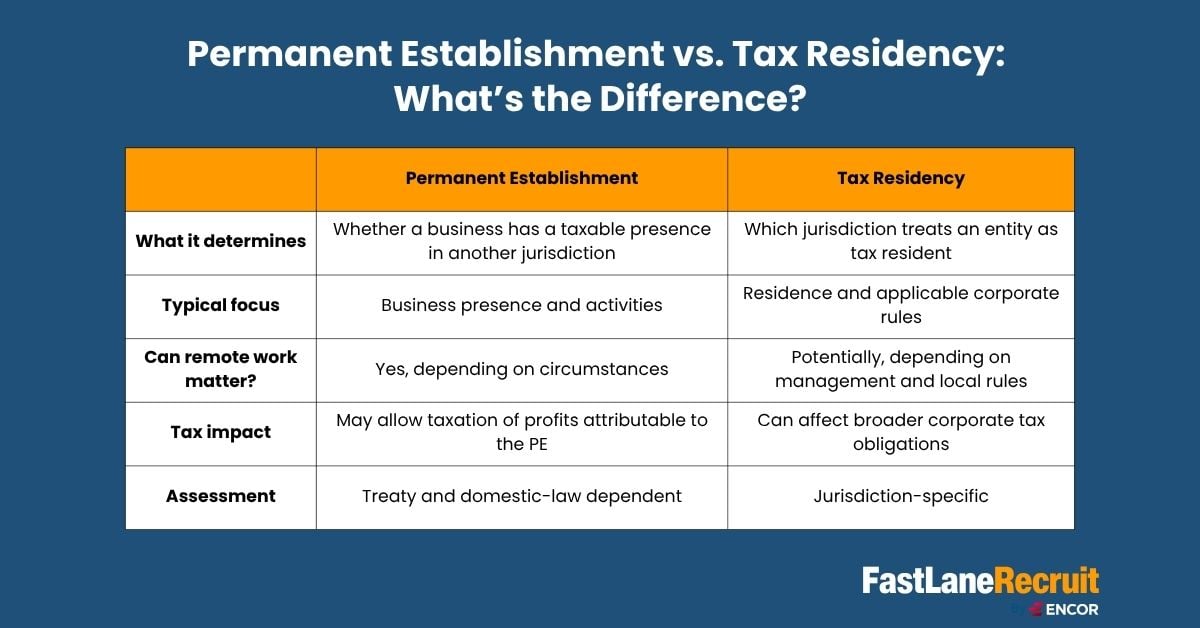
| Permanent Establishment | Tax Residency | |
| What it determines | Whether a business has a taxable presence in another jurisdiction | Which jurisdiction treats an entity as tax resident |
| Typical focus | Business presence and activities | Residence and applicable corporate rules |
| Can remote work matter? | Yes, depending on circumstances | Potentially, depending on management and local rules |
| Tax impact | May allow taxation of profits attributable to the PE | Can affect broader corporate tax obligations |
| Assessment | Treaty and domestic-law dependent | Jurisdiction-specific |
Understanding this distinction helps businesses avoid treating every cross-border tax issue as the same problem.
How Can Businesses Reduce Permanent Establishment Risk?
There is no single strategy that eliminates PE risk for every international business.
Instead, companies should build a structured global hiring and compliance process.
Review the employee’s role
Determine whether the employee will:
- Sell products or services
- Negotiate contracts
- Conclude contracts
- Manage customers
- Deliver core services
- Make strategic decisions
- Represent the company locally
Review the working arrangement
Document:
- Employee location
- Expected duration
- Working pattern
- Percentage of time spent in each country
- Business reason for the arrangement
- Customer-facing responsibilities
Review local requirements before hiring
Before employing someone in a new country, assess:
- Employment law
- Payroll obligations
- Social contributions
- Income tax requirements
- Corporate tax exposure
- Permanent establishment considerations
- Immigration and work authorization
Use the appropriate employment structure
For companies without a local entity, an Employer of Record can provide a practical way to employ workers through an established local employment structure while the company manages the employee’s day-to-day work.
However, an EOR should be viewed as part of a broader international tax and compliance strategy—not as an automatic PE exemption.
How Can an EOR Help With International Hiring?
An Employer of Record (EOR) legally employs workers on behalf of a client in a country where the client may not have its own local entity.
This can help businesses manage key employment responsibilities such as:
- Employment contracts
- Payroll
- Statutory contributions
- Employee benefits
- Local employment compliance
- Onboarding
- Offboarding
- Employment administration
For companies testing a new market, hiring a small international team, or expanding without immediately establishing a subsidiary, an EOR can reduce the operational burden of setting up and administering local employment.
EOR does not automatically eliminate PE risk
This distinction is important for an EEAT-focused article.
An EOR addresses the employment relationship and local workforce administration. Permanent establishment is a corporate-tax question determined by applicable law, treaty provisions, and the company’s activities.
Therefore, companies should still evaluate PE exposure based on their actual business operations.
Also Read: 10 Best Employer of Record (EOR) Services To Consider in 2026
EOR vs. Establishing a Local Entity
Choosing between an EOR and a local entity depends on the company’s expansion strategy.
| Consideration | EOR | Local Entity |
| Best suited for | Hiring employees without immediately establishing an entity | Long-term operations with substantial local presence |
| Setup | Generally faster than creating a subsidiary | Requires entity formation and registration |
| Employment administration | Managed through EOR structure | Managed directly by company |
| Payroll | EOR manages local payroll administration | Company manages or outsources payroll |
| Local employment compliance | Supported by EOR | Company’s responsibility |
| Market testing | Useful for testing demand and building an initial team | Better suited to established operations |
| Control over employee’s work | Client generally directs day-to-day work | Company directly employs and manages staff |
| Corporate tax / PE | Requires separate assessment | Entity has its own local tax and compliance obligations |
For companies entering a market with a small team or uncertain long-term commitment, an EOR may offer a more practical starting point.
When Should a Business Consider an EOR?
An EOR may be worth considering if:
- You need to hire employees in a country where you do not have a legal entity.
- You want to enter a market without immediately establishing a subsidiary.
- You are testing a new market or building a small initial team.
- You need local payroll and employment compliance support.
- You want to accelerate international hiring.
- Your HR team does not have local employment expertise.
- You want to centralize international workforce administration.
The right choice depends on your workforce size, expansion timeline, business activities, tax position, and long-term market strategy.
Final Consideration
Permanent establishment is no longer a question only for companies opening traditional overseas offices. As global hiring and cross-border remote work become more common, businesses need to consider how where employees work and what they do can affect international tax exposure.
The safest approach is not to assume that remote hiring either automatically creates or automatically avoids PE.
Instead, assess the country, employee role, working arrangement, business purpose, contractual authority, and applicable tax rules before expanding.
When you need to hire internationally without immediately establishing your own local employment infrastructure, FastLaneRecruit can help you build a compliant and practical global employment structure through EOR services.
FastLaneRecruit: Simplify International Hiring With an EOR
Expanding into a new country should not require your HR team to navigate every local employment process alone.
FastLaneRecruit helps businesses hire and manage employees internationally through Employer of Record services, providing support for local employment administration, payroll, benefits, and compliance.
Our EOR coverage includes:Malaysia, Singapore, Hong Kong, China, India, Philippines, Taiwan, Vietnam, Australia, United Kingdom, Switzerland, UAE, Saudi Arabia, Qatar.
Whether you are hiring your first international employee, building a distributed team, or testing a new market, FastLaneRecruit can help you establish a more structured approach to global employment.
Ready to Hire Internationally?
If you are considering hiring employees abroad and want to understand whether an EOR is the right structure for your expansion, talk to FastLaneRecruit’s global employment experts.
Book a Free Consultation with an Expert!
Frequently Asked Questions About Permanent Establishment
What is permanent establishment in simple terms?
Permanent establishment is a tax concept used to determine whether a business has a sufficiently established presence in another country for that country to potentially tax profits attributable to that presence.
Does hiring an employee in another country create permanent establishment?
Not necessarily. Hiring an employee abroad does not automatically create a PE. The outcome depends on the employee’s activities, workplace, authority, business purpose, applicable domestic law, and relevant tax treaty.
Can a remote employee create permanent establishment?
Yes, a remote employee can create PE considerations, particularly where the employee regularly works from a foreign location and performs substantive business activities there. However, remote work alone does not automatically create PE.
The OECD’s 2025 update provides specific guidance for assessing cross-border home-office arrangements, including a 50% working-time reference point in certain circumstances.
What is the 50% rule for permanent establishment?
The OECD’s 2025 commentary indicates that when an individual works from a home or other relevant location in another jurisdiction for less than 50% of their total working time for the enterprise over a relevant 12-month period, that location will generally not be treated as the enterprise’s place of business solely on that basis.
However, 50% is not an automatic PE threshold. Reaching or exceeding 50% does not automatically create PE; additional facts, including the commercial reason for the arrangement, must be considered.
What activities can increase permanent establishment risk?
Activities that may require closer review include:
- Habitually concluding contracts
- Playing a principal role leading to contracts
- Conducting sales activities
- Managing customers
- Providing core services
- Operating from a fixed location
- Performing significant business activities in another country
The exact test depends on the applicable treaty and local law.
Does an EOR eliminate permanent establishment risk?
No. An EOR should not be treated as an automatic PE exemption.
An EOR primarily provides a local employment structure and manages employment-related responsibilities. PE is a separate corporate-tax question that depends on the company’s activities, applicable tax rules, treaty provisions, and specific facts.
What is the difference between EOR and permanent establishment?
An EOR is an employment solution, while permanent establishment is a tax concept.
An EOR can help a company employ workers in another country without immediately creating its own local employment entity. PE analysis determines whether the company’s activities create a taxable presence in that jurisdiction.
Should I use an EOR or establish a local entity?
An EOR may be appropriate when you need to hire a small team, test a market, or expand quickly without immediately establishing a subsidiary.
A local entity may be more appropriate when you expect substantial, long-term operations and need a permanent corporate presence.
The decision should consider employment, tax, legal, immigration, operational, and commercial requirements.
Can FastLaneRecruit help with international hiring?
Yes. FastLaneRecruit provides EOR services across Malaysia, Singapore, Hong Kong, China, India, Philippines, Taiwan, Vietnam, Australia, the United Kingdom, Switzerland, UAE, Saudi Arabia, and Qatar.
Our EOR services can help businesses manage local employment, payroll, benefits, and employment compliance while they focus on building their international teams.