The right person for your next critical role may be thousands of miles away. Yet, limiting recruitment to one country can mean missing out on specialised skills, new perspectives and opportunities to build a more competitive workforce.
As businesses embrace remote work and international recruitment, borderless hiring is changing how employers find, recruit and manage talent. Companies are no longer looking exclusively within their domestic labour markets. They are exploring international talent pools to fill skills gaps, support regional operations and build teams around business needs rather than geographical limitations.
However, hiring across borders involves more than finding the right candidate. Employers must consider local employment laws, payroll requirements, taxation, statutory benefits and worker classification in every country where their employees work.
This creates an important business decision: how can companies access global talent without taking on unnecessary legal and administrative complexity?
Employer of Record (EOR) services offer one solution. By working with an EOR provider, businesses can employ international talent through an established local employment structure without necessarily setting up their own legal entity in every market.
Understanding how borderless hiring works, its benefits and its potential challenges can help employers determine the right approach to building an international workforce.
Key Summary
Borderless Hiring Expands Access to Global Talent
Businesses can recruit professionals across different countries, widening their candidate pools and accessing skills that may be difficult to find locally.
International Hiring Requires Local Compliance
Employment contracts, payroll, taxation, statutory benefits and termination requirements differ between jurisdictions. Employers must assess these obligations before hiring overseas.
Businesses Have Different International Hiring Options
Companies can hire through their own foreign entities, engage genuinely independent contractors or use an Employer of Record, depending on their workforce requirements.
EOR Services Simplify International Employment
An EOR becomes the legal employer in the relevant country and manages agreed employment responsibilities, including contracts, payroll, statutory contributions and compliance administration.
The Right Hiring Model Depends on Business Goals
EOR arrangements can suit businesses hiring international employees without establishing a local entity. Companies planning substantial, permanent operations may benefit from evaluating their own entity.
What Is Borderless Hiring?
Borderless hiring is a recruitment and workforce strategy that allows businesses to identify and hire talent across geographical and national boundaries rather than limiting recruitment to their domestic labour markets.
Instead of prioritising where candidates live, employers focus on the skills, qualifications, experience and capabilities required for a position.
This approach enables organisations to build distributed international teams, recruit specialised professionals and access talent markets that may offer better alignment with their workforce requirements.
Borderless hiring can involve:
- Recruiting remote employees who live in other countries.
- Hiring professionals with specialised skills unavailable locally.
- Building international teams across multiple time zones.
- Recruiting talent in countries where a business plans to expand.
- Engaging independent contractors for genuinely independent project-based work.
- Employing international workers through an Employer of Record.
The key distinction: Borderless hiring removes geographical limitations from talent sourcing, but it does not remove the employment laws and regulatory requirements of the countries where people work.
Borderless Hiring vs Remote Hiring: What Is the Difference?
Although the terms are closely related, borderless hiring and remote hiring are not interchangeable.
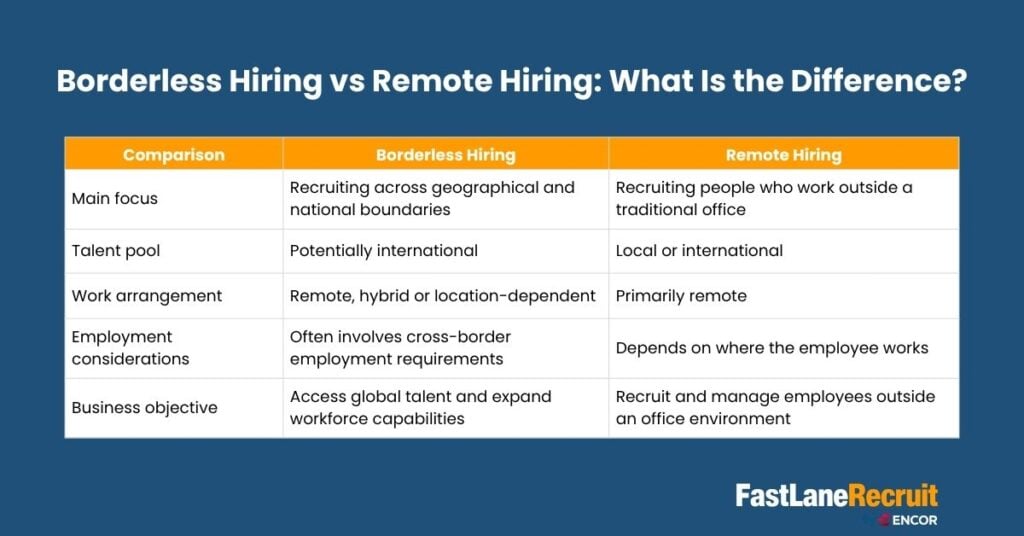
| Comparison | Borderless Hiring | Remote Hiring |
| Main focus | Recruiting across geographical and national boundaries | Recruiting people who work outside a traditional office |
| Talent pool | Potentially international | Local or international |
| Work arrangement | Remote, hybrid or location-dependent | Primarily remote |
| Employment considerations | Often involves cross-border employment requirements | Depends on where the employee works |
| Business objective | Access global talent and expand workforce capabilities | Recruit and manage employees outside an office environment |
For example, a Singapore-based company hiring a marketing professional who works remotely from Malaysia is practising borderless hiring.
A Singapore-based company hiring a marketing professional who works from home in Singapore is practising remote hiring, but not necessarily borderless hiring.
This distinction matters because employing someone in another country can introduce additional legal, tax and payroll obligations.
Why Is Borderless Hiring Becoming More Important for Businesses?
Global recruitment is becoming a more strategic workforce decision as employers compete for specialised skills, adapt to flexible working arrangements and respond to changing business requirements.
The 2025 KPMG Global Mobility Benchmarking Report highlights how organisations are increasingly positioning mobility as a talent and business enabler, with 60% of mobility functions anchored in talent management and talent acquisition.
Meanwhile, a November 2026 Greenhouse article highlights how widening recruitment beyond traditional geographical markets can help employers address skills shortages and improve access to suitable candidates.
Several developments are contributing to this shift.
1. Growing Demand for Specialised Skills
Some businesses struggle to find professionals with the technical expertise or industry experience required for specific roles.
This is particularly relevant to industries such as:
- Information technology and software development.
- Artificial intelligence and data analytics.
- Digital marketing and technology.
- Engineering and manufacturing.
- Financial services.
- Customer support and business operations.
Borderless hiring allows employers to search beyond domestic talent markets and identify candidates with the capabilities their organisations need.
2. Greater Acceptance of Distributed Workforces
Remote and hybrid working arrangements have changed how businesses organise their teams.
Many roles involving software development, marketing, design, consulting and customer support can be performed without employees being physically present in the same office.
This creates opportunities for companies to recruit internationally while maintaining collaboration through digital communication, project management and workforce management tools.
However, employers should assess whether a position can genuinely be performed remotely, considering security, licensing, customer requirements and local working conditions.
3. Businesses Are Expanding into International Markets
Companies entering new markets may need local professionals who understand regional customers, business practices, languages and industry requirements.
Hiring employees in the target market can help businesses:
- Develop local customer relationships.
- Support regional sales and marketing.
- Provide customer service across time zones.
- Build market-specific expertise.
- Coordinate regional business operations.
Rather than immediately establishing a full overseas operation, businesses may assess alternative employment arrangements, including EOR services, to support initial hiring.
4. More Flexible Workforce Planning
Traditional recruitment strategies often require businesses to plan around existing office locations and domestic headcount.
Borderless hiring provides greater flexibility when organisations need to recruit for specific projects, establish regional teams or respond to changing skill requirements.
Businesses can evaluate talent markets based on the role, expected workforce needs and operational requirements rather than automatically expanding their physical office footprint.
5. Technology Makes International Recruitment More Accessible
Digital recruitment platforms, video interviews, applicant tracking systems and collaborative tools have made it easier to identify and evaluate candidates in different countries.
AI-assisted recruitment can also support candidate screening and administrative processes.
However, employers should maintain human oversight, consistent evaluation criteria and appropriate data protection measures when using recruitment technology across jurisdictions.
What Are the Benefits of Borderless Hiring for Employers?
Borderless hiring can provide several business advantages when supported by an appropriate international employment strategy.
1. Access to a Wider Global Talent Pool
One of the most significant advantages is the ability to recruit beyond the domestic labour market.
Businesses can identify candidates with specialised expertise, professional qualifications and industry experience that may be difficult to source locally.
Business impact: Greater access to suitable candidates can improve recruitment opportunities and help address skills shortages.
2. Better Access to Specialised Expertise
Certain markets have established talent concentrations in particular industries.
For example, businesses may explore different countries for software development, engineering, financial operations, digital services or multilingual customer support.
Rather than assuming that all talent markets offer the same capabilities, employers can align recruitment locations with their specific workforce requirements.
Business impact: Companies can build teams with complementary skills and expertise.
3. Potentially More Efficient Workforce Costs
International recruitment gives employers the opportunity to evaluate compensation and operating costs across different labour markets.
However, lower salaries do not automatically mean lower total employment costs.
Employers should consider:
- Gross employee compensation.
- Employer social security contributions.
- Mandatory benefits and insurance.
- Payroll administration.
- Recruitment and onboarding expenses.
- EOR or entity administration costs.
- Currency and payment considerations.
Business impact: Comparing total employment costs helps businesses make better-informed international hiring decisions without compromising compliance or talent quality.
4. Greater Business Flexibility and Scalability
Borderless hiring can support businesses that need to expand teams without immediately committing to a physical office in every target market.
Companies can assess their hiring needs, recruit in suitable locations and choose an employment structure that aligns with their expansion plans.
Business impact: Greater flexibility when entering new talent markets or responding to changing workforce requirements.
5. Improved Regional Coverage and Customer Support
International employees can help businesses operate across different time zones and communicate more effectively with local customers.
For example, a company headquartered in Singapore may recruit employees in India, Vietnam and the Philippines to support regional operations.
Business impact: Better geographical coverage and access to local market knowledge.
6. Greater Workforce Diversity
Recruiting internationally can bring together employees with different professional experiences, cultural perspectives and problem-solving approaches.
When supported by inclusive management practices, this can strengthen collaboration and encourage new ideas.
Business impact: A more diverse workforce with broader perspectives and capabilities.
Also Read: Benefits of Global Outsourcing: How Businesses Reduce Costs, Access Global Talent, and Scale Faster
What Are the Challenges of Borderless Hiring?
Although international recruitment creates new opportunities, employers must consider the legal, financial and operational responsibilities associated with employing people in different countries.
The biggest challenge is that employment requirements remain jurisdiction-specific, even when employees work remotely.
1. Different Employment Laws and Regulations
Every country has its own employment legislation governing the relationship between employers and employees.
Requirements may cover:
- Employment contracts and mandatory terms.
- Minimum wages and working hours.
- Overtime and leave entitlements.
- Probation periods.
- Employee termination and notice periods.
- Severance and redundancy payments.
- Workplace protections.
A contract designed for an employee in one country may not satisfy the legal requirements of another.
What employers should do: Review local employment legislation and ensure that employment arrangements reflect the requirements of the country where the employee performs their work.
2. International Payroll and Tax Compliance
Managing payroll across multiple countries can become complicated because each jurisdiction may apply different tax rules, payment schedules and employer contributions.
Employers may need to account for:
- Personal income tax withholding.
- Employer social security contributions.
- Mandatory pension or retirement contributions.
- Statutory insurance.
- Payroll reporting and filing.
- Local currency payment requirements.
Errors in payroll calculations or statutory contributions can result in financial penalties, employee disputes and compliance issues.
What employers should do: Establish country-specific payroll procedures and identify who is responsible for withholding, reporting, payment and statutory administration.
3. Employee vs Independent Contractor Classification
Businesses sometimes engage overseas professionals as independent contractors to simplify international recruitment.
However, the contractual label does not determine employment status by itself.
Authorities may consider factors such as:
- The level of control exercised by the company.
- Whether the individual operates an independent business.
- The nature and continuity of the working relationship.
- Financial independence and commercial risk.
- Integration into the company’s operations.
If a worker is legally considered an employee, incorrectly classifying them as a contractor can result in backdated employment obligations, taxes, contributions and potential penalties.
What employers should do: Assess the actual working relationship against local classification rules before deciding whether to engage someone as an employee or independent contractor.
4. Managing Statutory Benefits and Employee Entitlements
Employee benefits are not consistent across international markets.
Depending on the jurisdiction, employers may need to provide:
- Annual and public holiday leave.
- Sick leave.
- Maternity and paternity entitlements.
- Health or social insurance.
- Pension or retirement contributions.
- Other mandatory allowances and protections.
Businesses must distinguish between statutory entitlements and additional benefits offered as part of their compensation packages.
What employers should do: Understand mandatory local entitlements before finalising compensation and employment offers.
5. Data Protection and Cross-Border Information Transfers
International recruitment involves collecting and processing employee information, including personal details, employment records and financial information.
Different countries have different privacy and data protection requirements.
For example, businesses handling personal data in the European Economic Area must consider the GDPR, including its requirements for international data transfers.
What employers should do: Review applicable privacy laws, control access to employee information and establish appropriate data processing and transfer arrangements.
6. Immigration, Work Authorisation and Right-to-Work Requirements
Hiring an international employee does not automatically mean that the person is authorised to work in any country.
Employers must distinguish between:
- Hiring someone who already has the legal right to work in their country of residence.
- Sponsoring a foreign national to relocate and work in another country.
- Employing someone remotely while they remain in their home country.
Each arrangement may involve different immigration, work authorisation and employment requirements.
What employers should do: Verify the individual’s right to work in the relevant location and determine whether immigration sponsorship or other approvals are necessary.
7. Permanent Establishment and Corporate Tax Exposure
Employing people internationally can create corporate tax considerations beyond individual employee payroll.
Depending on local tax rules and the employee’s responsibilities, activities may create a taxable presence or permanent establishment risk for the business.
This is particularly important when employees negotiate or conclude contracts, conduct revenue-generating activities or represent the company in another jurisdiction.
What employers should do: Obtain appropriate corporate tax advice before establishing substantial business activities through international employees.
How to Implement a Borderless Hiring Strategy
A successful international hiring strategy requires more than identifying suitable candidates. Businesses should establish an employment structure, compliance process and workforce management approach before onboarding employees.
The following steps provide a practical framework.
Step 1: Identify Your International Hiring Requirements
Start by defining why the business needs international talent.
Consider:
- Which roles need to be filled?
- What skills or qualifications are required?
- Can the positions be performed remotely?
- Which countries offer suitable talent?
- How many employees do you expect to hire?
- Is the hiring requirement temporary or long-term?
A clear hiring plan helps narrow down potential talent markets and employment options.
Step 2: Research and Select Suitable Hiring Markets
Evaluate potential countries based on more than salary expectations.
Important considerations include:
| Evaluation factor | What to assess |
| Talent availability | Relevant skills, qualifications and professional experience |
| Compensation | Market salary expectations and total employment costs |
| Employment regulations | Local labour laws and mandatory employment requirements |
| Payroll | Tax withholding, employer contributions and payment procedures |
| Language and time zone | Communication and operational compatibility |
| Business environment | Market conditions and long-term expansion objectives |
| Employment infrastructure | Availability of a suitable local entity or EOR arrangement |
This assessment helps employers avoid choosing a hiring location based solely on lower labour costs.
Step 3: Choose the Appropriate International Hiring Model
Before making an offer, determine how the individual will be legally engaged.
The main options include:
- Direct employment through your own local entity.
- Independent contractor engagement.
- Employment through an Employer of Record.
Each model has different responsibilities, costs and compliance considerations.
The most appropriate structure depends on the nature of the working relationship, the country involved and your long-term business objectives.
Step 4: Prepare Compliant Employment Contracts
Once the employment model is established, ensure that the relevant contracts meet local legal requirements.
Employment documentation may need to address:
- Job title and responsibilities.
- Compensation and payment arrangements.
- Working hours and overtime.
- Leave and statutory benefits.
- Probation and termination provisions.
- Confidentiality and intellectual property.
- Applicable employment policies.
Local requirements should be reviewed before the employee starts work.
Step 5: Establish Payroll and Benefits Administration
Employers must ensure that employees receive accurate compensation and applicable statutory benefits.
Set up the necessary processes for:
- Gross-to-net salary calculations.
- Tax withholding and reporting.
- Employer contributions.
- Statutory insurance and benefits.
- Payroll schedules.
- Payslips and employment records.
For businesses hiring across several countries, centralised oversight can help improve payroll consistency while maintaining country-specific compliance.
Step 6: Establish an International Onboarding Process
A consistent onboarding process helps international employees integrate into the organisation.
Consider preparing:
- Signed employment documentation.
- Employee information and payroll records.
- Company policies and procedures.
- Equipment and system access.
- Reporting structures.
- Communication and performance expectations.
Employers should also ensure that employee information is handled in accordance with applicable privacy requirements.
Step 7: Monitor Employment Compliance Continuously
International employment compliance does not end when an employee signs a contract.
Employers should regularly review changes to:
- Employment legislation.
- Minimum wages and statutory contributions.
- Tax and payroll requirements.
- Employee benefits.
- Immigration and work authorisation.
- Working arrangements and employee locations.
- Termination and redundancy obligations.
A structured compliance review helps businesses manage ongoing employment responsibilities as their international workforce grows.
What Are the Different International Hiring Models?
Businesses considering borderless hiring generally have three main employment options: direct employment through a local entity, independent contractor engagement and Employer of Record arrangements.
The right choice depends on whether the business needs employees or independent service providers, its international presence and the scale of its operations.
1. Direct Employment Through a Local Entity
A company can establish a legal entity in the target country and employ workers directly through that entity.
The local company assumes the applicable employer responsibilities, including employment contracts, payroll, tax, statutory benefits and labour law compliance.
Best suited for:
- Businesses planning substantial long-term operations.
- Companies building permanent local teams.
- Organisations requiring a direct legal and operational presence.
- Businesses with sufficient resources to manage local administration.
Considerations: Entity incorporation, registration, ongoing accounting, tax, payroll and corporate compliance can require considerable time and resources.
2. Independent Contractor Engagement
Businesses can engage independent contractors for services or projects where the relationship genuinely meets the relevant local independent contractor criteria.
Contractors generally operate independently and provide services under a commercial agreement rather than an employment relationship.
Best suited for:
- Genuine independent service providers.
- Project-based assignments.
- Specialist external consultants.
- Work arrangements with genuine commercial independence.
Considerations: Companies must assess classification carefully. Using a contractor agreement does not eliminate employment obligations if the actual relationship legally constitutes employment.
3. Employer of Record (EOR)
An Employer of Record is a third-party organisation that legally employs workers on behalf of another business in a particular country.
The EOR becomes the legal employer and manages agreed employment responsibilities, such as employment contracts, payroll, statutory contributions, benefits administration and local employment compliance.
The client company generally retains control over the employee’s day-to-day work, including job responsibilities, performance and operational management, subject to applicable law and the service agreement.
Best suited for:
- Businesses hiring employees in countries where they do not have a local entity.
- Companies entering new markets without immediately incorporating a subsidiary.
- Organisations building international teams.
- Employers seeking support with local employment administration.
Considerations: EOR availability, permitted employment structures, service scope and regulatory requirements vary by country. An EOR arrangement should not be assumed to eliminate all corporate tax, permanent establishment or regulatory risks.
EOR vs Direct Employment vs Independent Contractors
| Factor | EOR | Own Local Entity | Independent Contractor |
| Legal employment relationship | EOR employs the worker | Your local entity employs the worker | Commercial service relationship |
| Local entity required for client | Generally no, where EOR arrangement is permitted | Yes | Depends on business circumstances |
| Employment contracts | Managed through EOR | Managed by your entity | Service agreement |
| Payroll administration | Managed by EOR under agreement | Managed by your entity or payroll provider | Contractor invoices or agreed payment |
| Statutory employee benefits | Administered through EOR | Provided by your entity | Generally not employee benefits, subject to classification |
| Day-to-day work management | Generally client company | Client’s local entity | Based on the independent engagement |
| Setup requirements | EOR onboarding and local requirements | Incorporation and registration | Contracting and classification assessment |
| Typical use case | International employees without a local entity | Established local operations | Genuine independent service providers |
Which model should you choose?
- Choose an EOR when you need to employ international staff but do not want to establish your own local entity, provided the arrangement is legally available and suitable.
- Choose direct employment when you have or plan to establish a local entity and want to operate your own employment structure.
- Choose independent contractors when the individual genuinely provides independent services rather than performing the role of an employee.
Also Read: 7 Strategic Benefits of Using an EOR for Talent Acquisition
How Employer of Record Services Support Borderless Hiring
Recruiting internationally can be straightforward. Establishing a compliant employment relationship in another country is often more complicated.
An Employer of Record helps bridge this gap by providing a local employment structure for businesses that want to hire overseas employees without establishing their own entity in every market.
Instead of independently managing every aspect of local employment administration, businesses can work with an EOR provider to manage agreed legal employer responsibilities.
What Does an Employer of Record Handle?
An EOR typically manages the following responsibilities, subject to local law and the agreed service scope.
1. Local Employment Contracts
The EOR facilitates employment agreements that reflect applicable local employment requirements.
This helps ensure that employment documentation addresses relevant statutory terms and employee entitlements.
2. International Payroll Administration
The EOR manages agreed payroll processes, including salary calculations, statutory deductions, employer contributions and employee payments.
This supports accurate and consistent payroll administration in the relevant country.
3. Statutory Benefits and Contributions
The EOR administers applicable statutory benefits and employer contributions, such as social security, insurance and other mandatory entitlements.
The specific requirements depend on local legislation.
4. Employment Compliance Administration
The EOR supports employment administration in accordance with local labour laws, including relevant documentation and statutory processes.
This helps businesses navigate country-specific employment requirements.
5. Employee Onboarding and Offboarding
An EOR can coordinate employment-related onboarding and offboarding procedures, including documentation, payroll setup and applicable termination administration.
This provides businesses with a more structured approach to managing international employee lifecycles.
How Does an EOR Arrangement Work?
A typical EOR employment arrangement involves three parties:
- The client company: Selects the employee, defines the role and manages day-to-day work.
- The EOR provider: Becomes the legal employer and manages agreed employment responsibilities.
- The employee: Performs their role for the client company under the relevant employment arrangement.
The process generally follows these steps:
| Stage | What happens |
| 1. Hiring assessment | The business identifies the target country and employment requirements |
| 2. Employment structure | The EOR assesses the proposed arrangement and local requirements |
| 3. Contract preparation | The EOR facilitates compliant employment documentation |
| 4. Onboarding | Employee information, payroll and statutory arrangements are established |
| 5. Ongoing employment | The EOR manages agreed payroll and employment administration |
| 6. Offboarding | Employment termination and final payments are handled according to applicable requirements |
What Are the Benefits of Using EOR for Borderless Hiring?
Hire without establishing a local entity
Businesses can employ workers in supported countries through an EOR arrangement without incorporating their own local company, where legally permitted.
Simplify international employment administration
An EOR helps manage employment documentation, payroll, statutory contributions and other agreed responsibilities.
Reduce administrative complexity
Businesses can work with an established employment provider instead of independently building every local employment process.
Support international workforce expansion
Companies can recruit employees in multiple markets while using a structured approach to local employment administration.
Maintain focus on core business operations
With employment administration supported by an EOR, internal teams can focus on recruitment, performance management and business growth.
When Should Employers Consider Using an EOR for Borderless Hiring?
An EOR is not necessarily the right solution for every international hiring situation. However, it can be particularly useful when businesses need international employees without the administrative commitment of establishing their own local entity.
Consider an EOR if your business:
1. Wants to Hire Its First Employee in Another Country
Establishing a legal entity solely to employ one person may not be commercially practical.
An EOR can provide an alternative employment structure where permitted.
2. Plans to Enter a New Market
Businesses exploring a new country may want to recruit local employees before committing to a permanent corporate presence.
An EOR can support initial employment requirements while the company evaluates its long-term expansion strategy.
3. Needs to Recruit Specialised International Talent
If the right candidate lives outside your existing operational markets, an EOR can help facilitate local employment without requiring immediate entity incorporation.
4. Wants to Simplify Multi-Country Payroll
Managing different payroll systems, statutory contributions and employment requirements can become increasingly difficult as international headcount grows.
An EOR can help consolidate agreed employment administration across supported countries.
5. Wants to Reduce Internal Employment Administration
Companies without dedicated international HR, payroll or legal teams may benefit from working with an EOR provider that understands the relevant local employment framework.
When Might Establishing Your Own Entity Be More Suitable?
An EOR is not automatically the most economical or appropriate option for long-term expansion.
Businesses should evaluate their own local entity when they:
- Plan to build a substantial permanent workforce.
- Need direct corporate operations in the country.
- Require local licensing or regulated business activities.
- Intend to establish local offices or infrastructure.
- Need greater direct control over local corporate operations.
- Have reached a scale where maintaining an entity may be more commercially suitable.
The decision should consider total costs, business activities, tax exposure, legal requirements and long-term expansion objectives.
How FastLaneRecruit Supports Borderless Hiring Through EOR Services
Building an international workforce requires more than finding qualified candidates. Businesses also need an appropriate employment structure to manage contracts, payroll, statutory benefits and local employment requirements.
FastLaneRecruit helps businesses navigate international employment through Employer of Record services across 14 markets in Asia Pacific, Europe and the Middle East & Africa.
Our EOR solutions support companies looking to hire employees internationally without establishing their own local entity in every supported market, subject to applicable local requirements.
Our Employer of Record Services Include:
Local Employment Contracts
We facilitate employment agreements aligned with applicable local employment requirements.
International Payroll Administration
We support payroll processing, salary payments and applicable statutory deductions and contributions.
Statutory Benefits Administration
We help manage mandatory employee benefits and employer contributions according to local regulations.
Employment Compliance Support
We support employment administration based on the relevant country’s labour laws and statutory requirements.
Employee Onboarding and Offboarding
We assist with employment-related documentation and administration throughout the employee lifecycle.
Why Businesses Choose FastLaneRecruit
1. Coverage Across Multiple International Markets
Businesses can access EOR support across 14 countries without having to independently establish employment infrastructure in every supported market.
2. Regional Employment Expertise
Local employment requirements differ across countries. Our EOR services help businesses navigate country-specific employment administration and statutory obligations.
3. Integrated Employment and Payroll Support
We bring employment administration and payroll requirements together to support more coordinated international workforce management.
4. Flexible International Hiring Support
Whether your business is hiring its first international employee or building a workforce across multiple markets, we help assess suitable employment arrangements.
5. Support for International Business Expansion
We help companies manage employment-related requirements as they recruit overseas and develop their international workforce.
Where Does FastLaneRecruit Operate?
FastLaneRecruit supports international employment across the following markets:
- Asia Pacific: Malaysia, Singapore, Hong Kong, China, India, Philippines, Taiwan, Vietnam, Australia,
- Europe: United Kingdom, Switzerland
- Middle East & Africa: UAE, Saudi Arabia, Qatar
This regional coverage enables businesses to explore international recruitment and employment arrangements across key markets in Asia Pacific, Europe and the Middle East.
Employment availability, permitted arrangements and statutory requirements are subject to country-specific regulations and service scope.
Build Your Global Workforce with the Right EOR Partner
Borderless hiring creates opportunities for businesses to access international talent, address skills shortages and build a more flexible workforce. However, successful international recruitment depends on having the right employment structure behind every hire.
From local employment contracts and payroll administration to statutory benefits and employment compliance, businesses must understand the requirements of every country where their employees work.
An Employer of Record provides a practical employment solution for companies that want to recruit internationally without establishing their own local entity in every supported market.
FastLaneRecruit helps businesses navigate international employment through EOR services across 14 markets in Asia Pacific, Europe and the Middle East.
Whether you are hiring your first overseas employee, expanding into a new market or managing a growing international workforce, we can help you assess your employment requirements and identify a suitable EOR arrangement.
Ready to hire internationally?
Contact FastLaneRecruit to discuss your global hiring plans and explore how our Employer of Record services can support your international workforce.
Book a Free Consultation with an Expert.
Frequently Asked Questions About Borderless Hiring
1. What is borderless hiring?
Borderless hiring is a recruitment strategy that allows businesses to recruit talent across different countries rather than restricting their candidate searches to a single geographical market. It enables employers to access international professionals, build distributed teams and recruit specialised skills regardless of where candidates live.
2. How does borderless hiring work?
Borderless hiring involves identifying talent in different countries, assessing candidates remotely or through local recruitment channels, and establishing an appropriate employment arrangement. Businesses can hire through their own local entities, engage genuinely independent contractors or work with an Employer of Record to employ international workers.
3. Can a company hire employees internationally without setting up a local entity?
Yes. Businesses can hire employees in supported countries through an Employer of Record arrangement, where permitted by local law. The EOR becomes the legal employer and manages agreed employment responsibilities, including contracts, payroll and statutory obligations, while the client company generally manages the employee’s day-to-day work.
4. What is the difference between borderless hiring and global hiring?
Borderless hiring focuses on recruiting talent without restricting candidate searches to geographical boundaries. Global hiring is a broader term that includes international recruitment, employment, workforce management and expansion across multiple countries. Both approaches involve accessing talent beyond a company’s domestic market.
5. What are the biggest challenges of borderless hiring?
The main challenges include:
- Different employment laws and regulations.
- International payroll and tax compliance.
- Employee and contractor classification.
- Statutory benefits and employee entitlements.
- Immigration and work authorisation.
- Data protection and cross-border information transfers.
- Corporate tax and permanent establishment considerations.
Employers should assess these requirements before engaging international workers.
6. Is borderless hiring more cost-effective than local hiring?
It can be, depending on the country, role and employment structure. Businesses may access different salary markets and reduce certain office-related expenses. However, total employment costs must also account for statutory contributions, benefits, payroll administration, recruitment and EOR fees where applicable.
7. Can small businesses benefit from borderless hiring?
Yes. Small and medium-sized businesses can use borderless hiring to access specialised skills and expand their workforce without necessarily establishing offices in other countries. EOR services can also provide an employment structure for hiring overseas employees where permitted, making international recruitment more accessible.
8. What is the difference between an EOR and a local subsidiary?
An EOR is a third-party organisation that legally employs workers on behalf of a client company in a particular country. A local subsidiary is a legal entity owned or controlled by the business that directly employs its workers and manages its own corporate obligations. An EOR can support international employment without requiring the client to establish its own entity, where legally permitted.
9. Is an EOR better than hiring independent contractors?
Neither option is universally better. An EOR is generally suitable when a business needs to employ someone as an employee in another country. Independent contractor engagement is appropriate when the working relationship genuinely meets local contractor classification requirements. Businesses should assess the actual nature of the working relationship before choosing an arrangement.
10. How does an EOR manage international payroll?
An EOR typically manages payroll calculations, salary payments, applicable tax withholding, employer contributions and statutory reporting according to local requirements. The specific services depend on the country and the agreement between the EOR and client company.
11. Which countries can FastLaneRecruit support through EOR services?
FastLaneRecruit supports international employment across 14 markets: Malaysia, Singapore, Hong Kong, China, India, the Philippines, Taiwan, Vietnam, Australia, the United Kingdom, Switzerland, the UAE, Saudi Arabia and Qatar. Businesses can discuss their hiring requirements to determine the appropriate employment arrangement for their target market.
12. When should a company move from EOR to its own local entity?
A company may consider establishing its own local entity when it develops substantial long-term operations, builds a larger workforce, requires direct corporate infrastructure or needs to undertake activities that an EOR arrangement cannot support. The decision should account for incorporation costs, ongoing compliance, corporate tax obligations, headcount and long-term business plans.