HR outsourcing services Philippines have become a critical operational strategy for companies managing workforce growth, regulatory complexity, and increasing payroll demands.
Organizations today face challenges such as:
- Complex payroll and tax compliance requirements
- Frequent changes in labor regulations
- Administrative burden of employee lifecycle management
- Rising costs of maintaining internal HR teams
As businesses scale, many are shifting from traditional in-house HR functions to outsourced HR service providers that combine technology, compliance expertise, and operational support.
This guide provides a detailed breakdown of HR outsourcing services, pricing structures, provider types, and decision-making factors to help businesses choose the right solution.
Content Outline
Key Summary
HR Outsourcing Improves Efficiency
HR outsourcing services help businesses streamline payroll, compliance management, employee administration, and workforce operations while reducing the burden on internal HR teams.
Compliance Is a Major Driver of Outsourcing
Keeping up with labor laws, payroll regulations, and statutory reporting requirements can be challenging. Outsourcing HR functions helps reduce compliance risks and administrative errors.
Different Providers Serve Different Business Needs
Some HR outsourcing providers focus on payroll and administrative support, while others offer strategic HR advisory services, workforce planning, and technology-driven HR solutions.
HR Outsourcing Requires a Local Entity
While HR outsourcing can manage HR operations effectively, businesses generally need an existing legal entity in the country where employees are hired.
EOR Solves Cross-Border Hiring Challenges
An Employer of Record (EOR) enables companies to hire employees in a foreign country without establishing a local legal entity, making international expansion faster and more flexible.
Malaysia Is an Attractive Expansion Destination
Malaysia offers access to skilled talent, strong business infrastructure, competitive employment costs, and a strategic location within Southeast Asia, making it a popular choice for regional growth.
EOR Can Be More Practical Than Incorporation
For businesses testing the Malaysian market or building a small team, EOR services can significantly reduce setup costs, administrative complexity, and compliance obligations compared to establishing a local company.
FastLaneRecruit Simplifies Hiring in Malaysia
Through its Malaysia-focused Employer of Record services, FastLaneRecruit helps businesses hire, onboard, and manage employees compliantly without the need for company incorporation.
What Are HR Outsourcing Services in the Philippines?
HR outsourcing refers to the practice of delegating HR-related functions to a third-party provider that manages part or all of a company’s human resource operations.
These services typically include:
- Payroll processing and administration
- Government compliance and statutory reporting
- Employee records management
- HR policy development and documentation
- Recruitment and onboarding support
- HR advisory and workforce management support
Modern HR outsourcing providers operate using a combination of:
- HR software platforms (HRIS systems)
- Managed HR service teams
- Compliance and legal expertise
- Cloud-based payroll systems
This hybrid model allows companies to improve efficiency while reducing operational and compliance risks.
Core HR Outsourcing Services Explained
Payroll Processing and Management
Payroll is the most commonly outsourced HR function due to its complexity and compliance requirements.
Services include:
- Salary computation and payslip generation
- Tax withholding and reporting
- Government contributions (SSS, PhilHealth, Pag-IBIG)
- Bonus, overtime, and benefits calculations
- Payroll compliance reporting
Accurate payroll processing reduces errors, improves employee satisfaction, and ensures regulatory compliance.
HR Compliance and Regulatory Management
Compliance management is a core driver of HR outsourcing demand.
Providers help businesses manage:
- Labor law compliance and updates
- Employment contracts and legal documentation
- Government filings and statutory obligations
- Workplace policy updates and enforcement
- Risk mitigation in HR practices
This reduces legal exposure and ensures businesses stay aligned with evolving employment regulations.
HR Administration and Employee Records Management
This includes operational HR tasks such as:
- Employee data and record maintenance
- Leave and attendance tracking
- HR documentation and filing systems
- Employment lifecycle administration
- Internal HR reporting
Outsourcing these tasks allows internal teams to focus on strategic workforce development instead of repetitive administration.
Strategic HR Advisory Services
Advanced HR outsourcing providers also offer strategic support, including:
- Workforce planning and structuring
- Talent acquisition strategies
- Performance management frameworks
- HR analytics and reporting
- Organizational development guidance
This shifts HR outsourcing from an operational function to a strategic business enabler.
Benefits of HR Outsourcing Services
- Cost Optimization: Outsourcing HR reduces the need for large internal HR teams and lowers fixed overhead costs.
- Improved Compliance Accuracy: Specialized providers reduce compliance risks by staying updated with labor laws and regulatory changes.
- Operational Efficiency: Automated systems and expert-managed processes reduce administrative workload and errors.
- Access to Specialized Expertise: Companies gain access to experienced HR professionals without hiring full-time specialists.
- Business Scalability: HR outsourcing enables companies to scale workforce operations without restructuring internal HR systems.
Also Read: What Is Human Resource Outsourcing (HRO)?
HR Outsourcing Providers in the Philippines: Market Overview
The HR outsourcing landscape can generally be categorized into three types of providers:
1. Technology-Driven HR Platforms with Managed Services
These providers combine HR software with outsourced HR specialists, offering integrated payroll and compliance management.
Key strengths:
- Automation of payroll processes
- Cloud-based HR systems
- Integrated employee lifecycle management
2. Global HR Outsourcing Providers
These providers support multi-country operations and enterprise-level workforce management.
Key strengths:
- International payroll processing
- Global compliance frameworks
- Scalable enterprise HR systems
- Cross-border workforce management
3. Local HR Service Providers
Focused primarily on domestic compliance and SME support within the Philippines.
Key strengths:
- Strong knowledge of local labor laws
- Government compliance expertise
- Cost-effective HR support for SMEs
HR Outsourcing Pricing Models in the Philippines
HR outsourcing costs vary based on business size, complexity, and service scope.
Common Pricing Structures
1. Per Employee Per Month (PEPM)
A fixed monthly fee per employee, commonly used for payroll and compliance services.
2. Flat Monthly Subscription
Suitable for small businesses requiring basic HR and payroll support.
3. Tiered Service Packages
- Basic: Payroll only
- Standard: Payroll + compliance
- Premium: Full HR outsourcing with advisory support
4. Custom Enterprise Pricing
Designed for large organizations requiring multi-country or complex HR operations.
Key Pricing Drivers
- Number of employees
- Payroll complexity
- Compliance requirements
- Multi-country operations
- Level of HR advisory support required
HR Outsourcing vs In-House HR Teams
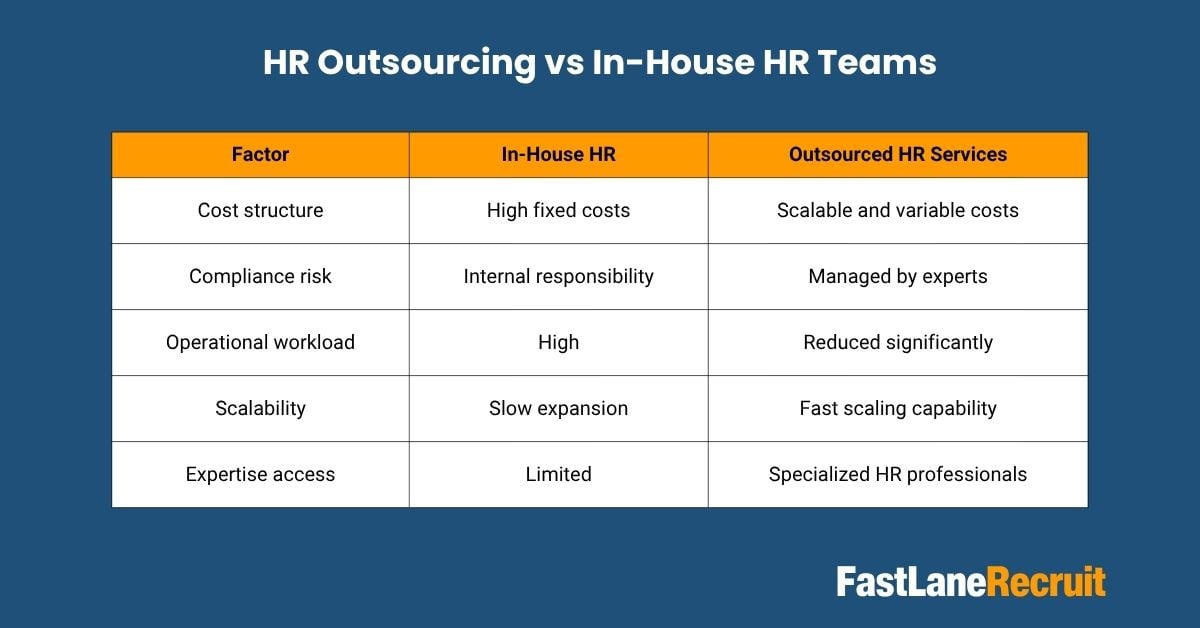
HR Outsourcing vs Employer of Record (EOR)
Understanding the difference is critical for companies expanding internationally.
HR Outsourcing
Best suited for companies that:
- Already have a legal entity in the Philippines
- Need payroll and HR operational support
- Require compliance and HR administration assistance
Employer of Record (EOR)
Best suited for companies that:
- Want to hire employees in a country without establishing a legal entity
- Require fast market entry
- Prefer reduced legal and administrative complexity
EOR becomes a strategic alternative to company incorporation when speed, compliance, and flexibility are priorities.
When HR Outsourcing Is Not Enough for International Expansion
HR outsourcing is highly effective for companies that already have a legal entity in the country where employees are being hired. It helps streamline payroll, compliance, employee administration, and workforce management while reducing the burden on internal HR teams.
However, HR outsourcing alone cannot solve one critical challenge: the legal employment of workers in a country where your business has no registered entity.
For example, a company based in Australia, Singapore, Hong Kong, the United Kingdom, or the United States may want to hire talent in Malaysia. While an HR outsourcing provider can assist with payroll administration and HR processes, the company still needs a legal entity to employ workers, manage statutory obligations, and comply with Malaysian employment laws.
This is where many businesses encounter a common expansion dilemma:
Option 1: Establish a Malaysian Company
Businesses can incorporate a local entity and build their own HR, payroll, tax, and compliance infrastructure.
While this approach provides full operational control, it often involves:
- Company registration procedures
- Corporate secretarial requirements
- Tax registration and reporting obligations
- Employment compliance responsibilities
- Ongoing administrative and operational costs
For businesses testing a new market or hiring only a small team, these requirements can significantly increase both cost and complexity.
Option 2: Partner with an Employer of Record (EOR)
An Employer of Record acts as the legal employer on behalf of your company, allowing you to hire employees in Malaysia without establishing a local entity.
Under this arrangement:
- The employee works exclusively for your business.
- The EOR manages employment contracts.
- Payroll and statutory contributions are administered compliantly.
- Employment regulations and labor law requirements are handled by local experts.
This allows businesses to focus on growth, market development, and talent acquisition while minimizing legal and administrative burdens.
Why Businesses Are Increasingly Choosing EOR
As international hiring becomes more common, organizations are prioritizing speed, flexibility, and compliance. Rather than committing significant resources to entity establishment before validating a market opportunity, many companies use EOR services as a low-risk entry strategy.
This approach is particularly attractive for:
- Remote-first organizations
- Startups expanding internationally
- SMEs entering Southeast Asia
- Companies hiring a small number of employees in a new market
- Businesses testing market demand before long-term investment
For these reasons, EOR has become one of the most practical workforce expansion models for companies entering Malaysia.
Also Read: 10 Best Employer of Record (EOR) Services To Consider in 2026
Why EOR Is Often Preferred Over Company Incorporation in Malaysia Expansion
For companies expanding into Malaysia, Employer of Record services can significantly reduce operational barriers.
Key advantages include:
- No requirement to establish a local legal entity
- Faster onboarding of employees
- Reduced incorporation and legal setup costs
- Lower compliance and administrative burden
- Immediate workforce deployment capability
Instead of spending months on company registration, businesses can begin hiring almost immediately through an EOR structure.
Why Malaysia Is a Strategic Market for EOR Hiring
Malaysia is a strong regional hub for business expansion due to:
- Strategic ASEAN location and trade access
- Competitive labor costs compared to regional markets
- Strong English proficiency in the workforce
- Developed financial and regulatory infrastructure
- Growing demand for skilled talent in tech, finance, and operations
These factors make Malaysia a preferred destination for companies scaling into Southeast Asia.
Get Expert Assistance from FastLaneRecruit
FastLaneRecruit provides Employer of Record (EOR) services exclusively in Malaysia, enabling companies to hire legally without establishing a local entity.
Through FastLaneRecruit’s EOR model, businesses can:
- Hire employees in Malaysia quickly and compliantly
- Manage payroll, taxes, and statutory requirements efficiently
- Reduce administrative and legal setup costs
- Focus on core business expansion instead of entity incorporation
This approach is ideal for companies seeking fast, compliant entry into the Malaysian market. Contact us today to support your business expansion process.
Conclusion
HR outsourcing services in the Philippines provide businesses with a scalable and efficient way to manage payroll, compliance, and HR administration while reducing operational costs and risk.
However, for companies thinking of expanding into Malaysia, Employer of Record services offer a more strategic alternative to immediate incorporation. EOR enables businesses to hire quickly, remain compliant, and avoid the complexity of establishing a legal entity.
FastLaneRecruit supports companies entering Malaysia through a fully managed EOR model, helping organizations build teams faster while maintaining compliance and operational efficiency.
For businesses focused on expansion, choosing between HR outsourcing and EOR depends on whether the goal is operational support within an existing entity or rapid market entry without incorporation.
Frequently Asked Questions (FAQs)
What are HR outsourcing services in the Philippines?
HR outsourcing services involve delegating payroll, compliance, recruitment, and HR administration to external providers.
How much do HR outsourcing services cost in the Philippines?
Costs vary depending on employee count and services, typically charged per employee per month or via tiered packages.
What is included in HR outsourcing?
Payroll processing, compliance management, HR administration, and sometimes HR advisory services.
Is HR outsourcing better than hiring an in-house HR team?
For SMEs and scaling businesses, outsourcing is often more cost-efficient and compliant.
What is the difference between HR outsourcing and EOR?
HR outsourcing supports companies with existing entities, while EOR allows hiring without setting up a legal entity.
Can EOR replace company incorporation?
Yes, in many cases businesses use EOR as a faster alternative before deciding on full incorporation.