
Italy is one of Europe’s largest economies and is an attractive destination for international companies seeking highly skilled professionals, access to the European Union market, and opportunities in sectors such as technology, manufacturing, engineering, fashion, design, finance, and professional services.
However, hiring employees in Italy can be challenging for foreign employers. Italian employment laws are comprehensive, employee protections are strong, and many workplace conditions are governed by collective bargaining agreements. Companies that want to hire talent in Italy must navigate payroll requirements, social security contributions, tax obligations, employment contracts, leave entitlements, and termination regulations.
Fortunately, an Employer of Record (EOR) offers a practical solution. An employer of record in Italy enables businesses to legally hire employees without establishing a local legal entity. The EOR becomes the legal employer while the client company manages the employee’s day-to-day work and performance.
In this guide, you’ll learn how an employer of record in Italy works, the benefits of using an EOR, employment compliance requirements, payroll obligations, hiring challenges, and how international businesses can expand into Italy quickly and compliantly.
Content Outline
Key Summary
An Employer of Record Simplifies Hiring in Italy
An Employer of Record (EOR) enables companies to legally hire employees in Italy without establishing a local company, reducing administrative complexity and accelerating market entry.
Italy Offers Access to Highly Skilled Talent
Italy is home to talented professionals across technology, engineering, manufacturing, design, fashion, finance, and professional services, making it an attractive destination for global hiring.
Employment Compliance Requires Local Expertise
Italian labor laws, social security requirements, payroll regulations, and Collective Bargaining Agreements (CCNLs) can be complex, making compliance a key consideration for foreign employers.
EOR Services Reduce Payroll and HR Burdens
An EOR manages payroll processing, tax withholding, benefits administration, employment contracts, and regulatory reporting, allowing businesses to focus on growth.
Hiring Through an EOR Is Faster Than Setting Up an Entity
Companies can onboard employees in weeks through an EOR, compared to the longer timelines and higher costs associated with establishing a local subsidiary.
Italy’s Strong Employee Protections Require Careful Management
Employers must understand rules related to working hours, leave entitlements, social security contributions, probation periods, and termination procedures to remain compliant.
An EOR Is Ideal for Testing the Italian Market
Businesses can use an EOR to hire local talent, explore market opportunities, and build a presence in Italy before deciding whether to establish a permanent legal entity.
Italy at a Glance
Before hiring employees in Italy, it is helpful to understand some key employment and business facts.
| Category | Details |
| Capital City | Rome |
| Currency | Euro (EUR) |
| Official Language | Italian |
| Time Zone | Central European Time (CET) |
| Payroll Frequency | Monthly |
| Standard Workweek | 40 Hours |
| Public Holidays | National and Regional Holidays |
| Employment Contracts | Required |
| Social Security System | Mandatory |
| Probation Period | Varies by contract |
| EU Membership | Yes |
Useful Official Resources
For the latest employment regulations and business information, employers should consult:
- Italian Ministry of Labour and Social Policies
- Italian National Social Security Institute (INPS)
- Italian Revenue Agency (Agenzia delle Entrate)
- European Commission Employment and Social Affairs Portal
- EUR-Lex European Employment Directives
These sources help employers stay informed about employment law updates and compliance requirements.
Also Read: 10 Best Employer of Record (EOR) Services To Consider in 2026
What Is an Employer of Record in Italy?
An Employer of Record (EOR) is a third-party organization that legally employs workers on behalf of another company.
When using an employer of record in Italy:
- The EOR becomes the legal employer.
- The employee performs work for your company.
- The EOR handles payroll administration.
- The EOR manages tax withholding.
- The EOR administers statutory benefits.
- The EOR ensures compliance with Italian labor laws.
- Your company directs the employee’s daily responsibilities.
This arrangement allows companies to hire employees in Italy without establishing a subsidiary or branch office.
Example
Imagine a Singapore-based software company wants to hire a senior developer in Milan.
Without an EOR, the company would need to:
- Establish an Italian entity
- Register with local authorities
- Manage payroll
- Administer benefits
- Ensure employment law compliance
With an EOR, the company can onboard the developer quickly while the EOR manages the legal employment relationship.
Why Companies Are Hiring Talent in Italy
Italy offers access to a highly educated workforce and a strategic location within Europe.
Strong Talent Pool
Italy produces thousands of graduates each year in fields including:
- Engineering
- Computer science
- Artificial intelligence
- Manufacturing
- Finance
- Architecture
- Design
Major cities such as Rome, Milan, Turin, Bologna, and Florence are known for specialized talent clusters.
Access to the European Market
Hiring employees in Italy provides businesses with access to the wider European Union market.
Companies can:
- Support regional operations
- Serve European customers
- Establish local sales teams
- Build multilingual customer support functions
Competitive Talent Costs Compared to Some Western European Markets
While compensation varies by industry and region, many companies find Italy more cost-effective than markets such as:
- Switzerland
- Germany
- Netherlands
- Luxembourg
while still offering access to highly qualified professionals.
Thriving Industries
Several industries continue to attract foreign investment in Italy:
- Technology
- Manufacturing
- Automotive
- Renewable Energy
- Fashion and Luxury Goods
- Engineering
- Life Sciences
- Financial Services
Also Read: 20 Best Employer of Record in the Philippines: EOR Philippines Guide 2026
Challenges of Hiring Employees in Italy
Although Italy offers many advantages, employers should be aware of several compliance and operational challenges.
Complex Employment Regulations
Italian employment law includes:
- National legislation
- Collective bargaining agreements (CCNLs)
- Industry-specific regulations
- EU employment directives
Employers must comply with all applicable requirements.
Collective Bargaining Agreements (CCNLs)
One of the most important aspects of employment in Italy is the widespread use of Collective Bargaining Agreements.
These agreements often define:
- Minimum salaries
- Working hours
- Overtime rules
- Notice periods
- Leave entitlements
- Bonus requirements
Different industries may have different agreements.
Understanding which agreement applies is critical.
Payroll and Tax Compliance
Employers must properly manage:
- Income tax withholding
- Social security contributions
- Employee deductions
- Payroll reporting
Errors can result in penalties and compliance risks.
Employee Protection Laws
Italian labor law places significant emphasis on employee protection.
This affects:
- Dismissal procedures
- Notice periods
- Contract terms
- Leave entitlements
- Workplace rights
Foreign employers unfamiliar with these requirements often benefit from local HR and legal expertise.
Why Use an Employer of Record Italy Instead of Setting Up a Local Entity?
For many businesses, establishing an Italian company is unnecessary during the early stages of expansion.
An employer of record offers a faster and lower-risk approach.
EOR vs Local Entity Comparison
| Factor | Employer of Record | Local Entity |
| Setup Time | Weeks | Several Months |
| Legal Registration | Not Required | Required |
| Payroll Administration | Managed by EOR | Managed Internally |
| HR Compliance | Managed by EOR | Internal Responsibility |
| Tax Registration | Included | Required |
| Upfront Costs | Lower | Higher |
| Market Testing | Easy | More Complex |
| Exit Flexibility | High | Lower |
When an EOR Makes Sense
An EOR is often ideal when:
- Hiring one or two employees
- Testing the Italian market
- Expanding quickly
- Building remote teams
- Supporting regional sales operations
- Avoiding entity setup costs
Key Benefits of Using an Employer of Record Italy
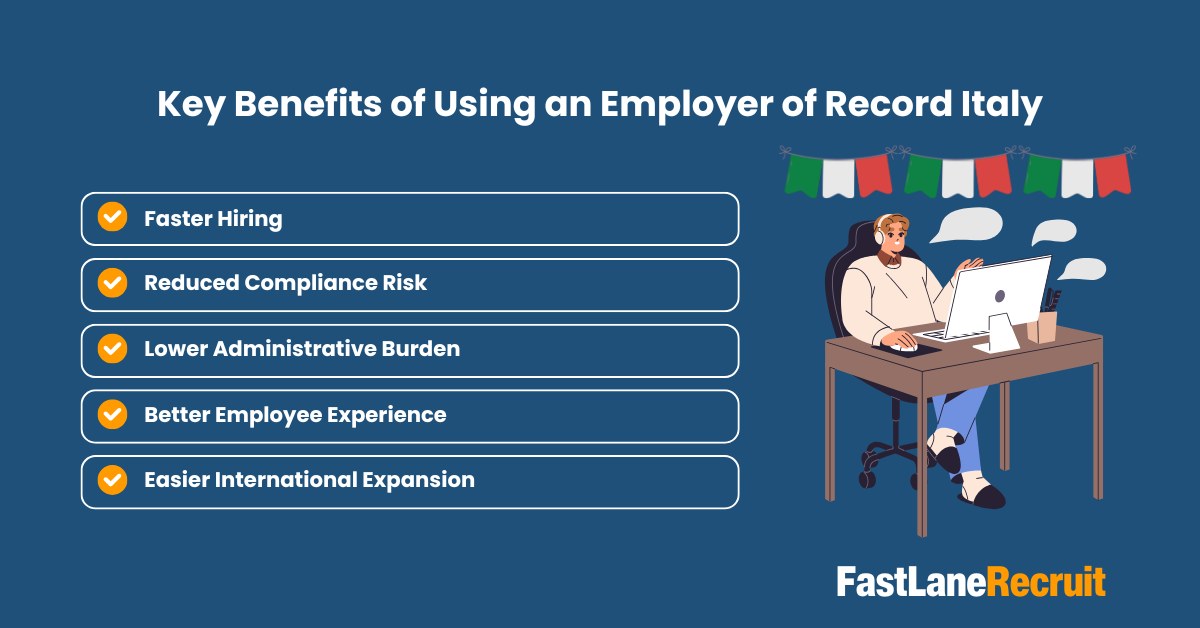
Faster Hiring
Instead of waiting months to establish a company, businesses can hire talent in a matter of weeks.
This helps organizations secure candidates before competitors do.
Reduced Compliance Risk
Employment regulations change regularly.
An EOR monitors legal developments and ensures employment practices remain compliant.
Lower Administrative Burden
The EOR manages:
- Employment contracts
- Payroll
- Benefits
- Tax withholding
- Government reporting
This allows internal teams to focus on business growth.
Better Employee Experience
Employees receive:
- Compliant employment contracts
- Accurate payroll
- Statutory benefits
- Local HR support
This contributes to a positive employment experience.
Easier International Expansion
Businesses can enter Italy without committing to the expense and complexity of establishing a legal entity.
Also Read: Top 10 Reasons to Use an Employer of Record (EOR)
Italian Employment Laws Employers Should Know
Understanding local employment regulations is essential when hiring employees in Italy.
Employment Contracts
Employment contracts should clearly outline:
- Job title
- Duties
- Salary
- Working hours
- Probation period
- Benefits
- Notice requirements
Contracts should align with applicable labor laws and collective bargaining agreements.
Working Hours
The standard workweek in Italy is generally 40 hours.
Specific working schedules may vary depending on industry and collective agreements.
Overtime rules and compensation requirements may also apply.
Probation Periods
Probation periods allow employers and employees to assess suitability.
The length typically depends on:
- Job role
- Seniority level
- Applicable collective agreement
During this period, termination procedures may differ from standard employment rules.
Payroll and Tax Administration in Italy
Managing payroll in Italy involves more than simply paying employees each month. Employers must comply with tax withholding requirements, social security contributions, payroll reporting obligations, and statutory employee benefits.
For international companies, this is often one of the main reasons for partnering with an employer of record in Italy.
How Payroll Works in Italy
Payroll is typically processed on a monthly basis. Employees receive their salary after deductions for taxes and social security contributions.
The employer is responsible for:
- Calculating employee compensation
- Withholding income taxes
- Paying employer social security contributions
- Filing payroll reports
- Maintaining payroll records
- Complying with labor regulations
An EOR handles these responsibilities on behalf of the client company.
Income Tax in Italy
Italy operates a progressive income tax system, meaning higher earnings are generally taxed at higher rates.
Employee income tax obligations may vary depending on:
- Income level
- Tax residency status
- Regional taxes
- Municipal taxes
- Applicable tax reliefs
Employers must ensure taxes are accurately withheld and reported.
Social Security Contributions
Both employers and employees contribute to Italy’s social security system.
Social security contributions help fund:
- State pensions
- Healthcare services
- Unemployment benefits
- Family support programs
- Workplace protections
The exact contribution amounts can vary depending on employment category, industry, and applicable collective bargaining agreements.
Payroll Compliance Requirements
Employers must maintain accurate records and submit payroll-related information to relevant authorities.
Compliance responsibilities often include:
- Employee registration
- Payroll reporting
- Tax payments
- Social security submissions
- Recordkeeping obligations
Failure to comply may result in penalties, audits, and reputational risks.
Payroll Responsibilities: EOR vs Employer
| Responsibility | Employer of Record | Client Company |
| Employment Contract | Yes | No |
| Payroll Processing | Yes | No |
| Tax Withholding | Yes | No |
| Social Security Administration | Yes | No |
| Benefits Administration | Yes | No |
| Day-to-Day Management | No | Yes |
| Performance Reviews | No | Yes |
| Work Assignments | No | Yes |
Employee Benefits in Italy
Employee benefits are an important part of the employment relationship in Italy. Employers must provide mandatory benefits and may also offer additional benefits to remain competitive in the talent market.
Statutory Benefits
Italian employees are generally entitled to various statutory protections and benefits, including:
- Paid annual leave
- Public holiday entitlements
- Sick leave protections
- Maternity leave
- Paternity leave
- Pension contributions
- Healthcare coverage through the public system
Annual Leave
Employees are entitled to paid annual leave under Italian employment law.
The minimum entitlement is generally four weeks per year, although collective bargaining agreements may provide additional leave benefits.
Many employers offer leave beyond the statutory minimum to attract and retain talent.
Public Holidays
Italy observes several national public holidays throughout the year.
Examples include:
- New Year’s Day
- Easter-related holidays
- Liberation Day
- Republic Day
- Christmas Day
Some regional holidays may also apply depending on the employee’s location.
Sick Leave
Employees who are unable to work due to illness may be entitled to sick leave benefits.
Compensation structures can vary based on:
- Employment agreement
- Industry regulations
- Collective bargaining agreements
Employers should ensure proper documentation and reporting procedures are followed.
Also Read: Employer of Record vs. Staffing Agency
Maternity Leave
Italy provides strong maternity protections.
Eligible employees may receive maternity leave benefits before and after childbirth.
Employers must comply with applicable leave requirements and employee protections.
Paternity Leave
Italy has expanded support for working parents in recent years, including paternity leave entitlements for eligible fathers.
Additional Competitive Benefits
To attract highly skilled professionals, many employers provide additional benefits such as:
- Private health insurance
- Meal vouchers
- Transportation allowances
- Flexible work arrangements
- Remote work support
- Professional development programs
- Performance bonuses
Step-by-Step Guide to Hiring Employees Through an Employer of Record in Italy
One of the biggest advantages of an employer of record is the simplicity of the hiring process.
Step 1: Identify the Position
Define:
- Job title
- Responsibilities
- Salary range
- Benefits package
- Reporting structure
The EOR can often provide guidance on local market expectations.
Step 2: Select Your Candidate
The candidate may come from:
- Your internal recruitment process
- Referrals
- Recruitment agencies
- EOR recruitment support services
Once selected, the onboarding process begins.
Step 3: Draft a Compliant Employment Agreement
The EOR prepares an employment contract that complies with:
- Italian labor laws
- Tax regulations
- Social security requirements
- Applicable collective bargaining agreements
This helps minimize compliance risks.
Step 4: Employee Onboarding
The EOR handles:
- Employee registration
- Government notifications
- Payroll setup
- Benefits enrollment
- Required documentation
Step 5: Employee Begins Work
The employee performs work exclusively for your business while remaining legally employed by the EOR.
Your company retains control over:
- Daily tasks
- Project management
- Performance expectations
- Team integration
Step 6: Ongoing Payroll and HR Administration
The EOR continues to manage:
- Monthly payroll
- Tax withholding
- Benefits administration
- Regulatory compliance
- Employment documentation
This allows your internal team to focus on business growth.
Industries That Benefit Most from an Employer of Record in Italy
Italy’s diverse economy creates opportunities across many sectors.
Technology
Technology companies frequently use EOR services to hire:
- Software developers
- Data analysts
- Cybersecurity specialists
- Product managers
- Cloud engineers
Manufacturing
Italy remains a major manufacturing center within Europe.
Businesses often recruit:
- Production managers
- Industrial engineers
- Supply chain specialists
- Quality assurance professionals
Fashion and Luxury Goods
Italy is globally recognized for fashion and luxury brands.
Companies may hire:
- Designers
- Merchandisers
- Marketing specialists
- Product development professionals
Engineering
Engineering talent is available across:
- Automotive
- Aerospace
- Construction
- Industrial manufacturing
Professional Services
Many international firms hire:
- Consultants
- Financial analysts
- Account managers
- Business development professionals
through EOR arrangements.
Also Read: Employers of Record – What You Need to Know!
Common Use Cases for an Employer of Record in Italy
Testing the Italian Market
Companies exploring expansion opportunities often use an EOR before investing in a local subsidiary.
This allows them to:
- Evaluate demand
- Build local relationships
- Generate revenue
- Assess long-term viability
Hiring a Single Employee
Some organizations only need one employee in Italy.
Examples include:
- Sales representatives
- Country managers
- Business development executives
An EOR enables compliant hiring without establishing a company.
Building a Remote Team
Global businesses increasingly hire remote employees across multiple countries.
An EOR simplifies multi-country workforce management.
Supporting Market Expansion
Companies can hire local experts to:
- Develop partnerships
- Manage clients
- Conduct market research
- Support regional operations
before making larger investments.
Managing Project-Based Growth
Organizations working on European projects often require temporary or specialized talent.
An EOR helps scale teams quickly while maintaining compliance.
Risks and Considerations When Using an Employer of Record in Italy
While EOR services provide many benefits, businesses should understand potential considerations.
Long-Term Expansion Plans
If Italy becomes a major operational hub, establishing a local entity may eventually become more cost-effective.
An EOR is often best suited for:
- Initial market entry
- Smaller teams
- Early-stage expansion
Provider Quality Matters
Not all EOR providers offer the same level of expertise.
Selecting a provider with strong local knowledge is critical.
Industry-Specific Requirements
Certain industries may have unique regulatory requirements.
Employers should verify that the EOR has experience supporting their sector.
Employee Experience
The best EOR providers deliver:
- Timely payroll
- Responsive HR support
- Transparent communication
- Compliance expertise
Employee satisfaction should remain a priority.
Employer of Record Provider Selection Checklist
Before choosing an employer of record in Italy, evaluate potential providers carefully.
Use the following checklist:
| Evaluation Criteria | Importance |
| Local Italy Expertise | High |
| Employment Law Knowledge | High |
| Payroll Administration Capabilities | High |
| Benefits Management | High |
| Data Security Standards | High |
| Transparent Pricing | High |
| Immigration Support | Medium |
| Recruitment Support | Medium |
| Multi-Country Coverage | High |
| Dedicated Account Management | High |
Questions to Ask an EOR Provider
- How do you ensure compliance with Italian labor laws?
- Do you support applicable collective bargaining agreements?
- What benefits administration services are included?
- How quickly can employees be onboarded?
- What countries do you support?
- How are payroll calculations handled?
- What reporting capabilities are available?
- What support is available for employee relations?
A strong provider should be able to answer these questions clearly and confidently.
Italy Hiring Cost Considerations
When expanding into Italy, understanding the total cost of employment is essential for budgeting and workforce planning.
Many companies focus only on base salary, but the actual employment cost includes several additional components.
Components of Employment Costs in Italy
| Cost Component | Description |
| Base Salary | Agreed employee compensation |
| Employer Social Security Contributions | Mandatory employer contributions |
| Employee Social Security Contributions | Withheld from employee salary |
| Payroll Administration | Payroll processing and reporting |
| Insurance Requirements | Statutory employment-related coverage |
| Employee Benefits | Mandatory and supplemental benefits |
| Recruitment Costs | Talent acquisition expenses |
| Compliance Management | HR and legal administration |
An employer of record provides a clear overview of these costs upfront, helping businesses forecast employment expenses more accurately.
Why Cost Transparency Matters
Without local expertise, foreign employers may underestimate:
- Social security obligations
- Leave-related costs
- Mandatory benefits
- Payroll administration requirements
- Compliance responsibilities
An experienced EOR partner helps avoid unexpected expenses and reduces administrative complexity.
Employer of Record vs Staffing Agency vs Contractor vs Local Entity
Businesses entering Italy often compare several hiring models before deciding which option best fits their goals.
Comparison Table
| Factor | Employer of Record | Staffing Agency | Independent Contractor | Local Entity |
| Legal Employment | EOR | Agency | Self-employed | Company |
| Payroll Management | Included | Agency | Contractor manages | Company manages |
| Employment Compliance | Included | Limited | Higher risk | Company responsible |
| Employee Benefits | Included | Varies | Not applicable | Company responsible |
| Long-Term Hiring | Excellent | Moderate | Limited | Excellent |
| Setup Time | Fast | Fast | Fast | Slow |
| Local Entity Required | No | No | No | Yes |
| Compliance Risk | Low | Moderate | Higher | Managed internally |
When an Employer of Record Is the Best Choice
An EOR is typically the preferred solution when:
- Hiring full-time employees in Italy
- Expanding quickly
- Testing a new market
- Building a remote workforce
- Avoiding entity setup costs
- Ensuring employment law compliance
Also Read: EOR Malaysia vs EOR Philippines Cost for Global Hiring: Which Market Is Better for Expansion?
Why Companies Use an EOR Before Incorporating in Italy
Many businesses are unsure whether they will need a permanent presence in Italy.
Rather than investing significant time and resources into entity formation immediately, companies often use an employer of record as a first step.
Benefits of Testing the Market
Using an EOR allows organizations to:
- Hire local talent quickly
- Assess market opportunities
- Build customer relationships
- Generate revenue
- Validate expansion plans
before deciding whether a subsidiary or branch office is necessary.
Example Scenario
A software company headquartered in the United States wants to expand into Southern Europe.
Instead of establishing an Italian company immediately, it hires:
- One sales manager
- One customer success specialist
- One technical consultant
through an employer of record.
After 12–24 months, the company can evaluate whether a permanent legal entity makes business sense.
This approach minimizes risk while accelerating growth.
Why Hire Talent in Italy?
Italy offers several strategic advantages for global employers.
Access to Highly Skilled Professionals
Italy has a strong educational system and produces talented professionals across multiple disciplines.
Popular hiring areas include:
- Software development
- Engineering
- Product design
- Marketing
- Finance
- Manufacturing
- Project management
Strategic European Location
Italy provides easy access to key European markets, including:
- Germany
- France
- Spain
- Netherlands
- Switzerland
- Austria
This makes Italy a valuable location for regional operations.
Strong Innovation Ecosystem
Major cities such as Milan, Turin, Rome, Bologna, and Florence support growing innovation ecosystems.
Businesses can access talent in:
- Technology
- Artificial intelligence
- Renewable energy
- Biotechnology
- Fintech
Multilingual Workforce
Many Italian professionals have experience working with international organizations and possess strong language capabilities, particularly in English and other European languages.
Growing Remote Work Culture
Remote and hybrid work models continue to expand across Italy, making it easier for international companies to recruit talent without requiring relocation.
Why Businesses Choose FastLaneRecruit for International Expansion
While your business may be exploring hiring opportunities in Italy, many companies are also expanding across Asia and the Middle East.
FastLaneRecruit helps businesses hire employees quickly and compliantly through Employer of Record solutions across key growth markets.
Countries Supported by FastLaneRecruit
| Country | EOR Services Available | Ideal For |
| Malaysia | Yes | Regional headquarters, shared services, technology |
| Singapore | Yes | APAC expansion, finance, technology |
| Hong Kong | Yes | International trade, finance, regional management |
| China | Yes | Manufacturing, sourcing, market expansion |
| Taiwan | Yes | Technology, semiconductor, R&D operations |
| UAE | Yes | Middle East expansion, regional business hubs |
Why Choose FastLaneRecruit?
FastLaneRecruit supports businesses by providing:
- Compliant employment solutions
- Payroll administration
- HR support
- Employee onboarding
- Benefits administration
- Multi-country workforce management
- Local compliance expertise
Whether you need to hire one employee or build an entire international team, FastLaneRecruit helps simplify global expansion.
Also Read: AOR vs. EOR: Everything You Need To Know About AOR Services and Global Hiring
Expand Your Team Faster with FastLaneRecruit’s Employer of Record Services
Hiring internationally does not have to be complicated.
FastLaneRecruit enables companies to:
- Hire employees without establishing a local entity
- Reduce compliance risks
- Streamline payroll management
- Accelerate international growth
- Access top talent across multiple countries
Explore Our Employer of Record Services
Our EOR services support hiring in:
Speak With Our Team
If your organization is exploring international hiring opportunities, FastLaneRecruit can help you build compliant teams through Employer of Record solutions across key Asian markets while reducing administrative burdens and accelerating market entry.
Conclusion
Italy remains one of Europe’s most attractive destinations for international hiring. With a highly skilled workforce, strong industrial sectors, access to the European Union market, and growing demand for remote work opportunities, Italy offers significant advantages for businesses seeking global talent.
However, hiring employees in Italy also involves navigating complex labor regulations, payroll obligations, social security requirements, employee protections, and collective bargaining agreements. Companies that fail to understand these requirements may face unnecessary compliance risks and administrative challenges.
An employer of record in Italy provides a practical and efficient solution. By partnering with an EOR, businesses can hire employees legally, manage payroll compliantly, administer benefits correctly, and expand into Italy without establishing a local legal entity.
For organizations looking to scale internationally, an EOR can reduce complexity, accelerate hiring, and create a smoother experience for both employers and employees.
Ready to Expand Your Global Team Without the Complexity?
If your business is planning international growth, now is the perfect time to explore how an Employer of Record can help you hire top talent quickly, compliantly, and confidently.
Speak with our team today to discover how FastLaneRecruit can support your expansion into Malaysia, Singapore, Hong Kong, China, Taiwan, and the UAE.
Frequently Asked Questions About Employer of Record Italy
What is an employer of record in Italy?
An employer of record in Italy is a third-party organization that legally employs workers on behalf of another company while managing payroll, taxes, benefits, and employment compliance.
Can I hire employees in Italy without setting up a company?
Yes. An employer of record allows you to hire employees in Italy without establishing a local legal entity.
Is using an EOR legal in Italy?
Yes. Employer of record services are commonly used by international businesses to hire employees compliantly in Italy.
How quickly can an EOR onboard employees in Italy?
Timelines vary, but many EOR providers can onboard employees within a few weeks, depending on documentation and employment requirements.
Who manages the employee’s daily work?
The client company manages day-to-day tasks, performance expectations, and project responsibilities.
Who pays employee salaries?
The EOR processes payroll and pays employees on behalf of the client company.
What benefits must employers provide in Italy?
Employees are generally entitled to statutory benefits including paid leave, social security coverage, and other protections under Italian employment law.
Are employment contracts required in Italy?
Yes. Employers should provide written employment agreements that comply with applicable laws and collective bargaining agreements.
What are CCNLs in Italy?
CCNLs are Collective Bargaining Agreements that establish employment standards for specific industries and professions.
Can an EOR support remote employees in Italy?
Yes. Many international companies use employer of record services to hire remote employees throughout Italy.
What industries commonly use EOR services in Italy?
Technology, manufacturing, engineering, professional services, fashion, and financial services are among the most common industries using EOR solutions.
Does an EOR handle tax withholding?
Yes. The EOR typically manages payroll taxes, reporting obligations, and statutory deductions.
Is an EOR suitable for hiring only one employee?
Absolutely. Many companies use an EOR to hire a single sales representative, consultant, or country manager.
What is the difference between an EOR and a staffing agency?
An EOR provides compliant long-term employment solutions, while staffing agencies are generally focused on temporary workforce placements.
When should a company establish a local entity instead of using an EOR?
Businesses often consider establishing a local entity when they have a large workforce, significant operational activities, or long-term expansion plans in Italy.