
Financial accuracy is no longer just a back-office function—it is a direct driver of business survival and growth. For SMEs and expanding companies, even small accounting errors can lead to compliance risks, cash flow disruptions, and poor strategic decisions.
In 2026, the role of accounting professionals has evolved significantly. They are expected not only to record transactions but also to ensure regulatory compliance, interpret financial data, support forecasting, and strengthen internal financial controls. This shift has made hiring the right accounting talent more critical—and more challenging—than ever.
At the same time, businesses are facing tighter labor markets, increasing salary expectations, and more complex cross-border compliance requirements. As a result, many companies are rethinking how they build and scale their accounting teams.
Understanding the full scope of accounting duties and responsibilities is the first step toward hiring effectively. The second is choosing a hiring model that is fast, compliant, and scalable—especially for companies operating or expanding in Malaysia.
Content Outline
Key Summary
What Accounting Duties and Responsibilities Cover
Accounting roles go beyond bookkeeping. They include financial reporting, compliance, tax preparation, budgeting, and strategic financial analysis that support business decision-making.
Why It Matters for SMEs
Hiring the right accounting professional reduces financial risk, ensures compliance, and improves cash flow visibility for business growth.
Hiring Challenge in 2026
Global talent shortage and rising compliance complexity make accounting hiring slower and more expensive for SMEs.
Best Hiring Strategy
Many organisations now prefer dedicated offshore staffing models because they provide greater control, stronger collaboration, and better integration with internal finance teams than traditional outsourcing arrangements.
Accounting Duties and Responsibilities in 2026
Accounting roles in 2026 extend beyond traditional bookkeeping. Modern accountants act as financial control specialists who ensure accuracy, compliance, and business visibility across all financial operations.
Core responsibilities include financial reporting, taxation, budgeting, auditing, and supporting strategic decision-making through data-driven insights.
1. Financial Recordkeeping and Ledger Management
Accurate financial records remain the foundation of accounting operations.
Key responsibilities:
- Record all financial transactions in accounting systems
- Maintain and update general ledger accounts
- Ensure invoices, receipts, and supporting documents are properly recorded
- Maintain audit-ready financial documentation
This ensures financial transparency and supports compliance audits when required.
2. Financial Reporting and Business Performance Analysis
Accountants are responsible for converting raw financial data into structured reports that support management decisions.
Key responsibilities:
- Prepare monthly, quarterly, and annual financial statements
- Generate balance sheets, profit and loss statements, and cash flow reports
- Analyze revenue, expenses, and profitability trends
- Provide insights for business planning and performance improvement
These reports are essential for investors, management teams, and regulatory authorities.
3. Bank Reconciliation and Financial Accuracy Control
Reconciliation ensures that company records match external financial statements.
Key responsibilities:
- Reconcile bank statements with internal accounting records
- Identify and resolve discrepancies in transactions
- Ensure accuracy across accounting entries
- Monitor financial consistency across all accounts
This reduces financial errors and prevents reporting inconsistencies.
4. Tax Compliance and Regulatory Management
Tax compliance is one of the most sensitive and high-risk areas in accounting.
Key responsibilities:
- Prepare and submit corporate tax filings
- Ensure compliance with Malaysian tax regulations and reporting standards
- Stay updated on regulatory changes and updates
- Support internal and external audit processes
Non-compliance can result in financial penalties and legal risks.
5. Budgeting, Forecasting, and Financial Planning
Accountants play a key role in shaping business financial strategy.
Key responsibilities:
- Assist in annual budget preparation
- Forecast revenue, costs, and financial performance
- Monitor budget variances and report deviations
- Provide recommendations for cost optimization
This helps SMEs maintain financial discipline and long-term stability.
6. Audit Support and Internal Control Systems
Strong internal controls reduce fraud risk and improve financial governance.
Key responsibilities:
- Support internal and external audit processes
- Review financial processes for compliance gaps
- Strengthen internal control systems
- Identify and mitigate financial risks
7. Payroll, Expenses, and Operational Finance (SME Function)
In SMEs, accounting professionals often handle broader operational finance responsibilities.
Key responsibilities:
- Manage payroll processing and statutory compliance
- Track employee expenses and reimbursements
- Ensure timely salary and benefits processing
- Maintain payroll and expense records
Essential Skills for Accounting Professionals in 2026
Modern accountants must combine technical expertise with digital and analytical capabilities.
Technical Expertise
- Knowledge of IFRS and GAAP standards
- Tax and regulatory compliance understanding
- Financial reporting frameworks
Digital Proficiency
- Accounting software (Xero, QuickBooks, ERP systems)
- Advanced Excel and financial modeling
- Cloud-based accounting systems
Analytical Capability
- Financial forecasting and variance analysis
- Data interpretation for business decisions
- Risk identification and control analysis
Soft Skills
- Clear communication with non-finance teams
- Strong ethical standards and confidentiality
- High attention to detail and accuracy
Also Read: Outsourced Accounting for Accountants: Choosing the Right Partner
How to Write Accounting Job Description
Writing a clear and effective accounting job description is critical for attracting the right candidates and avoiding mismatches in hiring. A strong job description does more than list tasks—it defines expectations, required capabilities, and the business context so candidates can self-assess before applying. For SMEs, especially those hiring in competitive markets like Malaysia, a well-structured job description directly improves hiring speed and quality.
1. Start with a Clear Job Title and Role Level
The job title should reflect both function and seniority to avoid confusion in candidate targeting.
Examples:
- Accountant (General Ledger / Full Set Accounts)
- Senior Accountant (Financial Reporting & Compliance)
- Accounting Executive (AP/AR Focus)
A precise title improves search visibility and ensures applications are relevant.
2. Define the Core Purpose of the Role
This section should explain why the role exists within the company, not just what the person will do.
For example:
- To maintain accurate financial records and ensure compliance with local regulations
- To support management with timely financial insights for decision-making
- To manage accounting operations and improve financial efficiency
This helps candidates understand business impact, not just task lists.
3. List Detailed Accounting Duties and Responsibilities
This is the most critical section and should be structured clearly under functional categories:
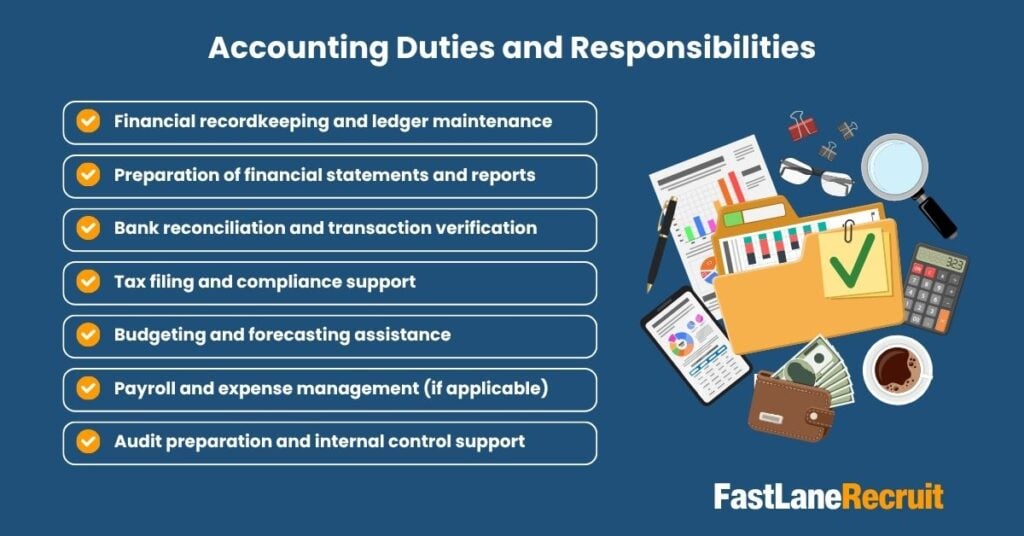
Avoid vague phrases like “handle accounts” and instead use specific operational responsibilities.
4. Specify Required Skills and Technical Competencies
Clearly separate must-have vs nice-to-have skills.
Must-have:
- Knowledge of accounting standards (IFRS / GAAP)
- Experience with accounting software (Xero, QuickBooks, ERP systems)
- Strong Excel skills for reporting and analysis
Nice-to-have:
- Audit experience
- Cross-border accounting exposure
- Automation or cloud accounting familiarity
This improves candidate filtering and reduces irrelevant applications.
5. Include Experience and Qualification Requirements
Typical requirements may include:
- Diploma or degree in Accounting, Finance, or related field
- 2–5 years of relevant accounting experience (adjust based on role level)
- Professional certification (ACCA, CPA, CIMA) is an advantage
Be realistic—overstated requirements can reduce your talent pool significantly.
6. Define Reporting Structure and Work Environment
Candidates want clarity on where they fit in the organization.
Include:
- Who the role reports to (e.g., Finance Manager, CFO)
- Whether the role is remote, hybrid, or onsite
- Team size and collaboration structure
- Tools and systems used
This is especially important for remote hiring and EOR-based employment in Malaysia.
7. Highlight Growth Opportunities
Top accounting talent often evaluates long-term career development.
You can include:
- Exposure to regional financial operations
- Opportunities to progress into senior finance roles
- Involvement in budgeting and strategic planning
This improves offer acceptance rates.
8. Align the Job Description with Hiring Strategy (EOR Advantage)
For companies hiring in Malaysia through Employer of Record (EOR), the job description should reflect operational flexibility:
- Emphasize compliance-managed employment structure
- Highlight streamlined onboarding process
- Clarify that employment is legally managed through a local partner
This builds trust and reduces candidate hesitation.
Important Note for Employers
A well-written accounting job description is not just a hiring document—it is a filtering system. The clearer and more structured it is, the higher the quality of applicants and the faster the hiring cycle.
For SMEs expanding into Malaysia, combining a strong job description with EOR-based hiring ensures faster access to qualified accounting professionals without the complexity of setting up a local entity.
Why Businesses Are Choosing EOR and Talent Solutions in Malaysia
Instead of building accounting teams through traditional incorporation in multiple countries, many companies are now adopting Employer of Record (EOR) models in Malaysia.
Why Malaysia is a Strategic Hiring Location
Malaysia has become a strong hub for accounting and finance talent due to:
- Large pool of English-speaking finance professionals
- Competitive salary structures compared to other APAC markets
- Strong familiarity with international accounting standards
- Stable regulatory and business environment
- Growing remote-ready workforce
For SMEs expanding in Asia, Malaysia offers a balance of cost efficiency, talent availability, and compliance stability.
Why EOR Is Better Than Traditional Company Setup
Setting up a local entity in Malaysia can be time-consuming and costly. In contrast, EOR solutions allow companies to:
- Hire accounting professionals without setting up a legal entity
- Ensure full compliance with Malaysian employment laws
- Reduce administrative and payroll burden
- Scale finance teams quickly based on business needs
- Avoid delays in operational setup
This makes EOR a faster and more flexible hiring strategy for growing companies.
Also Read:Incorporation vs EoR in Malaysia
Accounting Duties and Responsibilities: Summary for Employers
A qualified accounting professional in 2026 is expected to:
- Maintain accurate financial records
- Prepare financial statements and reports
- Ensure tax compliance and regulatory accuracy
- Support budgeting and forecasting
- Strengthen internal financial controls
- Provide insights for business decision-making
Understanding this scope is essential before making hiring decisions.
Get Expert Assistance from FastLaneRecruit (Malaysia Hiring Solutions)
Hiring accounting professionals requires more than job posting—it requires access to the right talent, compliance expertise, and a structured hiring process.
FastLaneRecruit helps companies hiring in Malaysia through tailored talent solutions and EOR support.
We help you:
- Access pre-vetted accounting professionals in Malaysia
- Hire without setting up a local entity
- Ensure compliance with Malaysian employment regulations
- Reduce hiring time and administrative complexity
- Build scalable accounting teams for long-term growth
Contact us now to support you and hire the best suited talent for your business.
Conclusion
Accounting duties and responsibilities in 2026 extend far beyond traditional bookkeeping. Businesses now rely on accountants for compliance, financial insight, risk management, and strategic planning.
However, the challenge is no longer just understanding the role—it is finding the right talent quickly and efficiently.
For companies expanding in Asia, Malaysia offers a strong talent market, but hiring locally can still be slow without the right structure. This is where EOR and talent solutions become essential.
With FastLaneRecruit’s Malaysia-focused hiring support, businesses can build reliable accounting teams faster, stay compliant, and scale without the burden of local incorporation.
FAQ: Accounting Duties and Responsibilities (2026)
1. What are the main accounting duties and responsibilities?
They include bookkeeping, financial reporting, tax compliance, auditing, budgeting, and financial analysis.
2. What skills are required for accountants in 2026?
Accountants need technical accounting knowledge, software proficiency, analytical thinking, and strong attention to detail.
3. Is accounting just bookkeeping?
No. Accounting includes analysis, reporting, compliance, and financial strategy, while bookkeeping focuses only on transaction recording.
4. Why is hiring accountants difficult for SMEs?
Due to talent shortages, rising salary costs, and increasing regulatory complexity.
5. What is the benefit of using EOR for accounting roles?
EOR allows companies to hire accountants globally without setting up a local entity while ensuring full compliance.
6. Can accounting be outsourced?
Yes. Many SMEs now outsource accounting functions to reduce cost and improve efficiency.
7. What is included in an accounting job description?
It typically includes financial reporting, tax filing, reconciliations, payroll, auditing, and budgeting responsibilities.