
Remote work is no longer a temporary trend. In 2026, it has become a fundamental part of how modern businesses operate. Advances in cloud technology, collaboration tools, and high-speed internet have made it possible for professionals to work from virtually anywhere in the world.
As a result, millions of professionals are embracing the digital nomad lifestyle—working remotely while traveling and living abroad. Cities worldwide are now competing to attract remote workers by improving internet infrastructure, expanding coworking spaces, and introducing digital nomad visas.
For many professionals, choosing the best city for remote work depends on several factors, including affordability, internet speed, lifestyle, climate, networking opportunities, and work-life balance.
In this guide, we explore the 20 best cities for remote work in 2026 based on quality of life, remote work infrastructure, affordability, cultural experiences, and popularity among digital nomads.
Content Outline
Key Summary
Global Shift Toward Remote Work
The number of digital nomads worldwide has grown rapidly as remote work becomes a long-term global trend, reshaping how professionals choose where and how they live and work.
What Defines the Best Remote Work Cities in 2026
The best cities for remote work in 2026 consistently share core advantages: strong internet infrastructure, accessible coworking spaces, affordable living costs, personal safety, and vibrant cultural and social lifestyles that support long-term stays.
Expansion of Digital Nomad Visa Programs
Countries across Europe, Asia, and the Americas are increasingly introducing or expanding digital nomad visa programs to attract remote workers, freelancers, and global talent seeking legal long-term residence options.
Top Cities for Digital Nomads Remain Consistent
Cities such as Lisbon, Chiang Mai, Medellín, Kuala Lumpur, and Austin continue to rank highly among digital nomads due to their balance of affordability, connectivity, community, and overall quality of life.
Remote Hiring Is Driving Demand for EOR Solutions
Businesses hiring international remote talent are increasingly relying on Employer of Record (EOR) services to simplify cross-border compliance, payroll, and legal employment without needing to establish local entities.
What Makes a City Ideal for Remote Work?
Before choosing a remote work destination, digital nomads and remote employees should consider several important factors:
Reliable Internet Connection
Fast and stable internet is essential for video calls, collaboration tools, and productivity.
Cost of Living
Affordable accommodation, transportation, food, and coworking spaces can significantly improve long-term sustainability.
Coworking Spaces and Cafes
Remote workers often prefer cities with strong coworking communities and laptop-friendly cafes.
Safety and Healthcare
Safe neighborhoods and access to quality healthcare are critical for long-term stays.
Visa Accessibility
Digital nomad visas and remote work-friendly immigration policies make relocation easier.
Lifestyle and Culture
The best cities for remote work also offer opportunities to enjoy local culture, outdoor activities, food, and social experiences.
20 Best Cities for Remote Work in 2026
1. Lisbon, Portugal
Lisbon continues to rank among the best cities for remote work thanks to its warm climate, affordable European lifestyle, and strong digital nomad community.
Remote workers benefit from:
- Fast internet speeds
- Numerous coworking spaces
- Excellent public transportation
- Beautiful coastal scenery
- Portugal’s digital nomad visa options
The city’s combination of culture, safety, and work-life balance makes it one of the most attractive destinations in Europe.
2. Chiang Mai, Thailand
Chiang Mai remains a favorite among digital nomads because of its affordability and relaxed lifestyle.
Why remote workers love Chiang Mai:
- Low cost of living
- Strong expat community
- Excellent cafes and coworking hubs
- Reliable internet infrastructure
- Warm weather year-round
For freelancers and entrepreneurs seeking affordability without sacrificing quality of life, Chiang Mai is one of the best places to work remotely.
3. Medellín, Colombia
Known as the “City of Eternal Spring,” Medellín offers comfortable weather, affordable living, and a growing startup ecosystem.
Top advantages include:
- Affordable rent and food
- Modern coworking spaces
- Vibrant culture and nightlife
- Friendly digital nomad community
- Expanding remote work infrastructure
Medellín has rapidly become one of Latin America’s leading remote work destinations.
4. Austin, Texas, USA
Austin continues to attract remote professionals and tech talent from around the world.
The city offers:
- A thriving startup ecosystem
- Strong job opportunities
- Excellent internet connectivity
- Vibrant music and food scenes
- High quality of life
Austin is especially attractive for remote workers in technology, creative industries, and entrepreneurship.
5. Kuala Lumpur, Malaysia
Kuala Lumpur has rapidly emerged as one of Southeast Asia’s most underrated yet high-potential remote work hubs. It offers a strong balance between affordability, infrastructure, and urban convenience—making it a rising alternative to more saturated nomad cities like Bali or Bangkok.
Remote workers are increasingly drawn to Kuala Lumpur because of:
- High-speed internet and widespread 5G coverage
- Affordable cost of living compared to Singapore or Hong Kong
- Modern coworking spaces across KLCC, Bangsar, and Mont Kiara
- Strong English proficiency in business environments
- Excellent food culture and multicultural lifestyle
- Strategic travel hub for Asia-Pacific connectivity
Malaysia’s long-standing initiatives like the Malaysia My Second Home (MM2H) program and newer digital nomad-friendly visa frameworks (such as DE Rantau Nomad Pass) make it increasingly attractive for remote professionals seeking longer stays in Asia.
6. Bali (Canggu), Indonesia
Canggu has become synonymous with digital nomad culture.
Remote workers enjoy:
- Beachside coworking spaces
- Wellness-focused lifestyle
- Affordable living
- Strong international community
- Year-round tropical climate
Bali’s balance of productivity and relaxation makes it one of the best cities for remote work in Asia.
7. Barcelona, Spain
Barcelona combines Mediterranean living with excellent infrastructure for remote professionals.
Benefits include:
- Fast internet
- Vibrant international community
- Access to beaches and culture
- Strong public transportation
- Spain’s digital nomad visa program
The city is particularly popular among creatives, freelancers, and startup founders.
8. Mexico City, Mexico
Mexico City has become one of the fastest-growing hubs for remote workers.
Why it stands out:
- Affordable lifestyle compared to major US cities
- Rich cultural experiences
- Excellent food scene
- Numerous coworking spaces
- Convenient time zone for North American companies
9. Tallinn, Estonia
Estonia was one of the first countries to introduce a digital nomad visa, making Tallinn a highly attractive destination.
Remote workers benefit from:
- Advanced digital infrastructure
- Reliable internet
- Safety and walkability
- Tech-friendly environment
- Efficient public services
Tallinn is particularly attractive for tech professionals and startup founders.
10. Buenos Aires, Argentina
Buenos Aires offers a blend of affordability, European-style architecture, and vibrant Latin culture.
Highlights include:
- Affordable cost of living
- Strong cafe culture
- Fast internet access
- Rich arts and nightlife scene
- Favorable exchange rates for foreign earners
11. Miami, Florida, USA
Miami combines urban energy with beachside living, making it one of the best cities for remote work in the United States.
Remote workers enjoy:
- Warm climate
- Strong entrepreneurial network
- Excellent coworking facilities
- International business environment
- Vibrant nightlife and entertainment
12. Porto, Portugal
Porto is becoming an increasingly popular alternative to Lisbon.
Why remote workers choose Porto:
- Lower living costs
- Beautiful coastal views
- Reliable internet
- Relaxed pace of life
- Growing remote work community
13. Budapest, Hungary
Budapest offers one of the best balances between affordability and quality of life in Europe.
The city provides:
- Affordable housing
- Excellent transportation
- Strong cafe culture
- Historic architecture
- Growing coworking scene
14. Denver, Colorado, USA
Denver is ideal for remote workers who enjoy outdoor activities and modern urban living.
Benefits include:
- Access to mountains and hiking
- Strong startup ecosystem
- High quality of life
- Excellent internet infrastructure
- Healthy work-life balance
15. Tbilisi, Georgia
Tbilisi has become a hidden gem for digital nomads.
Key advantages:
- Affordable living
- Friendly visa policies
- Growing coworking scene
- Rich cultural history
- Low taxes for some remote workers
16. New York City, USA
Despite its high cost of living, New York remains a top destination for ambitious remote professionals.
Remote workers value:
- Endless networking opportunities
- Global business connections
- Fast internet
- Diverse culture
- Access to world-class amenities
17. Prague, Czech Republic
Prague offers old-world charm combined with modern remote work infrastructure.
Remote workers appreciate:
- Beautiful architecture
- Reliable transportation
- Affordable European living
- Safe neighborhoods
- Strong expat community
18. Cape Town, South Africa
Cape Town is one of the most scenic remote work destinations in the world.
Highlights include:
- Stunning natural landscapes
- Affordable lifestyle
- Growing tech ecosystem
- Beach and mountain access
- Diverse cultural experiences
19. Dubrovnik, Croatia
Croatia’s digital nomad visa has made Dubrovnik increasingly popular among remote workers.
Benefits include:
- Coastal Mediterranean lifestyle
- Safe environment
- Historic charm
- Reliable internet
- Relaxed pace of life
20. Tokyo, Japan
Tokyo appeals to remote workers seeking innovation, safety, and cultural immersion.
Advantages include:
- Exceptional public transportation
- Ultra-fast internet
- World-class convenience
- Unique cultural experiences
- Increasing openness to remote professionals
How to Choose the Best City for Remote Work
The ideal remote work destination depends on your personal and professional priorities.
You may prioritize:
- Affordability
- Time zone compatibility
- Fast internet
- Career networking
- Climate
- Safety
- Community
- Access to nature
Before relocating, research visa requirements, healthcare access, taxation rules, and local living costs.
Also Read: Best Practices for Remote Work Performance Management
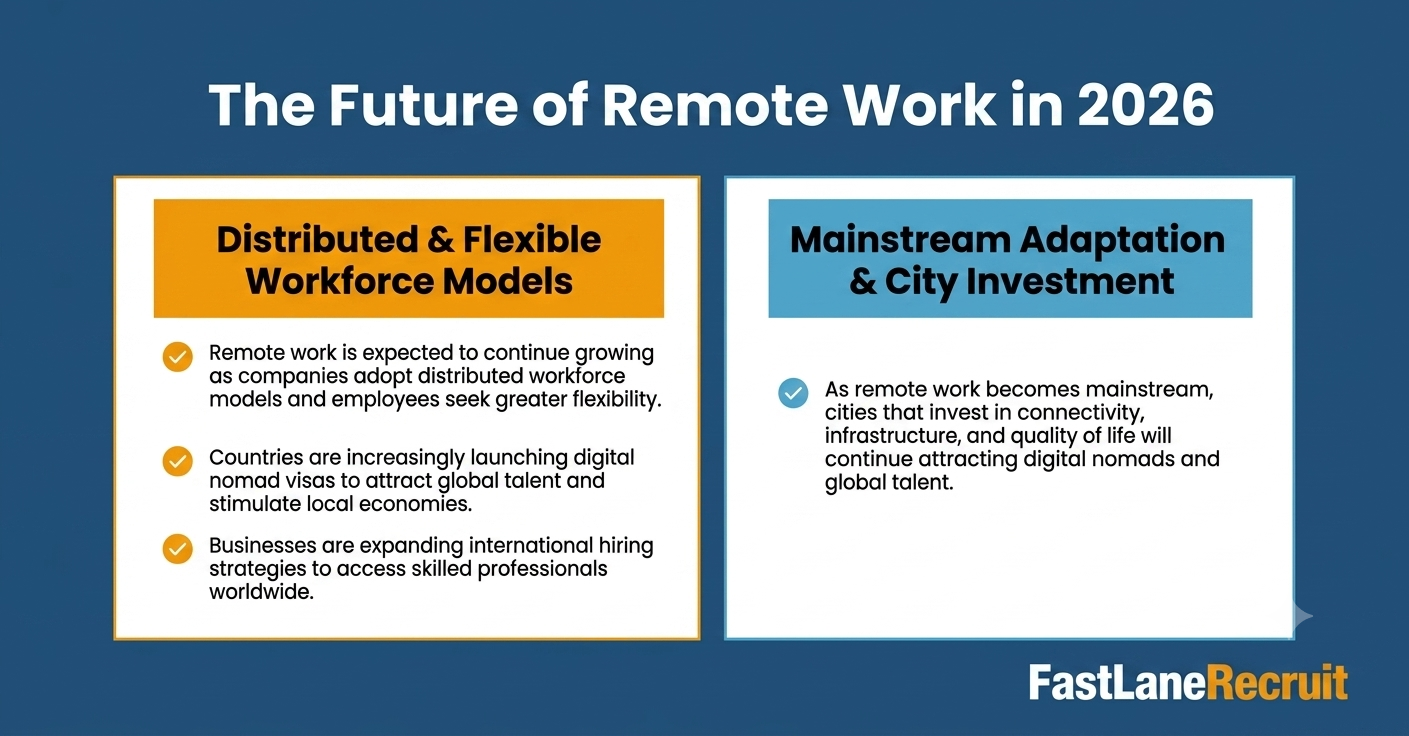
What Future Holds for Remote Work in 2026
Build Your Global Remote Team with FastLaneRecruit
As remote work expands globally, companies are increasingly hiring talent across borders. However, international hiring comes with challenges such as compliance, payroll management, employment laws, and tax regulations.
FastLaneRecruit helps businesses simplify resourceful hiring through recruitment and Employer of Record (EOR) solutions.
With EOR services, businesses can:
- Hire Malaysian employees legally without establishing a local entity
- Manage global payroll and compliance efficiently
- Expand into new markets faster
- Access top remote talent of Malaysia
Whether you are building a distributed workforce or hiring remote professionals internationally, FastLaneRecruit’s EOR services can help streamline your expansion strategy in Malaysia.
Conclusion
The rise of remote work has transformed how professionals live and work, giving them the freedom to build careers from virtually anywhere in the world. From the vibrant coworking communities of Lisbon and Chiang Mai to the dynamic business hubs of Kuala Lumpur, Austin, and Tokyo, the best cities for remote work in 2026 offer a combination of reliable infrastructure, affordable living, strong internet connectivity, and enriching lifestyles.
However, there is no single “best” destination for every remote worker. The ideal city depends on your priorities—whether that is cost of living, networking opportunities, climate, cultural experiences, or proximity to clients and colleagues. As more countries continue to introduce digital nomad visas and invest in remote work ecosystems, professionals have more choices than ever before.
For businesses, this global shift also presents new opportunities to access skilled talent beyond traditional hiring markets. By leveraging remote work and international hiring strategies, companies can build diverse, high-performing teams while expanding their global reach. Whether you are a digital nomad seeking your next destination or an employer building a distributed workforce, 2026 offers unprecedented opportunities to thrive in the borderless world of work.
FAQs
What are the best cities for remote work in 2026?
Some of the best cities for remote work in 2026 include Lisbon, Chiang Mai, Medellín, Austin, Bali, Barcelona, and Mexico City due to their affordability, internet infrastructure, coworking spaces, and quality of life.
Which country is best for digital nomads?
Portugal, Thailand, Spain, Estonia, and Indonesia remain among the most popular countries for digital nomads because of their remote work-friendly environments and visa programs.
What is the cheapest city for remote workers?
Chiang Mai, Thailand, is often considered one of the most affordable cities for remote workers due to its low living costs and strong digital nomad community.
Is remote work still growing in 2026?
Yes. Remote work continues to expand globally as businesses adopt flexible work arrangements and countries introduce digital nomad visa programs.
What should remote workers consider before relocating?
Remote workers should evaluate internet reliability, visa requirements, healthcare, safety, cost of living, taxation, and local coworking infrastructure before moving abroad.