Hiring employees in Singapore opens opportunities to access a skilled workforce and establish a presence in one of Asia’s leading business centres. However, employing people also means taking responsibility for statutory contributions, payroll accuracy, and ongoing employment compliance.
One of the most important requirements is the Central Provident Fund (CPF), Singapore’s mandatory social security savings scheme. For eligible employees, employers must calculate and pay CPF contributions accurately, apply the correct contribution rates, and meet monthly payment deadlines. These obligations require careful attention, particularly for international businesses hiring in Singapore for the first time.
For companies without an established local HR or payroll team, an Employer of Record (EOR) in Singapore can provide a structured way to employ eligible workers and manage local employment administration. FastLaneRecruit supports businesses with EOR and payroll services, helping simplify employment responsibilities while they focus on growing their operations.
Content Outline
Key Summary
CPF Contributions Are Mandatory for Eligible Employees
Employers must contribute to CPF for eligible Singapore Citizens and Singapore Permanent Residents working under a contract of service in Singapore. CPF generally does not apply to employees who remain foreign nationals without Singapore Permanent Resident status.
CPF Contribution Rates Depend on Employee Circumstances
The CPF contribution rate depends on factors such as the employee’s age, monthly wages, and Singapore Permanent Resident status. Employers must apply the correct rates and account for the applicable Ordinary Wage and Additional Wage ceilings.
Employers Are Responsible for Paying Both Shares
Employers must pay the combined employer and employee CPF contributions to the CPF Board. The employee’s share may be recovered through an appropriate wage deduction.
CPF Contributions Have Monthly Payment Deadlines
CPF contributions are due by the last day of the calendar month. Enforcement action may be taken if payment remains outstanding after the 14th of the following month, or the next working day when applicable.
An EOR Can Help Manage Singapore Employment Administration
An Employer of Record provides a local employment arrangement and can manage agreed responsibilities such as employment contracts, payroll processing, CPF administration for eligible employees, and statutory employment compliance.
Understanding CPF Contributions in Singapore
The Central Provident Fund (CPF) is Singapore’s compulsory social security savings scheme. It helps eligible employees build savings for retirement, healthcare, and housing through contributions from both employers and employees.
Under the CPF Act, employers must make CPF contributions for eligible Singapore Citizens and Singapore Permanent Residents employed under a contract of service in Singapore.
For businesses, CPF is not simply an additional payroll expense. It is a statutory employment obligation that must be incorporated into salary calculations, monthly payroll processing, employee records, and financial planning.
Who Is Required to Receive CPF Contributions?
CPF contributions generally apply to employees who meet all the following conditions:
- They are Singapore Citizens or Singapore Permanent Residents.
- They work in Singapore.
- They are employed under a contract of service.
- Their wages exceed the applicable CPF contribution threshold.
CPF contributions apply to eligible permanent, part-time, and casual employees. The nature of the employment arrangement does not automatically remove the contribution obligation.
Important distinction: CPF obligations depend on the employee’s citizenship and residency status, not simply on whether the employer is a Singapore-based or overseas company.
| Employee category | CPF contribution requirement |
| Singapore Citizen working in Singapore | Mandatory, subject to applicable wage rules |
| Singapore Permanent Resident working in Singapore | Mandatory, subject to applicable wage rules and SPR contribution rates |
| Foreign national holding an Employment Pass | Generally not subject to CPF |
| Foreign national holding an S Pass | Generally not subject to CPF |
| Foreign national holding a Work Permit | Generally not subject to CPF |
| Singapore Citizen or PR working overseas | Generally not mandatory |
When a foreign employee becomes a Singapore Permanent Resident, CPF obligations begin from the applicable effective date of their PR status.
What Is the CPF Contribution Rate in Singapore for 2026?
The CPF contribution rate is the percentage of an eligible employee’s wages that must be allocated to CPF by the employer and employee.
From 1 January 2026, the contribution rates for employees aged above 55 to 65 increased. Employers must therefore ensure that their payroll systems reflect the updated rates when calculating monthly contributions.
2026 CPF Contribution Rates for Singapore Citizens and Third-Year-Onwards PRs
The following table applies to private-sector and other non-pensionable employees earning monthly wages above S$750, subject to the applicable wage ceilings.
| Employee’s age | Employer share | Employee share | Total CPF rate |
| 55 and below | 17% | 20% | 37% |
| Above 55–60 | 16% | 18% | 34% |
| Above 60–65 | 12.5% | 12.5% | 25% |
| Above 65–70 | 9% | 7.5% | 16.5% |
| Above 70 | 7.5% | 5% | 12.5% |
Source: CPF Board, contribution rates effective 1 January 2026. First- and second-year Singapore Permanent Residents may have different graduated rates unless an approved application for full rates applies.
What Changed in the 2026 CPF Contribution Rates?
The 2026 adjustment increased CPF contributions for employees aged above 55 to 65.
| Employee’s age | 2025 total rate | 2026 total rate | Change |
| 55 and below | 37% | 37% | No change |
| Above 55–60 | 32.5% | 34% | +1.5 percentage points |
| Above 60–65 | 23.5% | 25% | +1.5 percentage points |
| Above 65–70 | 16.5% | 16.5% | No change |
| Above 70 | 12.5% | 12.5% | No change |
The increase for senior workers consists of a 0.5 percentage-point increase in employer contributions and a 1 percentage-point increase in employee contributions.
For employers, this means payroll calculations and employee cost projections should account for the updated contribution rates from January 2026.
How Are CPF Contributions Calculated?
CPF contributions are calculated based on an employee’s applicable wages, age, and residency status. Employers must also distinguish between Ordinary Wages (OW) and Additional Wages (AW).
Ordinary Wages (OW)
Ordinary Wages generally refer to wages earned for employment in a calendar month and payable by the 14th of the following month. Examples include:
- Monthly basic salary.
- Monthly fixed allowances that qualify as wages.
- Monthly contractual payments for work performed.
The Ordinary Wage ceiling for CPF contributions increased to S$8,000 per month from 1 January 2026.
Additional Wages (AW)
Additional Wages are wages that do not fall within the definition of Ordinary Wages. Common examples include:
- Annual bonuses.
- Annual leave encashment.
- Certain non-monthly incentives.
Additional Wages are subject to a separate annual ceiling, calculated using the employee’s Ordinary Wages and the applicable annual wage ceiling.
Employers should not simply apply the monthly CPF rate to every payment without considering the relevant wage classification and ceilings.
Example: Calculating Monthly CPF Contributions
Consider a Singapore Citizen aged 35 earning S$5,000 in monthly Ordinary Wages in 2026.
| Contribution component | Calculation | Amount |
| Employer contribution | 17% × S$5,000 | S$850 |
| Employee contribution | 20% × S$5,000 | S$1,000 |
| Total CPF contribution | 37% × S$5,000 | S$1,850 |
In this example:
- The employer’s CPF contribution is S$850.
- The employee’s CPF contribution is S$1,000.
- The total monthly CPF contribution is S$1,850.
The employer must remit the combined amount to CPF Board. The employee’s share is generally recovered through payroll deductions.
This example assumes the employee’s wages are entirely Ordinary Wages, exceed the applicable thresholds, and are within the 2026 Ordinary Wage ceiling.
For individual calculations, employers should use the official CPF contribution calculator, particularly when handling Additional Wages, graduated PR rates, or employees with different wage arrangements.
What Are the CPF Obligations of Employers in Singapore?
CPF compliance involves more than applying a percentage to an employee’s monthly salary. Employers must determine employee eligibility, classify wages correctly, calculate contributions, submit payments, and maintain accurate payroll records.
For eligible employees, the employer is legally responsible for ensuring that both the employer’s and employee’s CPF contributions are paid to CPF Board.
1. Identify Employees Who Qualify for CPF
Employers must determine whether each employee is a Singapore Citizen or Permanent Resident and whether the employment arrangement qualifies for CPF contributions.
They should also monitor changes in residency status, particularly when an employee obtains Singapore PR status.
2. Calculate and Pay the Correct CPF Contributions
Employers must apply the appropriate CPF contribution rate based on:
- Employee age.
- Singapore Citizenship or PR status.
- PR year of status and applicable graduated contribution rates.
- Monthly Ordinary Wages.
- Additional Wages and applicable ceilings.
Incorrect calculations can lead to underpayments, overpayments, and payroll corrections.
3. Submit CPF Contributions by the Required Deadline
CPF contributions are due on the last day of each calendar month. Employers should arrange payment promptly rather than treating the 14th of the following month as the regular payment deadline.
CPF Board may take enforcement action if contributions remain unpaid after the 14th of the following month, or the next working day when the 14th falls on a weekend or public holiday.
4. Maintain Accurate Payroll and Employment Records
Employers should maintain records that support accurate CPF calculations and submissions, including:
- Employee identification and residency information.
- Employment contracts and salary terms.
- Monthly payroll records.
- Ordinary Wage and Additional Wage breakdowns.
- CPF contribution calculations and payment records.
- Relevant employee status changes.
Accurate documentation helps employers demonstrate compliance and resolve discrepancies when necessary.
5. Account for Other Statutory Payments
CPF is not the only statutory payment employers may need to manage.
The Skills Development Levy (SDL) is compulsory for employees working in Singapore, including foreign employees who are not eligible for CPF contributions.
Depending on the employee and applicable requirements, employers may also need to account for Self-Help Group contributions and other payroll deductions.
Employer compliance checklist
| Responsibility | What employers need to do |
| Employee eligibility | Verify citizenship and PR status |
| Wage classification | Separate Ordinary Wages and Additional Wages |
| CPF calculations | Apply the correct contribution rates and ceilings |
| Payroll deductions | Account for the employee’s CPF share |
| Monthly submissions | Submit and pay CPF contributions |
| Other statutory payments | Account for SDL and applicable deductions |
| Recordkeeping | Maintain accurate payroll and employment records |
Also Read: Payroll Outsourcing in Singapore: Costs, Process, Compliance, and How to Choose the Best Provider
When Are CPF Contributions Due in Singapore?
Managing CPF payment deadlines is essential to maintaining payroll compliance.
CPF contributions are due on the last day of the calendar month in which the wages are paid. Employers should ensure that payments are processed on time to avoid late payment interest and enforcement action.
CPF Contribution Payment Timeline
| Timeline | Employer responsibility |
| During the payroll month | Calculate employee and employer contributions |
| Last day of the calendar month | CPF contribution payment due date |
| By the 14th of the following month | Payment should have been made to avoid enforcement action |
| After the applicable deadline | CPF Board may impose late payment interest and other penalties |
What Happens If Employers Pay CPF Contributions Late?
CPF Board takes non-compliance seriously. Employers who fail to pay CPF contributions correctly and promptly may face:
- Late payment interest: 1.5% per month, calculated from the day after the payment due date, subject to a minimum of S$5.
- Composition amount: Up to S$1,000 per offence, subject to CPF Board’s decision.
- Court fines: For a first conviction, S1,000–S5,000 per offence; for subsequent convictions, S2,000–S10,000 per offence.
- Imprisonment: Up to six months for a first conviction and up to 12 months for subsequent convictions, or both a fine and imprisonment.
Employers may also be required to pay outstanding contributions and interest. Directors may face prosecution in relevant circumstances.
These consequences make accurate payroll administration and timely statutory payments essential, particularly for companies managing employees across multiple markets.
Source: CPF Board’s enforcement and penalties guidance.
Enforcement and penalties for non-compliance+1
How Does an Employer of Record in Singapore Manage CPF Contributions?
Hiring employees in Singapore without establishing a local legal entity can create administrative and compliance challenges for international businesses.
An Employer of Record (EOR) in Singapore provides a local employment arrangement in which the EOR legally employs workers on behalf of the client company. The client continues to direct the employee’s day-to-day activities, while the EOR manages agreed legal employment and administrative responsibilities.
For eligible Singapore Citizens and Permanent Residents, the EOR can manage CPF contributions as part of its payroll and statutory compliance responsibilities.
How the EOR Arrangement Works
- Select the employee
Your company identifies the candidate and agrees on the role, salary, and employment terms. - Establish the local employment arrangement
The EOR enters into the employment relationship with the employee and prepares the applicable employment documentation. - Calculate monthly payroll
The EOR processes salary information and determines applicable CPF contributions, statutory deductions, and other payroll obligations. - Manage statutory submissions and payments
The EOR administers agreed statutory contributions, including CPF for eligible employees, and coordinates applicable payment deadlines. - Manage ongoing employment administration
The EOR supports payroll changes, employee records, benefits administration, and other agreed employment processes. - Your company manages daily operations
Your team continues directing work assignments, performance, and business activities in accordance with the EOR agreement and applicable law.
Which CPF Responsibilities Does an EOR Handle?
The precise scope depends on the EOR agreement and applicable law. In a typical arrangement, responsibilities can be organised as follows:
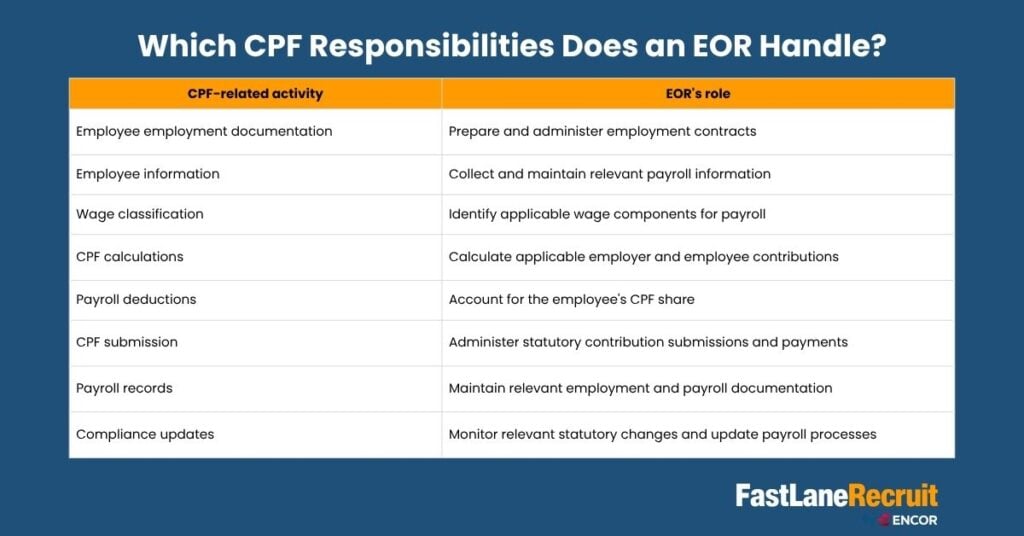
| CPF-related activity | EOR’s role |
| Employee employment documentation | Prepare and administer employment contracts |
| Employee information | Collect and maintain relevant payroll information |
| Wage classification | Identify applicable wage components for payroll |
| CPF calculations | Calculate applicable employer and employee contributions |
| Payroll deductions | Account for the employee’s CPF share |
| CPF submission | Administer statutory contribution submissions and payments |
| Payroll records | Maintain relevant employment and payroll documentation |
| Compliance updates | Monitor relevant statutory changes and update payroll processes |
Important: An EOR arrangement does not remove every responsibility from the client company. The EOR’s statutory obligations as the legal employer, the client’s operational responsibilities, and each party’s contractual duties should be clearly defined. Both parties should maintain appropriate oversight of employment compliance.
Does CPF Apply to Foreign Employees Hired Through an EOR?
Not every employee hired through an EOR is subject to CPF contributions.
CPF eligibility is based on the employee’s citizenship and residency status, rather than simply the use of an EOR.
| Employee hired through an EOR | CPF treatment |
| Singapore Citizen | CPF contributions generally apply |
| Singapore Permanent Resident | CPF contributions generally apply |
| Employment Pass holder | CPF contributions generally do not apply |
| S Pass holder | CPF contributions generally do not apply |
| Work Permit holder | CPF contributions generally do not apply |
Foreign employees who are not Singapore Citizens or Permanent Residents are generally excluded from mandatory CPF contributions. However, other statutory obligations, including SDL where applicable, may still apply.
An EOR can help businesses distinguish between these requirements and manage payroll according to each employee’s status.
Source: CPF Board and HiveDesk’s Singapore EOR guide, with regulatory eligibility verified against official guidance.
Ministry of Manpower Singapore+2
Why Use an EOR Instead of Establishing a Singapore Entity?
Establishing a Singapore company can make sense for businesses planning a long-term local operation. However, companies that need to hire a small team, test the market, or employ a specific individual may prefer an EOR arrangement.
An EOR provides an alternative employment structure without requiring the client to establish its own local employing entity, where the arrangement is legally suitable.
EOR vs Establishing a Local Entity
| Consideration | Employer of Record | Own Singapore entity |
| Local entity setup | Not required for the EOR employment arrangement | Required |
| Legal employer | EOR | Your Singapore company |
| Employment contracts | Administered by EOR | Managed by your company |
| CPF administration | Managed by EOR for eligible employees, according to the agreement | Managed by your company |
| Payroll processing | Included within the agreed EOR scope | Your company arranges payroll |
| HR administration | Supported by EOR | Managed internally or outsourced |
| Day-to-day work direction | Client company | Your company |
| Operational control | Shared according to the service and employment arrangements | Directly managed by your company |
| Best suited for | Market entry and hiring without a local entity | Businesses establishing a direct local presence |
When Should Businesses Choose an EOR in Singapore?
An EOR may be suitable if your business:
- Wants to hire one or several employees in Singapore without incorporating a local entity.
- Needs to enter the Singapore market before making a long-term investment.
- Does not have an in-house HR or payroll team familiar with CPF requirements.
- Wants to outsource employment contracts and statutory payroll administration.
- Needs a consistent employment arrangement while managing a distributed international workforce.
When Is Establishing Your Own Entity More Suitable?
Direct incorporation may be more appropriate when your business:
- Plans to establish a substantial and permanent Singapore operation.
- Needs a local corporate presence for broader commercial activities.
- Intends to employ a larger workforce directly.
- Requires direct control over its own local employment infrastructure.
- Needs its own entity for licensing, contracts, banking, or other business purposes.
The decision should consider long-term hiring plans, operational requirements, costs, regulatory responsibilities, and the scope of the proposed EOR arrangement.
Also Read: Foreign Subsidiary vs EOR: Which Costs Less and Is Faster to Set Up?
Why Businesses Choose FastLaneRecruit for EOR Services in Singapore
Hiring in another country should not require building an entire HR and payroll infrastructure from the ground up.
FastLaneRecruit helps businesses employ talent across international markets including Singapore through Employer of Record services, providing local employment administration and payroll support without requiring clients to establish their own local employing entity for the EOR arrangement.
1. Local Employment and Compliance Expertise
We provide local employment support through established entities in key markets, helping businesses navigate country-specific employment regulations, payroll requirements, and statutory obligations.
2. End-to-End Payroll Administration
We manage agreed payroll and employment administration responsibilities, including:
- Employment contract preparation and administration.
- Monthly payroll processing.
- Salary payments and payroll records.
- Applicable statutory contributions.
- Employee benefits administration.
- Tax and employment-related reporting.
- Employee onboarding and offboarding.
3. Faster International Market Entry
Businesses can hire employees in Singapore without waiting to establish their own local employing entity through employer of record Singapore services by FastLaneRecruit. This provides a practical option for companies entering new markets, expanding regional teams, or testing new business opportunities.
4. Regional HR and Payroll Expertise
Our regional capabilities help businesses manage employment across multiple jurisdictions while addressing different local payroll and compliance requirements.
5. Transparent and Predictable Pricing
We provide clear service scopes and pricing to help businesses understand their employment administration costs and plan international expansion more effectively.
FastLaneRecruit’s Global EOR Coverage
Beyond Singapore, FastLaneRecruit supports businesses hiring across Asia-Pacific, Europe, and the Middle East & Africa.
Our regional coverage allows companies to coordinate international employment through a single EOR service provider. FastLaneRecruit operates in
- Asia Pacific: Malaysia, Singapore, Hong Kong, China, India, Philippines, Taiwan, Vietnam, Australia,
- Europe: United Kingdom, Switzerland
- Middle East & Africa: UAE, Saudi Arabia, Qatar
With coverage across 14 markets, we help businesses simplify international hiring, payroll administration, and employment management as they expand into new regions.
Simplify Singapore Employment and CPF Compliance with FastLaneRecruit
Managing CPF contributions, monthly payroll, and statutory employment obligations requires consistent attention to changing regulations and employee circumstances.
For international companies without a local HR infrastructure, an Employer of Record offers a practical way to employ eligible workers in Singapore while outsourcing agreed employment and payroll administration responsibilities.
FastLaneRecruit helps businesses manage local employment arrangements, payroll processing, statutory contributions, and ongoing HR administration through our EOR services.
Whether you are planning your first Singapore hire or expanding an existing team, we can help you understand the employment requirements and identify an appropriate hiring arrangement.
Ready to hire in Singapore without establishing your own local entity?
Book a Free Consultation with FastLaneRecruit to discuss your Singapore EOR requirements and receive a tailored employment solution.
Frequently Asked Questions About CPF Contributions and EOR in Singapore
1. What is the CPF contribution rate in Singapore for 2026?
For Singapore Citizens and third-year-onwards Singapore Permanent Residents earning monthly wages above S$750, the total CPF contribution rate ranges from 12.5% to 37%, depending on age.
For employees aged 55 and below, the employer contributes 17% and the employee contributes 20%, giving a combined contribution rate of 37%.
Different rates apply to first- and second-year Singapore Permanent Residents under the graduated contribution scheme.
2. How much CPF must an employer contribute in Singapore?
The employer’s CPF contribution depends on the employee’s age, residency status, and applicable wages.
For example, an eligible Singapore Citizen aged 55 and below earning S5,000inmonthlyOrdinaryWagesin2026generallyattractsanemployercontributionofS850, equivalent to 17% of the salary.
3. Are foreign employees required to contribute to CPF in Singapore?
Generally, no. Foreign employees holding Employment Passes, S Passes, and Work Permits are not required to contribute to CPF.
Mandatory CPF contributions generally apply to Singapore Citizens and Permanent Residents working in Singapore under a contract of service.
4. Does an Employer of Record pay CPF contributions in Singapore?
Yes, an EOR acting as the legal employer can manage and pay CPF contributions for eligible Singapore Citizen and Permanent Resident employees as part of its payroll responsibilities.
The EOR typically handles contribution calculations, payroll deductions, submissions, and payments according to the applicable regulations and service agreement.
5. When must employers pay CPF contributions in Singapore?
CPF contributions are due on the last day of the calendar month in which the wages are paid.
Employers who fail to pay by the 14th of the following month, or the next working day if applicable, may face enforcement action and late payment interest.
6. What happens if an employer fails to pay CPF contributions?
Employers who fail to meet their CPF obligations may face late payment interest, composition amounts, court fines, and imprisonment upon conviction.
CPF Board can also require employers to settle outstanding contributions and interest.
7. What is the CPF Ordinary Wage ceiling in Singapore for 2026?
The CPF Ordinary Wage ceiling is S$8,000 per month from 1 January 2026.
CPF contributions on Ordinary Wages are calculated subject to this monthly ceiling. Additional Wages are subject to a separate annual ceiling.
8. Do employers need to pay CPF for part-time employees?
Yes. Eligible Singapore Citizen and Permanent Resident employees working part-time or casually under a contract of service are generally entitled to CPF contributions.
The applicable contribution depends on their age, residency status, and wages.
9. Can a foreign company hire employees in Singapore without setting up a local entity?
Yes. A foreign company can use an Employer of Record to employ eligible workers in Singapore without establishing its own local employing entity for that arrangement, subject to applicable legal requirements.
The EOR becomes the legal employer and manages agreed employment administration, payroll, and statutory obligations, while the client directs the employee’s day-to-day work.
10. What is the difference between CPF and SDL in Singapore?
CPF is Singapore’s compulsory savings scheme for eligible Singapore Citizens and Permanent Residents. Contributions are shared between employers and employees.
The Skills Development Levy (SDL) is a separate compulsory employer levy for employees working in Singapore, including foreign employees. It is not a substitute for CPF and must be accounted for separately.
11. Can an EOR manage both CPF and payroll in Singapore?
Yes. EOR services can include monthly payroll processing, CPF calculations and submissions for eligible employees, statutory deductions, salary payments, and payroll recordkeeping.
The exact responsibilities depend on the EOR’s service agreement.
12. Why should international companies use FastLaneRecruit as their Employer of Record in Singapore?
FastLaneRecruit provides EOR services that help international businesses hire employees without establishing their own local employing entity for the EOR arrangement.
Our services cover employment contracts, payroll processing, statutory contributions, employee benefits, and local employment administration. We also support international hiring across 14 markets in Asia-Pacific, Europe, and the Middle East & Africa.