Hiring employees in Hong Kong opens the door to one of Asia’s most established financial and business centres. However, attracting the right talent is only one part of building a workforce. Employers must also understand mandatory retirement contributions, statutory leave, employee entitlements, and ongoing employment obligations.
For international businesses without an established Hong Kong entity, managing these requirements can introduce additional administrative work and compliance risks. The Mandatory Provident Fund (MPF) system requires eligible employers to make regular retirement contributions, while the Employment Ordinance sets out statutory protections and benefits that employers must provide.
An Employer of Record (EOR) offers a practical way to manage these responsibilities. By legally employing workers on behalf of a client company, an EOR can administer local employment contracts, payroll, MPF contributions, statutory benefits, and employment-related administration.
FastLaneRecruit helps businesses hire in Hong Kong without establishing their own local entity, providing employment administration and compliance support so companies can focus on managing their teams and growing their operations.
Content Outline
Key Summary
MPF Contributions Are a Mandatory Employer Responsibility
Eligible employers and employees generally contribute 5% of an employee’s relevant income to an MPF scheme. For monthly paid employees, the maximum relevant income level is HK30,000,resulting in a maximum mandatory contribution of HK$ 1,500 from each party per month.
Employers Must Provide Statutory Employment Benefits
Hong Kong’s Employment Ordinance provides statutory entitlements covering holidays, annual leave, sickness allowance, maternity leave, paternity leave, severance payment, and long service payment, subject to applicable eligibility conditions.
MPF and Statutory Benefits Are Separate Obligations
MPF is a mandatory retirement savings arrangement governed by the Mandatory Provident Fund Schemes Ordinance. Statutory employment benefits are primarily governed by the Employment Ordinance. Employers must account for both when budgeting and managing their workforce.
Payroll Accuracy Is Essential for Compliance
Employers must calculate relevant income, MPF contributions, statutory payments, and employee entitlements accurately and meet applicable deadlines.
An EOR Can Simplify Local Employment Administration
An Employer of Record legally employs workers on behalf of a client company and manages agreed employment administration, including payroll, MPF contributions, statutory benefits, and compliance support.
FastLaneRecruit Supports Hiring Without Local Entity Establishment
FastLaneRecruit provides Hong Kong EOR services, allowing international businesses to hire local talent without incorporating their own Hong Kong company, subject to applicable employment and immigration requirements.
Understanding MPF and Statutory Benefits in Hong Kong
When hiring in Hong Kong, employers must distinguish between retirement contributions and statutory employment entitlements. Both are essential parts of the employment relationship, but they operate under different legal frameworks.
The Mandatory Provident Fund system provides retirement savings for eligible employees and self-employed persons. Employers must enrol eligible employees in an MPF scheme and make mandatory contributions according to the applicable rules.
Separately, the Employment Ordinance (Cap. 57) establishes minimum employment protections, including paid leave, statutory holidays, sickness allowance, and certain termination payments.
For international employers, these obligations affect more than payroll calculations. They influence employment contracts, workforce budgeting, leave administration, and termination procedures.
| Area | Main Requirement | Governing Framework |
| MPF contributions | Mandatory retirement contributions | Mandatory Provident Fund Schemes Ordinance |
| Statutory holidays | Statutory holiday entitlements | Employment Ordinance |
| Annual leave | Paid annual leave based on service | Employment Ordinance |
| Sickness allowance | Paid sickness allowance when eligibility conditions are met | Employment Ordinance |
| Maternity and paternity leave | Statutory family-related leave and pay | Employment Ordinance |
| Severance and long service payments | Qualifying termination-related payments | Employment Ordinance |
Understanding these differences helps businesses calculate the true cost of employment and determine which responsibilities need to be managed internally or through an EOR.
What Is the Mandatory Provident Fund (MPF) in Hong Kong?
The Mandatory Provident Fund (MPF) is Hong Kong’s compulsory retirement protection system. It requires eligible employers and employees to make regular contributions to an approved MPF scheme to build retirement savings.
Under the MPF system, employers are responsible for enrolling eligible employees, calculating mandatory contributions, deducting the employee’s share where applicable, and submitting the contributions within the required timeframe.
Who Must Enrol in an MPF Scheme?
Generally, employees aged 18 to 64 who are employed for 60 days or more must be enrolled in an MPF scheme, unless an applicable exemption applies.
The requirement covers eligible full-time and part-time employees. Employment arrangements and exemptions should be reviewed individually, as not every worker is subject to identical MPF requirements.
Common exemptions include certain employees covered by overseas retirement schemes, domestic employees, and employees employed for less than 60 days, subject to the statutory rules and applicable exceptions.
Employer responsibility: An employer should assess MPF eligibility at the beginning of the employment relationship rather than waiting until the first payroll cycle.
How Much Are MPF Contributions in Hong Kong?
For regular monthly paid employees, both the employer and employee generally contribute 5% of the employee’s relevant income, subject to the minimum and maximum relevant income levels.
The current monthly thresholds are:
- Minimum relevant income: HK$7,100
- Maximum relevant income: HK$30,000
- Employer mandatory contribution rate: 5%
- Employee mandatory contribution rate: 5%
- Maximum mandatory contribution per party: HK$1,500 per month
The following table illustrates how mandatory MPF contributions are calculated.
| Monthly Relevant Income | Employer Contribution | Employee Contribution |
| Below HK$7,100 | 5% of actual income | No mandatory contribution |
| HK7,100–HK30,000 | 5% of relevant income | 5% of relevant income |
| Above HK$30,000 | HK$1,500 | HK$1,500 |
Important: Even when an employee earns less than HK$7,100 per month, the employer must generally continue making its 5% mandatory contribution. The minimum income threshold affects the employee’s mandatory contribution, not the employer’s obligation.
MPF Contribution Calculation Examples
Understanding the contribution calculation helps employers estimate the additional cost of hiring in Hong Kong.
| Monthly Salary | Employer MPF | Employee MPF | Total Monthly MPF |
| HK$6,000 | HK$300 | HK$0 | HK$300 |
| HK$10,000 | HK$500 | HK$500 | HK$1,000 |
| HK$20,000 | HK$1,000 | HK$1,000 | HK$2,000 |
| HK$30,000 | HK$1,500 | HK$1,500 | HK$3,000 |
| HK$40,000 | HK$1,500 | HK$1,500 | HK$3,000 |
These examples assume regular monthly employment and standard mandatory contribution rules. They exclude voluntary contributions and other employment costs.
For employers, the employer’s contribution is an additional employment expense. The employee’s contribution is deducted from relevant income where required and is not an additional employer contribution.
What Counts as Relevant Income for MPF?
MPF contributions are calculated using an employee’s relevant income rather than basic salary alone.
Relevant income generally includes monetary payments such as:
- Basic salary and wages
- Leave pay
- Commissions
- Bonuses
- Gratuities
- Allowances and other qualifying monetary payments
Non-monetary benefits are generally excluded. Severance payments and long service payments under the Employment Ordinance are also excluded from relevant income.
This distinction is important for businesses offering commission-based compensation, performance bonuses, or additional monetary allowances.
When Must Employers Make MPF Contributions?
For regular employees, employers generally need to make the first mandatory contribution within 60 days after the employee’s employment begins, subject to the applicable rules.
After the initial contribution, employers must make regular contributions by the 10th day of the following month for monthly contribution periods.
Employers must also:
- Maintain accurate employee and payroll records.
- Calculate relevant income for each contribution period.
- Deduct the employee’s contribution where applicable.
- Submit both employer and employee contributions to the relevant MPF scheme.
- Provide the required contribution information to employees.
Missing deadlines or failing to make required contributions can result in surcharges, financial penalties, and potential legal consequences.
Also Read: How to Process Payroll for Global Teams
What Statutory Benefits Must Employers Provide in Hong Kong?
MPF is only one part of Hong Kong’s employment compliance framework. Employers must also comply with the Employment Ordinance, which provides minimum statutory protections for employees.
The specific entitlement depends on factors such as employment status, length of service, working arrangements, and statutory eligibility requirements.
1. Statutory Holidays
All employees covered by the Employment Ordinance are entitled to statutory holidays, regardless of their length of service.
Hong Kong has 15 statutory holidays in 2026, following the addition of Easter Monday to the statutory holiday calendar.
Employees who have been employed under a continuous contract for at least three months before a statutory holiday are generally entitled to holiday pay.
Employers must also follow the statutory arrangements for alternative holidays or substitute holidays when employees are required to work on a statutory holiday.
2. Paid Annual Leave
Employees employed under a continuous contract are entitled to paid annual leave after completing every 12 months of service.
The entitlement increases progressively according to years of service.
| Years of Service | Annual Leave Entitlement |
| 1 year | 7 days |
| 2 years | 7 days |
| 3 years | 8 days |
| 4 years | 9 days |
| 5 years | 10 days |
| 6 years | 11 days |
| 7 years | 12 days |
| 8 years | 13 days |
| 9 years or more | 14 days |
Annual leave pay is generally calculated using the employee’s average daily wages over the preceding 12 months, subject to statutory calculation rules.
Employers should maintain accurate leave records and ensure that unused leave and termination-related payments are handled correctly.
3. Sickness Allowance
Eligible employees may receive sickness allowance when they take qualifying sick leave.
The main requirements include:
- The employee must be employed under a continuous contract.
- The sick leave must meet the statutory duration requirement, generally at least four consecutive days.
- The employee must have accumulated sufficient paid sickness days.
- The employee must provide an appropriate medical certificate.
Sickness allowance is generally calculated at four-fifths of the employee’s average daily wages, subject to statutory requirements.
Paid sickness days accumulate at two days for each completed month of employment during the first 12 months and four days for each subsequent month, up to a maximum accumulation of 120 days.
4. Maternity Leave
Eligible female employees are entitled to 14 weeks of maternity leave under Hong Kong’s Employment Ordinance.
To qualify for maternity leave pay, the employee must generally have been employed under a continuous contract for at least 40 weeks immediately before the commencement of maternity leave and meet the other statutory conditions.
Maternity leave pay is generally calculated at four-fifths of the employee’s average daily wages, with the statutory payment cap applying to the additional four weeks of maternity leave pay.
Employers must also observe statutory maternity protection and other applicable employment requirements.
5. Paternity Leave
Eligible male employees are entitled to five days of paternity leave for each confinement.
To receive paternity leave pay, the employee must satisfy the applicable continuous-contract and other statutory eligibility requirements.
Paternity leave pay is generally calculated at four-fifths of the employee’s average daily wages.
Employers should maintain appropriate leave records and process qualifying payments in accordance with the Employment Ordinance.
6. Severance Payment and Long Service Payment
Employers may have additional financial obligations when terminating employment.
Severance payment generally applies when an employee meets the relevant service requirements and is dismissed by reason of redundancy or laid off.
Long service payment may apply when an employee meets the relevant service requirements and the employment ends under qualifying circumstances, such as dismissal other than summary dismissal, certain fixed-term contract expiries, or death.
Both payments are subject to statutory eligibility conditions and calculation rules.
Since 1 May 2025, Hong Kong has abolished the MPF offsetting arrangement for the post-transition portion of severance and long service payments. The transitional arrangement remains relevant for calculating qualifying pre-transition service.
Employers should therefore assess the applicable service period and payment liability carefully rather than assuming that all accrued employer MPF benefits can be used to offset termination payments.
Summary of Hong Kong Statutory Employment Benefits
| Statutory Benefit | General Entitlement | Key Eligibility Consideration |
| Statutory holidays | 15 days in 2026 | All employees covered by the Employment Ordinance |
| Annual leave | 7–14 days | Continuous contract and completed service |
| Sickness allowance | Four-fifths of average daily wages | Qualifying sick leave and accumulated entitlement |
| Maternity leave | 14 weeks | Applicable employment and service conditions |
| Paternity leave | 5 days | Applicable employment and service conditions |
| Severance payment | Based on statutory formula | Qualifying redundancy or layoff |
| Long service payment | Based on statutory formula | Qualifying termination circumstances |
These are statutory minimum entitlements, not a complete list of every possible contractual or employment obligation. Employers should review the relevant circumstances before calculating individual entitlements.
Also Read: Building a Competitive Compensation and Benefits Package in Hong Kong
How Much Does MPF and Statutory Benefits Add to the Cost of Hiring in Hong Kong?
When budgeting for a Hong Kong employee, employers should look beyond the agreed monthly salary.
The actual employment cost can include mandatory MPF contributions, paid leave, statutory holiday pay, sickness allowance, family-related leave, termination liabilities, and employment administration.
Key Employment Costs to Include in Your Budget
| Cost Component | Employer Consideration |
| Gross salary | Agreed employee compensation |
| Employer MPF | Generally 5% of relevant income, capped at HK$1,500 per month for regular monthly contributions |
| Statutory holiday pay | Payable when the employee meets applicable eligibility conditions |
| Annual leave pay | Based on statutory entitlement and average daily wages |
| Sickness allowance | Payable when statutory eligibility requirements are met |
| Maternity and paternity leave pay | Subject to statutory eligibility and reimbursement arrangements where applicable |
| Severance or long service payment | Potential termination-related liability |
| EOR service fee | Contractual fee for employment and administrative services |
Why Should Employers Calculate Total Employment Costs Before Hiring?
Underestimating employment costs can affect recruitment budgets, workforce planning, and expansion decisions.
For example, a company hiring an employee with a monthly salary of HK$ 40,000 should budget for an additional HK$ 1,500 in mandatory employer MPF contributions each month.
This is before accounting for leave entitlements, potential termination liabilities, and other employment-related expenses.
An EOR can help businesses understand and administer these obligations through a consolidated employment arrangement, making it easier to plan hiring costs and manage local payroll responsibilities.
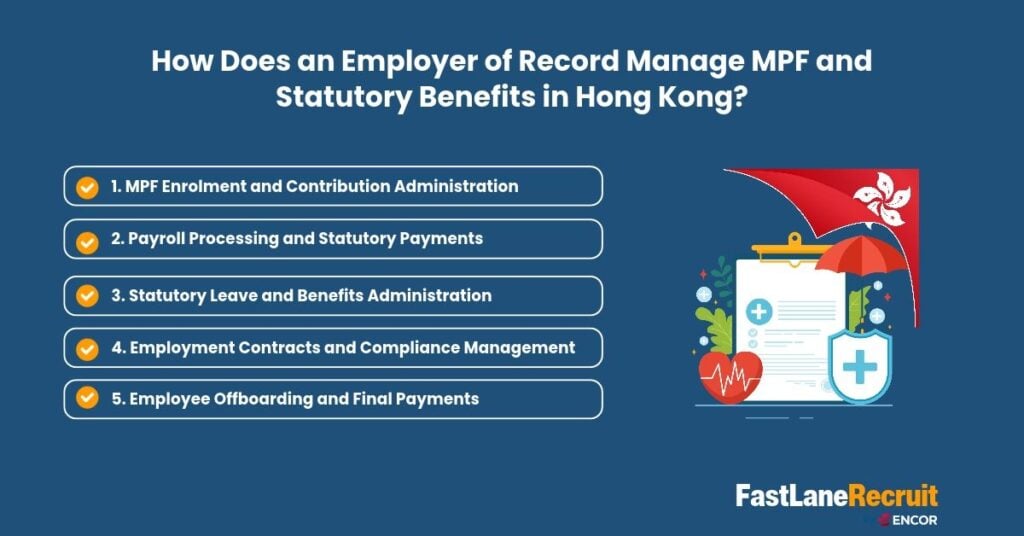
How Does an Employer of Record Manage MPF and Statutory Benefits in Hong Kong?
An Employer of Record (EOR) is a third-party organisation that legally employs workers on behalf of another company.
The client company retains responsibility for directing the employee’s day-to-day work, while the EOR manages the formal employment relationship and agreed local employment administration.
For international businesses without a Hong Kong entity, this arrangement provides a way to hire locally while managing employment obligations through an established service provider.
1. MPF Enrolment and Contribution Administration
An EOR manages the applicable MPF administration for eligible employees, including enrolment, contribution calculations, employee deductions, and submission of mandatory contributions.
This helps ensure that MPF responsibilities are incorporated into the regular payroll process.
2. Payroll Processing and Statutory Payments
An EOR coordinates payroll calculations and administration, including:
- Monthly salary payments
- Employer and employee MPF contributions
- Statutory leave payments
- Applicable employee deductions
- Payroll records and reporting
By coordinating these processes, businesses can reduce the administrative burden of managing local payroll independently.
3. Statutory Leave and Benefits Administration
An EOR helps administer applicable employee entitlements under Hong Kong employment regulations.
This may include annual leave balances, statutory holidays, sickness allowance, maternity leave, paternity leave, and qualifying termination payments.
Accurate employment records and eligibility checks are essential to ensure that employees receive the entitlements to which they are legally entitled.
4. Employment Contracts and Compliance Management
An EOR provides locally compliant employment documentation and administers employment-related processes in accordance with applicable regulations.
This includes supporting employment contract arrangements, maintaining employment information, administering changes to employment terms, and coordinating compliant offboarding.
5. Employee Offboarding and Final Payments
When employment ends, employers must assess outstanding salary, unused annual leave, notice payments, severance payment, or long service payment where applicable.
An EOR helps coordinate final payroll calculations and employment administration based on the circumstances of termination.
Important: An EOR arrangement does not remove the need for proper employment compliance. The EOR and client company should clearly define their responsibilities in the service agreement, including work supervision, employee management, workplace safety, and employment-related decision-making.
Should Your Business Use an EOR to Manage Hong Kong MPF and Statutory Benefits?
An EOR is particularly useful for companies that want to hire in Hong Kong without immediately establishing a local legal entity.
However, the right employment model depends on your hiring plans, operational requirements, and long-term business strategy.
When Is an EOR the Right Choice?
Consider an EOR if your business:
- Wants to hire its first employee in Hong Kong without incorporating a local company.
- Needs local payroll and MPF administration.
- Wants support managing statutory employment benefits.
- Is testing the Hong Kong market before making a long-term investment.
- Needs to hire a small team without building an internal HR and payroll function.
- Wants to expand across multiple countries through a regional employment partner.
EOR vs Establishing a Hong Kong Entity
| Consideration | Employer of Record | Own Hong Kong Entity |
| Local entity establishment | Not required for hiring through the EOR | Required |
| Legal employer | EOR | Your Hong Kong company |
| Employment contracts | Administered by the EOR | Managed by your company |
| MPF administration | Managed by the EOR under the arrangement | Managed by your company or appointed provider |
| Payroll processing | Managed by the EOR | Managed internally or outsourced |
| Statutory benefits | Administered by the EOR under the arrangement | Managed by your company |
| Operational control | Client directs day-to-day work within the agreed arrangement | Direct employer management |
| Best suited for | Market entry, lean hiring, and international expansion | Established operations and long-term local presence |
When Should You Establish Your Own Hong Kong Company?
Setting up a local entity may be more suitable when your business intends to establish a substantial long-term presence, conduct activities that require its own local legal structure, build a larger workforce, or enter into local commercial arrangements in its own name.
An EOR can provide a practical entry route, but it is not a substitute for every type of local business establishment. Companies should also consider licensing, immigration, tax, permanent establishment, and regulatory requirements relevant to their activities.
Manage Hong Kong MPF and Statutory Benefits with FastLaneRecruit
Hiring in Hong Kong should not mean navigating unfamiliar employment regulations and payroll administration alone.
FastLaneRecruit provides Employer of Record services that help international businesses employ talent in Hong Kong without establishing their own local entity.
As your EOR partner, We manage the formal employment relationship and agreed employment administration, allowing your business to focus on employee performance, business operations, and regional growth.
Our Hong Kong EOR Services Include:
- Employment Contracts: Locally compliant employment agreements and employment documentation.
- Payroll Administration: Monthly payroll processing and salary administration.
- MPF Contributions: Administration of applicable employer and employee MPF contributions.
- Statutory Benefits: Administration of applicable employee leave and statutory entitlements.
- Tax Compliance: Support with applicable employment-related tax administration and reporting.
- Employee Onboarding: Employment documentation and onboarding coordination.
- Employee Offboarding: Final payroll and employment administration in accordance with applicable requirements.
Why Businesses Choose FastLaneRecruit
Hire Without Establishing a Local Entity
Employ eligible employees in Hong Kong through our EOR arrangement without incorporating your own Hong Kong company.
Simplify Employment Administration
Coordinate employment contracts, payroll, MPF contributions, and statutory benefits through one employment service provider.
Support Local Employment Compliance
Receive support with local employment administration and applicable statutory requirements, reducing the burden of managing unfamiliar regulations independently.
Scale Across Multiple Markets
Work with one regional partner to support international workforce expansion across multiple jurisdictions.
Focus on Your Business Growth
Spend less time coordinating local employment administration and more time building your team, managing operations, and developing new markets.
FastLaneRecruit Operates Across Three Key Regions
Beyond Hong Kong, FastLaneRecruit supports international hiring and workforce expansion across Asia Pacific, Europe, and the Middle East & Africa.
FastLaneRecruit operates in
- Asia Pacific: Malaysia, Singapore, Hong Kong, China, India, Philippines, Taiwan, Vietnam, Australia,
- Europe: United Kingdom, Switzerland
- Middle East & Africa: UAE, Saudi Arabia, Qatar
Whether you are hiring one employee in Hong Kong or building a workforce across multiple markets, FastLaneRecruit can help coordinate your international employment requirements through regional EOR services.
Hire in Hong Kong with Confidence
Managing MPF contributions and statutory benefits is an essential part of employing talent in Hong Kong. From retirement contributions and paid leave to payroll administration and termination obligations, employers must account for local employment requirements throughout the employee lifecycle.
With FastLaneRecruit, your business can hire in Hong Kong without establishing its own local entity while receiving support with employment contracts, payroll, MPF contributions, statutory benefits, and employment administration.
Ready to expand your workforce in Hong Kong?
Talk to FastLaneRecruit about your hiring plans and discover how our Employer of Record services can simplify local employment administration.
Book a Free Consultation with Our EOR Specialists.
Frequently Asked Questions About Hong Kong MPF, Statutory Benefits and EOR
1. How much must employers contribute to MPF in Hong Kong?
Employers generally contribute 5% of an eligible employee’s relevant income to an MPF scheme. For monthly paid employees, the maximum relevant income level is HK30,000,resultinginamaximummandatoryemployercontributionofHK1,500 per month.
2. Does an employer have to pay MPF if an employee earns less than HK$7,100?
Yes. Employers generally remain responsible for contributing 5% of the employee’s relevant income, even when monthly income is below HK$7,100. The employee is not required to make mandatory contributions during that contribution period when the relevant income is below the minimum threshold.
3. What statutory benefits are employees entitled to in Hong Kong?
Employees covered by the Employment Ordinance may be entitled to statutory holidays, paid annual leave, sickness allowance, maternity leave, paternity leave, severance payment, and long service payment, depending on the applicable eligibility conditions.
4. How many statutory holidays are there in Hong Kong in 2026?
Hong Kong has 15 statutory holidays in 2026. Easter Monday became an additional statutory holiday from 2026 as part of the gradual expansion of statutory holidays.
5. Is MPF included in an employee’s salary?
Mandatory employer MPF contributions are separate from an employee’s gross salary and are an additional employer cost. The employee’s mandatory contribution is generally deducted from relevant income where applicable.
6. Can a foreign company hire employees in Hong Kong without setting up a company?
Yes. A foreign company can hire eligible employees in Hong Kong through an Employer of Record, subject to applicable legal, employment, and immigration requirements. The EOR becomes the legal employer and administers the formal employment relationship.
7. Can an EOR manage MPF contributions in Hong Kong?
Yes. An EOR can manage applicable MPF administration, including employee enrolment, contribution calculations, payroll deductions, and contribution submissions, as part of its employment services.
8. Does an EOR handle statutory leave and employee benefits?
An EOR can administer statutory leave and employee benefits as part of its agreed service scope. This may include leave records, statutory holiday pay, sickness allowance, maternity and paternity leave pay, and qualifying termination payments.
9. What happens if an employer fails to make MPF contributions?
Failure to make mandatory MPF contributions can result in contribution surcharges, financial penalties, and other legal consequences. Employers should maintain accurate payroll records and ensure contributions are submitted by the applicable deadlines.
10. Is an EOR better than setting up a Hong Kong company?
An EOR may be more practical for businesses hiring a small number of employees, testing the market, or expanding without establishing a local entity. Setting up a company may be more appropriate for businesses planning substantial long-term operations or activities requiring their own legal presence.
11. Does using an EOR remove the client’s employment compliance responsibilities?
No. The EOR manages the formal employment relationship and agreed employment obligations, but the client company still needs to comply with its contractual responsibilities and applicable laws. Responsibilities should be clearly allocated in the EOR agreement.
12. How much does it cost to hire an employee through an EOR in Hong Kong?
The cost generally includes the employee’s salary, mandatory employer MPF contributions, applicable employment expenses, and the EOR’s service fee. The final amount depends on salary, employee eligibility, benefits, and the scope of services included in the agreement.