International hiring gives businesses access to new talent and markets, but it also introduces important responsibilities for protecting employee information. From payroll records and identification documents to bank details and sensitive personal data, companies must understand how employee information is collected, shared, stored, and protected across borders.
An Employer of Record (EOR) can help businesses manage local employment arrangements, payroll administration, and employment-related compliance when hiring internationally. However, using an EOR does not automatically eliminate your company’s data protection obligations. Responsibilities depend on applicable laws, the parties’ actual roles in processing personal data, and the contractual arrangements between them.
Understanding these responsibilities before choosing an EOR provider can help businesses reduce data security risks, establish clear accountability, and make more informed international hiring decisions.
This guide explains the key data protection obligations when using an EOR, the safeguards businesses should implement, and how to evaluate an EOR provider for international employment.
Content Outline
Key Summary
An EOR Does Not Automatically Transfer Every Data Protection Responsibility
Your company and the EOR must establish who is responsible for collecting, using, storing, and sharing employee data. Their legal responsibilities depend on the applicable jurisdiction and their actual roles in processing the information.
Employment and Payroll Data Require Appropriate Protection
Employee records may contain identification documents, bank account details, salary information, tax records, and sensitive personal information. Businesses should limit access to authorized personnel and use appropriate security measures.
Contracts Should Clearly Define Data Protection Responsibilities
Before onboarding employees, review the EOR agreement and relevant data protection provisions. Where required, appropriate agreements should specify the purposes of processing, permitted data uses, security measures, confidentiality, data transfers, and incident notification procedures.
International Data Transfers Need Specific Attention
When employee information moves between countries, businesses should assess applicable data transfer restrictions and implement any required safeguards.
Choosing the Right EOR Requires More Than Comparing Prices
Businesses should evaluate an EOR provider’s contractual commitments, data handling procedures, security controls, incident response arrangements, and ability to support applicable local employment requirements.
What Are Data Protection Obligations When Using an EOR?
Data protection obligations are the legal and operational responsibilities involved in collecting, processing, storing, sharing, retaining, and disposing of personal information.
When a business hires employees through an EOR, both parties may handle employee information for different purposes.
For example, the EOR may need personal information to prepare employment contracts, administer payroll, manage statutory contributions, and maintain employment records. Meanwhile, the client company may use employee information for work allocation, performance management, system access, and internal HR administration.
Depending on the applicable law and the parties’ actual activities, each organization may have different responsibilities under data protection legislation.
Relevant requirements may arise under the EU General Data Protection Regulation (GDPR), the UK GDPR, Malaysia’s Personal Data Protection Act 2010 (PDPA), or other applicable national data protection laws.
The key principle is that outsourcing employment administration does not, by itself, remove a company’s responsibility to assess how personal data is handled.
The European Data Protection Board explains that controllers and processors have different responsibilities under the GDPR, with contractual arrangements required where a controller-processor relationship exists. These classifications must be determined by examining the actual processing activities rather than relying solely on the parties’ contractual labels.
What Employee Data Must Be Protected When Using an EOR?
An EOR arrangement can involve the processing of personal information throughout the employment lifecycle, from recruitment and onboarding to payroll administration and offboarding.
Businesses should identify the information being shared, understand why it is needed, and ensure that appropriate safeguards are in place.
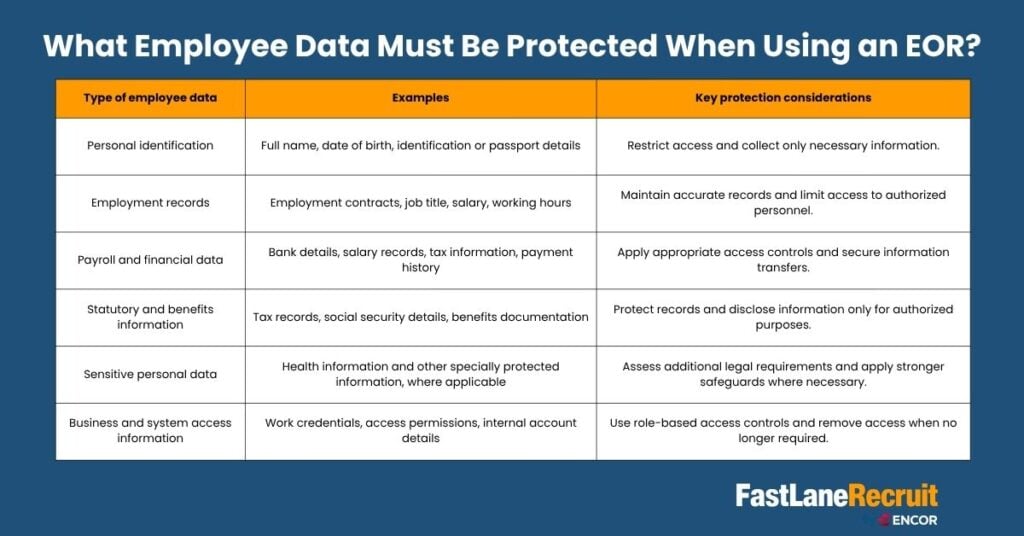
| Type of employee data | Examples | Key protection considerations |
| Personal identification | Full name, date of birth, identification or passport details | Restrict access and collect only necessary information. |
| Employment records | Employment contracts, job title, salary, working hours | Maintain accurate records and limit access to authorized personnel. |
| Payroll and financial data | Bank details, salary records, tax information, payment history | Apply appropriate access controls and secure information transfers. |
| Statutory and benefits information | Tax records, social security details, benefits documentation | Protect records and disclose information only for authorized purposes. |
| Sensitive personal data | Health information and other specially protected information, where applicable | Assess additional legal requirements and apply stronger safeguards where necessary. |
| Business and system access information | Work credentials, access permissions, internal account details | Use role-based access controls and remove access when no longer required. |
The specific data collected will depend on the employment arrangement, the country where the employee works, and applicable legal requirements.
Businesses should avoid sharing complete employee records when a particular process requires only limited information.
7 Data Protection Obligations to Address When Using an EOR
Meeting data protection obligations requires a coordinated approach involving contractual safeguards, operational controls, and ongoing oversight.
The following measures provide a practical starting point for businesses evaluating or implementing an EOR arrangement.
1. Establish Clear Responsibilities for Employee Data
Before entering an EOR arrangement, determine which organization is responsible for each personal data processing activity.
For example, the EOR may process employee information to administer payroll and maintain employment records, while your company may determine how employee information is used for internal workforce management.
Under applicable data protection laws, the parties may act as independent controllers, a controller and processor, or joint controllers for particular activities. An EOR should not automatically be classified as a processor for every activity simply because it provides an outsourced service.
What businesses should do:
- Identify the personal data each party collects and uses.
- Document the purpose of each processing activity.
- Establish responsibility for privacy notices and employee requests.
- Clarify who manages data protection incidents.
- Review the parties’ responsibilities against applicable local laws.
Clear allocation of responsibilities helps prevent gaps in accountability when employee information is shared between organizations.
2. Review EOR Agreements and Data Protection Clauses
An EOR agreement should explain how the provider handles employee information and how the parties coordinate their responsibilities.
Depending on the relationship and applicable law, additional contractual provisions or a separate data processing agreement may be necessary.
A data protection agreement or relevant contractual schedule should address the processing activities and safeguards applicable to the arrangement.
| Contract provision | What businesses should verify |
| Purpose and scope | What personal data will be processed and for what purposes? |
| Permitted data use | How may the parties use, disclose, or otherwise process employee information? |
| Confidentiality | What obligations apply to personnel who can access employee data? |
| Security measures | What technical and organizational safeguards protect the information? |
| Subcontractors | Can the EOR engage other providers to process employee data, and what controls apply? |
| International transfers | What safeguards or legal mechanisms are required for cross-border transfers? |
| Incident notification | How and when must the parties notify each other of a data breach or security incident? |
| Data retention and deletion | How will employee information be retained, returned, or deleted when no longer needed? |
| Employee rights | How will the parties coordinate requests to access, correct, or otherwise exercise rights over personal data? |
The European Data Protection Board identifies contractual terms governing processing instructions, confidentiality, and security as important elements of controller-processor arrangements under the GDPR.
Businesses should have the relevant agreements reviewed against the laws that apply to their specific employment and data processing arrangements.
3. Apply Appropriate Security Measures
Contractual protections are important, but they must be supported by effective operational security.
An EOR may handle sensitive information through HR systems, payroll platforms, document management tools, and communication channels. Businesses should understand how these systems are protected and who can access the information.
Recommended safeguards include:
- Role-based access controls: Restrict employee records to personnel who need them for their responsibilities.
- Multi-factor authentication: Strengthen authentication for systems containing sensitive employee information.
- Encryption: Use appropriate encryption for data transfers and storage where suitable.
- Secure file sharing: Avoid sending sensitive employee documents through unsecured channels.
- Access reviews: Regularly review permissions and remove unnecessary access.
- Staff training: Ensure personnel understand confidentiality, privacy, and secure data handling.
- Incident response procedures: Establish processes for identifying, escalating, investigating, and responding to security incidents.
The appropriate controls depend on the sensitivity of the information, the risks associated with processing, and applicable legal requirements.
Businesses should ask potential EOR providers what controls they maintain and what evidence they can provide to support their security practices.
4. Understand Cross-Border Data Transfer Requirements
International employment frequently involves transferring employee information between countries.
For example, an EOR may process employment records locally while the client company accesses certain information through its HR systems in another country.
These arrangements can trigger data transfer restrictions under applicable privacy laws.
Under the GDPR, transfers of personal data outside the European Economic Area may require an adequacy decision or appropriate safeguards, depending on the circumstances. Other jurisdictions have their own rules governing overseas transfers.
Before transferring employee data internationally, businesses should:
- Identify the countries from which data is collected, accessed, stored, and transferred.
- Determine which data protection laws apply.
- Assess whether the transfer is permitted under those laws.
- Implement any required contractual or legal safeguards.
- Confirm how onward transfers and access by other service providers are managed.
- Review the arrangement when providers, systems, or processing locations change.
Do not assume that an international EOR arrangement automatically authorizes every cross-border data transfer.
Where required, seek advice from a qualified privacy professional or legal adviser familiar with the relevant jurisdictions.
5. Maintain Transparency and Respect Employee Privacy Rights
Employees should understand how their personal information is used and which organizations may receive it.
Depending on applicable law and the circumstances, businesses may need to provide privacy information explaining the purpose of processing, the legal basis, relevant recipients, retention periods, and available rights.
Employee information should not be collected or reused indiscriminately.
For example, information collected to administer payroll should not automatically be repurposed for unrelated activities without assessing whether the new use is lawful.
Businesses should establish procedures to:
- Provide appropriate employee privacy notices.
- Explain why information is collected and how it is used.
- Identify relevant recipients and service providers.
- Handle requests to access or correct personal information.
- Apply appropriate retention and deletion rules.
- Review the use of sensitive information and employee monitoring systems.
Under the UK GDPR, organizations must handle employment records in accordance with applicable data protection principles, including lawfulness, fairness, transparency, and purpose limitation.
The exact obligations will depend on the law applicable to the processing activity.
6. Establish Data Breach and Incident Response Procedures
A data breach involving employee records can expose personal information and create legal, operational, and reputational risks.
Examples include sending payroll information to the wrong recipient, unauthorized access to HR systems, lost devices containing employee records, or compromised employee credentials.
Businesses should agree in advance on how the EOR and client company will respond to such incidents.
An effective incident response arrangement should define:
- Who receives and escalates incident reports.
- How quickly the EOR must notify the client under the agreed procedures and applicable requirements.
- Who investigates the incident and preserves relevant evidence.
- How the parties assess the affected information and individuals.
- Who determines whether regulatory or individual notification is required.
- How corrective measures are implemented and documented.
Under the GDPR, certain personal data breaches must be reported to the relevant supervisory authority within 72 hours of the controller becoming aware of the breach, where the legal reporting threshold is met. Notification to affected individuals may also be required when the breach is likely to result in a high risk to their rights and freedoms.
This is not a universal 72-hour deadline for every incident in every country. Other jurisdictions may impose different notification requirements.
Businesses should establish clear escalation procedures that allow the responsible party to assess and meet applicable deadlines.
7. Review Data Retention, Employee Offboarding, and Ongoing Compliance
Data protection responsibilities continue after an employee leaves the business.
Employment, payroll, tax, and statutory records may need to be retained for legally required periods. Other information may no longer be necessary once the employment relationship ends.
Businesses should not assume that every record must be deleted immediately or retained indefinitely.
A practical offboarding and retention process should cover:
- Removing access to company systems when no longer authorized.
- Revoking credentials and reviewing third-party system permissions.
- Confirming which employment records must be retained.
- Applying appropriate retention periods to different data categories.
- Securely deleting or returning information when legally and contractually appropriate.
- Confirming the EOR’s responsibilities for records it maintains.
- Reviewing access permissions and retention procedures periodically.
The EOR and client company should establish clear procedures for managing records throughout the employment lifecycle.
This helps ensure that employee information remains protected even when the employee, service provider, or employment arrangement changes.
EOR vs. Client Company: Who Is Responsible for Data Protection?
One of the most important steps in meeting data protection obligations is understanding how responsibilities are divided between the EOR and the client company.
The division depends on the applicable laws, the parties’ actual processing activities, and their contractual arrangements.
The following table provides a general operational guide, not a universal legal allocation.
| Responsibility | EOR provider | Client company |
| Employment administration | Manages agreed employment documentation and administration. | Provides accurate information required for the employment arrangement. |
| Payroll processing | Handles agreed payroll activities and related employee information. | Supplies accurate payroll inputs and manages its own records appropriately. |
| Data security | Protects information within its systems and responsibilities. | Protects information within its own systems and responsibilities. |
| Employee privacy information | Supports appropriate information provision for processing activities it manages, as applicable. | Provides or coordinates privacy information for processing activities it controls, as applicable. |
| Access control | Restricts access to employee information within its environment. | Manages access to internal HR, communication, and business systems. |
| Data breach response | Escalates and manages incidents according to its legal obligations and agreed procedures. | Assesses its own obligations and coordinates with the EOR where necessary. |
| Data retention | Retains employment records as required by applicable law and the service arrangement. | Applies appropriate retention rules to records it maintains. |
Important: Neither party should rely solely on the service agreement’s labels to determine its legal responsibilities. The actual processing activities and applicable law must be considered.
Also Read: EOR Arrangement: Who Legally Employs Your Staff?
How to Choose an EOR Provider With Strong Data Protection Practices
Selecting an EOR involves more than reviewing employment administration fees or onboarding speed. Businesses should also assess whether the provider can explain how employee information is protected throughout the employment lifecycle.
Use the following checklist when evaluating a potential provider.
| Evaluation area | Questions to ask |
| Legal responsibilities | How are data protection responsibilities allocated between the EOR and client company? |
| Contractual safeguards | Does the agreement address confidentiality, permitted data use, security, and incident notification? |
| Security controls | What access controls, authentication measures, and information security procedures are in place? |
| Data storage and transfers | Where is employee data stored, and which countries or service providers may access it? |
| Subcontractors | Does the EOR use other providers to process employee information, and how are they assessed? |
| Employee privacy rights | How are requests to access, correct, or otherwise exercise rights over personal data handled? |
| Incident response | What procedures govern incident escalation, investigation, and required notifications? |
| Retention and offboarding | How are employment records retained, returned, or deleted when appropriate? |
| Local employment administration | Can the provider explain the employment and payroll requirements relevant to the target country? |
| Evidence and accountability | Can the provider explain its controls and supply relevant documentation or assurance evidence? |
Red Flags to Watch For
Be cautious if a prospective provider:
- Cannot clearly explain how employee information is handled.
- Avoids clarifying data protection responsibilities in the contract.
- Provides little information about security controls or incident response.
- Cannot explain where employee information is processed or transferred.
- Does not have a clear process for handling employee data requests.
- Makes broad compliance guarantees without explaining their scope or limitations.
No single document or certification proves that every data protection obligation has been met. Businesses should assess the provider’s practices in the context of their actual requirements and risk exposure.
Also Read: What Does EOR Do? 10 Key Responsibilities of an Employer of Record
How FastLaneRecruit Supports International Employment
Managing international employment involves coordinating local employment arrangements, payroll administration, employee documentation, and applicable statutory requirements.
FastLaneRecruit provides Employer of Record services to help businesses hire employees in supported markets without establishing their own local entity in every country.
Our EOR services can support agreed employment administration activities, including:
- Local employment contracts: Employment arrangements prepared according to applicable local requirements.
- Payroll administration: Coordination of salary payments and relevant payroll processes.
- Statutory contributions and employment-related filings: Support for applicable employment and payroll obligations within the agreed service scope.
- Employee benefits administration: Administration of applicable benefits where included in the service arrangement.
- Employee onboarding: Coordination of required employment documentation and onboarding procedures.
- Ongoing employment administration: Support throughout the employment relationship, including relevant administrative processes.
These services can help businesses coordinate international employment more efficiently while clarifying which responsibilities sit with the EOR and which remain with the client.
Does Using FastLaneRecruit Eliminate Your Data Protection Responsibilities?
No. Using an EOR does not automatically remove a client’s data protection obligations.
The responsibilities of FastLaneRecruit and the client company depend on the applicable laws, the specific processing activities, and the agreed service arrangement.
Businesses should discuss their employee data requirements, contractual safeguards, information-sharing processes, and relevant security expectations before onboarding employees.
Our team can help businesses understand the employment administration involved in hiring across supported markets and determine whether our EOR services align with their international workforce needs.
Why Businesses Choose FastLaneRecruit
Businesses expanding internationally need an employment partner that understands local employment administration and can support a structured approach to hiring across markets.
FastLaneRecruit helps companies manage key employment processes while avoiding the need to establish their own legal entity in every supported market.
Support Across Multiple Markets
FastLaneRecruit supports international employment across selected markets in Asia Pacific, Europe, and the Middle East & Africa, helping businesses navigate employment administration in their target markets.
Local Employment and Payroll Administration
Our EOR services can support employment contracts, payroll administration, statutory contributions, onboarding, and relevant employment administration according to applicable local requirements and the agreed service scope.
Secure Data Protection
Protecting employee information is an important consideration in international employment. Businesses should understand how their EOR provider handles personal data, manages access to employee information, and addresses relevant data protection responsibilities.
FastLaneRecruit encourages businesses to clarify data handling arrangements, contractual safeguards, and applicable compliance requirements when establishing an EOR relationship. Responsibilities depend on the applicable laws, the parties’ actual roles in processing personal data, and the agreed service arrangements.
A More Practical Route to International Hiring
Businesses can use EOR services to hire employees in supported markets without establishing a separate local entity for each employment arrangement.
Support Throughout the Employment Lifecycle
From onboarding to ongoing employment administration and offboarding, our services help businesses coordinate essential employment processes.
Clearer Employment Administration
A defined service arrangement helps businesses understand which employment and administrative responsibilities FastLaneRecruit handles and which remain with their internal teams.
Markets Supported by FastLaneRecruit
Our EOR services cover selected markets across three regions.
- Asia Pacific: Malaysia, Singapore, Hong Kong, China, India, Philippines, Taiwan, Vietnam, Australia,
- Europe: United Kingdom, Switzerland
- Middle East & Africa: UAE, Saudi Arabia, Qatar
Employment requirements, service availability, and the scope of support vary by country. Contact our team to confirm the arrangements available for your target market.
Meet Your International Employment Needs With FastLaneRecruit
Protecting employee information is an essential part of responsible international hiring. Choosing an EOR should involve more than finding a provider that can issue employment contracts and process payroll. Businesses also need to understand how employee information is handled and how employment responsibilities are allocated.
FastLaneRecruit helps businesses hire employees across supported international markets through Employer of Record services that can support local employment contracts, payroll administration, statutory contributions, onboarding, and ongoing employment administration.
Whether you are hiring your first international employee or expanding an existing regional team, our team can help you understand the employment arrangements available for your target market.
Book a Free Consultation with an Expert to discuss your international hiring plans, understand our EOR service scope, and identify the next steps for building your team.
Frequently Asked Questions About Data Protection Obligations When Using an EOR
1. Who Is Responsible for Data Protection When Using an EOR?
Responsibility depends on the applicable data protection laws and the actual roles of the EOR and client company in processing personal information.
An EOR may be responsible for certain employment and payroll processing activities, while the client company may retain responsibility for employee information used in its own systems and business operations. Some activities may involve independent or joint controller responsibilities.
The parties should document their respective obligations and ensure that the contractual arrangements reflect how personal data is actually processed.
2. Does an EOR Need to Comply With GDPR?
An EOR must comply with the GDPR when the regulation applies to its processing activities. Applicability depends on the relevant circumstances, including the organizations involved, the processing activities, and the territorial scope of the regulation.
Businesses should not assume that every EOR arrangement is automatically subject to GDPR or that GDPR compliance alone satisfies all local data protection requirements.
3. Can an EOR Share Employee Data With a Client Company?
Employee data may be shared when the disclosure is permitted under applicable law and is consistent with the relevant processing purposes and legal requirements.
The parties should determine what information needs to be shared, why it is required, who may access it, and what safeguards apply.
Employee information should not be disclosed indiscriminately simply because an EOR and client company have a commercial relationship.
4. What Should a Data Processing Agreement With an EOR Include?
Where a controller-processor relationship exists and the applicable law requires a data processing agreement, it should address the relevant processing activities, permitted instructions, confidentiality, security, subcontracting, assistance with individual rights, breach notifications, and the return or deletion of information.
International data transfers and audit or assurance arrangements may also require specific provisions.
The agreement should reflect the actual relationship and the applicable legal framework.
5. What Are the Risks of Using an EOR Without Clear Data Protection Arrangements?
Unclear arrangements can lead to excessive data sharing, unauthorized access, inconsistent retention practices, delayed incident response, and uncertainty over who must handle employee requests or regulatory obligations.
Businesses can reduce these risks by reviewing contracts, establishing clear procedures, limiting access, and assessing the EOR’s security and data handling practices before onboarding employees.
6. How Can Businesses Protect Employee Data During International Hiring?
Businesses should identify the information required for hiring, establish lawful and transparent processing practices, use secure data-sharing channels, restrict access, and assess any international transfer requirements.
They should also review the EOR agreement, provide appropriate employee privacy information, and establish procedures for data breaches, retention, and offboarding.
7. Does an EOR Handle All Employment and Data Protection Compliance?
No. An EOR can support employment administration and certain compliance activities, but the scope of its responsibilities depends on the service arrangement and applicable law.
Businesses may retain obligations relating to their own processing activities, internal systems, employee management, and other legal requirements. They should clarify these responsibilities with the EOR before entering the arrangement.
8. How Do I Choose the Right EOR for International Hiring?
Compare providers based on their availability in your target country, local employment expertise, contractual arrangements, payroll administration, security practices, data handling procedures, incident response processes, and transparency about responsibilities.
Request relevant documentation and ask how the provider handles employee information throughout onboarding, employment, and offboarding.
The right EOR should fit your hiring needs while providing a clear understanding of the services and responsibilities covered by the agreement.