Running a business on your own can work well until the workload grows beyond what one person can realistically manage. Your next step may be hiring someone to handle operations, sales, customer service, administration, or specialist work.
But becoming an employer introduces responsibilities that do not exist when you operate alone.
So, can a sole proprietor hire employees? Yes. A sole proprietor can generally hire employees without first forming an LLC or corporation. However, once you hire, you become responsible for applicable employment, payroll, tax, recordkeeping, insurance, and labor-law requirements in the relevant jurisdiction.
For business owners hiring internationally, the situation can become more complex because employment obligations generally depend on where the employee works, not simply where the business owner is based. An Employer of Record (EOR) can provide a way to employ workers in supported countries without requiring the business to establish its own local employing entity.
Content Outline
Key Summary
A sole proprietor can hire employees
The word “sole” refers to ownership, not the number of people working for the business. A sole proprietor can employ one or more workers while remaining the sole owner.
You do not automatically need an LLC to hire
In the United States, for example, a sole proprietor does not have to form an LLC or corporation before hiring an employee. However, changing business structure may be worth discussing with qualified legal, tax, and insurance professionals as the business grows because a sole proprietorship does not create the same legal separation between the owner and business as certain incorporated structures.
International hiring requires another level of planning
If the employee is located in another country, you need to consider local employment laws, payroll, tax, mandatory benefits, social contributions, employment contracts, and the appropriate employing structure.
An EOR can help businesses employ workers internationally through a local employment structure without requiring the business to establish its own entity in every country.
What Is a Sole Proprietor?
A sole proprietorship is a business structure in which one individual owns and operates the business. In many jurisdictions, the business and owner are not separate legal persons in the same way that a corporation or certain other entities are.
This structure is often attractive because it can be relatively simple to establish and operate. However, that simplicity does not remove the owner’s responsibilities when the business begins employing people.
A useful distinction is:
| Business owner | Employee |
| Owns and operates the business | Performs work for the business |
| Receives business profits according to the applicable tax structure | Receives wages or salary |
| Is responsible for business obligations | Is subject to the employer’s applicable employment terms |
| May be self-employed | Is generally covered by employment rules |
A sole proprietor can therefore remain the sole owner while becoming an employer.
Can a Sole Proprietor Hire Employees?
Yes. A sole proprietor can hire employees.
There is generally no rule that says a business must become an LLC, corporation, or another incorporated entity simply because it wants to hire its first employee. For example, current U.S. guidance confirms that sole proprietors can employ workers and must then meet applicable employer, payroll, tax, and labor requirements.
However, hiring an employee changes your responsibilities.
Before making the first hire, consider:
- What role does the business need?
- Is the worker actually an employee or an independent contractor?
- What employment laws apply?
- What payroll and tax registrations are required?
- What documents must the employee complete?
- What insurance or statutory benefits apply?
- How will wages, leave, and other employment obligations be administered?
- Where will the employee work?
The final question becomes particularly important when hiring internationally.
What Does a Sole Proprietor Need to Hire an Employee?
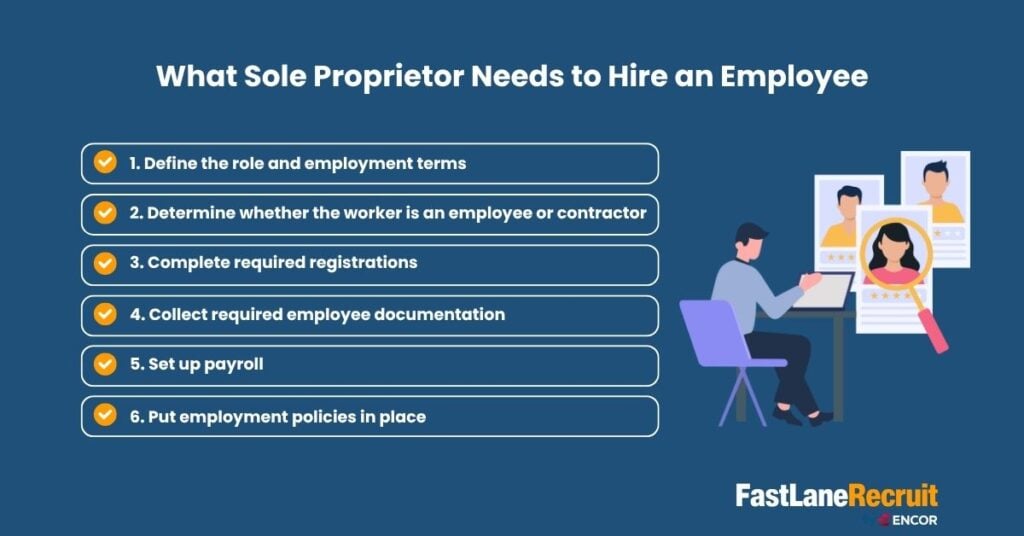
The precise requirements depend on the employee’s location and the applicable laws. However, a typical hiring process includes several core steps.
1. Define the role and employment terms
Before recruiting, establish:
- Job responsibilities
- Required skills and qualifications
- Working hours
- Work location
- Compensation
- Pay frequency
- Probationary period, where applicable
- Leave and benefits
- Reporting structure
- Termination provisions
Clear terms help both sides understand the employment relationship before work begins.
2. Determine whether the worker is an employee or contractor
Do not choose worker classification solely based on what is most convenient for the business.
Worker classification generally depends on the actual relationship between the parties, including factors such as the degree of control over the work, financial arrangements, and the nature of the relationship. The U.S. IRS, for example, evaluates behavioral control, financial control, and the relationship between the parties when distinguishing employees from independent contractors.
Misclassification can create tax, wage, benefit, and employment-law exposure.
3. Complete required registrations
Depending on the jurisdiction, you may need:
- An employer identification or business number
- Payroll tax registration
- Unemployment insurance registration
- Workers’ compensation coverage
- Local employer registrations
- Other statutory registrations
For example, U.S. sole proprietors generally need an EIN when they have employees, while other countries use different employer-registration systems.
4. Collect required employee documentation
Employee onboarding can require documents relating to:
- Identity
- Tax withholding
- Work authorization
- Banking and payment information
- Employment agreements
- Emergency contacts
- Benefits
- Company policies
The exact forms vary by jurisdiction.
5. Set up payroll
Employees must generally be paid through an appropriate payroll process.
This can involve:
- Calculating gross wages
- Applying required deductions
- Withholding applicable taxes
- Calculating employer contributions
- Processing statutory payments
- Issuing required payroll records
- Filing employment tax returns
Payroll obligations should be established before the first payroll run, not after the employee has already started working.
6. Put employment policies in place
Even a small business should establish clear expectations around:
- Working hours
- Pay dates
- Leave
- Workplace conduct
- Confidentiality
- Health and safety
- Data protection
- Performance
- Termination
As the workforce grows, informal arrangements can become difficult to manage consistently.
Can a Sole Proprietor Hire Employees Without an LLC?
Yes, in many jurisdictions, including the United States, forming an LLC is not a prerequisite to hiring employees.
However, these are separate questions:
Can you hire?
Generally, yes.
Should you change your business structure?
That depends on factors such as liability exposure, taxation, business growth, insurance, and long-term plans.
A sole proprietorship does not provide the same legal separation between the owner and business that an incorporated entity can provide. As a result, business owners should obtain jurisdiction-specific legal and tax advice when evaluating whether to change their structure.
Sole Proprietor Employee vs. Independent Contractor
Hiring an employee is not the same as engaging an independent contractor.
| Factor | Employee | Independent Contractor |
| Relationship | Employment relationship | Independent business relationship |
| Control | Employer generally has greater control over how work is performed | Contractor generally has greater independence |
| Payment | Payroll/wages | Contract-based payments |
| Benefits | May be entitled to statutory or employer-provided benefits | Generally not treated as an employee for benefits |
| Tax treatment | Employer has applicable withholding/reporting obligations | Contractor generally handles their own applicable taxes |
| Compliance | Employment laws and payroll obligations | Contractor classification and applicable contract/tax requirements |
| Risk | Employment compliance | Misclassification can create exposure |
The labels used in a contract do not necessarily determine classification. The actual working relationship matters.
When might a contractor be appropriate?
An independent contractor may be appropriate when a genuine independent business relationship exists, such as project-based work where the individual operates independently and the legal criteria for contractor status are satisfied.
It should not be used simply to avoid employee obligations.
What Taxes Does a Sole Proprietor Pay for Employees?
Once a sole proprietor becomes an employer, the business may have additional payroll-related tax obligations.
These can include:
- Employee income-tax withholding
- Social insurance or equivalent contributions
- Employer contributions
- Unemployment-related taxes
- Payroll reporting
- Other jurisdiction-specific employment taxes
The exact calculation depends on where the employee works, how much they earn, their employment status, and the applicable local rules.
For example, U.S. employers have federal employment-tax withholding and reporting responsibilities, while other countries operate different payroll-tax and social-insurance systems.
For international hiring, businesses should not assume that their home-country payroll rules automatically apply to an employee working overseas.
Can a Sole Proprietor Hire Employees in Another Country?
This is where hiring can become significantly more complicated.
A sole proprietor may want to hire someone overseas because the right candidate lives in another market. However, directly employing that person can require the business to understand and comply with the employee’s local rules.
Depending on the country, this can involve:
- Local employment contracts
- Payroll registration
- Income-tax withholding
- Social-security contributions
- Mandatory employee benefits
- Paid leave requirements
- Working-time rules
- Termination requirements
- Employment records
- Data-protection obligations
- Immigration or work authorization requirements where applicable
The question therefore changes from:
Can a sole proprietor hire employees?
to:
How can a sole proprietor employ someone in another country compliantly?
That distinction is important for small businesses that want to expand internationally without immediately establishing a foreign subsidiary.
When Should a Sole Proprietor Consider an EOR?
An Employer of Record (EOR) can be relevant when a business wants to hire an employee in another country but does not have its own local employing entity there.
An EOR can generally serve as the local legal employer for employment administration, while the client business maintains the employee’s day-to-day direction and role responsibilities under the applicable arrangement.
An EOR may be worth considering when:
- You want to hire internationally without establishing a local entity.
- You need to employ a candidate in a new market quickly.
- You are testing a new international market.
- You expect to hire only a small number of employees overseas.
- You want local payroll and employment administration handled through an established structure.
- You need support navigating country-specific employment requirements.
An EOR does not mean that every tax, immigration, permanent-establishment, or regulatory obligation automatically disappears. The arrangement should be evaluated based on the employee’s location, business activities, and applicable laws.
Sole Proprietor Direct Hiring vs. EOR
| Consideration | Direct Employment | EOR |
| Local employing entity | May be required for international employment | EOR provides the local employing structure where supported |
| Payroll | Business manages or outsources it | EOR manages employment payroll administration |
| Employment compliance | Business is responsible for applicable obligations | EOR handles designated employer responsibilities |
| International expansion | Can require significant setup | Can simplify entry into supported markets |
| Employee management | Business manages employee | Business generally directs day-to-day work |
| Best suited for | Businesses able to establish and manage employment locally | Businesses seeking a simpler international employment route |
The appropriate model depends on the country, workforce strategy, expected headcount, and how the business wants to manage its international operations.
How FastLaneRecruit Can Support International Hiring
For a sole proprietor or growing business, international hiring can create administrative work that goes well beyond finding the right candidate.
FastLaneRecruit provides Employer of Record services for businesses hiring internationally, helping businesses use an established employment structure in supported markets rather than immediately creating their own local entity.
Our support can be relevant when you need to:
- Hire employees internationally
- Employ workers without establishing your own local entity
- Manage country-specific employment administration
- Support payroll and employment processes
- Expand into a new market with a small initial team
- Reduce the administrative burden associated with cross-border employment
FastLaneRecruit operates across Malaysia, Singapore, Hong Kong, China, India, Philippines, Taiwan, Vietnam, Australia, United Kingdom, Switzerland, UAE, Saudi Arabia, Qatar
For a sole proprietor considering an international hire, the practical question is not simply whether you can hire the person. It is whether your chosen employment structure is appropriate for the country and your business objectives.
Why Businesses Choose FastLaneRecruit
Hire internationally without immediately establishing a local entity
An EOR structure can help businesses enter supported markets without setting up their own employing entity from the beginning.
Simplify international employment administration
Instead of managing every employment process independently, businesses can use FastLaneRecruit’s local employment infrastructure and expertise.
Support market expansion
An EOR can be particularly useful when a business wants to test a market, hire an initial employee, or build a small international team before committing to a permanent local structure.
Keep control of day-to-day work
The business can generally continue to manage the employee’s role, responsibilities, objectives, and daily work while FastLaneRecruit handles designated employment responsibilities as the EOR.
Build a more scalable international hiring process
As your business moves beyond a one-person operation, having a structured approach to international employment can reduce administrative friction and help you focus on growth.
A Practical Checklist Before Hiring Your First Employee
Before making an offer, review these questions:
| Question | What to check |
| Do I need an employee? | Define the business problem and role |
| Employee or contractor? | Assess the actual working relationship |
| Where will they work? | Identify the governing employment jurisdiction |
| What registrations are required? | Employer, payroll and tax registrations |
| What will the employee cost? | Salary plus taxes, contributions, benefits and other costs |
| Is payroll ready? | Set up an appropriate payroll process |
| Are contracts ready? | Prepare applicable employment documentation |
| Are benefits required? | Check statutory and contractual requirements |
| Do I need insurance? | Review applicable workers’ compensation or equivalent requirements |
| Is the hire international? | Evaluate local employment structure and EOR options |
This checklist can help prevent a common mistake: treating hiring as simply finding someone and paying them.
Common Mistakes Sole Proprietors Make When Hiring
Treating a contractor as an employee—or vice versa
Worker classification should be based on the actual relationship and applicable law, not simply the title used in the agreement.
Paying employees without setting up payroll correctly
Payroll registrations, withholding, reporting, and employer contributions should be established before the first payment where required.
Assuming an LLC is required
A sole proprietor can generally hire employees without first becoming an LLC in jurisdictions such as the United States. Whether changing the business structure is appropriate is a separate legal and tax question.
Using home-country rules for an overseas employee
An employee working abroad can trigger obligations in the country where they work. International employment should therefore be assessed locally.
Assuming an EOR removes every compliance obligation
An EOR can simplify designated employment responsibilities, but businesses should still evaluate their wider tax, immigration, regulatory, and business-presence obligations.
Ready to Hire Internationally Without Establishing a Local Entity?
Hiring your first employee is a significant step for any sole proprietor. Hiring internationally adds another layer of employment, payroll, and compliance considerations.
If you are planning to hire an employee in Malaysia, Singapore, Hong Kong, China, India, Philippines, Taiwan, Vietnam, Australia, the United Kingdom, Switzerland, UAE, Saudi Arabia, or Qatar, FastLaneRecruit can help you evaluate an EOR employment structure for your international hiring plans.
Book a Free Consultation with an Expert to discuss your hiring requirements and determine whether an EOR model fits your expansion plans.
Frequently Asked Questions
Can a sole proprietor hire employees?
Yes. A sole proprietor can hire employees while remaining the sole owner of the business. Hiring employees creates additional payroll, tax, employment, documentation, and compliance responsibilities.
Can a sole proprietor have multiple employees?
Yes. A sole proprietorship is defined by its ownership structure, not by having only one worker. The applicable employment requirements must be met for each employee.
Does a sole proprietor need an LLC to hire employees?
Not necessarily. In the United States, a sole proprietor can hire employees without forming an LLC first. Other jurisdictions have their own business-registration and employment requirements.
Does a sole proprietor need an EIN to hire employees?
In the United States, employers generally need an EIN when they have employees. Other countries use different employer identification or payroll-registration systems.
Can a sole proprietor hire an independent contractor?
Yes, provided the worker genuinely qualifies as an independent contractor under the applicable rules. Worker classification depends on the actual relationship, not simply the contract label.
What is the difference between an employee and an independent contractor?
An employee generally works within an employment relationship subject to employer direction and applicable employment protections, while a genuine independent contractor operates an independent business relationship. Classification rules vary by jurisdiction.
Can a sole proprietor hire someone in another country?
Potentially, yes, but international employment introduces additional considerations around local employment law, payroll, taxes, benefits, and employment structure.
Can an EOR help a sole proprietor hire internationally?
An EOR can provide a local employment structure in supported countries, allowing a business to hire internationally without immediately establishing its own local employing entity. FastLaneRecruit provides EOR services across supported markets in Asia Pacific, Europe, and the Middle East.
Is an EOR suitable for a small business?
An EOR can be relevant for small businesses that want to hire internationally but do not want to establish and maintain their own local entity for an initial or small-scale workforce.