Hiring an employee in the United States can look straightforward until a company has to deal with the country’s layered employment, payroll, tax, and compliance requirements.
For international companies, the challenge becomes even greater. Hiring a US-based employee may require navigating federal employment laws, state and local requirements, payroll tax obligations, employee benefits, workers’ compensation, employment eligibility verification, and state-specific rules.
This is where an Employer of Record (EOR) in the US can provide a practical alternative.
An EOR is a third-party organization that becomes the legal employer of a worker on behalf of your company. The EOR manages employment administration such as compliant contracts, payroll, tax withholding, benefits administration, and other employer obligations, while your company retains control over the employee’s day-to-day work.
The model can allow companies to hire in the United States without immediately establishing their own local employment infrastructure.
For businesses evaluating international expansion, the key question is not simply “What is an employer of record?” It is:
“How can I use an EOR to hire and manage employees in the US while controlling compliance risk, administrative workload, and expansion costs?”
This guide explains how the US EOR model works, what an EOR handles, how US employment compliance affects hiring, when an EOR makes sense compared with establishing an entity, and how the same expansion strategy can be applied across markets such as Malaysia, Singapore, Hong Kong, China, the UAE, and Taiwan.
Content Outline
Key Summary
An EOR can allow companies to hire in the US without establishing their own employing entity
The EOR becomes the legal employer of the employee while the client company manages the employee’s daily work.
US employment compliance is highly state-specific
Federal requirements form the baseline, but states and local jurisdictions can impose additional requirements covering wages, leave, payroll taxes, benefits, workers’ compensation, and employment practices.
An EOR can simplify payroll and employment administration
Depending on the service agreement, an EOR can manage employment contracts, payroll processing, tax withholding, statutory filings, benefits administration, and employee documentation.
An EOR is not the same as a staffing agency or payroll provider
A staffing agency primarily focuses on sourcing and supplying talent. A payroll provider primarily processes payroll. An EOR assumes the legal employer role within the agreed scope.
The right EOR depends on more than price
Companies should assess entity ownership, country and state coverage, compliance expertise, payroll capabilities, benefits, data security, insurance, service scope, termination procedures, and customer support.
The EOR model can also support broader international expansion
Companies that use an EOR to test or enter one market can apply the same approach when expanding into additional countries where they do not yet have local entities.
What Is an Employer of Record in the US?
An Employer of Record (EOR) is a third-party organization that legally employs a worker on behalf of another company.
The EOR becomes the employer responsible for formal employment administration, while the client company remains responsible for managing the employee’s day-to-day responsibilities, business objectives, performance, and work.
A typical EOR arrangement involves three parties:
EOR → Legal employment
Client company → Day-to-day management
Employee → Performs the work
The EOR may manage:
- Employment contracts
- Employee onboarding
- Payroll processing
- Tax withholding
- Employment tax filings
- Benefits administration
- Workers’ compensation
- Employment documentation
- Statutory reporting
- Certain HR administration
- Termination administration
- Compliance support
The exact allocation of responsibilities depends on the EOR agreement.
For example, an EOR may be responsible for payroll processing and employer tax filings, while the client company remains responsible for deciding an employee’s salary, role, performance objectives, and whether the employee should be terminated.
This distinction is important because an EOR does not replace your management team. It provides the legal and administrative employment infrastructure needed to employ the worker.
How Does an Employer of Record Work in the United States?
The EOR model generally works through a service agreement between the client company and the EOR, followed by an employment agreement between the EOR and the employee.
Step 1: Your company selects a candidate
You identify and select the employee you want to hire.
Step 2: The EOR prepares compliant employment documentation
The EOR prepares an employment agreement and onboarding documentation based on applicable US federal, state, and local requirements.
Step 3: The employee becomes employed by the EOR
The EOR becomes the legal employer for the purposes covered by the arrangement.
Step 4: Your company manages the employee
The employee works for your organization operationally. You manage responsibilities such as:
- Daily tasks
- Team integration
- Performance
- Projects
- Reporting
- Business objectives
Step 5: The EOR manages employment administration
The EOR handles the agreed employment obligations, including payroll, tax administration, benefits, and HR compliance.
Step 6: Ongoing employment is administered through the EOR
The EOR continues supporting payroll, compliance, employee administration, and relevant employment changes throughout the employment lifecycle.
Also Read: What Is an Employer of Record (EOR)?
Why Is Hiring in the United States Challenging?
The United States does not have a single employment framework that answers every question for every employee.
Federal law provides important baseline requirements, while states and sometimes cities impose additional obligations.
A company hiring an employee in California can therefore face different requirements from a company hiring an employee in Texas, New York, or Florida.
Common areas of complexity include:
- Federal employment law
- State employment law
- Local employment requirements
- Minimum wage
- Overtime
- Employee classification
- Payroll taxes
- State unemployment insurance
- Workers’ compensation
- Paid sick leave
- Family and medical leave
- Benefits
- Pay transparency
- Background checks
- Employment eligibility verification
- Termination requirements
- Recordkeeping
This is one reason an EOR can be particularly useful for international companies entering the US market.
US Employment Laws and Compliance Requirements
A company hiring in the US should consider both federal and state requirements.
Fair Labor Standards Act (FLSA)
The FLSA establishes federal requirements covering areas including minimum wage, overtime, recordkeeping, and other wage-and-hour protections.
Covered non-exempt employees generally must receive overtime at not less than 1.5 times their regular rate for hours worked over 40 in a workweek, unless an exemption applies. State law may impose additional or more protective requirements.
This makes employee classification particularly important.
An employee incorrectly classified as exempt or non-exempt can create exposure to unpaid overtime and other wage claims.
Anti-Discrimination Requirements
US employers may also need to comply with federal laws enforced by the Equal Employment Opportunity Commission (EEOC).
These include laws addressing discrimination based on factors such as:
- Race
- Color
- Religion
- Sex
- National origin
- Disability
- Age
- Genetic information
Coverage can depend on the employer, employee count, and type of claim, while state and local laws may provide additional protections.
An EOR can help employers establish employment processes and documentation that align with applicable requirements.
Family and Medical Leave Act (FMLA)
The FMLA provides eligible employees of covered employers with job-protected leave for qualifying family and medical reasons.
Generally, covered private-sector employers have at least 50 employees in 20 or more workweeks in the current or preceding calendar year, although public agencies and certain schools are covered regardless of employee count. Employee eligibility also depends on service and worksite requirements.
State and local leave laws may provide additional rights.
Employment Eligibility Verification
US employers must comply with employment eligibility verification requirements.
Form I-9 is used to verify identity and employment authorization. The current USCIS materials specify that employees generally complete Section 1 no later than their first day of employment, while the employer or authorized representative completes the employer portion according to the applicable rules.
E-Verify may also apply depending on the employer, jurisdiction, contract, or other circumstances.
An EOR can manage the applicable employment verification process as part of onboarding.
Payroll Taxes
US payroll can involve federal and state-level tax obligations.
For 2026, the Social Security tax rate is 6.2% for both the employee and employer, with a Social Security wage base of $184,500. Medicare is 1.45% for both employee and employer, with no wage base limit.
Employers can also have federal unemployment tax obligations under FUTA and state unemployment tax obligations. The IRS notes that employers may owe both federal and state unemployment taxes depending on the circumstances.
This is one of the areas where an EOR can reduce administrative complexity by managing payroll tax calculations, withholding, reporting, and applicable filings within the scope of its service.
Payroll and Benefits Administration in the United States
Payroll is one of the most important components of an EOR service.
A US EOR may manage:
| Payroll Area | What an EOR Can Manage |
| Salary payments | Regular employee payroll |
| Tax withholding | Applicable federal and state withholding |
| Social Security | Employer and employee contributions |
| Medicare | Employer and employee contributions |
| Unemployment taxes | Applicable FUTA and state obligations |
| Payroll reporting | Required employment tax reporting |
| W-2 | Annual employee wage reporting |
| Benefits deductions | Employee contributions where applicable |
| Payroll records | Employment and payroll documentation |
| State requirements | State-specific payroll obligations |
The IRS requires employers to report wages and employment taxes through applicable forms and provide employees with annual wage statements such as Form W-2.
Employee Benefits
Benefits vary significantly depending on the employee’s location, employer size, role, and applicable federal and state requirements.
Potential benefits and employment programs may include:
- Health insurance
- Retirement plans
- Workers’ compensation
- Disability insurance
- Paid leave
- Sick leave
- Family leave
- Statutory benefits
- Employer-sponsored benefits
The Affordable Care Act also creates employer responsibilities for applicable large employers.
A strong EOR should explain which benefits are legally required, which are market-standard, and which are optional enhancements.
Why Use an EOR in the US Instead of Setting Up a Local Entity?
Establishing a US entity may be appropriate for a company planning a substantial long-term US operation.
However, it can be excessive for businesses that want to:
- Hire one or several employees
- Test a new market
- Hire remote workers
- Enter the US quickly
- Validate demand before establishing a subsidiary
- Build a small US team
- Hire specialist talent
- Avoid managing multiple state registrations immediately
The US Small Business Administration notes that companies may need to register in states where they conduct business activities, and that having employees working in a state can be one factor indicating business activity requiring registration. Companies operating across multiple states may also need foreign qualification.
An EOR can provide an alternative by using its existing employment infrastructure.
EOR vs Local Entity vs Staffing Agency
Choosing the correct employment model depends on the company’s objectives.
| Factor | Employer of Record | Local Entity | Staffing Agency |
| Local entity required for client | No, within the EOR structure | Yes | Depends on arrangement |
| Legal employer | EOR | Client’s entity | Staffing provider, depending on model |
| Payroll administration | EOR | Client | Staffing provider |
| Employee sourcing | Usually client-led | Client-led | Often a core service |
| Day-to-day management | Client | Client | Depends on arrangement |
| Compliance administration | EOR | Client | Staffing provider within scope |
| Best for | Market entry and distributed hiring | Long-term established operations | Temporary or sourced talent |
| Control over employment structure | Moderate | High | Varies |
| Initial infrastructure burden | Lower | Higher | Lower |
| Long-term strategic presence | Limited compared with own entity | Strong | Usually not the objective |
An EOR is therefore not necessarily a permanent replacement for establishing an entity.
Instead, it can function as an entry and scaling strategy while the company determines whether a permanent local structure makes commercial sense.
EOR vs PEO in the United States
EOR and PEO models are often confused.
The key distinction is generally the legal employment and entity structure.
With an EOR, the EOR becomes the legal employer under the arrangement.
With a PEO, the client typically maintains its own legal entity and enters a co-employment relationship with the PEO.
| Factor | EOR | PEO |
| Client needs own entity | Generally no | Generally yes |
| Legal employer | EOR | Shared/co-employment structure |
| Best for | Entering a new market | Existing US businesses |
| Entity setup | EOR infrastructure | Client infrastructure |
| Payroll support | Yes | Yes |
| HR support | Yes | Yes |
| Compliance support | Yes | Yes |
| Market-entry use | Strong | Limited if entity does not exist |
For companies that already have a US entity, a PEO may be worth considering. For companies without one, an EOR can offer a more direct route to employment.
Also Read: Hiring Globally: PEO, EOR, and Global Talent
EOR vs Payroll Provider
A payroll provider primarily provides payroll technology or payroll processing.
An EOR goes further by becoming the legal employer within the agreed arrangement.
| Function | EOR | Payroll Provider |
| Payroll processing | Yes | Yes |
| Tax administration | Yes | Yes |
| Legal employment | Yes | No |
| Employment contract | Yes | Usually no |
| Benefits administration | Often | Varies |
| Entity required by client | Generally no | Usually yes |
| Employment compliance responsibility | EOR within scope | Client |
| Best for | Hiring without own entity | Businesses with existing entities |
If the problem is simply “How do I process payroll?”, payroll software may be sufficient.
If the problem is “How do I legally employ someone in a market where I don’t have an entity?”, an EOR may be more appropriate.
Hiring Challenges an EOR Can Help Address
1. Hiring Without a Local Entity
International companies may not want to establish a US entity for a small initial team.
An EOR can provide the employment infrastructure needed to hire without immediately building that structure themselves.
2. State-by-State Compliance
US employment rules can change depending on where the employee works.
An EOR with appropriate state coverage can manage the applicable employment requirements.
3. Payroll Complexity
Federal, state, and local payroll requirements can create administrative work for international companies.
An EOR centralizes much of this administration.
4. Employee Classification
Businesses need to distinguish between employees and independent contractors and, where applicable, exempt and non-exempt employees.
Misclassification can result in wage, tax, benefit, and compliance exposure.
5. Benefits Administration
An EOR can provide access to and administer applicable employee benefit programs.
6. Employment Documentation
The EOR can prepare and manage employment documentation based on applicable requirements.
7. Employee Lifecycle Management
The EOR can support onboarding, payroll changes, benefits administration, compliance updates, and termination processes throughout the employment lifecycle.
Benefits of Using an Employer of Record in the US
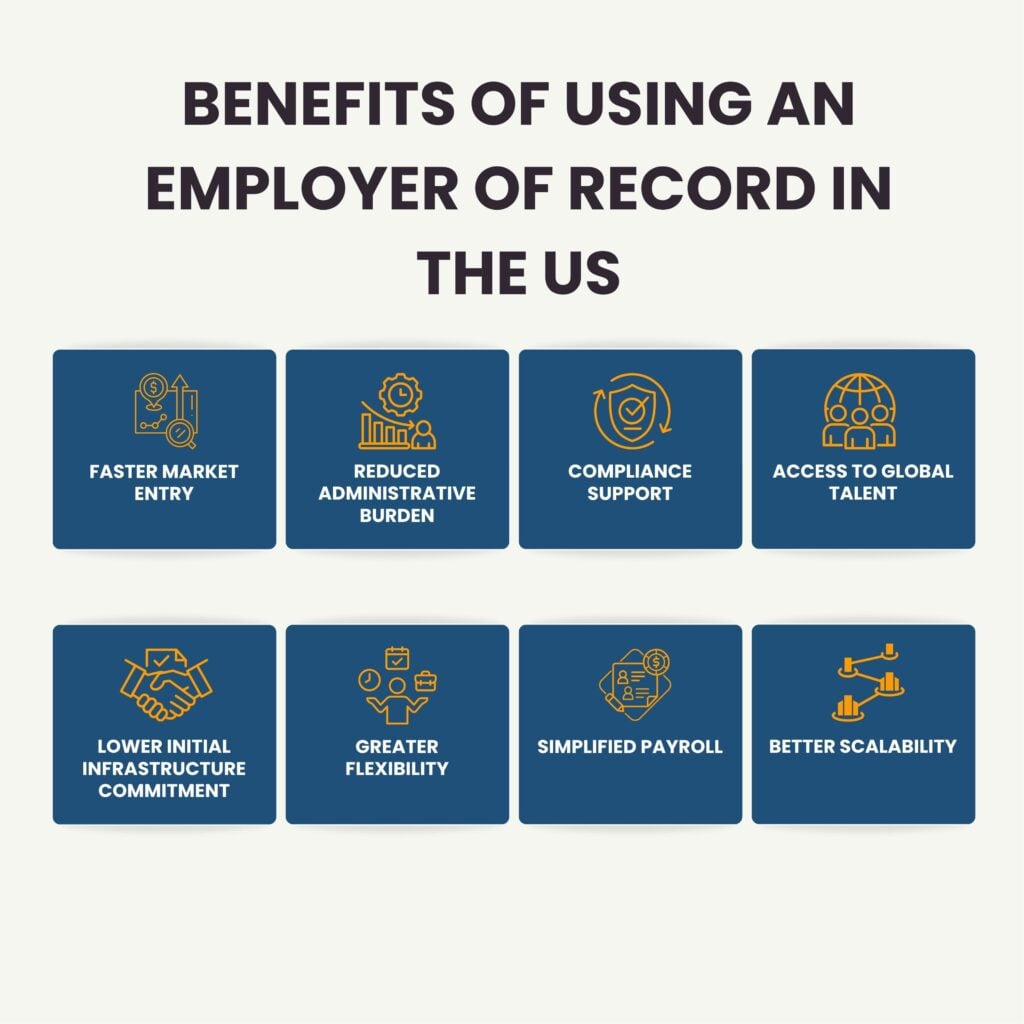
Faster Market Entry
An EOR can remove much of the initial employment infrastructure work associated with establishing a local operation.
Reduced Administrative Burden
Your internal HR and finance teams can spend less time managing local employment administration.
Compliance Support
An experienced EOR can help manage applicable employment, payroll, tax, and benefits requirements.
Access to Global Talent
Companies can hire employees based on talent availability rather than limiting recruitment to countries where they already have entities.
Greater Flexibility
An EOR can be useful for market testing, project teams, remote hiring, or smaller initial workforces.
Simplified Payroll
Payroll administration can be consolidated through the EOR.
Better Scalability
Once the initial hiring process is established, companies can add employees without recreating their entire employment infrastructure.
Lower Initial Infrastructure Commitment
Instead of investing immediately in incorporation, payroll infrastructure, HR administration, and other local processes, companies can use an existing employment platform.
Step-by-Step: How to Hire an Employee Through an EOR
Step 1: Identify the Role
Define:
- Job title
- Responsibilities
- Location
- Salary
- Working arrangement
- Benefits
- Start date
Step 2: Select Your Candidate
Your company typically conducts the recruitment and chooses the candidate.
Step 3: Confirm Employment Requirements
The EOR reviews the proposed employment arrangement and identifies applicable requirements.
Step 4: Review the Employment Agreement
The EOR prepares the employment documentation required for the employee’s location.
Step 5: Complete Onboarding
The employee provides required personal, tax, identification, and employment information.
Step 6: Complete Employment Eligibility Verification
Applicable employment eligibility requirements, including Form I-9 procedures, are completed.
Step 7: Set Up Payroll and Benefits
The EOR establishes the employee’s payroll, tax withholding, benefits, and other applicable administration.
Step 8: Begin Employment
The employee begins working under the agreed arrangement.
Step 9: Manage the Employee Day to Day
Your company manages:
- Work
- Performance
- Projects
- Team integration
- Business objectives
Step 10: Let the EOR Manage Employment Administration
The EOR continues handling the agreed payroll, benefits, tax, compliance, and HR administration.
Industries That Can Benefit From an EOR
An EOR can be useful across industries where companies need specialized talent without immediately establishing local employment infrastructure.
Technology and Software
Technology companies can use EOR services to hire developers, engineers, product managers, cybersecurity specialists, and other remote professionals.
Professional Services
Consulting and professional services companies can hire local specialists while maintaining flexible market-entry strategies.
Financial Services
Financial and fintech companies can use EOR structures when building regional teams while evaluating market expansion.
Healthcare and Life Sciences
Companies can use EOR services to support specialized recruitment while managing employment administration.
Manufacturing
Manufacturers expanding their commercial or operational footprint may use EOR services for initial local hires.
E-commerce and Retail
EOR services can support market-entry teams across sales, operations, marketing, customer support, and management.
Education
International education businesses can hire regional employees without immediately establishing entities in every target market.
Startups
Startups can use EOR services to validate international markets without committing substantial capital to entity infrastructure at the earliest stage.
EOR Provider Selection Checklist
Before choosing an employer of record, ask:
Legal and Compliance
- Does the provider have an appropriate legal employment structure?
- Does it cover the employee’s exact state?
- Who is responsible for payroll tax filings?
- Who manages workers’ compensation?
- How are employment law changes monitored?
- How are employee classification decisions handled?
Payroll
- How frequently is payroll processed?
- Who calculates employer taxes?
- Who files required tax returns?
- How are W-2s handled?
- Can the provider support bonuses, commissions, equity, and off-cycle payroll?
Benefits
- What health insurance options are available?
- What retirement benefits are available?
- Which benefits are statutory?
- Which benefits are optional?
- What are the employee contribution levels?
Technology and Security
- Is employee information protected?
- Does the provider have recognized security certifications?
- How is personal data stored?
- Who can access payroll and HR information?
Commercial Terms
- What is included in the monthly fee?
- Are there setup charges?
- Are there termination charges?
- Are there additional payroll charges?
- How are currency exchange costs handled?
Service Quality
- How quickly can employees be onboarded?
- Who is the dedicated contact?
- Is local HR support available?
- What happens when an employee has a payroll issue?
- How are disputes handled?
Country Comparison: Choosing an EOR Market for International Expansion
A US hiring strategy does not necessarily mean that the United States should be your first international employment market.
For companies expanding from Asia or building a broader international workforce, the right market depends on talent availability, operating costs, business objectives, compliance requirements, and regional strategy.
| Market | Why Companies May Hire There | EOR Can Help With |
| Malaysia | Regional operations, technology, shared services, manufacturing | Employment, payroll, statutory contributions, HR administration |
| Singapore | Regional headquarters, finance, technology, professional services | Employment contracts, payroll, benefits, compliance |
| Hong Kong | Finance, trading, professional services, regional operations | Employment administration, payroll, MPF and compliance |
| China | Manufacturing, technology, sales, sourcing and operations | Local employment, payroll, statutory benefits and compliance |
| Taiwan | Technology, semiconductors, engineering and manufacturing | Employment contracts, payroll, Labor Insurance, NHI and pension administration |
| UAE | Regional headquarters, sales, professional services and Middle East expansion | Employment, payroll, benefits and local compliance |
| Saudi Arabia | Middle East expansion, sales, professional services and operations | Employment, payroll and local employment administration |
| Qatar | Energy, infrastructure, professional services and regional operations | Local employment and HR administration |
| Philippines | BPO, technology, customer support and shared services | Employment, payroll and statutory administration |
| Vietnam | Technology, manufacturing, operations and services | Employment, payroll and local compliance |
| Australia | Technology, professional services and regional hiring | Employment, payroll and local compliance |
| India | Technology, engineering, support and professional services | Employment, payroll and statutory administration |
| United Kingdom | European operations, technology and professional services | Employment and payroll administration |
| Switzerland | Finance, technology, life sciences and specialized talent | Local employment and compliance |
FastLaneRecruit currently positions its EOR services around across Asia Pacific, Europe, and the Middle East and Africa, including Malaysia, Singapore, Hong Kong, China, India, Philippines, Vietnam, Australia, United Kingdom, Switzerland, UAE, Saudi Arabia, Qatar.
What If You Need to Hire Outside the United States?
An EOR strategy becomes especially valuable when a company needs to build a multi-country workforce.
For example, a company may begin by hiring a technology specialist in the US, then discover that it also needs:
- A regional sales team in Singapore
- Developers in Malaysia
- Operations staff in the Philippines
- A finance team in Hong Kong
- Manufacturing support in China
- A Middle East representative in the UAE
- Technology talent in Taiwan
Instead of establishing a legal entity in every country immediately, companies can evaluate an EOR-led market-entry strategy.
This allows the business to separate two decisions:
“Where do we need talent?”
from:
“Where do we need to establish a permanent legal entity?”
That distinction can make international expansion more flexible.
Expand Your Global Team With FastLaneRecruit
If the United States is only one part of your international hiring strategy, the next question is where else you need to build your workforce.
FastLaneRecruit provides Employer of Record solutions across selected markets in Asia Pacific and the Middle East, helping businesses hire employees without taking on the full administrative burden of establishing and operating their own local employment infrastructure.
Our EOR services can support businesses expanding into markets including:
- Malaysia
- Singapore
- Hong Kong
- China
- India
- Philippines
- Vietnam
- Australia
- United Kingdom
- Switzerland
- UAE
- Saudi Arabia
- Qatar
Whether you are hiring your first international employee or building a multi-country team, an EOR can help you enter new markets while managing local employment, payroll, and compliance requirements.
Ready to explore your next hiring market?
Speak with FastLaneRecruit about your international hiring requirements and find out which EOR structure best fits your expansion plans.
Why Consider FastLaneRecruit for International Hiring?
International expansion involves more than finding the right employee.
You also need to consider:
- Local employment laws
- Employment contracts
- Payroll
- Tax administration
- Statutory contributions
- Benefits
- HR administration
- Employee onboarding
- Compliance
- Ongoing employee management
FastLaneRecruit’s EOR approach is designed to help businesses manage these requirements through a local employment structure.
Instead of establishing an entity before making your first hire, businesses can explore an EOR model and determine whether it fits their expansion strategy.
When Should You Use an EOR Instead of Establishing an Entity?
An EOR can be particularly useful when:
- You are hiring only a few employees initially.
- You want to test a market before making a long-term commitment.
- You need to hire quickly.
- You do not yet have a local entity.
- You want to reduce HR administration.
- You are hiring remote employees.
- You need access to specialized international talent.
- You are expanding into several countries.
- You want to convert contractors into employees.
- You are uncertain whether a permanent subsidiary is commercially justified.
A local entity may eventually make more sense when your workforce, revenue, operations, and long-term market commitment reach a scale that justifies permanent infrastructure.
The best approach is therefore not always EOR versus entity.
For many businesses, it can be:
EOR first → validate the market → build the team → establish an entity when the business case supports it.
Build Your International Team Without the Entity-Building Burden
Hiring internationally should not require you to establish a company in every country before you can access the talent you need.
Whether you are expanding into Malaysia, Singapore, Hong Kong, China, India, Philippines, Vietnam, Australia, United Kingdom, Switzerland, UAE, Saudi Arabia, Qatar, an EOR can provide a more flexible route to international employment.
FastLaneRecruit can help you evaluate your target market, understand the employment requirements, and choose an appropriate EOR approach for your expansion plans.
Ready to hire internationally?
Book a Free Consultation with FastLaneRecruit to discuss your hiring plans and find the right EOR solution for your target market.
Conclusion
Using an Employer of Record in the US can give international companies a practical way to hire employees without immediately building their own local employment infrastructure.
The value of an EOR goes beyond payroll.
A well-structured EOR relationship can help companies navigate employment contracts, payroll taxes, employee benefits, workers’ compensation, employment eligibility verification, state-specific requirements, and other administrative responsibilities.
However, an EOR should not be selected solely because it promises fast hiring or a low monthly fee.
Companies should evaluate the provider’s legal structure, state coverage, compliance capabilities, payroll expertise, benefits, security, insurance, service scope, and overall ability to support their workforce.
For companies building an international workforce, the same principle applies beyond the United States: hire where the talent is, establish permanent entities when the business case supports them, and use an appropriate EOR structure to make market entry more flexible.
If your next expansion market is in Asia or the Middle East, FastLaneRecruit can help you explore EOR options in markets including Malaysia, Singapore, Hong Kong, China, Taiwan, the UAE, Saudi Arabia, and Qatar.
Contact FastLaneRecruit to discuss your hiring plans and explore the right EOR solution for your target market.
Frequently Asked Questions About Employer of Record in the US
What is an employer of record in the US?
An employer of record is a third-party organization that legally employs a worker on behalf of another company. The EOR typically manages employment administration such as contracts, payroll, tax withholding, benefits, and compliance, while the client company manages the employee’s day-to-day work.
Can an EOR hire employees in the United States without my company having a US entity?
Yes, an EOR arrangement can allow a company without its own US employing entity to hire employees through the EOR’s employment structure. The exact structure and responsibilities depend on the provider and service agreement.
Is using an EOR legal in the United States?
EOR arrangements can be legally structured in the United States. However, employers and providers must still comply with applicable federal, state, and local employment requirements.
What does a US EOR handle?
Depending on the provider, services may include employment contracts, onboarding, payroll, tax withholding, employment tax filings, benefits administration, workers’ compensation, HR administration, and termination support.
What is the difference between an EOR and a PEO?
An EOR generally becomes the legal employer under the arrangement, while a PEO typically operates through a co-employment model with a client’s existing legal entity.
What is the difference between an EOR and a staffing agency?
A staffing agency typically focuses on sourcing and supplying workers. An EOR focuses on the legal and administrative employment relationship. A company may use both recruitment and EOR services depending on its hiring needs.
What is the difference between an EOR and a payroll provider?
A payroll provider processes payroll but generally does not become the legal employer. An EOR takes on the legal employer role within the scope of the EOR arrangement.
Does an EOR manage an employee’s daily work?
No. The client company generally continues to manage the employee’s daily responsibilities, projects, performance, and business objectives.
Can an EOR help with US payroll?
Yes. Payroll is a core component of many EOR services. The provider may calculate payroll, manage tax withholding, process payments, and handle applicable payroll reporting.
Does an EOR handle employee benefits?
Many EOR providers administer employee benefits, but the available benefits vary by provider, employee location, eligibility, and plan.
Can an EOR hire employees in every US state?
Not necessarily. Companies should verify that the provider has the appropriate employment infrastructure and coverage for the employee’s specific state and location.
Can an EOR help convert a contractor into an employee?
An EOR can support a contractor-to-employee transition by establishing a compliant employment arrangement, onboarding the worker, and managing payroll and employment administration.
However, worker classification should be assessed carefully because the applicable tests can vary by jurisdiction and circumstances.
How much does a US EOR cost?
There is no universal US EOR price. Costs can depend on the provider’s service fee, employee salary, employer taxes, benefits, insurance, location, exchange rates, and additional services.
Companies should request a complete cost breakdown rather than comparing monthly EOR fees alone.
When should a company establish its own US entity instead of using an EOR?
A local entity may make sense when a company has a substantial and long-term US operation, significant local revenue, many employees, or other business requirements that justify permanent infrastructure.
An EOR can be useful when the company is entering the market, testing demand, hiring a small initial team, or needs flexibility.
Can FastLaneRecruit provide EOR services in the United States?
FastLaneRecruit’s EOR offering is focused on selected international markets rather than the United States. Its current EOR coverage includes markets across Asia Pacific and the Middle East, including Malaysia, Singapore, Hong Kong, China, Taiwan, and the UAE.
Which countries does FastLaneRecruit support for EOR?
FastLaneRecruit currently promotes EOR support across markets including Malaysia, Singapore, Hong Kong, China, Taiwan, the UAE, Saudi Arabia, Qatar, the Philippines, Vietnam, Australia, India, the UK, and Switzerland.
Businesses planning international expansion can contact FastLaneRecruit to confirm current coverage and determine the appropriate hiring structure for their target market.