
Modern businesses operate in a high-speed, multi-channel environment where founders, executives, and teams are constantly overloaded with operational work. As organizations scale, a significant portion of daily workload becomes repetitive, time-consuming, and process-driven rather than strategic.
Virtual assistants provide a structured way to delegate these operational tasks without increasing internal headcount or operational complexity. Businesses that adopt delegation early typically experience improved productivity, faster decision-making cycles, and more efficient cost structures.
A virtual assistant is no longer limited to administrative support. Today, VAs contribute across marketing, customer support, sales operations, data management, and business coordination functions.
Content Outline
Key Summary
Virtual assistants remove operational bottlenecks
They handle repetitive tasks that slow down leadership teams and reduce strategic focus.
Delegation improves scalability
Businesses grow faster when leaders focus on revenue and growth rather than execution-heavy tasks.
Modern VAs cover multiple business functions
Support now extends beyond admin work into CRM, marketing, sales, and operations.
Outsourcing reduces hiring and overhead costs
Compared to full-time staffing, virtual assistants offer more flexible and cost-efficient workforce expansion.
Structured outsourcing improves business efficiency
Proper task delegation increases output quality while reducing internal workload pressure.
What Are the Tasks to Outsource to a Virtual Assistant?
Virtual assistants are best utilized for structured, repeatable, and time-intensive tasks that do not require direct executive decision-making.
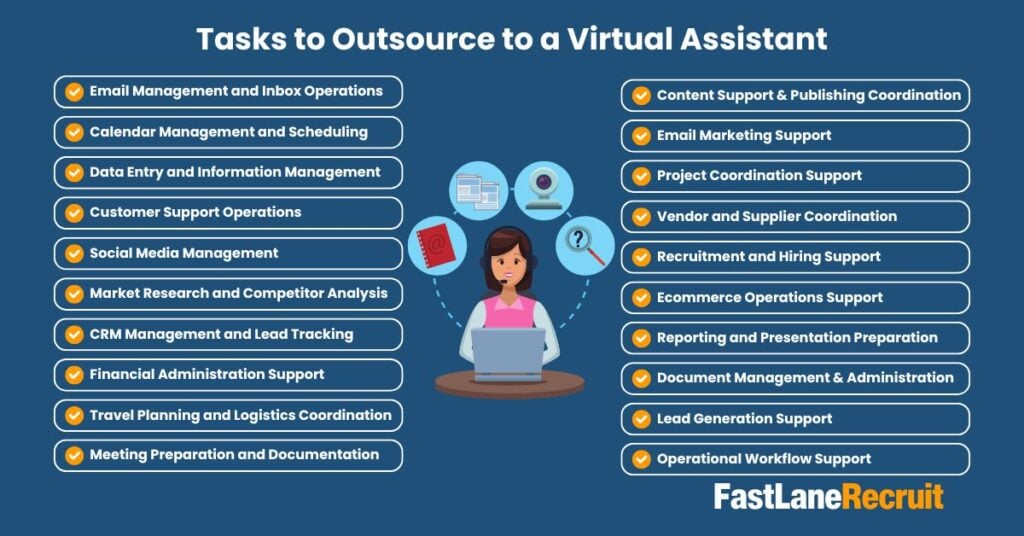
Below is a comprehensive breakdown of the top 20 tasks to outsource to a virtual assistant, grouped by functional business areas.
1. Email Management and Inbox Operations
Email management is one of the most commonly outsourced functions due to its high time consumption.
A virtual assistant can:
- Organize inboxes using priority tagging systems
- Filter spam and non-essential communication
- Draft responses to routine inquiries
- Follow up on pending emails
- Maintain structured email filing systems
This ensures that executives focus only on critical communication, improving responsiveness and decision quality.
2. Calendar Management and Scheduling
Scheduling inefficiencies often reduce productivity in leadership teams.
A virtual assistant supports by:
- Managing daily and long-term calendars
- Coordinating meetings across multiple time zones
- Sending reminders and confirmations
- Resolving scheduling conflicts
- Optimizing meeting flow to avoid downtime
This results in improved time utilization and reduced administrative friction.
3. Data Entry and Information Management
Accurate data management is essential for business decision-making.
Tasks include:
- Updating CRM records
- Maintaining spreadsheets and databases
- Cleaning and verifying contact lists
- Generating structured reports
- Organizing business documentation
Well-maintained data systems directly improve operational accuracy and forecasting.
4. Customer Support Operations
Customer support is a critical area where responsiveness affects retention and brand trust.
Virtual assistants can:
- Handle live chat inquiries
- Respond to FAQs and common issues
- Manage support tickets
- Escalate complex issues
- Provide order and service updates
This improves customer experience without requiring a full in-house support team.
5. Social Media Management
Maintaining consistent digital presence requires ongoing effort.
A VA can:
- Schedule social media posts
- Manage content calendars
- Respond to comments and messages
- Track engagement metrics
- Support basic community management
This ensures brand visibility without constant internal supervision.
6. Market Research and Competitor Analysis
Research tasks are highly time-intensive but critical for decision-making.
A virtual assistant can:
- Conduct competitor benchmarking
- Analyze industry trends
- Gather customer insights
- Identify potential leads
- Summarize findings into structured reports
This enables leadership teams to make informed strategic decisions faster.
7. CRM Management and Lead Tracking
Sales pipelines require continuous maintenance to remain effective.
Tasks include:
- Updating lead statuses
- Tracking sales interactions
- Following up on prospects
- Maintaining CRM hygiene
- Supporting pipeline reporting
This reduces lead leakage and improves conversion efficiency.
8. Bookkeeping and Financial Administration Support
While not replacing accountants, VAs assist with administrative finance tasks:
- Invoice tracking and organization
- Expense logging
- Payment reminders
- Document preparation for accounting teams
This helps maintain financial clarity and reduces administrative burden.
9. Travel Planning and Logistics Coordination
Executives often outsource travel management due to its complexity.
Tasks include:
- Booking flights and hotels
- Coordinating transport arrangements
- Preparing detailed itineraries
- Managing schedule alignment during travel
This ensures seamless travel execution with minimal executive involvement.
10. Meeting Preparation and Documentation
Virtual assistants improve meeting efficiency by:
- Preparing agendas and briefing documents
- Sending invites and confirmations
- Recording meeting minutes
- Tracking action items and follow-ups
This improves accountability and execution consistency.
11. Content Support and Publishing Coordination
Marketing teams often rely on VAs for execution support:
- Uploading blog content to CMS platforms
- Formatting and editing content
- Scheduling publication calendars
- Repurposing content across channels
12. Email Marketing Support
Email campaigns require structured execution:
- Building and segmenting mailing lists
- Scheduling newsletters
- Tracking campaign performance
- Managing automation workflows
13. Project Coordination Support
Virtual assistants help maintain workflow consistency:
- Tracking deadlines and milestones
- Coordinating team tasks
- Updating project management tools
- Supporting operational execution
14. Vendor and Supplier Coordination
Businesses often delegate operational communication:
- Following up with suppliers
- Managing order tracking
- Handling documentation requests
- Coordinating delivery schedules
15. Recruitment and Hiring Support
HR teams frequently outsource early-stage hiring tasks:
- Screening resumes
- Shortlisting candidates
- Scheduling interviews
- Posting job advertisements
16. Ecommerce Operations Support
For online businesses:
- Managing product listings
- Updating inventory records
- Processing order details
- Handling customer inquiries
17. Reporting and Presentation Preparation
A VA can prepare:
- Business reports
- KPI dashboards
- Executive summaries
- Presentation slides
18. Document Management and Administration
Administrative efficiency improves through:
- File organization systems
- SOP documentation updates
- Digital archiving
- Formatting business documents
19. Lead Generation Support
Sales teams benefit from structured lead support:
- Prospect research
- Email list building
- Data validation
- Outreach coordination
20. Operational Workflow Support
General business operations include:
- Task tracking
- Internal coordination support
- Workflow documentation
- Administrative execution assistance
What Tasks Should NOT Be Outsourced to a Virtual Assistant?
Certain responsibilities must remain internal due to strategic importance:
- Business strategy decisions
- Financial approvals
- Legal decisions
- Core leadership responsibilities
- High-risk HR decisions
Why Businesses Choose Virtual Assistants Instead of Expanding Teams
Organizations are increasingly shifting toward flexible workforce models because they reduce operational complexity and fixed overhead costs.
Compared to traditional hiring:
- Faster onboarding cycles
- Lower long-term commitments
- Scalable workforce structure
- Reduced administrative burden
- Access to specialized skill sets
However, successful delegation requires structured hiring and compliance management, especially when scaling across borders.
Also Read:Top 15 Virtual Assistant Companies in Malaysia
Why Malaysia Is a Strategic Market for Virtual Assistant Hiring
Malaysia has become a preferred outsourcing and talent hub for businesses expanding in Asia due to several structural advantages:
1. Strong English proficiency and business communication skills
Malaysia offers a highly capable English-speaking workforce suitable for global operations.
2. Cost-efficient talent market
Compared to Western markets and regional hubs, Malaysia provides competitive labor costs without compromising quality.
3. Established digital and business infrastructure
Strong internet connectivity and digital readiness support remote-first operations.
4. Strategic ASEAN location
Malaysia serves as a regional business hub for Southeast Asia expansion.
5. Growing pool of remote-ready professionals
Increasing number of professionals are trained in digital tools, CRM systems, and remote collaboration platforms.
For companies planning to expand or outsource operations in Malaysia, structured hiring solutions significantly reduce compliance and operational risks.
Also Read: Singapore vs Malaysia: Full Comparison for Business Expansion, Hiring Costs, and Workforce Strategy
Get Expert Assistance from FastLaneRecruit
FastLaneRecruit supports businesses in building efficient remote and outsourced teams in Malaysia through structured, compliant, and scalable hiring solutions through employer of record services.
Instead of managing fragmented hiring processes, businesses can streamline workforce expansion with professional recruitment support tailored to operational needs.
FastLaneRecruit helps companies:
- Build remote support teams in Malaysia
- Access pre-vetted talent for operational roles
- Reduce hiring time and administrative complexity
- Scale teams without traditional setup overhead
This is particularly valuable for companies that want to expand operations without establishing complex internal hiring infrastructure.
Conclusion: Strategic Delegation Is a Growth Lever, Not Just Cost Saving
Outsourcing tasks to virtual assistants is no longer a tactical productivity hack—it is a strategic business model that directly impacts scalability, operational efficiency, and cost structure.
Businesses that successfully implement delegation frameworks are able to:
- Focus leadership time on revenue and growth
- Reduce operational inefficiencies
- Improve customer experience and responsiveness
- Scale faster with controlled overhead
When combined with structured hiring support in Malaysia through FastLaneRecruit, organizations gain a practical pathway to build efficient, scalable, and high-performing remote teams.
Get expert assistance today and streamline your hiring strategy with FastLaneRecruit.
FAQ: Tasks to Outsource to a Virtual Assistant
What to outsource to a virtual assistant?
You can outsource administrative tasks, customer support, marketing, research, scheduling, and CRM management.
What are the best tasks for a virtual assistant?
The best tasks are repetitive, time-consuming, and process-driven, such as email management, data entry, and scheduling.
What are the tasks of a virtual assistant?
Virtual assistants handle administrative, operational, marketing, sales support, and customer service tasks.
What are your responsibilities/tasks as a VA?
A VA is responsible for managing delegated tasks efficiently, ensuring accuracy, meeting deadlines, and supporting business operations remotely.
What tasks should I outsource to a virtual assistant?
Outsource tasks that do not require your direct strategic input, especially repetitive and operational work.
What are some specific tasks virtual assistants can perform?
Email handling, CRM updates, customer support, research, social media management, bookkeeping support, and travel coordination.