
Global finance operations are undergoing a structural shift. Companies are no longer relying solely on local hiring markets to build accounting teams. Instead, they are adopting distributed workforce models that allow them to access skilled professionals in other countries while maintaining full operational control.
Offshore accounting has become one of the most practical responses to this shift. It enables businesses to build dedicated finance teams in cost-efficient, talent-rich locations while integrating them directly into internal accounting systems and processes.
Rather than outsourcing isolated tasks, organizations are now structuring offshore accounting teams as long-term extensions of their finance departments. This model supports scalability, cost optimization, and faster financial operations, especially for companies operating across multiple markets.
Understanding offshore accounting meaning is essential for any business evaluating how to modernize its finance function and improve operational efficiency in a global environment.
Content Outline
Key Summary
Offshore accounting is a structured global hiring model
Businesses hire accounting professionals in another country to handle finance functions as part of their internal team.
It is different from traditional outsourcing
Offshore accounting focuses on dedicated teams, long-term integration, and process ownership.
It improves cost efficiency and operational scalability
Companies reduce hiring pressure while maintaining financial accuracy and compliance.
Malaysia is emerging as a preferred offshore accounting hub
Due to strong talent availability, English proficiency, and cost competitiveness.
FastLaneRecruit helps companies build offshore accounting teams in Malaysia
Without requiring entity incorporation or complex legal setup.
What Is Offshore Accounting Meaning?
Offshore accounting refers to the practice of employing accounting professionals located in a different country to manage financial and accounting operations for a business.
These professionals typically perform core finance functions such as:
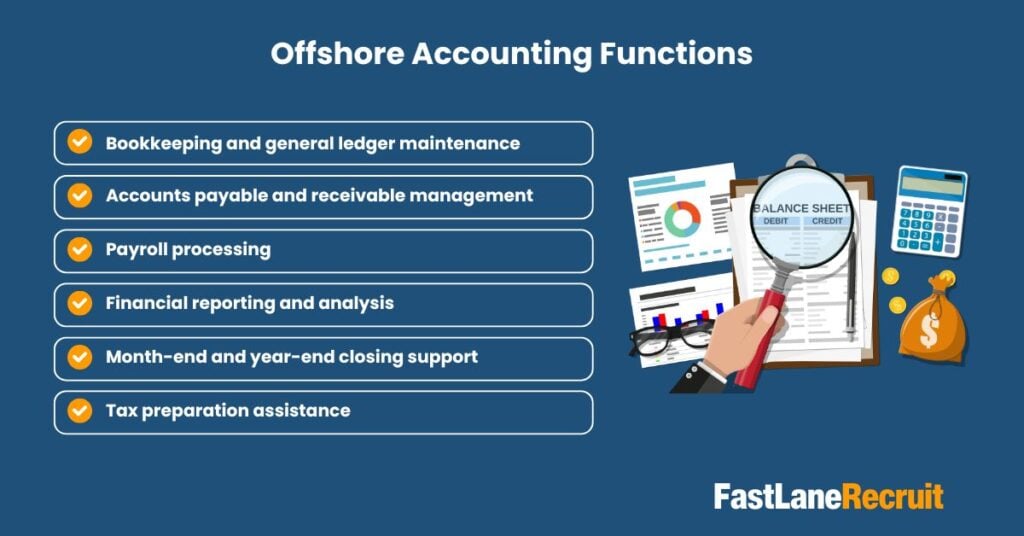
Unlike ad hoc outsourcing, offshore accounting is designed as a long-term operational model where offshore staff function as an extension of the internal finance team.
Offshore Accounting Meaning in Business Context
In modern business operations, offshore accounting is not simply a cost-saving initiative. It is a strategic workforce model used to restructure finance operations globally.
Organizations use offshore accounting to:
- Build distributed finance teams
- Reduce dependency on expensive local hiring markets
- Improve operational continuity across time zones
- Increase financial processing capacity without increasing office overhead
This model is particularly common among:
- Accounting and audit firms
- Technology startups
- Multinational corporations
- SMEs expanding into international markets
Also Read: 5 Examples Of Offshoring Companies
How Offshore Accounting Works (Operational Model)
Offshore accounting operates through a structured integration process rather than informal remote work.
Step 1: Role identification
Companies determine which finance functions can be offshored, such as:
- Transaction processing
- Financial reporting support
- Payroll administration
Step 2: Talent acquisition in offshore location
Qualified accounting professionals are hired in a selected offshore hub, such as Malaysia.
Step 3: Integration with internal systems
Offshore accountants work using the company’s systems:
- Cloud accounting platforms (Xero, QuickBooks, NetSuite)
- ERP systems
- Internal reporting dashboards
Step 4: Process standardization
Standard operating procedures (SOPs) are implemented to ensure consistency in:
- Reporting accuracy
- Compliance adherence
- Workflow management
Step 5: Continuous collaboration
Offshore teams operate as part of the internal finance function through:
- Scheduled reporting cycles
- Virtual collaboration tools
- Performance tracking systems
Why Offshore Accounting Is Growing Globally
The demand for offshore accounting has increased due to structural changes in global finance operations.
Rising cost pressure in developed markets
Hiring accountants in markets such as the UK, US, and Australia has become increasingly expensive, especially for mid-level and senior finance roles.
Talent shortages in accounting and finance
Many regions are experiencing shortages in:
- Qualified accountants
- Audit professionals
- Financial analysts
Shift to cloud-based finance systems
Digital accounting tools have eliminated geographical barriers, making remote financial collaboration more efficient.
Need for scalable finance operations
Businesses require flexible accounting teams that can scale during:
- Tax seasons
- Audit periods
- Rapid business expansion phases
Offshore Accounting vs Outsourcing Accounting
Understanding the distinction is essential for decision-making.
Outsourcing accounting
- Task-based execution
- Short-term engagement
- Limited integration with internal teams
- Focus on cost and workload reduction
Offshore accounting
- Dedicated team model
- Long-term strategic integration
- Full alignment with internal finance processes
- Ownership of workflows and reporting responsibilities
Offshore accounting is increasingly preferred by companies that require control, scalability, and consistency rather than fragmented task delivery.
Benefits of Offshore Accounting Meaning for Businesses
Cost optimization without compromising quality
Businesses reduce operational expenses while maintaining access to skilled accounting professionals.
Access to a wider talent pool
Companies are no longer constrained by local hiring shortages and can recruit from global talent markets.
Faster financial processing cycles
Time zone differences enable continuous workflow, improving month-end and reporting speed.
Improved scalability
Finance teams can be expanded quickly without long recruitment or onboarding delays.
Better focus on strategic finance
Internal teams can shift focus from routine processing to:
- Financial planning
- Business analysis
- Strategic decision-making
Challenges and Risk Considerations
Communication and coordination gaps
Differences in time zones and working styles may require structured communication frameworks.
Data security and compliance requirements
Financial data handling requires:
- Role-based access control
- Secure cloud infrastructure
- Confidentiality agreements
Dependency on process maturity
Offshore accounting performance depends heavily on:
- Clear SOPs
- Training quality
- Management oversight
Integration complexity
Without proper onboarding, offshore teams may operate in isolation rather than as integrated units.
Why Malaysia Is a Strategic Offshore Accounting Hub
Malaysia has become a strong offshore accounting destination due to several structural advantages.
Strong accounting talent pool
Malaysia produces a steady pipeline of accounting and finance graduates with practical industry exposure.
English business proficiency
English is widely used in business environments, reducing communication barriers with global companies.
Cost efficiency
Compared to Western markets and Singapore, Malaysia offers significantly lower hiring costs while maintaining quality standards.
Time zone advantage
Malaysia’s time zone supports real-time collaboration with Asia-Pacific businesses and overlapping working hours with global teams.
Stable regulatory and business environment
Malaysia provides a structured legal and financial ecosystem that supports international business operations.
These factors make Malaysia a balanced offshore location combining cost, quality, and operational efficiency.
Offshore Accounting Meaning and the Role of EOR vs Company Incorporation
Many companies assume they must establish a legal entity to hire offshore accountants. This is not always necessary.
Traditional approach: Company incorporation
- Requires legal registration in the offshore country
- Involves compliance, taxation, and administrative overhead
- Slower time-to-hire
Modern approach: Employer of Record (EOR)
- No local entity required
- Faster hiring process
- Managed compliance and payroll
- Reduced legal and operational complexity
For most SMEs and scaling businesses, the EOR model is more efficient because it allows companies to focus on operations rather than administrative setup.
Who Should Consider Offshore Accounting
Offshore accounting is suitable for organizations that:
- Are experiencing accounting workload pressure
- Want to reduce finance operation costs
- Need to scale without increasing office size
- Require access to specialized accounting skills
- Operate across multiple countries or currencies
When Offshore Accounting Becomes a Strategic Advantage
Offshore accounting becomes particularly valuable when:
- Month-end closing cycles are delayed
- Finance teams are understaffed
- Recruitment costs are increasing
- Business expansion is accelerating
- Operational efficiency is a priority
Get Expert Assistance from FastLaneRecruit
FastLaneRecruit helps companies build offshore accounting teams in Malaysia by connecting them with qualified finance professionals who are ready to integrate into your existing operations.
What FastLaneRecruit provides:
- Offshore accounting recruitment in Malaysia
- Pre-vetted accounting professionals
- Dedicated finance team hiring
- Employer of Record (EOR) support where required
- Payroll and compliance coordination
- Scalable hiring solutions for growing businesses
Why companies choose FastLaneRecruit:
- Faster access to qualified talent in Malaysia
- Reduced hiring and onboarding complexity
- No need for local entity incorporation
- Cost-efficient scaling of finance operations
Why Choose Malaysia for Offshore Accounting with FastLaneRecruit
Partnering with FastLaneRecruit in Malaysia provides a strategic advantage:
- Access to a growing pool of accounting professionals
- Lower operational costs compared to Western markets
- Strong alignment with international finance standards
- Efficient hiring timelines
- Stable and business-friendly environment
Malaysia is not just a cost-saving destination; it is a strategic operational base for building scalable finance teams. Contact us today to get started!
Conclusion
Offshore accounting has evolved from a cost-saving tactic into a strategic workforce model that enables companies to build scalable, efficient, and globally distributed finance teams.
Understanding offshore accounting meaning is essential for businesses planning to expand or optimize financial operations. It represents a shift from traditional hiring models toward flexible, international talent structures.
Malaysia stands out as a strong offshore accounting destination due to its talent quality, cost efficiency, and operational compatibility with global businesses.
For companies ready to move from understanding offshore accounting to implementation, FastLaneRecruit provides a structured and practical pathway to build offshore accounting teams in Malaysia without the complexity of entity setup.
FAQ: Offshore Accounting Meaning
1. What is offshore accounting in simple terms?
Offshore accounting means hiring accountants in another country to manage financial tasks for your business remotely.
2. Is offshore accounting legal?
Yes. Offshore accounting is fully legal as long as tax and regulatory compliance requirements are followed.
3. What is the difference between offshore accounting and outsourcing?
Offshore accounting involves a dedicated team model, while outsourcing is task-based and short-term.
4. Why do companies use offshore accounting?
To reduce costs, access global talent, and scale finance operations more efficiently.
5. Do I need to set up a company to hire offshore accountants?
Not necessarily. Many companies use EOR or offshore staffing models instead of incorporation.
6. Which countries are best for offshore accounting?
Common hubs include Malaysia, India, Philippines, and Eastern Europe.
7. What roles can be offshored in accounting?
Bookkeeping, payroll, accounts payable, accounts receivable, reconciliations, and financial reporting.
8. Is offshore accounting safe for financial data?
Yes, if proper security systems, access controls, and compliance policies are implemented.