
Managing finances accurately is one of the most important responsibilities in any business. Whether you are a startup tracking cash flow, a growing SME managing payroll, or a multinational handling complex financial reporting, having competent accounting staff can make a significant difference to your company’s success. Yet many business owners ask the same question: What is accounting staff, and when should I hire one?
Accounting staff are the professionals responsible for recording, organizing, monitoring, and reporting financial transactions within a business. They help ensure financial accuracy, support compliance requirements, and provide valuable insights that guide business decisions.
In this guide, we’ll explain what accounting staff do, their qualifications and responsibilities, how to hire the right talent, and why many businesses are turning to Malaysia’s growing accounting talent market to build cost-effective finance teams.
Content Outline
Key Summary
Accounting Staff Are Essential for Financial Accuracy
Accounting staff handle daily financial activities, maintain records, reconcile accounts, and support reporting processes that keep businesses financially healthy.
Their Responsibilities Extend Beyond Bookkeeping
Modern accounting staff assist with financial analysis, tax compliance, budgeting, audits, payroll support, and management reporting.
Hiring the Right Candidate Requires More Than Technical Skills
Employers should evaluate accounting knowledge, software proficiency, attention to detail, communication skills, and problem-solving abilities.
Malaysia Offers a Strong Accounting Talent Pool
Businesses can access qualified accounting professionals in Malaysia while reducing hiring costs compared to many Western markets.
Employer of Record (EOR) Solutions Simplify International Hiring
An EOR allows businesses to hire accounting professionals in Malaysia quickly without establishing a local entity, reducing administrative and compliance burdens.
What Is Accounting Staff?
Accounting staff refers to professionals responsible for managing an organization’s financial records, transactions, and reporting activities.
They serve as the operational backbone of a company’s finance department by ensuring financial information remains accurate, organized, and compliant with applicable regulations.
Depending on company size, accounting staff may work under:
- Senior Accountants
- Accounting Managers
- Financial Controllers
- Finance Directors
- Chief Financial Officers (CFOs)
Their work supports strategic business decisions by providing reliable financial information and maintaining accurate records of business activities.
Accounting staff can work in:
- Private companies
- Public corporations
- Accounting firms
- Government agencies
- Non-profit organizations
- Multinational corporations
What Does Accounting Staff Do?
The answer varies based on the company and industry, but accounting staff generally manage day-to-day financial operations and support financial reporting.
Their role ensures every financial transaction is properly documented and accounted for.
Typical activities include:
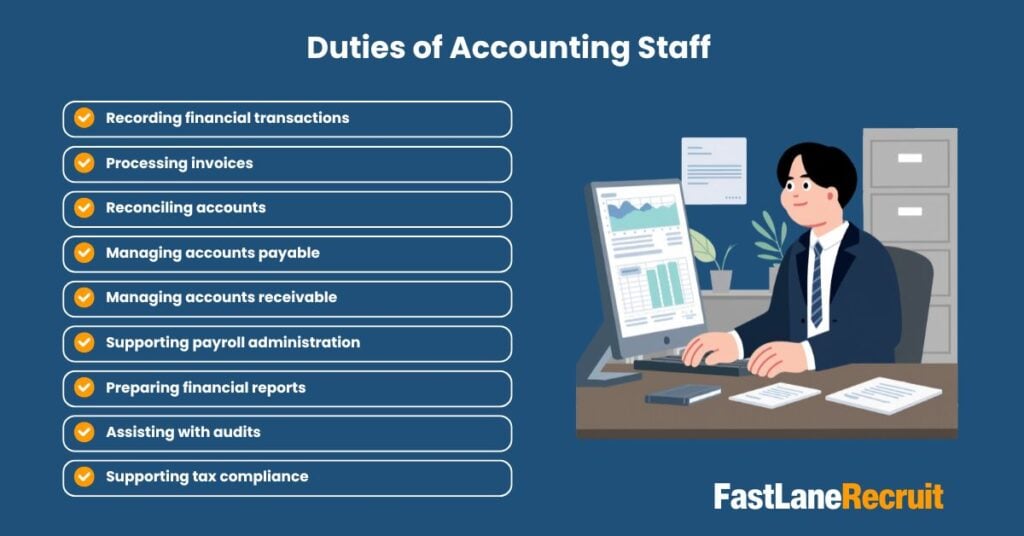
Without competent accounting staff, businesses risk inaccurate reporting, compliance issues, and poor financial decision-making.
What to include in Accounting Staff Job Description
An accounting staff member is responsible for maintaining accurate financial records, processing transactions, reconciling accounts, preparing financial reports, and supporting tax and compliance activities. They help ensure the company’s financial operations run smoothly while providing accurate data for business decision-making.
Financial Record Maintenance
Accounting staff maintain accurate records of all company transactions.
Responsibilities include:
- Posting journal entries
- Recording expenses
- Tracking revenue
- Updating ledgers
- Maintaining financial databases
Accurate recordkeeping forms the foundation of all financial reporting and compliance activities.
Account Reconciliation
Reconciliation helps ensure financial records match actual transactions.
Accounting staff regularly reconcile:
- Bank accounts
- Credit card statements
- Vendor accounts
- Customer accounts
- General ledger balances
Any discrepancies must be investigated and resolved promptly.
Accounts Payable Management
Accounting staff help businesses manage outgoing payments.
Tasks include:
- Processing supplier invoices
- Verifying payment details
- Scheduling payments
- Managing vendor records
- Monitoring payment deadlines
Efficient accounts payable processes improve supplier relationships and cash flow management.
Accounts Receivable Management
Accounting staff also monitor incoming payments.
Responsibilities may include:
- Issuing invoices
- Tracking outstanding balances
- Following up on overdue payments
- Recording customer payments
- Generating receivables reports
Strong receivables management supports healthy cash flow.
Financial Reporting
Accounting staff assist in preparing financial reports such as:
- Income statements
- Balance sheets
- Cash flow statements
- Profit and loss reports
- Management reports
These reports provide leadership with critical financial insights.
Tax Compliance Support
Many accounting staff help prepare documentation for tax filings.
They may assist with:
- Corporate tax reporting
- Payroll tax administration
- Tax documentation
- Regulatory reporting
- Compliance record maintenance
Audit Assistance
Accounting staff frequently support internal and external audits.
Responsibilities include:
- Organizing documentation
- Preparing schedules
- Gathering supporting evidence
- Responding to auditor requests
Also Read: Accounting Duties and Responsibilities in 2026: Job Description and Hiring Best Practices
Qualifications Required for Accounting Staff
Most employers seek candidates with a combination of education, technical expertise, and practical experience.
Educational Requirements
Common qualifications include:
- Bachelor’s Degree in Accounting
- Bachelor’s Degree in Finance
- Business Administration with Accounting specialization
Some organizations may also prefer:
- Master’s Degree in Accounting
- Professional accounting certifications
Professional Certifications
While not always required, certifications can strengthen a candidate’s profile.
Popular credentials include:
- CPA (Certified Public Accountant)
- ACCA
- CMA (Certified Management Accountant)
- CIA (Certified Internal Auditor)
- CIMA
Relevant Experience
Employers often look for experience in:
- Bookkeeping
- Accounts payable
- Accounts receivable
- Payroll administration
- Financial reporting
- Tax preparation
Essential Skills Every Accounting Staff Should Have
Technical Accounting Knowledge
Candidates should understand:
- Accounting principles
- Financial statements
- Journal entries
- Accrual accounting
- Tax regulations
Accounting Software Proficiency
Modern accounting teams rely heavily on technology.
Desired software skills include:
- Xero
- QuickBooks
- SAP
- Oracle NetSuite
- Sage
- Microsoft Dynamics
Advanced Excel Skills
Accounting professionals frequently use Excel for:
- Financial analysis
- Reporting
- Forecasting
- Data validation
Attention to Detail
Small accounting errors can lead to major financial consequences.
Strong accounting staff demonstrate:
- Accuracy
- Consistency
- Thoroughness
Communication Skills
Accounting professionals regularly interact with:
- Management
- Auditors
- Clients
- Vendors
- Government agencies
Clear communication is essential.
How to Write an Accounting Staff Job Description
A well-written accounting staff job description helps attract qualified candidates and reduces hiring time. It should clearly outline the role’s purpose, responsibilities, qualifications, and required skills so applicants understand what is expected from the position.
1. Start with a Brief Job Summary
Provide a concise overview of the role and how it contributes to the company’s financial operations.
Example:
“We are seeking a detail-oriented Accounting Staff member to support daily accounting activities, maintain accurate financial records, prepare reports, and assist with compliance and financial management tasks.”
2. List Key Responsibilities
Clearly define the day-to-day duties of the position.
Common responsibilities include:
- Recording financial transactions and journal entries
- Managing accounts payable and accounts receivable
- Reconciling bank statements and general ledger accounts
- Preparing monthly financial reports
- Assisting with payroll processing
- Supporting tax filing and compliance activities
- Assisting with internal and external audits
3. Specify Required Qualifications
Outline the educational background and experience candidates should possess.
Examples include:
- Bachelor’s degree in Accounting, Finance, or a related field
- 1–3 years of accounting experience
- Knowledge of accounting principles and financial reporting
- Experience with accounting software such as Xero, QuickBooks, or SAP
4. Highlight Essential Skills
Include both technical and soft skills required for success.
Examples:
- Strong analytical and problem-solving abilities
- Attention to detail and accuracy
- Proficiency in Microsoft Excel
- Excellent organizational and time-management skills
- Strong communication skills
5. Mention Preferred Certifications
If applicable, include certifications that may strengthen a candidate’s profile.
Examples:
- CPA (Certified Public Accountant)
- ACCA
- CMA
- CIMA
6. Include Salary and Benefits Information
Providing compensation details can increase application rates and attract suitable candidates.
Consider mentioning:
- Salary range
- Performance bonuses
- Medical benefits
- Professional development opportunities
- Flexible work arrangements
Example Accounting Staff Job Description
Job Title: Accounting Staff
Job Summary:
We are looking for an Accounting Staff member to support daily accounting operations and maintain accurate financial records. The successful candidate will assist with financial reporting, account reconciliation, accounts payable and receivable, and compliance-related activities.
Responsibilities:
- Record and maintain financial transactions
- Process invoices and payments
- Reconcile bank and ledger accounts
- Prepare monthly financial reports
- Support payroll and tax-related activities
- Assist with audits and compliance requirements
Qualifications:
- Bachelor’s degree in Accounting, Finance, or related field
- Minimum 1 year of accounting experience preferred
- Proficiency in accounting software and Microsoft Excel
- Strong attention to detail and analytical skills
By creating a clear and detailed accounting staff job description, employers can attract candidates with the right qualifications, skills, and experience to support their organization’s financial success.
Accounting Staff vs Staff Accountant: What’s the Difference?
Although the terms are often used interchangeably, there can be subtle differences.
| Accounting Staff | Staff Accountant |
| Broad term covering accounting personnel | Specific accounting position |
| May include clerks, assistants, and accountants | Typically a professional accounting role |
| Focused on various accounting functions | Usually handles reconciliations, reporting, and analysis |
| Can include entry-level positions | Often requires more accounting expertise |
In many companies, however, the distinction is minimal and the titles overlap.
When Should a Company Hire Accounting Staff?
Many businesses delay hiring accounting professionals until financial issues emerge.
Common signs you need accounting staff include:
- Financial records becoming difficult to manage
- Increasing transaction volume
- Frequent reporting errors
- Payroll challenges
- Tax compliance concerns
- Business expansion plans
- Audit preparation requirements
Hiring early can prevent costly mistakes and improve financial visibility.
How to Hire Accounting Staff
Step 1: Define Business Requirements
Determine:
- Required responsibilities
- Experience level
- Industry expertise
- Software knowledge
- Reporting expectations
Step 2: Create a Detailed Job Description
Include:
- Core responsibilities
- Required qualifications
- Preferred certifications
- Technical skills
- Performance expectations
Step 3: Screen Candidates Carefully
Evaluate:
- Accounting knowledge
- Analytical ability
- Attention to detail
- Communication skills
- Cultural fit
Step 4: Assess Technical Competencies
Consider testing:
- Reconciliation skills
- Financial reporting abilities
- Excel proficiency
- Accounting software knowledge
Step 5: Verify Credentials
Confirm:
- Education
- Certifications
- Employment history
- References
Why More Businesses Hire Accounting Staff in Malaysia
Malaysia has become a preferred destination for finance and accounting recruitment.
Large Pool of Qualified Talent
Malaysia produces thousands of accounting graduates annually and maintains strong professional accounting education standards.
Strong English Proficiency
Many accounting professionals are fluent in English, making communication easier for international employers.
Cost-Effective Hiring
Businesses can access highly skilled accounting professionals at lower costs compared to hiring in many Western markets.
Also Read: Malaysia Salary Guide 2026
Familiarity With International Standards
Many Malaysian accountants work with:
Why an Employer of Record (EOR) Is Better Than Setting Up a Company in Malaysia
Businesses expanding into Malaysia often assume they must establish a local company before hiring talent.
In reality, an Employer of Record (EOR) can be a faster and more efficient solution.
Faster Hiring
An EOR enables companies to hire employees quickly without waiting for company registration.
Lower Administrative Burden
An EOR manages:
- Employment contracts
- Payroll processing
- Statutory contributions
- Employment compliance
Reduced Compliance Risk
Employment laws, tax regulations, and payroll requirements are handled by local experts.
Lower Expansion Costs
Instead of spending time and resources establishing a legal entity, companies can begin hiring immediately.
For businesses testing new markets or building remote finance teams, an EOR often provides greater flexibility and lower risk than company incorporation.
Build Your Accounting Team with FastLaneRecruit
Finding qualified accounting professionals can be time-consuming and challenging, especially when hiring across borders.
Through FastLaneRecruit’s Talent Solutions, businesses can access experienced accounting talent across Malaysia and other key markets.
How FastLaneRecruit Helps
- Source qualified accounting professionals
- Screen and assess candidates
- Reduce recruitment timelines
- Support hiring in Malaysia
- Provide Employer of Record (EOR) solutions
- Help businesses scale finance teams efficiently
Whether you need an accounting assistant, staff accountant, senior accountant, or a complete finance team, FastLaneRecruit can help you find the right talent while minimizing hiring complexity.
Ready to hire accounting professionals? Contact FastLaneRecruit today to build a reliable, compliant, and cost-effective accounting team.
Conclusion
Understanding what accounting staff do is essential for businesses looking to improve financial accuracy, maintain compliance, and support sustainable growth. From managing daily transactions and preparing reports to supporting audits and tax obligations, accounting staff play a vital role in keeping business finances organized and reliable.
As competition for accounting talent continues to grow, many organizations are expanding their search globally. Malaysia has emerged as a leading destination for qualified accounting professionals, offering a strong talent pool, international expertise, and cost-effective hiring opportunities.
For businesses looking to hire efficiently, partnering with FastLaneRecruit and leveraging Employer of Record solutions can provide a faster, more compliant, and more scalable alternative to establishing a local entity, allowing you to focus on growth while building a high-performing finance team.
Frequently Asked Questions
What are the duties of accounting staff?
Accounting staff are responsible for recording financial transactions, reconciling accounts, preparing reports, managing accounts payable and receivable, supporting audits, and assisting with tax compliance.
What does accounting staff do daily?
Daily tasks often include processing invoices, posting journal entries, updating financial records, reconciling transactions, monitoring payments, and preparing financial reports.
What is accounting staff job description?
An accounting staff job description typically includes maintaining financial records, preparing reports, reconciling accounts, supporting compliance activities, and assisting with audits and tax-related tasks.
What qualifications are needed to become accounting staff?
Most employers require a bachelor’s degree in accounting, finance, or a related field. Professional certifications such as CPA, ACCA, or CMA can improve career opportunities.
Is accounting staff the same as a staff accountant?
Not always. Accounting staff is a broader term that can include various accounting roles, while a staff accountant is a specific professional accounting position.
What accounting software should accounting staff know?
Popular accounting software includes Xero, QuickBooks, SAP, Oracle NetSuite, Sage, and Microsoft Dynamics.
How much experience should accounting staff have?
Requirements vary by employer. Entry-level positions may accept graduates, while more advanced roles often require one to five years of accounting experience.
Should I hire accounting staff in-house or through an EOR?
If you are hiring internationally, an EOR can help you onboard accounting professionals quickly without establishing a local legal entity, reducing compliance risks and administrative workload.