Malaysia’s Employment Pass (EP), administered under the Expatriate Services Division (ESD), is the primary work authorization mechanism for hiring foreign professionals in Malaysia.
Each EP application is classified into Category 1, Category 2, or Category 3, based on a combination of:
- Job seniority and scope of responsibility
- Monthly salary level
- Organisational hierarchy and role justification
In practice, EP approval is not purely a salary compliance exercise. The most critical approval factor is alignment between the EP category, the job role, and the salary offered.
This is especially important when evaluating Malaysia Employment Pass Category 1 vs 2, where misalignment is one of the most common reasons for rejection or delays.
With a major policy update effective 1 June 2026, employers must also adjust workforce planning due to revised salary thresholds across all EP categories.
Content Outline
Key Summary
Malaysia’s Employment Pass (EP) Uses a Category-Based Structure
The EP system is divided into Category 1, 2, and 3 based on salary level, job seniority, and role responsibilities.
Salary Alone Does Not Determine EP Approval
Authorities assess whether the salary, job scope, and employment pass category are properly aligned before approving an application.
Malaysia Revised EP Salary Thresholds in 2026
The updated Employment Pass framework effective from 1 June 2026 increases minimum salary requirements across all EP categories.
Category 1 Is Reserved for Senior Leadership Roles
This category applies to high-level executives such as CEOs, directors, and C-suite professionals earning RM20,000 or more monthly.
Category 2 Covers Mid-Level Managers and Skilled Professionals
Professionals earning between RM10,000 and RM19,999 generally qualify under Category 2 and may sponsor dependents.
Category 3 Applies to Junior or Entry-Level Foreign Professionals
This category is intended for employees earning RM5,000 to RM9,999 and does not provide dependent privileges.
Correct EP Classification Is Critical for Approval
Misalignment between salary level, job responsibilities, and EP category is one of the most common reasons for rejection or delays.
Salary-Role Mismatches Can Trigger Compliance Issues
Incorrect categorisation may lead to reapplications, extended processing times, or additional scrutiny from immigration authorities.
Employers Should Prepare EP Applications Strategically
Companies should review salary structures, job descriptions, and workforce planning early to ensure compliance with updated EP regulations.
Latest Update: Malaysia Employment Pass Salary Revision (Effective 1 June 2026)
According to the official announcement by the Ministry of Home Affairs Malaysia and MYXpats Centre, Malaysia will implement a revised EP salary framework starting 1 June 2026.
Revised EP Salary Thresholds
| EP Category | Previous Range | Revised Range (2026) | Maximum Duration |
| Category I | RM10,000+ | RM20,000 and above | Up to 10 years |
| Category II | RM5,000 – RM9,999 | RM10,000 – RM19,999 | Up to 10 years (with conditions) |
| Category III | RM3,000 – RM4,999 | RM5,000 – RM9,999 | Up to 5 years |
Policy Objective
The revision supports Malaysia’s long-term workforce strategy under the Thirteenth Malaysia Plan (RMK-13), focusing on:
- Reducing dependency on low-cost foreign labour
- Increasing local talent participation
- Encouraging higher-value expatriate roles
Applicability
All new EP applications and renewals submitted on or after 1 June 2026 must comply with the revised structure.
Understanding the EP Category System in Malaysia
The EP category system is designed to classify expatriates based on job complexity, authority level, and remuneration.
However, immigration authorities assess applications holistically. This means approval depends on whether the application demonstrates:
- A justified business need for the foreign hire
- A salary level consistent with the role
- A category that accurately reflects job seniority
This is why Malaysia Employment Pass Category 1 vs 2 comparisons are critical for employers, especially when structuring senior hires.
EP Category 1: Senior Leadership and Strategic Decision-Makers
EP Category 1 is the highest tier of the Employment Pass system and is reserved for executive leadership roles with significant organisational authority.
Role Scope and Eligibility
Typical roles include:
- Chief Executive Officer (CEO)
- Chief Financial Officer (CFO)
- Chief Operating Officer (COO)
- Board-level directors
- Senior executives with full strategic authority
- Majority shareholders actively managing operations
These roles are characterised by decision-making autonomy and enterprise-wide responsibility.
Salary Requirement (2026 Update)
- RM20,000 and above per month
Validity Period
- Up to 10 years
Approval Considerations
Category 1 applications are generally straightforward when:
- The role clearly demonstrates executive authority
- Salary meets or exceeds threshold
- Company structure supports senior-level expatriation
However, one of the most common errors is attempting to classify non-executive roles under Category 1 to bypass lower category limitations—this typically results in rejection due to misalignment.
EP Category 2: Mid-Level Management and Specialist Professionals
When evaluating Malaysia Employment Pass Category 1 vs 2, Category 2 represents the most operationally flexible category for skilled expatriate hiring.
It bridges the gap between executive leadership and junior professional roles.
Role Scope and Eligibility
Category 2 typically applies to:
- Department heads
- Senior managers
- Project leaders
- Technical specialists (engineering, IT, finance, etc.)
- Experienced professionals with niche expertise
These roles carry functional or departmental responsibility, but not full corporate decision-making authority.
Salary Requirement (2026 Update)
- RM10,000 – RM19,999 per month
Dependent Eligibility
- Eligible to bring spouse and children (dependents allowed)
This is a key differentiator compared to Category 3 and is often a deciding factor for relocation packages.
Validity Period
- Up to 10 years, subject to approval conditions
Practical Use Cases
Category 2 is commonly used for:
- Senior technical hires in multinational companies
- Mid-level management positions in regional operations
- Experienced expatriates relocating with families
In most organisations, Category 2 represents the largest share of EP approvals due to its balance between flexibility and compliance requirements.
EP Category 3: Junior Professional and Entry-Level Roles
EP Category 3 is the entry-level tier for expatriate professionals working in Malaysia.
Role Scope and Eligibility
This category is typically used for:
- Junior professionals
- Early-career specialists
- Technical staff in non-leadership roles
- Fresh expatriate hires entering Malaysian labour market
Salary Requirement (2026 Update)
- RM5,000 – RM9,999 per month
Key Restriction: No Dependents Allowed
Category 3 does not permit dependent passes, making it suitable primarily for:
- Single expatriates
- Short-to-medium term assignments
- Early-career international placements
Validity Period
- Up to 5 years
Practical Consideration
While Category 3 provides access for junior talent, employers often reassess upward migration to Category 2 once the employee reaches higher seniority or requires family relocation support.
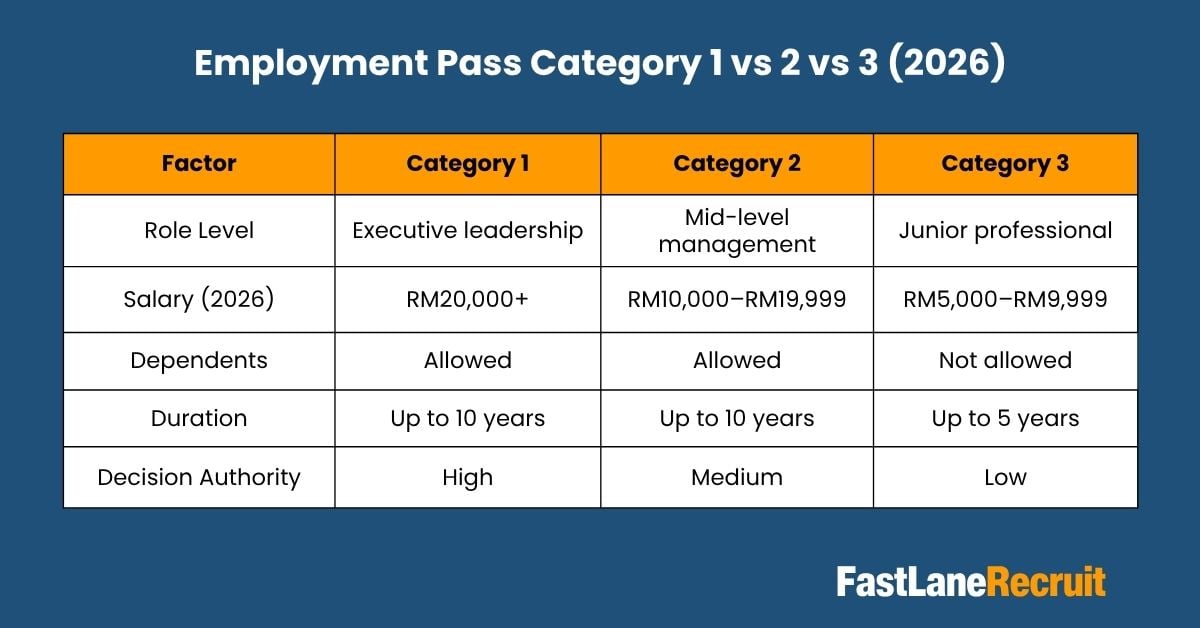
Malaysia Employment Pass Category 1 vs 2 vs 3: Strategic Comparison
Understanding Malaysia Employment Pass Category 1 vs 2 is critical for workforce planning, but a full comparison across all three categories reveals clear structural differences:
Key Insight
The most sensitive comparison is between Category 1 and Category 2, as misclassification here often triggers scrutiny due to overlap in senior management roles.
The Three-Factor Approval Framework (Critical for Employers)
From an immigration compliance perspective, successful EP approvals consistently depend on alignment across three factors:
1. Job Role Alignment
Does the role reflect the correct seniority level?
2. Salary Justification
Is the salary appropriate for the category?
3. Category Selection Accuracy
Does the EP category match both role and compensation?
When these three factors align, approval probability increases significantly.
When they conflict, applications may be delayed or rejected.
What Happens If You Apply for the Wrong EP Category?
Incorrect categorisation is treated based on severity.
Minor Issues
- Missing documents
- Formatting errors
- Incomplete submissions
➡ Usually returned for correction
Major Misalignment
- Incorrect EP category selection
- Salary does not justify role
- Role inconsistencies in company structure
➡ May result in rejection or formal appeal
➡ Reapplication may be restricted for a defined period
Employer Action Plan Before the 2026 EP Changes
With new salary thresholds taking effect, employers should take immediate steps:
- Audit all existing expatriate positions
- Re-evaluate salary bands for compliance
- Identify renewals affected by new thresholds
- Prioritise pending applications before implementation
- Update hiring budgets for foreign talent acquisition
Early planning is essential to avoid disruption in onboarding or renewal cycles.
Conclusion
The Malaysia EP system is increasingly structured toward high-skill, high-value expatriate employment. With the 2026 salary revision, employers must be more precise in structuring roles and compensation packages.
Understanding the distinctions between EP Categories 1, 2, and 3—especially the differences in Malaysia Employment Pass Category 1 vs 2—is essential for successful hiring, compliance, and long-term workforce planning in Malaysia.
Need Help with Malaysia Employment Pass Applications?
Navigating Malaysia’s Employment Pass requirements—especially with the upcoming 2026 salary revisions and stricter category alignment rules—can be complex and time-consuming for employers.
Misclassification between EP Category 1, 2, or 3, or incorrect salary structuring, can lead to delays, or unnecessary resubmissions. That’s why many companies choose to work with experienced recruitment and immigration support specialists to ensure a smoother approval process.
At FastLane Recruit, we support employers with end-to-end expatriate hiring and Employment Pass application services in Malaysia. From assessing the correct EP category to ensuring salary and role alignment, our team helps businesses reduce compliance risks and improve approval success rates.
Whether you are:
- Hiring your first expatriate employee
- Expanding your regional team in Malaysia
- Or renewing existing Employment Passes under the new 2026 framework
We can help you structure your applications correctly from the start.
Learn more or get support here: FastLane Recruit
FAQ: Malaysia Employment Pass Categories (EP 1, 2, and 3)
1. What is the difference between EP Category 1, 2, and 3 in Malaysia?
EP Category 1 is for senior leadership roles with the highest salary threshold, Category 2 is for mid-level managers and skilled professionals, and Category 3 is for junior professionals. The key differences lie in salary level, job seniority, and eligibility for dependents.
2. What is the main difference in Malaysia Employment Pass Category 1 vs 2?
The main difference between Malaysia Employment Pass Category 1 vs 2 is role seniority and salary range. Category 1 is strictly for executive leadership (CEO, directors, C-level roles), while Category 2 is for senior managers, specialists, and professionals who do not hold top executive authority.
3. What are the new EP salary requirements in 2026?
From 1 June 2026, the revised minimum salary thresholds are:
- Category 1: RM20,000 and above
- Category 2: RM10,000 – RM19,999
- Category 3: RM5,000 – RM9,999
These changes apply to both new applications and renewals.
4. Can EP Category 2 holders bring dependents?
Yes. EP Category 2 allows expatriates to bring dependents (spouse and children), making it suitable for professionals relocating with families.
5. Can EP Category 3 holders bring dependents?
No. EP Category 3 does not allow dependents, which is one of its key limitations compared to Category 2.
6. What happens if I apply under the wrong EP category?
Minor errors may result in the application being returned for correction. However, major mismatches—such as incorrect category selection or salary misalignment—can lead to rejection or the need to reapply after a waiting period.
7. How long is each Employment Pass valid for?
- Category 1: Up to 10 years
- Category 2: Up to 10 years (subject to approval conditions)
- Category 3: Up to 5 years
8. What is the most important factor for EP approval?
The most critical factor is alignment between the job role, salary level, and EP category. Inconsistencies between these three elements are a common reason for delays or rejection.
9. Is Category 2 suitable for senior professionals?
Yes. Category 2 is commonly used for senior managers, department heads, and technical experts who do not hold full executive authority but still require high-level expertise.
10. Where can employers get help with EP applications in Malaysia?
Employers can seek professional support from experienced recruitment and immigration consultants such as FastLane Recruit, who assist with EP structuring, category selection, and application processing.