
Complete Employer Guide for Hiring in Malaysia (2026)
Hiring employees in Malaysia comes with important legal responsibilities. Whether you are a local business, foreign company, startup, or global employer expanding into Southeast Asia, understanding the Employment Act 1955 is essential for staying compliant and building a strong workforce.
The Employment Act 1955 is Malaysia’s main employment law governing employee rights, employer obligations, working hours, wages, leave entitlements, termination procedures, and workplace protections. Over the years, the law has evolved to support modern working arrangements, employee welfare, and international labour standards.
For businesses hiring local or foreign talent in Malaysia, keeping up with these changes helps reduce compliance risks, improve employee experience, and support long-term business growth.
In this guide, we explain the key provisions of the employment act 1955, recent updates, employer responsibilities, and practical tips for managing employees in Malaysia in 2026.
Content Outline
Key Summary
Employment Act 1955 Is Malaysia’s Core Labour Law
The Employment Act 1955 is the main legislation governing employment relationships in Peninsular Malaysia and Labuan. It sets minimum standards for contracts, wages, working hours, leave, and workplace protections.
Wider Employee Coverage After 2022 Amendments
The Act now applies to most employees under a contract of service, including those earning above RM4,000, although some provisions still vary based on salary level and job type.
Clear Rules on Working Hours and Overtime
Employees are generally limited to 45 working hours per week, with overtime pay required for extra hours. This supports fair workload distribution and better work-life balance.
Statutory Leave and Parental Benefits Are Strengthened
Employees are entitled to structured leave benefits including annual leave, sick leave, maternity leave (98 days), and paternity leave (7 days), depending on eligibility and service period.
Employers Must Follow Strict Wage and Payroll Rules
Salary payments must be made on time with proper minimum wage compliance. Employers must also ensure lawful deductions and accurate payroll management to avoid disputes.
EPF, SOCSO, and EIS Are Mandatory Contributions
Employers must contribute to EPF, SOCSO, and EIS schemes to support employee retirement, social protection, and unemployment benefits. Non-compliance may lead to penalties and legal risks.
2026 Updates Focus on Compliance and Modern Work Practices
Recent updates include mandatory employment contract stamping, flexible work arrangements, reduced working hours, and stricter foreign employment rules, aligning Malaysia with global labour standards.
What Is the Employment Act 1955 in Malaysia?
The employment act 1955 is the main employment law in Malaysia that regulates the relationship between employers and employees. It establishes the minimum rights, protections, and responsibilities that must be provided in a workplace.
This law applies to employment relationships in Peninsular Malaysia and Labuan and plays an important role in ensuring fair treatment, proper working conditions, and legal protection for both employers and employees.
For businesses hiring in Malaysia, understanding the employment act 1955 is essential to maintaining compliance, avoiding legal disputes, and creating a positive work environment.
The Act has also evolved over time through amendments and policy updates to reflect modern workplace practices such as flexible work arrangements, improved parental leave, and stronger employee protections.
Why Is the Employment Act 1955 Important?
The employment act 1955 serves as the foundation of Malaysian labour law. It provides a legal framework that helps employers manage employees fairly while protecting employee welfare.
For employers, the Act helps:
- Establish clear employment practices
- Create legally compliant employment contracts
- Reduce workplace disputes
- Ensure proper payroll and leave management
- Support fair termination procedures
- Improve workplace transparency and accountability
For employees, the Act helps protect important workplace rights such as:
- Timely salary payments
- Reasonable working hours
- Paid leave entitlements
- Protection against unfair treatment
- Safe and respectful working conditions
For international companies and global employers, the Act is especially important when hiring or outsourcing employees in Malaysia because local labour compliance requirements may differ from those in other countries.
What Does the Employment Act 1955 Cover?
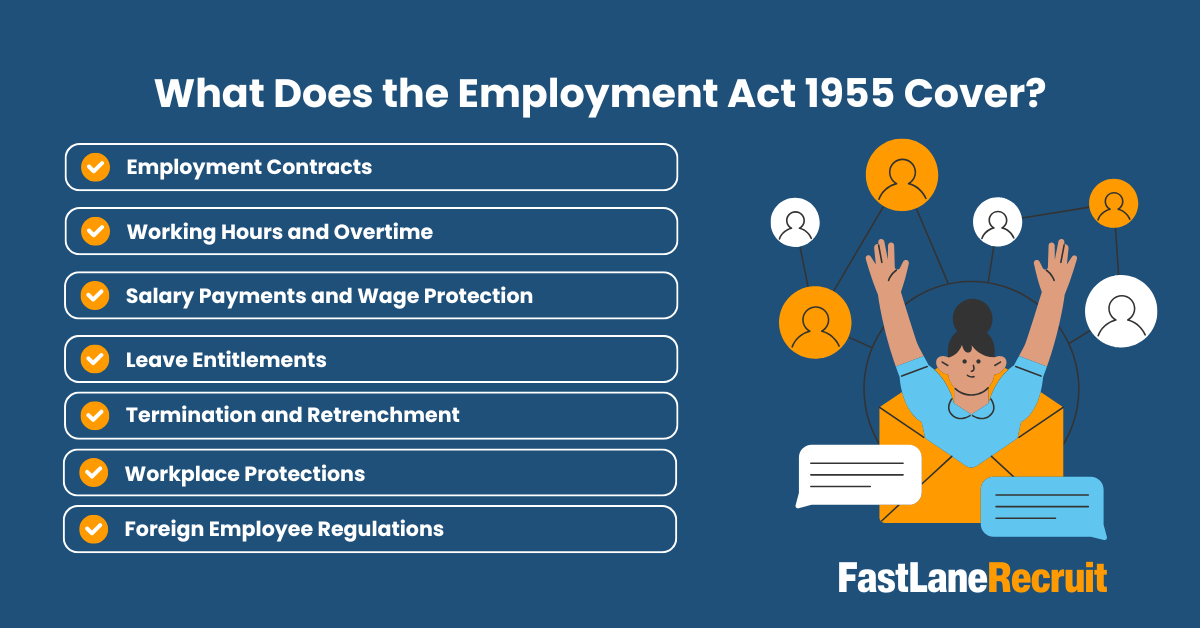
The employment act 1955 covers many important areas of employment and workforce management in Malaysia.
Employment Contracts
The Act outlines basic requirements for contracts of service between employers and employees. Employment contracts should clearly state:
- Job responsibilities
- Salary and payment terms
- Working hours
- Leave entitlements
- Benefits and allowances
- Termination conditions
Having a clear written contract helps both parties understand their rights and obligations.
Working Hours and Overtime
The Act regulates standard working hours and overtime rules to help maintain fair working conditions.
Under current regulations:
- Employees generally cannot work more than 45 hours per week
- Overtime pay must be provided for eligible employees who work beyond normal hours
- Employees are entitled to rest days and breaks
These rules help promote healthier work-life balance and prevent excessive working hours.
Salary Payments and Wage Protection
The employment act 1955 also contains rules on salary payments and wage protection.
Employers must:
- Pay salaries on time
- Follow minimum wage requirements
- Provide lawful salary deductions only
- Maintain proper payroll records
Failure to comply with wage regulations may lead to penalties or employment disputes.
Leave Entitlements
Employees in Malaysia are entitled to different types of statutory leave under the Act.
These include:
- Annual leave
- Sick leave
- Hospitalisation leave
- Public holidays
- Maternity leave
- Paternity leave
The amount of leave employees receive often depends on their length of service and employment terms.
Termination and Retrenchment
The Act provides guidelines for lawful termination and retrenchment procedures.
Employers must follow fair practices when ending employment relationships, including:
- Providing notice periods
- Paying final wages
- Conducting proper disciplinary procedures when necessary
- Managing retrenchment exercises fairly
This helps reduce the risk of wrongful dismissal claims and workplace disputes.
Workplace Protections
The employment act 1955 also includes workplace protection measures relating to:
- Sexual harassment prevention
- Employee welfare
- Fair treatment
- Workplace safety obligations
Recent amendments have strengthened employer responsibilities in creating safe and respectful workplaces.
Foreign Employee Regulations
Malaysia has specific regulations for hiring foreign employees and expatriates.
Employers hiring foreign workers must comply with:
- Work permit requirements
- Immigration approvals
- Employment pass rules
- Statutory contribution obligations
This is especially important for multinational companies and businesses expanding into Malaysia.
Who Enforces the Employment Act 1955?
The employment act 1955 is enforced by the Department of Labour Peninsular Malaysia under the Ministry of Human Resources Malaysia.
These government authorities oversee:
- Employment law compliance
- Labour inspections
- Workplace dispute management
- Employee complaints
- Employer investigations
Employers should regularly monitor official government announcements because employment regulations and labour policies may change over time.
Official Resources for Employers
For accurate guidelines and the latest updates on Malaysian employment laws, employers can refer to these official resources:
- Ministry of Human Resources Malaysia
- Department of Labour Peninsular Malaysia
- Employment Act 1955 Official Act PDF
Who Is Covered Under the Employment Act 1955?
Understanding who is covered under the employment act 1955 is important for both employers and employees in Malaysia. The law determines which workers are entitled to statutory protections such as overtime pay, leave benefits, working hour limits, and other employment rights.
One of the biggest changes introduced through the Employment (Amendment) Act 2022 was the expansion of employee coverage. This amendment significantly widened the scope of protection under Malaysian employment law and brought the country closer to international labour standards.
Today, more employees in Malaysia are protected under the Act compared to previous years.
Expansion of Coverage Under the Employment (Amendment) Act 2022
Before the 2022 amendments, the employment act 1955 mainly applied to employees earning below a certain salary threshold. Employees earning above that amount were often excluded from many statutory protections unless they worked in specific manual or operational job categories.
Following the amendments, the Act now generally applies to all employees who work under a contract of service, regardless of salary level.
This means many professional, managerial, and higher-income employees now benefit from broader employment protections under Malaysian labour law.
However, some provisions under the Act still apply differently depending on:
- Salary level
- Nature of work
- Job category
- Employment arrangement
For example, overtime eligibility rules may not apply equally to all employees.
What Is a Contract of Service?
The employment act 1955 applies to individuals working under a contract of service.
A contract of service refers to an employment relationship where:
- An employer hires a worker
- The employee performs work under the employer’s direction or control
- The employer provides wages or salary in return
This can include:
- Full-time employees
- Part-time employees
- Contract employees
- Apprentices
- Foreign employees
The contract may be:
- Written
- Verbal
- Expressed formally
- Implied through work arrangements
Employee Categories Covered Under the Employment Act 1955
Below is a general overview of employee categories covered under the Act.
| Employee Category | Coverage Under Employment Act 1955 |
| Employees earning RM4,000 and below | Fully covered |
| Employees earning above RM4,000 | Covered under most provisions, with some exceptions |
| Foreign employees | Covered |
| Apprentices | Covered |
| Domestic servants | Limited coverage |
| Government employees | Generally governed by separate regulations |
Employees Earning RM4,000 and Below
Employees earning RM4,000 and below are generally fully covered under the employment act 1955.
These employees are entitled to statutory protections such as:
- Overtime pay
- Working hour limits
- Rest days
- Annual leave
- Sick leave
- Public holiday entitlements
- Termination benefits
This category includes many operational, administrative, retail, hospitality, and support employees across various industries.
Employees Earning Above RM4,000
Employees earning above RM4,000 are also covered under many parts of the employment act 1955 following the recent amendments.
However, some provisions may not apply automatically, particularly:
- Overtime entitlement
- Overtime calculation rules
- Rest day overtime rates
- Certain termination benefit provisions
In many cases, higher-income employees rely more heavily on the terms outlined in their employment contracts.
For employers, this makes it important to draft clear and legally compliant employment agreements for managerial and professional employees.
Foreign Employees
Foreign employees working legally in Malaysia are also protected under the employment act 1955.
This includes expatriates, skilled foreign professionals, and migrant workers employed under valid work permits or employment passes.
Employers hiring foreign workers must comply with:
- Immigration regulations
- Employment pass requirements
- Statutory contribution obligations
- Employment standards under Malaysian labour law
Foreign workers are entitled to many of the same workplace protections as local employees.
Apprentices and Trainees
Apprentices working under apprenticeship contracts are covered under the Act.
Recent amendments updated apprenticeship rules and reduced the minimum contract duration requirement, making apprenticeship arrangements more flexible for employers and trainees.
Businesses using internship or apprenticeship programmes should still ensure:
- Proper agreements are in place
- Working conditions comply with labour laws
- Training arrangements are clearly documented
Domestic Servants
Domestic servants have limited protection under the employment act 1955 compared to other employee categories.
Some statutory provisions may not fully apply to domestic workers, depending on the nature of their work arrangement.
However, employers are still expected to maintain fair employment practices and comply with applicable regulations.
Government Employees
Government employees in Malaysia are generally governed by separate public service regulations rather than the employment act 1955.
Their employment terms are usually managed under:
- Public service rules
- Government circulars
- Civil service regulations
As a result, some provisions under the employment act 1955 may not apply directly to public sector employees.
Why Employer Classification Matters
Correctly identifying employee coverage is essential for compliance.
Misclassifying workers may lead to:
- Payroll disputes
- Overtime claims
- Employment lawsuits
- Government penalties
- Compliance investigations
For example, a company that incorrectly assumes a high-income employee is fully exempt from employment protections may face disputes relating to leave entitlements or unfair dismissal procedures.
Practical Tip for Global Employers
International companies hiring employees in Malaysia should avoid assuming employment rules are the same as those in their home country.
Even remote employees working from Malaysia may still fall under Malaysian labour law depending on the employment arrangement.
Businesses should:
- Use locally compliant employment contracts
- Review employee classifications carefully
- Seek local HR or legal guidance when hiring Malaysian talent
- Regularly monitor labour law updates
This helps reduce compliance risks while creating a smoother hiring and employee management process.
Key 2026 Updates to Malaysia Employment Laws
Malaysia continues to modernise its employment laws to support a more competitive, fair, and employee-friendly workforce environment. In recent years, the government has introduced several important updates to the employment act 1955 and related labour regulations to align with international employment standards and changing workplace expectations.
These updates affect both local businesses and international companies hiring employees in Malaysia. Employers should stay informed and regularly review their HR policies, payroll practices, and employment contracts to remain compliant.
Below are some of the most important Malaysia employment law updates employers should understand in 2026.
1. Mandatory Employment Contract Stamping
One of the major compliance updates introduced in 2026 is the mandatory electronic stamping of employment contracts.
Under Malaysia’s Stamp Duty Self-Assessment System (SDSAS), employment contracts must now be stamped electronically through the tax authority’s online platform.
This requirement helps formalise employment documentation and improve legal enforceability in employment disputes.
Key Requirements for Employment Contract Stamping
| Requirement | Details |
| Platform | LHDN MyTax Portal |
| Stamp duty | RM10 for applicable contracts |
| Exemption | Monthly salary RM3,000 and below |
| Deadline | Within 30 days of execution |
Why Employment Contract Stamping Matters
Many employers overlook contract stamping because the fee itself is relatively small. However, the legal implications of non-compliance can be significant.
An unstamped employment contract may face limitations during legal proceedings and may not be admissible in court as evidence in certain disputes.
This can become a serious issue during:
- Salary disputes
- Wrongful termination claims
- Contract disagreements
- Employment litigation
For employers managing large workforces or hiring remote employees, implementing a proper contract management process is highly recommended.
Practical Tip for Employers
Businesses should:
- Digitise employment contract workflows
- Monitor contract signing dates
- Track stamping deadlines
- Store stamped agreements securely
This is especially important for global companies managing employees across multiple countries.
Official reference:
2. Reduced Weekly Working Hours
Malaysia officially reduced the maximum weekly working hours from 48 hours to 45 hours under recent amendments to the employment act 1955.
This update reflects a growing global focus on employee wellbeing, productivity, and healthier work-life balance practices.
Current Working Hour Rules in Malaysia
| Employment Rule | Requirement |
| Maximum weekly hours | 45 hours |
| Maximum daily hours | 8 hours |
| Weekly rest day | Minimum 1 day |
| Overtime pay | Required beyond legal hours |
How This Change Impacts Employers
Employers may need to adjust:
- Work schedules
- Shift planning
- Payroll calculations
- Overtime policies
- Attendance systems
Businesses operating in industries with long operating hours such as:
- Retail
- Manufacturing
- Hospitality
- Logistics
- Customer support
may need additional workforce planning to maintain compliance.
Overtime Compliance Remains Important
Even with reduced working hours, employers must still provide overtime pay for eligible employees who work beyond legal limits.
Failure to properly calculate overtime can lead to:
- Employee disputes
- Labour complaints
- Financial penalties
- Reputational risks
Example
If an employee regularly works 50 hours per week without overtime compensation, the employer may be violating Malaysia’s employment regulations.
Benefits of Reduced Working Hours
Although some businesses initially viewed the change as an operational challenge, many employers now recognise benefits such as:
- Improved employee wellbeing
- Reduced burnout
- Better productivity
- Higher employee retention
- Improved workplace morale
The update also helps Malaysia align more closely with international labour standards followed in many developed economies.
3. Flexible Working Arrangements
Flexible working arrangements have become increasingly important in modern workplaces, especially after the global shift toward hybrid and remote work models.
Under the employment act 1955, employees in Malaysia can now formally request flexible work arrangements from their employer.
Types of Flexible Work Arrangements
Employees may request arrangements such as:
- Remote work
- Hybrid work schedules
- Flexible working hours
- Adjusted workdays
- Alternative work locations
The request must generally be submitted in writing.
Employer Responsibilities
Employers are required to:
- Review the request fairly
- Respond within 60 days
- Provide reasons if the request is rejected
This process encourages more transparent communication between employers and employees.
Why Flexible Work Policies Matter
Flexible work arrangements are becoming a major factor in:
- Talent attraction
- Employee retention
- Workforce satisfaction
- Employer branding
This is particularly important for:
- Technology companies
- Startups
- Remote-first businesses
- Global employers managing distributed teams
Practical Example
A company outsourcing customer support operations to Malaysia may allow employees to work remotely while maintaining compliance with local employment laws.
This flexibility can help businesses:
- Access wider talent pools
- Reduce office costs
- Improve employee satisfaction
- Support business continuity
Recommendation for Employers
Businesses should create clear internal policies covering:
- Remote work expectations
- Attendance tracking
- Data security
- Performance management
- Communication standards
Well-defined flexible work policies help reduce misunderstandings and improve operational consistency.
4. Expanded Maternity and Paternity Leave
Malaysia has strengthened parental leave protections under the employment act 1955 to better support working families and promote employee wellbeing.
The updated provisions provide longer maternity leave and introduce statutory paternity leave for eligible fathers.
Current Leave Entitlements
| Leave Type | Entitlement |
| Maternity leave | 98 days |
| Paternity leave | 7 consecutive days |
| Hospitalisation leave | Up to 60 days |
Maternity Leave Protection
Female employees are entitled to 98 days of maternity leave for each confinement, subject to eligibility requirements.
Importantly, employers are generally prohibited from terminating a female employee because:
- She is pregnant
- She is on maternity leave
- She is experiencing pregnancy-related illness
This protection helps support workplace fairness and gender equality.
Paternity Leave Rights
Eligible married male employees are entitled to seven consecutive days of paid paternity leave.
This reflects Malaysia’s growing recognition of shared parental responsibilities and family support.
Why These Updates Matter for Employers
Employers should ensure that:
- HR policies reflect updated leave entitlements
- Payroll systems are updated correctly
- Managers understand employee rights
- Leave applications are handled consistently
For multinational companies hiring in Malaysia, parental leave obligations may differ from employment laws in other countries, making local compliance especially important.
Building a Family-Friendly Workplace
Companies that support employee well-being through fair parental leave policies often experience:
- Better employee loyalty
- Improved retention
- Higher workplace engagement
- Stronger employer reputation
Family-friendly workplace practices can also strengthen recruitment efforts in competitive hiring markets.
Employer Obligations Under the Employment Act 1955
Understanding employer obligations is critical for avoiding disputes and maintaining compliance.
Employment Contracts
Employers should issue clear written employment contracts that include:
- Job responsibilities
- Salary details
- Working hours
- Leave entitlements
- Benefits
- Termination clauses
- Confidentiality terms
- Probation conditions
Practical Tip
Global companies hiring Malaysian employees remotely should localise employment contracts to ensure they comply with Malaysian labour laws rather than relying solely on foreign employment templates.
Wage and Salary Compliance
Employers must pay wages no later than the 7th day of the following month.
Minimum Wage in Malaysia
As of 2025 enforcement:
| Requirement | Amount |
| Minimum monthly wage | RM1,700 |
Salary deductions are only permitted under approved conditions such as:
- EPF contributions
- SOCSO contributions
- Tax deductions
- Approved employee loans
Overtime Rules in Malaysia
Eligible employees must receive overtime pay when working beyond legal working hours.
Overtime Rates
| Situation | Overtime Rate |
| Normal working day | 1.5x hourly rate |
| Rest day | 2x hourly rate |
| Public holiday | 3x hourly rate |
Example
A Malaysian employee working during a national public holiday must generally receive three times their normal hourly wage under the employment act 1955.
Annual Leave and Public Holidays
Employee leave entitlements are based on length of service.
Annual Leave Entitlements
| Years of Service | Minimum Annual Leave |
| Less than 2 years | 8 days |
| 2–5 years | 12 days |
| More than 5 years | 16 days |
Employees are also entitled to:
- Paid public holidays
- Sick leave
- Hospitalisation leave
- Maternity leave
- Paternity leave
Employment of Foreign Workers in Malaysia
Malaysia remains a major destination for international hiring and outsourcing in Southeast Asia.
Companies employing foreign workers must comply with:
- Valid work permits
- Employment Pass regulations
- Immigration approvals
- Levy obligations
- Mandatory statutory contributions
2026 Employment Pass Updates
Malaysia introduced stricter Employment Pass salary thresholds and localisation policies.
| Employment Pass Category | Minimum Salary |
| Category I | RM20,000 |
| Category II | RM10,000–RM19,999 |
| Category III | RM5,000–RM9,999 |
Additional requirements may include:
- Local succession planning
- Internship quotas
- Workforce localisation strategies
Official immigration references:
EPF, SOCSO, and Statutory Contributions
Employers in Malaysia are legally required to contribute to several mandatory employee protection and social security schemes. These statutory contributions form an important part of Malaysia’s employment system and help provide financial protection, retirement savings, and social security coverage for employees.
For both local and foreign employers hiring in Malaysia, understanding statutory contribution requirements is essential for maintaining compliance under the employment act 1955 and related labour regulations.
Failure to comply with contribution obligations may result in:
- Financial penalties
- Late payment charges
- Government enforcement action
- Employee disputes
- Reputational risks
Businesses hiring employees in Malaysia should ensure payroll systems are properly configured to calculate and remit contributions accurately and on time.
What Are Statutory Contributions in Malaysia?
Statutory contributions are mandatory payments that employers and employees make to government-managed protection schemes.
These contributions are designed to support employees in areas such as:
- Retirement savings
- Workplace injury protection
- Financial assistance during unemployment
- Social security benefits
- Long-term financial wellbeing
In Malaysia, the three main statutory contribution schemes are:
- Employees Provident Fund (EPF)
- Social Security Organisation (SOCSO)
- Employment Insurance System (EIS)
Key Statutory Contributions in Malaysia
| Contribution Type | Purpose |
| EPF | Retirement savings |
| SOCSO | Social security protection |
| EIS | Employment insurance |
Employees Provident Fund (EPF)
The Employees Provident Fund, commonly known as EPF, is Malaysia’s mandatory retirement savings scheme.
It is managed by the Employees Provident Fund and helps employees build long-term retirement savings throughout their working years.
How EPF Works
Both employers and employees contribute a percentage of the employee’s monthly salary to the EPF account.
The contributions are accumulated over time and can generally be accessed under approved conditions such as:
- Retirement
- Permanent disability
- Certain housing or education withdrawals
- Approved medical purposes
Why EPF Is Important
EPF helps employees:
- Build retirement savings
- Improve long-term financial security
- Encourage structured savings habits
For employers, EPF compliance demonstrates responsible employment practices and supports workforce stability.
EPF Contribution Responsibilities
Employers must:
- Register eligible employees
- Calculate contributions correctly
- Submit payments before monthly deadlines
- Maintain accurate payroll records
Late or incorrect EPF contributions may result in:
- Dividends owed
- Penalty charges
- Compliance investigations
Foreign Worker EPF Contributions
Malaysia has gradually expanded EPF coverage requirements for certain foreign employees as part of broader workforce protection initiatives.
Employers hiring expatriates or foreign workers should regularly review the latest EPF contribution requirements because obligations may vary depending on:
- Employee nationality
- Immigration status
- Employment arrangement
Official resource:
Social Security Organisation (SOCSO)
SOCSO, also known as PERKESO, is Malaysia’s social security protection scheme managed by the Social Security Organisation.
SOCSO provides financial and medical support to employees in situations such as:
- Workplace injuries
- Occupational diseases
- Invalidity
- Disability
- Employment-related accidents
SOCSO Coverage
SOCSO helps protect employees and their families against unexpected financial hardship caused by work-related incidents or long-term disability.
Benefits may include:
- Medical treatment
- Temporary disability payments
- Permanent disability benefits
- Dependant benefits
- Rehabilitation support
Employer Responsibilities Under SOCSO
Employers are generally required to:
- Register eligible employees
- Contribute monthly payments
- Report workplace accidents
- Maintain employment records
SOCSO contribution amounts are typically based on employee salary levels.
Expanded Protection for Foreign Workers
Malaysia has strengthened social protection coverage for foreign employees in recent years.
Many foreign workers are now covered under SOCSO contribution requirements, helping improve workplace protection standards and employee welfare across industries.
This is especially important for sectors such as:
- Manufacturing
- Construction
- Hospitality
- Logistics
- Plantation industries
Official resource:
Employment Insurance System (EIS)
The Employment Insurance System (EIS) is designed to provide temporary financial assistance and employment support for employees who lose their jobs.
The scheme is also administered by SOCSO.
Purpose of EIS
EIS helps employees during periods of unemployment by offering:
- Temporary financial aid
- Job search assistance
- Career counselling
- Skills training programmes
The system helps reduce financial pressure on employees while supporting workforce reintegration.
Employer Obligations for EIS
Employers must:
- Register eligible employees
- Contribute monthly payments
- Ensure payroll compliance
Like other statutory contributions, EIS payments are linked to employee salary levels.
Why Statutory Contribution Compliance Matters
Statutory contribution compliance is one of the most important responsibilities for employers operating in Malaysia.
Accurate payroll management helps businesses:
- Stay legally compliant
- Protect employee welfare
- Build trust with employees
- Reduce compliance risks
- Avoid costly penalties
For international companies hiring Malaysian employees remotely, statutory contribution requirements can sometimes be complex because local payroll obligations may differ significantly from those in other countries.
Common Employer Challenges
Some employers face challenges such as:
- Miscalculating contribution amounts
- Missing payment deadlines
- Incorrect employee classifications
- Managing foreign employee contributions
- Integrating payroll across multiple countries
Without proper systems in place, payroll compliance issues can quickly become operational and legal risks.
Practical Tip for Global Employers
Companies expanding into Malaysia should consider:
- Using locally compliant payroll systems
- Conducting regular payroll audits
- Working with local HR specialists
- Partnering with an Employer of Record (EOR) provider
This can help simplify:
- Payroll processing
- Statutory calculations
- Government submissions
- Employment compliance management
How EOR Services Help With Compliance
An Employer of Record (EOR) provider can help global companies manage statutory obligations in Malaysia without establishing a local entity.
An EOR typically handles:
- Employee onboarding
- Payroll processing
- EPF, SOCSO, and EIS contributions
- Employment contracts
- Compliance reporting
This allows businesses to hire employees in Malaysia faster while reducing administrative complexity and compliance risks.
Termination and Retrenchment Rules
Employers must follow fair termination procedures.
Standard Notice Periods
| Length of Service | Notice Period |
| Less than 2 years | 4 weeks |
| 2–5 years | 6 weeks |
| More than 5 years | 8 weeks |
For misconduct-related dismissal, employers should:
- Conduct a domestic inquiry
- Issue a show cause letter
- Allow employee response
- Document the investigation process
For retrenchment exercises, employers should consider:
- Fair selection criteria
- Retrenchment benefits
- Government notification requirements
Sexual Harassment and Workplace Protection
The employment act 1955 requires employers to actively prevent workplace harassment.
Employer Responsibilities
Employers should:
- Create anti-harassment policies
- Display awareness notices
- Investigate complaints promptly
- Take disciplinary action where necessary
A safe workplace supports employee wellbeing and strengthens employer reputation.
Common Compliance Risks for Employers
Many businesses unintentionally violate Malaysian employment laws due to outdated policies or lack of local HR knowledge.
Common Mistakes
- Using non-compliant employment contracts
- Miscalculating overtime
- Delayed salary payments
- Improper termination procedures
- Ignoring foreign worker regulations
- Failing to update HR policies after amendments
Recommendation
Conduct regular HR and payroll compliance audits to ensure alignment with current Malaysian labour laws.
Example: Outsourcing Employees in Malaysia
A global software company expanding into Southeast Asia may hire Malaysian developers remotely without establishing a local entity.
Instead of setting up a company immediately, the business can partner with an Employer of Record (EOR) provider in Malaysia to:
- Hire employees legally
- Manage payroll and statutory contributions
- Handle employment contracts
- Ensure compliance with the employment act 1955
- Reduce administrative complexity
This approach helps businesses scale faster while reducing compliance risks.
How FastLaneRecruit Helps Global Companies Hire in Malaysia
Hiring in Malaysia can be complex for overseas businesses unfamiliar with local employment laws, payroll regulations, and statutory requirements.
FastLaneRecruit helps companies simplify hiring, outsourcing, and workforce management in Malaysia through Employer of Record (EOR) solutions.
Why Companies Choose FastLaneRecruit
With FastLaneRecruit’s Recruitment and EOR solutions, your business can:
- Hire Malaysian employees quickly and legally
- Stay compliant with the employment act 1955 and local labour regulations
- Manage payroll, EPF, SOCSO, EIS, and tax contributions accurately
- Support remote, hybrid, and distributed teams
- Reduce administrative workload and compliance risks
- Scale operations in Malaysia more efficiently
Whether you are testing the Malaysian market, hiring remote talent, or building a full local team, FastLaneRecruit simplifies the entire employment process so you can focus on growing your business.
Conclusion
The employment act 1955 remains the foundation of employment law in Malaysia and continues to evolve alongside modern workforce expectations and international labour standards.
For employers, understanding these regulations is essential for:
- Protecting employee rights
- Maintaining legal compliance
- Avoiding penalties
- Building a productive workplace culture
As Malaysia strengthens its labour protections and global workforce policies in 2026, businesses should proactively review their HR practices, employment contracts, payroll systems, and foreign hiring strategies.
Companies planning to hire or outsource talent in Malaysia can benefit significantly from working with experienced local HR and EOR partners to navigate compliance confidently and scale efficiently.
Ready to Build a Stronger, Compliant Workforce in Malaysia?
Hiring and managing employees in Malaysia doesn’t have to be complicated. Whether you are a local company scaling your team or an international business expanding into Malaysia, having the right partner can make all the difference.
FastLaneRecruit helps businesses simplify recruitment, hiring, payroll, and employment compliance through end-to-end recruitment and Employer of Record (EOR) solutions.
Get Started Today
Take the next step toward smarter hiring and compliant workforce management. Explore how FastLaneRecruit can support your business growth in Malaysia today.