A Practical Hiring Guide for Global Employers
Hiring in Malaysia is no longer just about filling roles; it’s about choosing the right employment model to support business growth, compliance, and long-term success. As workforce strategies evolve, companies are increasingly deciding between contract vs permanent employment Malaysia to balance flexibility, talent quality, and regulatory requirements.
With updates to employment regulations, tighter enforcement on statutory contributions, and growing demand for specialised skills, making the right hiring decision is more important than ever. In this guide, we break down everything global employers need to know, from legal differences to practical hiring strategies and how to hire and offshore talent in Malaysia effectively.
Content Outline
Key Summary
Understand Employment Types
Malaysia offers permanent, fixed-term contract, and independent contractor options. Each comes with unique benefits, obligations, and compliance requirements.
Flexibility vs Stability
Contract hiring provides agility for short-term projects, while permanent employees ensure continuity and long-term knowledge retention.
Access Skills vs Retain Knowledge
Contract professionals bring specialised, project-based expertise. Permanent employees build institutional knowledge and support growth.
Compliance Is Crucial
Employers must follow Malaysian labor laws, statutory contributions (EPF, SOCSO, EIS), and tax requirements to avoid penalties and disputes.
Weigh Costs and Benefits
Permanent hires receive full statutory and company benefits. Contract hires may reduce long-term costs but still require statutory contributions.
Use a Balanced Workforce Strategy
The most successful companies combine contract and permanent roles to achieve flexibility, stability, and business growth.
EOR Solutions Simplify Hiring
An Employer of Record (EOR) like FastLaneRecruit allows global companies to hire and manage Malaysian talent quickly, compliantly, and without setting up a local entity.
Understanding Employment Types in Malaysia
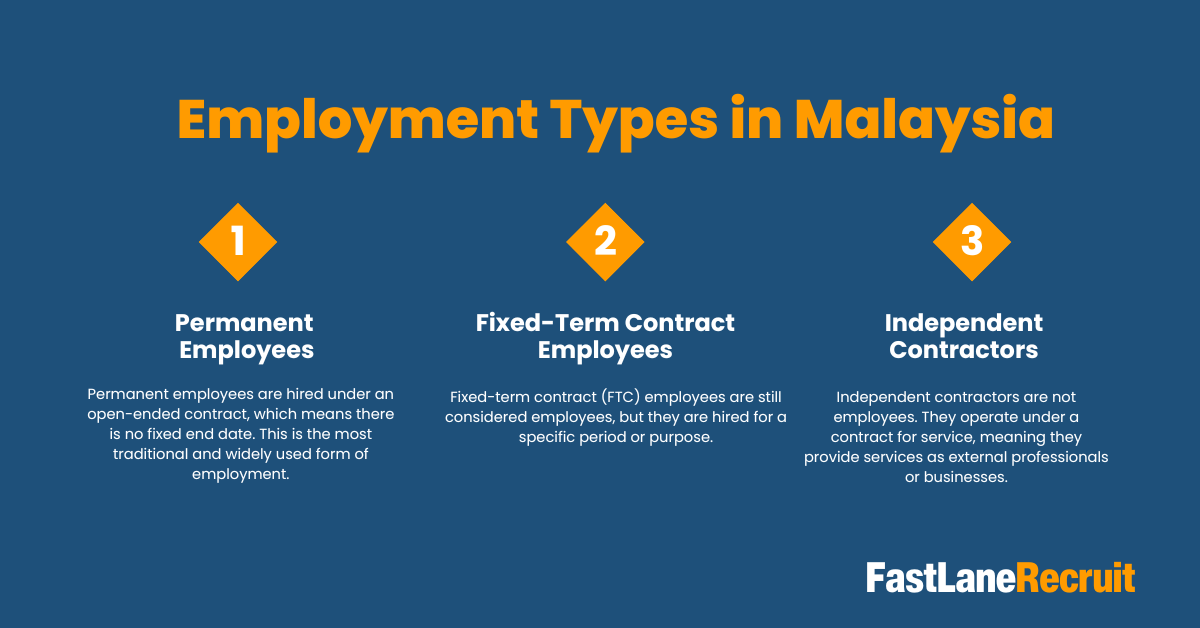
Before deciding between contract and permanent hiring, it’s important to understand the three main types of workforce arrangements in Malaysia. Each comes with different responsibilities, flexibility levels, and compliance requirements.
1. Permanent Employees
Permanent employees are hired under an open-ended contract, which means there is no fixed end date. This is the most traditional and widely used form of employment.
They are typically:
- Core to business operations and long-term goals
- Fully integrated into the company structure and culture
- Entitled to full statutory benefits such as EPF, SOCSO, and leave entitlements
- Included in career development plans, promotions, and internal training
Example:
A company hiring a Finance Manager or HR Executive to support daily operations and long-term growth would usually choose permanent employment.
This model is ideal for roles that require:
- Stability and continuity
- Deep company knowledge
- Long-term commitment
2. Fixed-Term Contract Employees
Fixed-term contract (FTC) employees are still considered employees, but they are hired for a specific period or purpose.
Common use cases include:
- Project-based roles (e.g. system implementation, product launch)
- Temporary replacement (e.g. maternity leave or long-term absence)
- Seasonal demand (e.g. retail hiring during festive periods)
They are entitled to statutory benefits, but company benefits may vary depending on the contract terms.
Example:
A business hiring a 6-month marketing specialist to support a campaign rollout would typically use a fixed-term contract.
Important to note:
In Malaysia, courts look beyond the contract label. If:
- The contract is renewed repeatedly, or
- The role is clearly ongoing and not temporary,
The employee may be legally treated as a permanent employee, even if the contract says otherwise.
Also Read: Offshoring Talent: Guide to Building a Successful Offshore Team
3. Independent Contractors
Independent contractors are not employees. They operate under a contract for service, meaning they provide services as external professionals or businesses.
They are suitable when:
- You are paying for specific deliverables or outcomes, not managing daily work
- The individual has control over how, when, and where the work is done
- The role does not form part of your internal team structure
Example:
Hiring a freelance web developer to build a website or a consultant to advise on a short-term strategy project.
Key difference:
Unlike employees, contractors:
- Do not receive statutory employee benefits
- Manage their own taxes and contributions
- Work with multiple clients independently
Important risk:
If a contractor is treated like an employee (e.g. fixed working hours, reporting to a manager, using company systems daily), authorities may reclassify them as an employee.
This can lead to:
- Backdated statutory contributions
- Tax penalties
- Legal disputes
Quick Summary
| Type | Best For | Key Advantage | Key Risk |
| Permanent Employee | Long-term, core roles | Stability and retention | Higher termination obligations |
| Fixed-Term Employee | Projects or temporary needs | Flexibility with structure | Risk of being treated as permanent |
| Independent Contractor | Specialised, output-based work | High flexibility | Misclassification risk |
Understanding these employment types helps you choose the right hiring approach, avoid compliance issues, and build a workforce that supports your business goals effectively.
Contract vs Permanent Employment Malaysia: Key Differences
Choosing between contract and permanent hiring is not just about cost or flexibility—it directly impacts your operations, compliance, and long-term business strategy.
Here’s a clearer breakdown of how each model compares in practice:
Key Comparison Table
| Factor | Contract Hiring | Permanent Hiring |
| Duration | Fixed-term or project-based with a defined end date | Ongoing employment with no fixed end date |
| Flexibility | High – easy to scale workforce up or down based on business needs | Lower – designed for long-term workforce stability |
| Stability | Lower – role ends after project or contract period | High – continuous employment and income stability |
| Skill Access | Access to specialised, project-specific expertise across industries | Deep, company-specific knowledge built over time |
| Termination | Ends upon contract expiry (if the contract is genuine and properly structured) | Requires “just cause and excuse” and proper process under Malaysian law |
| Benefits | Statutory benefits apply; company benefits may be limited or prorated | Full statutory and company benefits (leave, bonuses, medical, etc.) |
| Legal Risk | Risk of misclassification or being treated as permanent if misused or repeatedly renewed | Higher scrutiny during termination, especially for unfair dismissal claims |
What These Differences Mean in Practice
1. Flexibility vs Stability
Contract hiring gives businesses the ability to respond quickly to changing demands. For example, if you are expanding into Malaysia or launching a short-term project, hiring contract talent allows you to scale without long-term commitments.
Permanent hiring, on the other hand, is designed for business continuity. It helps build a stable workforce that understands your processes, culture, and long-term goals.
2. Access to Skills vs Knowledge Retention
Contract professionals are often hired for their specialised expertise. They bring experience from multiple industries and can deliver results quickly.
Permanent employees develop institutional knowledge over time. They understand internal systems, customers, and long-term strategies, making them valuable for sustained growth.
Also Read: What Is an Onshore and Offshore Team?
3. Termination and Compliance
In Malaysia, termination is a critical legal consideration.
- For contract employees, employment typically ends when the contract expires—but only if the contract is genuine and not repeatedly renewed for ongoing roles.
- For permanent employees, termination must follow proper procedures and be supported by valid reasons, such as performance issues or redundancy.
Failing to follow due process can lead to unfair dismissal claims and financial penalties.
4. Cost and Benefits Considerations
While contract hiring may appear more flexible, employers still need to comply with statutory contributions such as EPF and SOCSO (where applicable).
Permanent employees usually receive:
- Paid leave
- Medical benefits
- Bonuses and allowances
This makes permanent hiring more suitable for long-term talent investment, while contract hiring supports short-term efficiency.
5. Legal Risk and Workforce Planning
Contract hiring comes with specific risks if not managed properly, such as:
- Repeated contract renewals
- Using contract roles for ongoing business functions
- Treating contractors like employees
Permanent hiring carries greater scrutiny during termination, but offers clearer legal structure when managed correctly.
Quick Takeaway
- Choose contract hiring for flexibility, specialised skills, and short-term needs
- Choose permanent hiring for stability, retention, and long-term growth
Most companies today benefit from a hybrid approach, combining both models to build a workforce that is agile, compliant, and scalable.
Also Read: Essential Elements to Include in a Remote Work Policy
Why More Companies Hire Contract Talent in Malaysia
The hiring landscape is shifting globally and Malaysia is no exception.
Companies are increasingly adopting flexible workforce models to:
- Access specialised skills quickly
- Scale teams based on project demand
- Improve operational efficiency
- Support digital transformation initiatives
Contract professionals often bring:
- Cross-industry experience
- Adaptability across work environments
- Up-to-date, in-demand skills
This makes contract hiring a strategic option, especially for fast-growing or project-driven businesses.
When Should You Choose Contract vs Permanent Hiring?
Choose Permanent Hiring When:
- The role is core to daily operations
- You need long-term stability and retention
- You are building leadership or internal capabilities
Choose Contract Hiring When:
- Work is project-based or time-bound
- You need specialised expertise quickly
- Business demand is uncertain or seasonal
Legal and Compliance Considerations in Malaysia
When you hire in Malaysia, compliance is critical.
1. Employment Laws
Employers must comply with:
- Employment Act 1955
- Industrial Relations Act 1967
Dismissals must be supported by “just cause and excuse”.
2. Statutory Contributions
Applicable to both permanent and contract employees:
- Employees Provident Fund (EPF/KWSP): https://www.kwsp.gov.my
- Social Security Organisation (SOCSO/PERKESO): https://www.perkeso.gov.my
- Employment Insurance System (EIS)
Recent updates include mandatory EPF contributions for foreign workers, impacting hiring cost structures.
3. Tax and Reporting
- Employees → Form EA / Form E (PCB deductions)
- Contractors → CP58
More info:
- Inland Revenue Board of Malaysia (LHDN): https://www.hasil.gov.my
4. Fixed-Term Contract Risks
Malaysian courts focus on substance over contract wording.
A contract may be treated as permanent if:
- It is repeatedly renewed
- The role is ongoing in nature
- The employee receives similar benefits as permanent staff
Potential consequences:
- Unfair dismissal claims
- Compensation up to 24 months’ salary
- Reinstatement orders
Also Read: 6 Fastest Growing Remote Hiring Destinations in 2025
Common Mistakes Employers Should Avoid
Many companies run into issues due to:
- Using contract roles as informal probation periods
- Repeatedly renewing contracts without justification
- Treating contractors like employees
- Overlooking EPF, tax, or documentation requirements
These risks often surface during audits or disputes when fixing them becomes costly.
Practical Hiring Tips for Employers
To hire effectively in Malaysia:
1. Match the Role to the Right Model
Ask:
- Is this role temporary or ongoing?
- Does it support core business functions?
2. Define Contracts Clearly
- Include start and end dates
- State the purpose of the role
- Avoid automatic renewals
3. Plan for Workforce Flexibility
Use a mix of:
- Permanent employees (stability)
- Contract talent (agility)
4. Stay Compliant from Day One
- Ensure proper classification
- Maintain documentation
- Follow termination procedures
Contract vs Permanent Employment in Malaysia: Which Option Is Right for You?
When it comes to hiring in Malaysia, there isn’t a single answer that works for every business. The best choice depends on several important factors, including:
- Business Goals – Are you looking for long-term growth, or do you need quick, flexible support for specific projects?
- Project Timelines – Do you have short-term assignments that require specialized skills, or ongoing roles that are crucial to your operations?
- Talent Strategy – Are you aiming to retain in-house expertise, or do you want access to diverse, niche talent for temporary needs?
- Compliance Considerations – Each employment type has different legal, tax, and statutory requirements in Malaysia.
The most successful companies often don’t rely on just one type of employment. Instead, they build a balanced workforce strategy, combining contract and permanent hires to meet their business objectives efficiently while staying compliant.
By understanding your needs and the pros and cons of each approach, you can create a workforce that’s flexible, resilient, and ready for growth.
Also Read: Managing Remote Teams Best Practices
Real-World Example: Hiring or Offshore Talent in Malaysia
Scenario: A global tech company expanding into Southeast Asia
- Contract hiring: Engages a 6-month cybersecurity specialist for system implementation
- Permanent hiring: Builds a local operations and support team
- Offshore model: Uses Malaysia as a hub for finance or customer support
This blended approach allows companies to:
- Stay flexible
- Access high-quality talent
- Maintain cost efficiency without long-term risk
Also Read: Singapore Companies Hire Remote Employees from Malaysia
Hire and Offshore Talent in Malaysia via an Employer of Record (EOR)
If your company wants to hire employees in Malaysia but doesn’t have a local office or legal entity, an Employer of Record (EOR) solution can make it simple and hassle-free.
Using FastLaneRecruit’s EOR service, you can:
- Hire Malaysian talent quickly and legally – You can onboard employees without the need to set up a company in Malaysia.
- Handle payroll, taxes, and legal contributions – We take care of salaries, social security, taxes, and other statutory obligations so you don’t have to.
- Reduce administrative work – Say goodbye to complex paperwork and compliance worries.
- Easily scale your team – Grow your workforce in Malaysia as needed without committing to a long-term local office setup.
This approach is particularly helpful for companies that want to:
- Offshore operations to Malaysia – Move certain business functions or teams to Malaysia efficiently.
- Test new markets – Explore business opportunities in Malaysia before making a big investment.
- Build remote or distributed teams – Hire skilled professionals in Malaysia while keeping your team connected globally.
Conclusion
Choosing between contract and permanent hiring in Malaysia is no longer just an HR decision; it’s a strategic one. Contract hiring offers flexibility and access to specialised skills. Permanent hiring provides stability and long-term growth.
The key is not choosing one over the other but aligning your hiring model with your business goals while staying compliant.
With the right approach and the right partner, you can build a workforce in Malaysia that is both agile and sustainable.
Ready to Hire in Malaysia?
Take the fastest route to building your team in Malaysia. With FastLaneRecruit’s EOR service, you can hire top talent quickly, stay fully compliant, and focus on growing your business, no local entity required.
Get Started Today → Let us handle the paperwork so you can focus on what matters: your team and your growth.
Frequently Asked Questions (FAQs)
1. What is the difference between contract vs permanent employment Malaysia?
Contract roles are time-bound, while permanent roles are ongoing with full benefits and stronger legal protections.
2. Is a contract employee considered an employee in Malaysia?
Yes, fixed-term contract employees are still legally employees.
3. Can employers terminate contract staff more easily?
Only if the contract is genuine. Otherwise, legal risks may arise.
4. Is hiring contract staff more cost-effective?
It can reduce long-term commitments, but statutory obligations still apply.
5. What is the risk of misusing fixed-term contracts?
Employees may be legally treated as permanent, leading to claims and penalties.