A Complete Guide for Global Employers
A few years ago, remote work was seen as a temporary solution. Today, it has become a standard way of working across industries. In Malaysia, both employers and professionals are actively embracing remote and hybrid work models, not just for flexibility, but as a long-term strategy for growth.
With strong digital infrastructure, a growing talent pool, and supportive government initiatives, Malaysia is quickly positioning itself as a reliable hub for building a remote team. For global companies, this shift presents an opportunity: access skilled professionals, expand across borders, and build high-performing offshore teams without traditional limitations.
Content Outline
Key Summary
Understanding Remote & Hybrid Work
Remote work allows employees to work outside a traditional office, while hybrid models mix in-office and remote schedules. Both provide flexibility and improve work-life balance.
Common Work Models in Malaysia
Companies use fully remote, hybrid, flexible, or project-based setups depending on business needs, from global hiring to short-term specialized projects.
Why Remote Work Is Growing in Malaysia
Factors like employee demand for flexibility, digital economy growth, broader talent pools, and outcome-based productivity drive remote work adoption.
Global Companies Choose Malaysia
Malaysia’s skilled workforce, English proficiency, time zone advantage, strong digital infrastructure, and supportive business environment make it attractive for international teams.
Legal and Compliance Considerations
Employees can request flexible work arrangements, standard hours are capped at 45 per week, and programs like the DE Rantau Nomad Pass allow foreign professionals to work legally.
Benefits for Employers and Employees
Employers enjoy reduced costs, faster hiring, and higher productivity, while employees gain better work-life balance, saved commuting time, and autonomy.
Simplifying Hiring with EOR
Employer of Record services let global companies hire Malaysian talent without a local entity, manage compliance, payroll, and onboarding, and scale teams efficiently.
What Is Remote and Hybrid Work?
Remote work means employees can do their jobs outside of a traditional office. Instead of commuting daily, they can work from home, a coworking space, or even while travelling. As long as they have a stable internet connection and the right tools, they can stay connected with their team.
Hybrid work is a combination of both remote and office work. Employees split their time between working from home and going into the office. For example, someone might work from home three days a week and go into the office for meetings or team collaboration on the other two days.
Both remote and hybrid work models give businesses more flexibility while helping employees manage their time better. For global companies, this also makes it easier to build a remote team across different locations, including Malaysia.
Common Work Models in Malaysia
Different companies use different work setups depending on their needs. Here are the most common ones:
| Work Model | Description | Best For Employers | Example |
| Fully Remote | Employees work entirely outside the office | Global hiring, distributed teams | A Singapore-based startup hires Malaysian developers who work from home full-time |
| Hybrid Work | Employees split time between home and office | Roles requiring teamwork and meetings | A finance company in Kuala Lumpur allows staff to work remotely 2–3 days a week |
| Flexible Work | Employees choose their working hours or days | Knowledge-based roles | A digital marketing team works flexible hours as long as deadlines are met |
| Project-Based | Freelancers or contractors work remotely for specific tasks | Short-term or specialised needs | A company hires a Malaysian graphic designer for a 3-month branding project |
Why These Models Matter for Employers
Understanding these work models helps companies choose the right setup when building a remote team or offshore team in Malaysia.
- If you want to hire talent from anywhere, a fully remote model works best
- If your team needs regular collaboration, hybrid work offers a good balance
- If your work is outcome-based, flexible work arrangements improve productivity
- If you need specialised skills quickly, project-based hiring is efficient
In many cases, companies combine these models to create a setup that fits their business goals while supporting employee flexibility.
Also Read: Building a High-Performing Offshore Accounting Team in Malaysia (Singapore Edition)
Why Remote Work Malaysia Is Growing Rapidly
Remote work in Malaysia is not just a passing trend; it is becoming a normal way of working. This shift is happening because of changing employee expectations, rapid digital growth, and the need for businesses to stay competitive in a global market.
For companies building a remote team or offshore team, Malaysia offers the right mix of talent, technology, and flexibility.
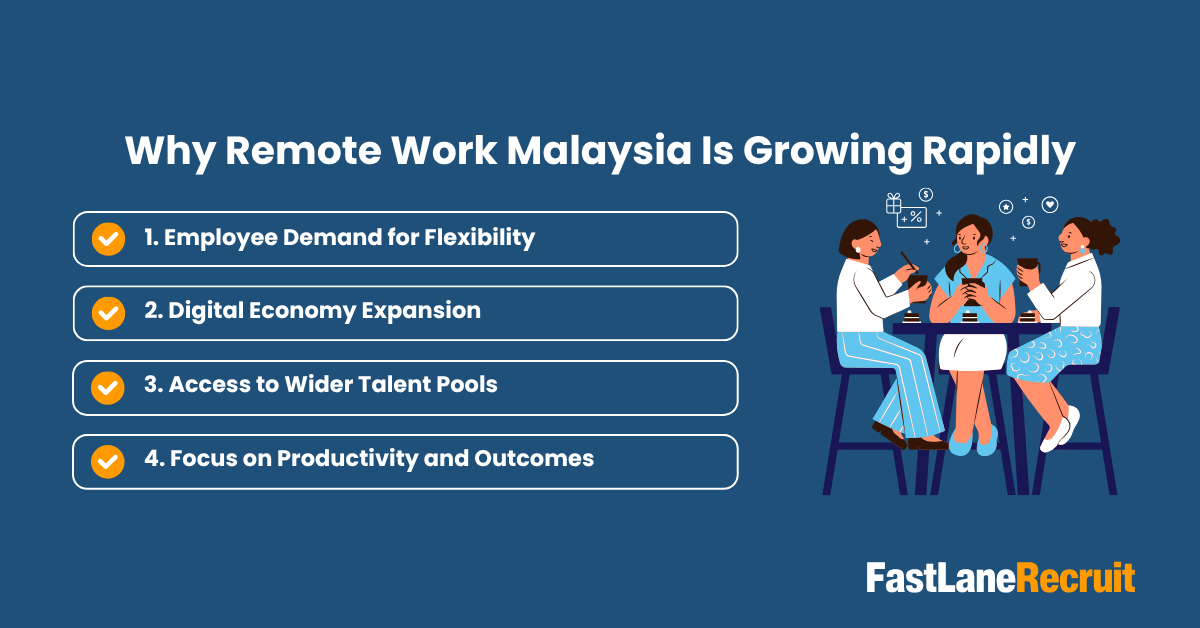
Key Growth Drivers
1. Employee Demand for Flexibility
Today’s workforce values flexibility more than ever. Many professionals want the option to work from home or follow a hybrid schedule instead of commuting daily.
Studies show that over 70% of employees prefer remote and hybrid work arrangements. This is especially important in cities where commuting can take hours each day.
Example: A marketing executive in Kuala Lumpur may choose a hybrid setup to avoid daily traffic while still attending in-person meetings when needed. This improves both productivity and job satisfaction.
2. Digital Economy Expansion
Malaysia’s digital economy is growing quickly, creating more jobs that can be done remotely. Industries like technology, finance, shared services, and digital marketing are leading this shift. According to the Department of Statistics Malaysia, the digital sector continues to contribute a significant share to the country’s GDP. This means more roles are becoming “remote-ready.”
Example: A global company can hire a Malaysian software developer or data analyst who works entirely online using cloud platforms and collaboration tools.
3. Access to Wider Talent Pools
Remote work allows companies to hire talent from anywhere in Malaysia, not just major cities like Kuala Lumpur.
This opens up opportunities to tap into skilled professionals in other regions who may prefer remote work but still have strong qualifications and experience.
Example: Instead of hiring only in Kuala Lumpur, a company can build a remote team with employees based in Penang, Johor, or Sabah, increasing access to diverse talent.
4. Focus on Productivity and Outcomes
Many businesses are moving away from traditional “9-to-5 office hours” and focusing more on results. What matters now is the quality of work and meeting goals, not where the work is done.
Remote and hybrid work models support this shift by allowing employees to work in environments where they are most productive.
Example: A finance team working remotely may use digital tools to track performance and deadlines, ensuring tasks are completed efficiently without needing constant supervision.
What This Means for Employers
For global companies, these trends make Malaysia an attractive destination to build a remote team:
- You can hire skilled professionals across different regions
- You can improve productivity with flexible work models
- You can scale your offshore team more efficiently
Remote work in Malaysia is growing because it benefits both businesses and employees, making it a sustainable and long-term strategy.
Also Read: Offshoring Talent: Guide to Building a Successful Offshore Team
Why Global Companies Are Building Remote Teams in Malaysia
Malaysia is becoming an increasingly popular choice for global companies looking to build a remote team or offshore team. It offers a strong mix of skilled professionals, reliable infrastructure, and a business-friendly environment.
For companies expanding into Asia or looking to support global operations, Malaysia provides a practical and scalable solution for remote hiring.
Key Advantages
| Factor | Why It Matters | Example |
| Skilled Workforce | Malaysia has a well-educated talent pool with strong capabilities in tech, finance, digital marketing, and shared services | A UK-based company hires Malaysian developers and accountants to support global operations |
| English Proficiency | English is widely used in business, making communication smooth across international teams | A US company manages a remote team in Malaysia without language barriers |
| Time Zone Advantage | Malaysia’s time zone overlaps with Asia-Pacific and partially with Europe, enabling real-time collaboration | A company with teams in Singapore, Malaysia, and the UK can align working hours easily |
| Digital Infrastructure | High internet penetration, fibre broadband, and expanding 5G support remote work at scale | A remote customer support team in Malaysia can handle global clients with stable connectivity |
| Business Environment | Government policies support digital growth, flexible work, and foreign investment | Companies can hire and manage remote employees with clearer regulatory support |
Real-World Example: Building an Offshore Team in Malaysia
To better understand how companies benefit, here’s a simple example:
Scenario:
A fast-growing Australian startup wants to expand its operations but needs skilled talent across different functions.
Solution:
They build a remote team in Malaysia by hiring:
- A software developer
- A digital marketer
- A finance executive
Outcome:
- Faster hiring compared to local markets
- Access to skilled professionals across multiple roles
- Smooth collaboration due to English proficiency and time zone overlap
Why This Matters for Global Employers
Choosing the right location is key when building a remote team. Malaysia stands out because it offers:
- Access to high-quality talent across multiple industries
- A stable and connected digital environment
- The ability to scale teams efficiently across regions
- A supportive ecosystem backed by government initiatives
For companies looking to grow internationally, Malaysia is not just an alternative, it’s a strategic advantage for building high-performing remote teams.
Also Read: What Is an Onshore and Offshore Team?
Real-World Adoption: How Companies in Malaysia Are Embracing Hybrid Work
Many established organizations have already implemented remote and hybrid work strategies:
- Maybank enables hybrid arrangements for its workforce
- PETRONAS introduced flexible work policies
- Tech firms and startups are hiring fully remote teams across regions
At the same time, global investments from companies like Google and Microsoft continue to strengthen Malaysia’s digital ecosystem.
In-Demand Roles for Remote Teams in Malaysia
If you’re planning to build a remote team, these roles are highly востребованные:
| Role | Remote Suitability | Key Skills |
| Software Developer | High | Programming, cloud, DevOps |
| Data Analyst | High | Analytics, BI tools |
| Digital Marketer | High | SEO, paid ads, CRM |
| Accountant | Medium–High | Financial systems, reporting |
| HR Specialist | Medium | HRIS, compliance |
Legal and Compliance: What Employers Need to Know
When hiring a remote team in Malaysia, understanding basic legal and compliance requirements is important. The country has updated its employment framework to support modern work arrangements, including remote and hybrid work.
These updates help both employers and employees operate with more clarity and flexibility.
Key Considerations
1. Flexible Work Arrangements (FWA)
Employees in Malaysia have the right to request flexible work arrangements. This can include changes to:
- Working hours
- Working days
- Work location (remote or hybrid)
Employers are required to review these requests and respond formally.
Example:
An employee may request to work remotely three days a week. The employer can approve it or provide a clear business reason if it’s not suitable for the role.
2. Formal Employer Response
If an employee submits a flexible work request, the employer must respond in writing. If the request is declined, valid reasons must be provided such as operational needs or client-facing responsibilities.
This creates a more transparent and structured process for managing hybrid or remote setups.
3. Working Hours Regulations
Malaysia’s standard working hours are capped at 45 hours per week. This applies whether employees are working in the office or remotely.
For employers managing a remote team, this means:
- Tracking working hours still matters
- Overtime and labour compliance must be considered
4. Growing Protection for Gig and Contract Workers
Malaysia is also strengthening protections for freelancers and gig workers. This includes:
- Clear contracts and payment terms
- Social security coverage (where applicable)
- Better dispute resolution mechanisms
This is especially relevant if you plan to hire project-based or contract remote talent.
What This Means for Employers
For global companies, Malaysia offers:
- A clear framework for flexible work
- Increasing protection for different types of workers
- A stable environment to build and manage remote teams
However, managing compliance, payroll, and contracts across borders can still be complex, especially without a local entity.
Also Read: Essential Elements to Include in a Remote Work Policy
Infrastructure: Is Malaysia Ready for Remote Teams?
The short answer is yes and it continues to improve.
Malaysia has invested heavily in digital infrastructure, making it well-equipped to support remote work at scale. This allows companies to confidently hire and manage offshore teams without worrying about connectivity issues.
Key Infrastructure Strengths
1. Nationwide Internet Connectivity
Malaysia has high internet penetration, with strong coverage in both urban and many semi-urban areas. Fibre broadband is widely available, and speeds continue to improve.
Example:
A remote employee in Penang or Johor can reliably join video calls, access cloud systems, and collaborate with global teams.
2. 5G and Digital Expansion
The country is actively rolling out 5G networks, improving speed and reliability for remote work. This supports data-heavy roles such as:
- Software development
- Data analytics
- Digital design
3. Growing Coworking Ecosystem
Coworking spaces are becoming more popular, especially for hybrid workers who want a structured work environment outside their homes.
These spaces provide:
- Reliable internet
- Meeting rooms
- Networking opportunities
Example:
A remote team member may work from home most days but use a coworking space for meetings or focused work sessions.
4. Government-Led Digital Initiatives
Programs like JENDELA (National Digital Network Plan) aim to improve connectivity across the country, including rural areas.
This ensures that remote work opportunities are not limited to major cities.
What This Means for Employers
For companies building a remote team in Malaysia, strong infrastructure means:
- Reliable communication and collaboration
- Fewer disruptions to daily operations
- Ability to hire talent from multiple regions
Overall, Malaysia’s infrastructure supports long-term remote and hybrid work strategies, making it a dependable choice for global hiring.
Also Read: 6 Fastest Growing Remote Hiring Destinations in 2025
Benefits of Remote and Hybrid Work
Remote and hybrid work models offer clear advantages for both businesses and employees. When implemented well, they can improve productivity, support business growth, and create a more positive work experience.
For Employers
1. Reduced Operational Costs
One of the most immediate benefits is lower overhead expenses. Companies can reduce spending on:
- Office rent
- Utilities (electricity, water, maintenance)
- Office equipment and space
This allows businesses to reallocate resources into growth areas such as technology, talent development, or expansion.
Example: A company building a remote team in Malaysia may not need a large physical office, helping reduce operational costs while still maintaining productivity.
2. Faster Hiring Across Regions
Remote work removes geographical limits. Employers can hire the best talent regardless of location, which speeds up the recruitment process.
Instead of competing only within one city, companies can access talent across the entire country, or even globally.
Example: If a company cannot find a suitable candidate in Kuala Lumpur, they can hire a skilled professional from Penang or Johor without requiring relocation.
3. Increased Productivity and Efficiency
Many companies report that remote employees are more productive. This is often due to:
- Fewer workplace distractions
- Flexible working hours
- More comfortable work environments
Employees can focus better and manage their time more effectively.
Example: A developer working remotely may complete tasks faster without interruptions from office meetings or commuting fatigue.
4. Improved Employee Retention
Offering remote or hybrid work options makes companies more attractive to employees. Flexibility has become a key factor in job satisfaction.
When employees feel trusted and supported, they are more likely to stay long-term.
Example: A company that allows hybrid work may retain experienced staff who would otherwise leave for more flexible opportunities.
For Employees
1. Better Work-Life Balance
Remote and hybrid work help employees manage their personal and professional lives more effectively. They can spend more time with family, focus on personal well-being, and reduce stress.
Example: An employee can plan their day around both work tasks and personal commitments without being tied to a strict office schedule.
2. Time Savings from Reduced Commuting
One of the biggest benefits is eliminating daily travel. Employees save time that would otherwise be spent commuting, especially in busy cities.
This saved time can be used for:
- Rest and recovery
- Skill development
- Personal activities
Example: Instead of spending 1–2 hours commuting daily, an employee can start work earlier or use that time more productively.
3. Greater Flexibility and Autonomy
Remote work gives employees more control over how they work. They can choose environments and schedules that suit their productivity levels.
This often leads to higher job satisfaction and better performance.
Example: A digital marketer may choose to work during their most productive hours, whether that’s early morning or later in the day, as long as deadlines are met.
Why This Matters
For both employers and employees, remote and hybrid work create a more flexible and efficient way of working. Businesses can scale their remote team more effectively, while employees benefit from improved quality of life.
This balance is one of the key reasons why remote work Malaysia continues to grow and why more companies are adopting hybrid and remote work strategies.
Also Read: Managing Remote Teams Best Practices
Challenges of Managing a Remote Team (And How to Solve Them)
| Challenge | Solution |
| Communication gaps | Use structured tools like Slack, Zoom, and clear reporting |
| Productivity tracking | Focus on outcomes, not hours |
| Team culture | Schedule regular check-ins and virtual team activities |
| Work-life boundaries | Encourage defined working hours |
| Cybersecurity | Implement secure systems and employee training |
Practical Tips for Building a Remote Team in Malaysia
Building a high-performing remote or hybrid team requires more than just hiring talent. Companies need clear structures, the right tools, and supportive practices to ensure productivity, engagement, and compliance.
1. Define Clear Roles and Expectations
Clarity is key when managing remote teams. Employees should know their responsibilities, goals, and reporting structure.
Tips:
- Create detailed job descriptions that outline tasks and deliverables.
- Set measurable goals and deadlines to track performance.
- Schedule regular check-ins to maintain alignment and address issues promptly.
Example: A shared services manager in a remote Malaysian team could have weekly goals for payroll processing, compliance reporting, and team coordination, ensuring accountability without micromanagement.
2. Use Reliable Collaboration Tools
Effective communication is the backbone of any remote team. Using the right tools helps teams stay connected and productive.
Recommended tools:
- Project Management: Asana, Trello, Jira
- Communication: Slack, Microsoft Teams, Zoom
- File Sharing: Google Drive, Dropbox, OneDrive
Example: A hybrid digital marketing team in Malaysia can use Slack for daily messaging, Zoom for weekly team meetings, and Google Drive for sharing campaign assets, keeping everyone in sync regardless of location.
3. Focus on Skills, Not Location
Hiring based on skills ensures you get the best talent while remote work eliminates geographic restrictions.
Tips:
- Assess candidates through skill-based tests or practical projects.
- Prioritize remote work competencies like self-management, communication, and digital literacy.
Example: Instead of limiting hiring to Kuala Lumpur, a software company can hire a front-end developer in Johor with the same expertise, creating a diverse and capable remote team.
Also Read: Singapore Companies Hire Remote Employees from Malaysia
4. Ensure Compliance with Local Employment Laws
Remote work comes with legal responsibilities. Understanding Malaysia’s employment laws is crucial to avoid penalties and ensure fair treatment.
Key points:
- Flexible Work Arrangements (FWA) requests must be considered and formally responded to.
- Standard work hours are capped at 45 hours per week.
- Gig workers and freelancers have growing protections.
- For foreign hires, programs like the
DE Rantau Nomad Pass
allow legal work arrangements.
Example: A company hiring remote talent in Malaysia should ensure contracts are clear on working hours, deliverables, and statutory benefits like EPF and SOCSO contributions.
5. Invest in Onboarding and Training
A strong onboarding process helps new hires integrate quickly, even if they never step into a physical office. Continuous training keeps remote teams aligned and up-to-date.
Tips:
- Provide digital onboarding kits with company policies, tools, and workflows.
- Schedule virtual orientation sessions to introduce teams and culture.
- Offer regular upskilling programs and workshops to maintain productivity.
Example: A remote HR team in Malaysia could have a two-week virtual onboarding program, including software tutorials, compliance training, and team-building activities conducted online.
Bonus Tip: Foster Engagement and Culture
Remote teams need deliberate efforts to maintain culture and engagement:
- Virtual coffee chats or team-building activities
- Recognition programs to celebrate achievements
- Open communication channels for feedback
Example: A fully remote offshore team might have monthly virtual town halls to recognize top performers, share updates, and strengthen team cohesion.
These strategies help companies build remote teams in Malaysia that are not only productive but also motivated, compliant, and connected, laying the foundation for long-term success.
Also Read: The Ultimate Playbook for Building and Integrating Offshore Teams
Hiring Malaysian Talent: A Smarter Approach with EOR
Building a remote or hybrid team in Malaysia offers huge opportunities, but managing local employment regulations, payroll, taxes, and compliance can be complex and time-consuming, especially for companies without a local presence.
This is where an Employer of Record (EOR) solution can simplify everything.
How EOR Works
An EOR acts as the official employer for your Malaysian team while you retain full control over day-to-day tasks and operations. This means you can hire talent, manage projects, and scale your workforce without the need to establish a legal entity in Malaysia.
Benefits of Using FastLaneRecruit’s EOR Service
1. Hire Malaysian Talent Quickly Without Setting Up a Local Entity
You can onboard full-time employees in Malaysia almost immediately, bypassing the legal complexities of company registration.
Example: A tech startup in Singapore wants to hire software developers in Kuala Lumpur. With EOR, they can legally employ the talent in weeks rather than months, without creating a separate Malaysian company.
2. Ensure Compliance With Employment Laws and Payroll Regulations
FastLaneRecruit handles local statutory requirements including:
- Employment contracts compliant with the Employment Act 1955
- EPF, SOCSO, and tax contributions
- Flexible work arrangement requests (FWA) and gig worker compliance
This protects your business from legal risk while keeping your remote team fully compliant.
3. Seamless Management of Contracts, Benefits, and Onboarding
EOR solutions streamline HR processes such as:
- Drafting employment agreements
- Managing payroll and statutory benefits
- Conducting digital onboarding and orientation
Example: A finance company hires a remote accountant in Penang. FastLaneRecruit manages payroll, social security contributions, and onboarding forms, so the company can focus on work outcomes rather than paperwork.
4. Scale Your Offshore Team Quickly and Efficiently
Whether you’re adding one role or building an entire team, EOR allows you to scale without extra administrative burden. You can expand your remote or hybrid workforce as business needs grow.
Example: An e-commerce company wants to hire a 10-person remote marketing team in Malaysia. With EOR, they can recruit, onboard, and pay staff in a fraction of the time it would take to set up a local branch.
Why EOR Is a Smart Choice
- Reduces time and cost associated with legal entity setup
- Minimizes risk by ensuring compliance with local regulations
- Provides flexibility to test new markets or pilot remote teams
- Lets your company focus on outcomes and growth rather than administrative tasks
Whether you’re exploring Malaysia as a new market or expanding your existing remote team, FastLaneRecruit’s EOR service offers a flexible, low-risk, and efficient way to hire the right talent and manage them effectively.
Conclusion
Remote and hybrid work in Malaysia is no longer a trend, it’s a long-term shift shaping how businesses operate globally.
With strong infrastructure, supportive policies, and a highly skilled workforce, Malaysia offers a compelling destination for companies looking to build remote teams.
For global employers, the opportunity is clear: Access talent, increase flexibility, and scale smarter with the right hiring strategy.
If you’re exploring how to hire and manage a remote team in Malaysia, FastLaneRecruit is ready to support your journey.
Ready to Build Your Remote Team in Malaysia?
Expanding your workforce in Malaysia doesn’t have to be complicated. With FastLaneRecruit’s EOR service, you can hire top Malaysian talent quickly, stay fully compliant with local laws, and manage payroll, benefits, and onboarding, all without setting up a local entity.
Whether you’re testing a new market, scaling your offshore team, or building a hybrid workforce, our EOR solution makes the process simple, flexible, and low-risk.
Take the next step: Start building your high-performing remote team in Malaysia today. Contact FastLaneRecruit to learn how we can help you hire, manage, and scale your offshore talent seamlessly.