
A Complete Guide for Global Employers
Malaysia is now a strategic hiring destination for global companies seeking System Administrators. Malaysia offers a strong IT talent pool, competitive salary expectations, multilingual professionals, and a business-friendly environment.
Before hiring, employers must understand Malaysia’s employment laws to ensure proper compliance, especially if you’re hiring remotely or managing cross-border teams. Getting the basics right protects both the employer and the talent.
This guide walks you through everything you need to know about Malaysia’s employment laws for System Administrators, from statutory requirements and compliance tips. You’ll also learn about a streamlined solution: partnering with FastLaneRecruit’s Employer of Record (EOR), which lets you legally hire System Administrators in Malaysia without the need to set up a local entity.
Content Outline
Key Summary
Malaysia’s Advantage for SysAdmins
Skilled IT workforce, competitive salaries, English proficiency, mature infrastructure, and supportive government policies.
Employment Laws & Compliance
Follow the Employment Act 1955, Industrial Relations Act, EPF, SOCSO, EIS, and income tax obligations to stay compliant.
Employee Classification
SysAdmins under employer control with recurring wages are employees; misclassification can result in penalties.
Contracts & Working Terms
Include responsibilities, working hours, on-call duties, salary, leave, NDAs, IP ownership, and cybersecurity policies.
Payroll, Statutory Contributions & Leave
Ensure accurate EPF, SOCSO, EIS, and tax deductions; provide statutory leave entitlements and consider flexible policies.
Data Security & IT Access
Clearly define admin access, offboarding, IP assignment, and compliance frameworks (e.g., SOC 2, ISO 27001) in contracts.
FastLaneRecruit EOR Solution
Hire Malaysian SysAdmins without a local entity, FastLaneRecruit manages payroll, HR, statutory compliance, contracts, and onboarding.
Why Malaysia Is a Top Location for Hiring System Administrators
Malaysia has emerged as one of Southeast Asia’s fastest-growing technology hub and the momentum isn’t slowing down. With fast-growing sectors like telecommunications, cybersecurity, fintech, software development, cloud computing, and digital infrastructure, the country’s tech ecosystem is expanding at full speed.
As more businesses embrace digital transformation, the role of System Administrators (SysAdmins) has become more crucial. They’re the people behind the scenes who keep everything running from servers and cloud platforms to network security and enterprise systems. Their work ensures systems remain stable, secure, and optimised, enabling uninterrupted business operations.
For global companies looking to expand their IT teams, Several structural advantages position Malaysia as an ideal market for hiring System Administrators.:
- Strong English Proficiency
Malaysia is a multilingual country, but English is widely used in business and education. Most IT professionals, including SysAdmins, are fluent in English, making communication with international teams seamless and reducing potential language barriers in cross-border operations. - Competitive Labour Costs
Compared to countries like Singapore, Australia, or the United States, Malaysia offers highly competitive labour costs. While Malaysian SysAdmins are well-trained and experienced, salaries are typically lower than in more developed markets. This allows global companies to access top IT talent while managing costs effectively. - Skilled IT Workforce and Education System
Malaysia has a growing pool of IT professionals trained in both local universities and international programs. Many SysAdmins hold certifications such as AWS, Microsoft Azure, Linux, Cisco, and cybersecurity qualifications. This skilled workforce ensures that businesses can find talent capable of managing complex IT environments. - Mature Digital Infrastructure
Malaysia’s IT infrastructure, including high-speed internet, cloud services, and modern data centres, is well-developed. This infrastructure enables efficient remote operations, cloud administration, and ongoing system monitoring—essential for system administration roles. - Time Zone Compatibility with APAC, Europe, and Parts of the US
Malaysia is strategically located in the GMT+8 time zone, allowing overlap with teams in Asia-Pacific, Europe, and even parts of the US. This time zone advantage makes it easier to manage international IT operations and provide round-the-clock system support. - Supportive Government Policies for Digital Economy Growth
The Malaysian government has introduced initiatives to attract foreign investment in the tech sector and strengthen the digital economy. Programs supporting workforce development, technology adoption, and industry-specific regulations make it easier for global companies to hire IT talent while remaining compliant.
Also Read: Top 15 Business Consulting Firms in Australia
Despite these advantages, hiring System Administrators in Malaysia requires careful attention to employment laws and compliance requirements. Whether hiring full-time employees, remote workers, or cross-border teams, companies must adhere to regulations such as:
- Employment Act 1955 – Covers contracts, working hours, leave entitlements, and termination procedures.
- Industrial Relations Act 1967 – Governs employment disputes, unfair dismissal claims, and collective bargaining.
- EPF (Employees Provident Fund), SOCSO (Social Security), and EIS (Employment Insurance System) – Mandatory contributions for employee social security and retirement benefits.
- Income Tax Obligations – Includes proper withholding for Malaysian tax purposes.
Understanding these legal requirements is essential for maintaining full compliance, avoiding penalties, and creating a fair, secure work environment for System Administrators. This guide will provide a comprehensive overview of what global employers need to know to successfully hire and manage SysAdmins in Malaysia.
Overview of Malaysian Employment Laws for System Administrators
When hiring System Administrators (SysAdmins) in Malaysia, it’s essential to understand the legal framework that governs employment. Malaysia’s labour laws apply to all employees, including IT professionals, though some provisions in the Employment Act 1955 (Amendment 2022) primarily target employees earning RM4,000 or below per month. For higher-earning roles, such as senior SysAdmins or IT managers, many companies still apply the Employment Act standards as best practice. Doing so ensures fairness, reduces legal risk, and aligns with HR compliance expectations.
Below is a detailed overview of the key legislation that affects IT and technology roles in Malaysia:
| Law / Regulation | Purpose and Relevance for System Administrators |
| Employment Act 1955 | This is the cornerstone of Malaysia’s employment law. It sets minimum standards for employment contracts, wages, working hours, overtime, annual leave, sick leave, maternity/paternity leave, and termination procedures. For SysAdmins earning below RM4,000, statutory overtime rates and rest day compensations apply. Even for higher-paid IT professionals, following EA principles helps prevent disputes and demonstrates fair HR practices. |
| Industrial Relations Act 1967 | Regulates employment disputes, unfair dismissal claims, and union-related rights. If a SysAdmin is terminated without just cause or proper procedure, this Act governs how claims are handled in Industrial Courts. Understanding this helps employers manage performance issues, disciplinary actions, and redundancies lawfully. |
| Labour Ordinances (Sabah & Sarawak) | East Malaysia (Sabah and Sarawak) has its own labour ordinances, which are broadly similar to the Employment Act. Companies hiring SysAdmins in these states must comply with local regulations regarding working hours, leave entitlements, and termination. |
| Employees Provident Fund (EPF) Act 1991 | EPF is Malaysia’s mandatory retirement savings scheme. Employers contribute 12–13% of an employee’s salary, while employees contribute 11%. This applies to local and certain foreign employees, ensuring long-term financial security for the workforce. For IT roles, proper EPF contributions are mandatory to avoid fines. |
| SOCSO Act 1969 & Employment Insurance System (EIS) Act 2017 | SOCSO provides social security protection against workplace injuries, invalidity, and dependents’ benefits, while EIS supports unemployment benefits and job search assistance. Both require employer contributions and are applicable to most System Administrators in Malaysia. |
| Income Tax Act 1967 (MTD / PCB) | Employers are responsible for withholding income tax via Monthly Tax Deduction (MTD/PCB) from employee salaries and remitting it to the Inland Revenue Board (LHDN). This includes foreign employees with valid work passes. Accurate payroll reporting ensures compliance with tax obligations and avoids penalties. |
Key Takeaways for Employers Hiring System Administrators in Malaysia:
- Even if SysAdmins earn above RM4,000, following Employment Act guidelines for contracts, leave, and overtime is considered best practice.
- Ensure that all payroll deductions (EPF, SOCSO, EIS, tax) are calculated correctly for each employee.
- Be aware of regional differences for hires in Sabah or Sarawak.
- Document contracts, leave records, working hours, and termination processes to comply with regulatory inspections.
- Understand the Industrial Relations Act for handling disputes or termination issues fairly and legally.
Official Resources for Reference:
By understanding and implementing these laws, global companies can hire and manage System Administrators effectively in Malaysia while ensuring full compliance, avoiding penalties, and creating a fair, secure work environment for IT professionals.
Also Read: Top 15 HR SaaS Platforms in Australia
Who Is Considered an Employee in Malaysia?
For System Administrators (SysAdmins), understanding who qualifies as an employee versus an independent contractor is crucial for legal compliance. Misclassification can result in penalties, back pay, and social security liabilities.
A SysAdmin qualifies as an employee when the following conditions are met under Malaysian labour laws:
- Contract of Service
- They work under a contract of service, which can be written or verbal, defining the employment relationship.
- Example: A SysAdmin hired full-time to manage a company’s servers and network infrastructure.
- Employer Control
- The company directs work schedules, responsibilities, and processes.
- Example: The employer sets weekly on-call rosters and monitors system uptime performance.
- Provision of Tools and Equipment
- The employer provides essential tools such as servers, network access credentials, laptops, VPN access, or other IT infrastructure.
- The employer provides essential tools such as servers, network access credentials, laptops, VPN access, or other IT infrastructure.
- Regular Payment of Wages
- Employees receive recurring wages (monthly or bi-weekly), which distinguishes them from contractors paid per project or milestone.
Key Distinction:
- Contract of Service (Employee): Employer controls how, when, and where the work is performed. Social security, EPF, SOCSO, and tax obligations apply.
- Contract for Service (Independent Contractor): Freelancer or consultant provides services independently, usually with a fixed fee per project. Social security contributions are not mandated.
Misclassification exposes employers to fines, legal consequences, and statutory back-payments for unpaid statutory contributions.
Employment Contracts for System Administrators
All contracts exceeding one month must be in writing and clearly outline the employment terms. For IT roles, clarity in contracts protects both the company and the SysAdmin, especially given the sensitive nature of their work.
A well-drafted contract should include:
- Job Title and Responsibilities
- Examples: Network administration, cloud management, cybersecurity, database management, system patching, backup and recovery.
- Examples: Network administration, cloud management, cybersecurity, database management, system patching, backup and recovery.
- Work Location
- Onsite, hybrid, or fully remote, including travel obligations for data centers or office visits.
- Onsite, hybrid, or fully remote, including travel obligations for data centers or office visits.
- Working Hours and On-Call Expectations
- Include regular hours, standby periods, and after-hours support obligations.
- Include regular hours, standby periods, and after-hours support obligations.
- Salary, Allowances, and Bonuses
- Include fixed salary, performance bonuses, on-call allowances, and overtime policies (if applicable).
- Include fixed salary, performance bonuses, on-call allowances, and overtime policies (if applicable).
- Leave Entitlements
- Annual, sick, maternity/paternity leave as per Employment Act and company policy.
- Annual, sick, maternity/paternity leave as per Employment Act and company policy.
- Termination Clauses
- Notice periods, grounds for dismissal, and severance provisions.
- Notice periods, grounds for dismissal, and severance provisions.
- Confidentiality and Data Security Obligations
- Strong clauses protecting access to servers, cloud systems, and sensitive business data.
- Strong clauses protecting access to servers, cloud systems, and sensitive business data.
- Intellectual Property (IP) Ownership and Access Control Policies
- Ensure the company retains ownership of code, scripts, or configurations created by SysAdmins.
- Ensure the company retains ownership of code, scripts, or configurations created by SysAdmins.
- Non-Disclosure Agreements (NDAs)
- Critical for roles with access to customer data, proprietary systems, and cybersecurity operations.
Additional Considerations for System Administrators:
Because SysAdmins often manage mission-critical systems, include IT-specific clauses such as:
- Access control policies (who can access what systems and under what conditions)
- Cybersecurity responsibilities and mandatory compliance with company security protocols
- Asset protection clauses covering company-owned devices and licenses
- Data privacy obligations under Malaysian PDPA (Personal Data Protection Act)
Also Read: Top 20 Collaboration Tools in Australia
Working Hours, On-Call Duties, and Overtime for System Administrators
System Administrators frequently work outside standard office hours due to the nature of IT operations. Tasks may include:
- Server maintenance and health checks
- System patching and updates
- Incident response and troubleshooting outages
- Infrastructure upgrades and migrations
- Backup verification and disaster recovery
Legal Working Hours (Employment Act)
- Maximum: 8 hours per day, 45 hours per week
- Overtime rules apply primarily to employees earning RM4,000 or below, or roles in certain industries with special provisions.
- Many employers voluntarily compensate overtime or provide time-off-in-lieu for SysAdmins, even when not legally required, to maintain workforce satisfaction.
Recommended Best Practices for SysAdmins
- Document After-Hours Expectations: Clearly define on-call schedules and emergency responsibilities in the employment contract.
- On-Call Allowance: Provide compensation for weekends, public holidays, or extended emergency responses.
- Time Off in Lieu: Allow additional leave for significant disruptions or extended overtime work.
- Emergency Response Protocols: Ensure the SysAdmin knows the escalation process, communication channels, and reporting structure.
Example Scenario:
A Singapore-based SaaS company hires a Malaysian SysAdmin to monitor cloud infrastructure. The contract includes:
- A rotational on-call schedule for weekends
- Weekend and public holiday allowances
- Clear emergency response compensation
This approach aligns with Employment Act requirements, reduces compliance risk, and motivates the SysAdmin to perform critical tasks efficiently.
Minimum Wage Requirements for System Administrators
As of 2023, the national minimum wage in Malaysia is RM1,500 per month. This sets the legal baseline for all employees, including System Administrators (SysAdmins).
However, in practice, SysAdmins typically earn significantly higher wages, reflecting their specialized skills and critical role in IT infrastructure. Factors affecting salaries include:
- Experience Level: Junior SysAdmins might start around RM3,000, while senior or specialized professionals can earn RM6,000–RM8,000+ per month.
- Industry: Tech-heavy sectors such as fintech, cloud computing, cybersecurity, and SaaS often offer higher compensation.
- Certifications: Skills verified by AWS, Azure, Linux, CISCO, or VMware certifications can command premium salaries.
- Scope of Responsibility: SysAdmins handling cross-border IT infrastructure or mission-critical systems may receive additional allowances and bonuses.
Key Takeaway for Employers:
Even though the minimum wage is RM1,500, offering competitive pay is essential to attract and retain skilled IT talent. Companies should benchmark salaries against market rates and consider certifications and on-call responsibilities.
Also Read: Top 20 Accounting BPO Providers in Australia
Statutory Contributions and Payroll Requirements for Hiring System Administrators
When hiring SysAdmins in Malaysia, employers must comply with mandatory statutory contributions. This ensures both legal compliance and social protection for employees.
Employer Obligations
| Statutory Item | Employer Contribution | Employee Contribution |
| EPF (Retirement Fund) | 12–13% | 11% |
| SOCSO (Social Security) | 1.75% | 0.5% |
| EIS (Employment Insurance System) | 0.2% | 0.2% |
| Monthly Tax Deduction (PCB/MTD) | Employer withholds | Based on schedule |
Why This Matters for System Administrators
- SysAdmins often work with remote teams or hybrid schedules. Employers must correctly calculate contributions regardless of work location or reporting line.
- Incorrect contributions can result in legal penalties, fines, or reputational risks for multinational companies.
- Using automated HR and payroll software, such as MiHCM, ensures statutory deductions are calculated accurately for IT staff.
Best Practice:
Include clear payroll policies in the employment contract and provide employee access to contribution statements, ensuring transparency.
Leave Entitlements for System Administrators
Malaysia’s labour laws guarantee several types of leave to all employees, including tech professionals. These entitlements are critical for IT staff, who often work long hours or on-call shifts.
Annual Leave
| Years of Service | Minimum Days |
| 1–2 years | 8 days |
| 2–5 years | 12 days |
| 5+ years | 16 days |
Sick Leave
- 14–22 days per year, depending on tenure.
- Hospitalisation leave: up to 60 days, inclusive of sick leave.
Maternity Leave
- Up to 98 days for private-sector employees.
Public Holidays
- 11 gazetted days annually, with additional state holidays where applicable.
Tip for Global Employers:
- Many tech companies enhance leave policies beyond statutory requirements to attract top talent.
- Flexible scheduling, remote work options, and compensatory leave for on-call duties are common in the IT sector.
Termination, Resignation, and Unfair Dismissal (Critical for IT/Admin Roles)
System Administrators often manage sensitive IT systems, customer data, and intellectual property. Termination must therefore be handled carefully to avoid disputes and protect business assets.
Employer Responsibilities
- Provide reasonable notice based on contract terms.
- Document performance issues and maintain a record of incidents or system failures.
- Issue written warnings before termination where applicable.
- Conduct a fair inquiry before ending employment.
Legal Protections
- Under the Industrial Relations Act 1967, employees can file claims for unfair dismissal if termination is not justified.
- Employment disputes are resolved through the Industrial Relations Department
Practical Recommendations for IT Roles
- Include data access revocation clauses in termination procedures.
- Ensure handover protocols for servers, cloud accounts, and system credentials.
- Use exit checklists to mitigate security risks.
- Maintain documentation of on-call schedules, incidents, and employee performance, which may be crucial in case of legal claims.
Clear HR policies and adherence to statutory requirements help protect both the company and the System Administrator during employment transitions.
Also Read: Top 20 EOR Services in Australia
Data Security, Access Rights, and IP Ownership for System Administrators
For System Administrators (SysAdmins), data security and access management are central to their role. They often have full administrative access to servers, cloud environments, networks, and critical corporate data, making contractual and operational safeguards essential.
Key Responsibilities of System Administrators
SysAdmins typically manage:
- User credentials and authentication systems
- Production servers and databases
- Cloud platforms (AWS, Azure, Google Cloud)
- Sensitive corporate data and client information
- Network and firewall configurations
- Incident response and cybersecurity monitoring
What Should Be Included in Employment Contracts
To protect both the employer and the employee, contracts should clearly define:
- Non-Disclosure Agreements (NDAs):
- Protects confidential corporate and client information.
- Restricts disclosure of system credentials, project details, and trade secrets.
- Data Classification Policies:
- Defines levels of data sensitivity (e.g., public, internal, confidential).
- Specifies handling, storage, and sharing protocols.
- Admin Access Protocols:
- Defines which systems the SysAdmin can access and under what conditions.
- Includes logging, monitoring, and approval processes.
- Offboarding Procedures:
- Immediate revocation of all access upon resignation or termination.
- Secure retrieval of hardware, tokens, and credentials.
- Intellectual Property (IP) Assignment:
- Ensures that any software, scripts, or configurations developed during employment belong to the employer.
- Ensures that any software, scripts, or configurations developed during employment belong to the employer.
- Security Compliance Frameworks:
- For sensitive industries, contracts may reference SOC 2, ISO 27001, or NIST standards.
Example:
A US fintech company hiring a Malaysian SysAdmin includes clauses requiring adherence to SOC 2, ISO 27001, and NIST standards to protect sensitive financial data.
Also Read: Top 15 Recruitment Agencies in Australia
Compliance Challenges When Hiring System Administrators in Malaysia
Employers often face several hurdles when hiring IT professionals in Malaysia:
Common Challenges
- Employee misclassification: Hiring a SysAdmin as a contractor when they meet the criteria of an employee under the Employment Act 1955 can result in penalties.
- Incorrect statutory contributions: EPF, SOCSO, and EIS contributions must be accurately calculated and remitted.
- On-call and standby allowances: Tracking and compensating SysAdmins for after-hours or emergency work can be complex.
- Remote work tax implications: Cross-border reporting and taxation must comply with Malaysian law.
- IT access for distributed teams: Structuring secure, auditable access for cloud and internal systems.
- Regionally compliant contracts: Employment agreements must align with Malaysian labour law, even for senior IT professionals earning above RM4,000.
Tips for Global Employers
- Always provide a written contract following Employment Act (EA) best practices.
- Document all performance, disciplinary, and on-call actions.
- Maintain secure and auditable IT access management systems.
- Conduct regular compliance audits to mitigate legal and operational risks.
- Use trusted payroll systems integrated with Malaysian statutory requirements to avoid errors.
Example: A Global Company Hiring a Malaysian System Administrator
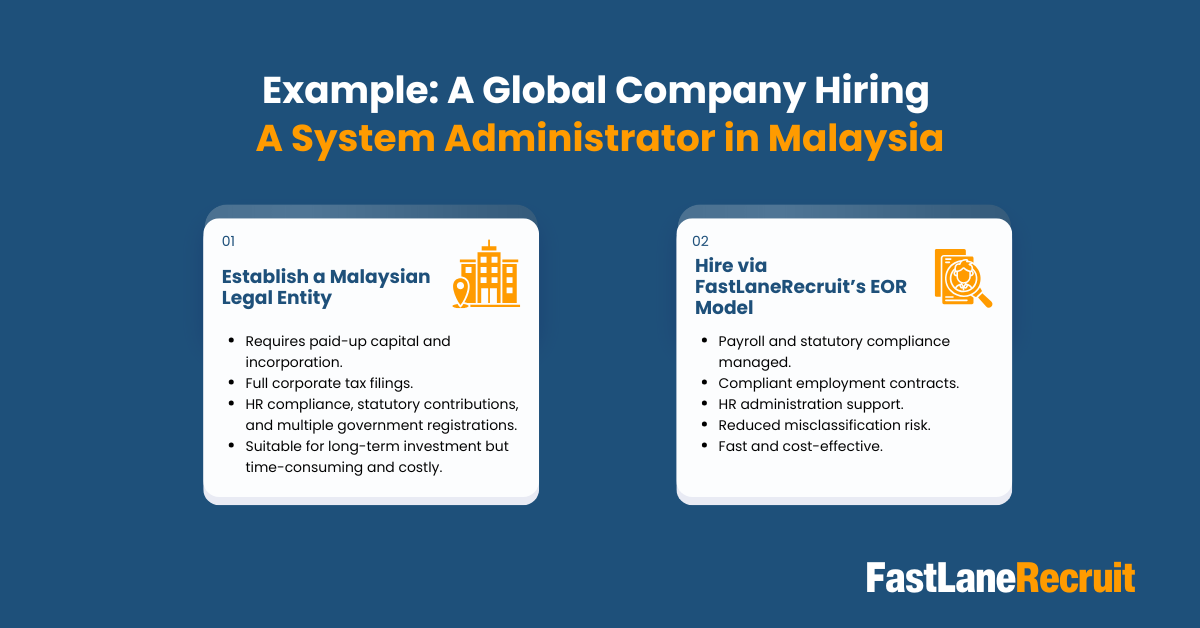
A U.S-based cybersecurity firm needs a Malaysian SysAdmin to support 24/7 infrastructure operations. They have two options:
Option A: Establish a Malaysian Legal Entity
- Requires paid-up capital and incorporation.
- Full corporate tax filings.
- HR compliance, statutory contributions, and multiple government registrations.
- Suitable for long-term investment but time-consuming and costly.
Option B: Hire via FastLaneRecruit’s EOR Model
FastLaneRecruit’s Employer of Record (EOR) solution allows companies to hire Malaysian System Administrators without establishing a local entity. Key benefits include:
- Payroll and statutory compliance managed: EPF, SOCSO, EIS contributions, and income tax obligations are handled by FastLaneRecruit.
- Compliant employment contracts: Written contracts aligned with Malaysia’s Employment Act 1955 and best HR practices.
- HR administration support: Onboarding, leave management, and ongoing HR processes are taken care of.
- Reduced misclassification risk: Ensures the SysAdmin is correctly classified as an employee under Malaysian law.
- Fast and cost-effective: Streamlines hiring while guaranteeing legal compliance from day one.
Conclusion: For global employers seeking to hire SysAdmins quickly, efficiently, and legally, FastLaneRecruit’s Employer of Record (EOR) model is the preferred option, avoiding the complexity and cost of setting up a Malaysian legal entity.
Technology, Automation & HR Systems for System Administrators
Modern HR and IT management tools simplify hiring and managing SysAdmins:
Key Uses
- Payroll compliance: Automated calculation and statutory deductions for EPF, SOCSO, EIS, and taxes.
- Performance tracking: Monitor KPIs, on-call response times, and project deliverables.
- Leave management: Track annual, sick, and public holiday leave, including flexible scheduling.
- Onboarding: Secure account creation, system access, and asset allocation.
- Access rights documentation: Maintain logs for IT audits and compliance reviews.
Popular Employer Tools
- HRDF-certified training portals for continuous IT upskilling.
- Payroll automation software integrated with Malaysian statutory rules.
- Remote monitoring and access control systems for secure cloud and on-premise infrastructure.
Benefit: Technology reduces administrative errors, increases transparency, and ensures statutory compliance for IT teams.
Long-Term Benefits of Compliance When Hiring System Administrators
Compliance is not just about avoiding penalties, it also drives strategic advantages:
- Higher employee trust: Transparent contracts, payroll, and access policies improve retention.
- Reduced legal and financial risk: Accurate statutory contributions and HR records prevent disputes.
- Stronger cybersecurity posture: Clear access control and data protection policies protect sensitive IT infrastructure.
- Better employer branding: Compliance signals a professional and trustworthy organization.
- Improved operational efficiency: Automation reduces manual errors and frees HR teams to focus on strategic initiatives.
Note: For System Administrators, who handle critical and sensitive systems, well-managed employment relationships are essential to prevent operational and reputational risks.
Conclusion
Malaysia offers a strong pipeline of System Administrators with the technical knowledge, certifications, and experience to support global businesses. But compliance with Malaysian labour laws, from payroll to statutory contributions, working hours, and data security, is essential.
Global companies must ensure they hire system administrators legally, fairly, and securely.
Hire Malaysian System Administrators Easily Through FastLaneRecruit’s EOR Service
If you want to hire System Administrators in Malaysia without setting up a local entity, FastLaneRecruit’s Employer of Record (EOR) service handles:
- Compliant employment contracts
- Payroll, EPF, SOCSO, EIS
- Local tax withholding
- HR documentation
- Onboarding and offboarding
- Employee management
- Full legal compliance with Malaysian labour laws
This gives you the ability to deploy IT talent quickly and safely, while FastLaneRecruit manages all regulatory responsibilities.
Speak to FastLaneRecruit today to hire System Administrators in Malaysia with full compliance and zero risk.