Behind every high-performing company is a robust HR technology team. From HRIS administration, payroll automation, and compliance to reporting and digital employee support, HRIS administrators and HR tech specialists ensure smooth workforce management. Today, more global companies are building their HR tech teams remotely, and Malaysia is quickly emerging as one of the top destinations. With strong digital infrastructure, government-backed talent programs, multilingual professionals, and mature HR systems, Malaysia offers the perfect environment for global HR tech teams to thrive.
Let’s explore why Malaysia is a top destination for HRIS administrators and HR tech talent and how your company can benefit.
Content Outline
Key Summary
Malaysia’s Digital-First HR Ecosystem
Government initiatives like MyDIGITAL, MDEC, HRD Corp, and SME Digitalisation Grant have created a tech-savvy HR workforce ready for cloud HR systems, digital payroll, and PDPA-compliant data handling.
Comprehensive HR Tech Support
HRIS administrators manage HR systems, payroll automation, onboarding software, reporting dashboards, and compliance tools, ensuring smooth HR tech operations globally.
Multilingual and Skilled Talent Pool
Malaysian HR tech professionals often speak English, Malay, Mandarin, and Tamil, supporting APAC and global employees across multiple countries efficiently.
Strong Compliance and Security Expertise
Trained in employment law, HRIS governance, and PDPA-compliant data protection, Malaysian HR tech teams are ideal for finance, healthcare, and technology sectors.
Shared Services and Regional Experience
Many global enterprises operate HR shared service centres in Malaysia, providing a pipeline of talent experienced in regional HR tech operations and cross-border reporting.
Practical Hiring Tips for Global Companies
Prioritize candidates with cloud HR system experience, shared services exposure, compliance knowledge, strong communication, and structured HRIS administration skills.
FastLaneRecruit EOR: Simplified Expansion
FastLaneRecruit’s Employer of Record service allows companies to legally hire, manage payroll and benefits, and scale HR tech teams in Malaysia without establishing a local entity.
Malaysia’s Digital-First HR Ecosystem
Over the past few years, Malaysia has focused on becoming a digital-ready economy. National programs actively help companies modernize HR processes, adopt cloud HRIS platforms, and upskill HR professionals in data analytics and compliance.
| Government Program | What It Means for HR Teams |
| MyDIGITAL Blueprint | A national roadmap that encourages companies to use digital systems for daily operations, including HR, payroll, and employee management. |
| MDEC (Malaysia Digital Economy Corporation) | Works closely with companies to develop digital talent and promote the use of HR software, analytics tools, and cloud platforms. |
| HRD Corp (formerly HRDF) | Provides training support so employees can learn modern HR tools, data handling, compliance processes, and digital workflows. |
| SME Digitalisation Grant | Helps businesses move from manual HR processes to cloud-based systems like digital payroll, leave management, and employee records. |
Because of these programs, HR professionals in Malaysia are already comfortable using modern HR technology. Many teams work daily with:
- Cloud HRIS administration: managing employee records, leave, benefits, and workflows digitally.
- HR analytics and reporting: tracking workforce trends and supporting business decisions.
- Digital onboarding and payroll systems: reducing errors and improving efficiency.
- PDPA-compliant data handling: safeguarding employee information securely.
This environment enables global companies to integrate Malaysia-based HR tech teams into their systems seamlessly.
Also Read: How to Build an Offshore HR Administration Team in Malaysia
What HRIS Administrators and HR Tech Talent Typically Handle
HRIS administrators and HR tech specialists in Malaysia play a crucial role in keeping HR operations running smoothly for global companies. They focus on managing HR technology, ensuring data accuracy, improving efficiency, supporting employees, and maintaining compliance. Their work covers the entire HR lifecycle, from hiring and onboarding to payroll, reporting, and employee exits, while using digital systems to make processes faster, more reliable, and scalable.
Here’s a closer look at what they handle:
1. Payroll & Benefits Automation
HRIS administrators manage automated payroll systems and benefits platforms, ensuring that employees are paid correctly and on time. They also handle the setup and administration of benefits like insurance, allowances, and leave entitlements. By automating these processes, companies reduce human errors, save time, and maintain consistency across regions.
Example:
A global SaaS company relies on a Malaysia-based HRIS team to monitor automated payroll workflows for employees across Asia-Pacific. The HRIS team ensures salaries are calculated correctly, deductions are accurate, and benefits are properly applied. If any discrepancies occur, the team investigates and resolves them quickly to avoid delays.
Why It Matters:
- Prevents payroll errors and late payments.
- Ensures benefits compliance and accurate reporting.
- Supports employees in multiple countries efficiently.
2. HR System Administration
HRIS administrators maintain the company’s HR technology platforms, including:
- HRIS (Human Resource Information System): Manages employee records, leave balances, job histories, and benefits.
- ATS (Applicant Tracking System): Tracks recruitment processes, applications, and candidate progress.
- Performance Management Platforms: Monitors employee performance reviews, goal tracking, and talent development.
They ensure that these systems are updated, secure, and accessible for HR teams and managers worldwide.
Example:
A Malaysia-based HRIS specialist updates employee profiles, configures permissions for new hires, and ensures that BambooHR, Workday, or SAP SuccessFactors are running correctly. They might also generate automated notifications for managers when tasks like performance reviews or probation evaluations are due.
Why It Matters:
- Keeps employee data accurate and up to date.
- Allows managers to make informed decisions.
- Enables smooth integration with other HR systems like payroll and benefits platforms.
3. Employee Lifecycle Technology Support
HRIS administrators oversee all digital processes throughout the employee lifecycle, from onboarding to transfers and exits. This includes creating system access, assigning workflows, managing digital forms, and ensuring proper recordkeeping.
Example:
When a new hire joins a remote company, Malaysia HRIS administrators prepare automated onboarding checklists, grant access to required systems, and track completion of forms and training. Similarly, if an employee transfers to a different department or leaves the company, the HRIS team ensures all digital records are updated and access permissions are removed.
Why It Matters:
- Streamlines onboarding and offboarding processes.
- Reduces manual paperwork and administrative delays.
- Ensures data consistency across the company.
4. HR Analytics & Reporting
HRIS administrators use HR systems to collect, analyze, and report workforce data. They create dashboards and generate reports on metrics like headcount, turnover, leave usage, payroll costs, and recruitment trends. These insights help HR leaders make strategic decisions.
Example:
A regional HR manager reviews HRIS-generated reports from the Malaysia team to plan upcoming hiring, training budgets, and employee engagement initiatives. The reports might highlight areas with high turnover or identify departments needing more staffing support.
Why It Matters:
- Provides actionable insights for business planning.
- Supports data-driven HR decisions.
- Helps identify trends and address workforce issues proactively.
5. Compliance Documentation & Policy Management
HRIS administrators ensure that employment contracts, HR policies, and other compliance documents are properly maintained in digital systems. They follow local labor laws and data protection regulations such as Malaysia’s PDPA (Personal Data Protection Act).
Example:
A fintech company relies on Malaysia-based HRIS specialists to maintain digital employment contracts, update HR policies, and ensure all records are audit-ready and secure. This protects the company from legal risks and ensures compliance across borders.
Why It Matters:
- Protects the company from legal and regulatory issues.
- Maintains organized, secure employee records.
- Supports audits and compliance checks.
6. Employee Support Desk
HRIS administrators often manage an internal HR helpdesk or ticketing system. Employees can submit queries about system access, payroll issues, benefits, or self-service tools, and the HRIS team resolves them quickly and accurately.
Example:
Employees across different countries submit system-related requests through a ticketing platform. The Malaysia HRIS team reviews the tickets, provides step-by-step guidance, and ensures any technical issues are fixed promptly.
Why It Matters:
- Ensures employees can access HR systems without delays.
- Improves employee satisfaction by resolving issues quickly.
- Reduces the administrative burden on managers and HR teams.
Summary Table
| HR Tech Function | How It Supports Global Teams |
| Payroll & benefits automation | Ensures accurate, timely salary and benefits processing across regions |
| HR system administration | Maintains HRIS, ATS, and performance platforms for reliable HR operations |
| Employee lifecycle tech support | Streamlines onboarding, transfers, and exit processes digitally |
| HR analytics & reporting | Provides insights for strategic HR and workforce planning |
| Compliance documentation | Maintains contracts, policies, and audit-ready records per local laws |
| Employee support desk | Resolves HR system, payroll, and benefits queries efficiently |
Also Read: HR Administrator Salary Guide 2025
Why Global Companies Choose Malaysia for HRIS Teams
Global companies are increasingly setting up HRIS teams in Malaysia because the country offers a unique combination of technical skills, digital readiness, multilingual talent, and a stable workforce. These factors make Malaysia an ideal hub for managing HR technology operations remotely and across multiple regions.
1. Multilingual Talent
Malaysia’s workforce is highly multilingual, with professionals fluent in English, Malay, Mandarin, and Tamil. This makes it easier for HRIS teams to communicate clearly with employees and managers across the APAC region and globally.
Example:
A Malaysia-based HRIS team supports employees in Singapore, Indonesia, and Australia by handling payroll issues, system training, and onboarding requests in the language best suited for each region. Multilingual skills reduce miscommunication and ensure smoother cross-border HR operations.
Why It Matters:
- Enables clear communication with a diverse workforce.
- Supports HR workflows across multiple countries without delays.
- Reduces errors caused by language barriers in HR documentation and reporting.
2. Digital HR Maturity
HRIS professionals in Malaysia are familiar with cloud-based HR systems, automated payroll platforms, digital onboarding tools, and performance management software. This digital maturity allows companies to integrate remote HRIS teams into their existing workflows quickly.
Example:
A European tech company integrates its Malaysia-based HRIS team directly into its Workday system to manage onboarding, payroll inputs, and reporting without requiring additional training or manual processes.
Why It Matters:
- Accelerates the setup of remote HR teams.
- Reduces errors and administrative delays.
- Makes HR processes scalable for growing teams across multiple countries.
3. Strong Compliance Culture
Malaysia-trained HRIS teams understand employment laws, labor regulations, and data protection requirements such as the Personal Data Protection Act (PDPA). This ensures all HR records, contracts, and systems are maintained in a legally compliant way.
Example:
A fintech company relies on Malaysia-based HRIS specialists to maintain digital employment contracts and HR policies in audit-ready formats, ensuring full PDPA compliance across regional offices.
Why It Matters:
- Minimizes legal and regulatory risks.
- Keeps sensitive employee data secure.
- Supports audits and compliance reviews efficiently.
4. Stable Workforce Pipeline
Government-backed initiatives, such as HRD Corp training programs and the SME Digitalisation Grant, ensure a steady stream of HR tech professionals with skills in HRIS administration, cloud payroll, and HR analytics.
Example:
HRIS administrators in Malaysia regularly attend training programs to upgrade their expertise in systems like SAP SuccessFactors, Workday, and BambooHR, ensuring the workforce remains up-to-date with modern HR technology trends.
Why It Matters:
- Provides global companies with a reliable talent pool.
- Reduces hiring risks by ensuring candidates have the right skills.
- Supports long-term scalability of HRIS operations.
5. Shared Services Experience
Many global companies run HR shared service centres in Malaysia, giving local professionals experience managing HR operations for multiple countries. This exposure makes Malaysia-based HRIS teams comfortable with cross-border payroll, reporting, and HR technology processes.
Example:
A multinational corporation’s Malaysia HRIS team manages onboarding, payroll, and reporting for employees across Singapore, Thailand, and Vietnam, ensuring all processes are standardized and efficient.
Why It Matters:
- Local HRIS teams can handle complex multi-country operations.
- Reduces training time for companies expanding in the APAC region.
- Ensures consistent HR processes and data integrity across borders.
Also Read: Why Malaysia Is a Prime Destination for Offshore HR Administrators
Practical Tips for Hiring HRIS Administrators in Malaysia
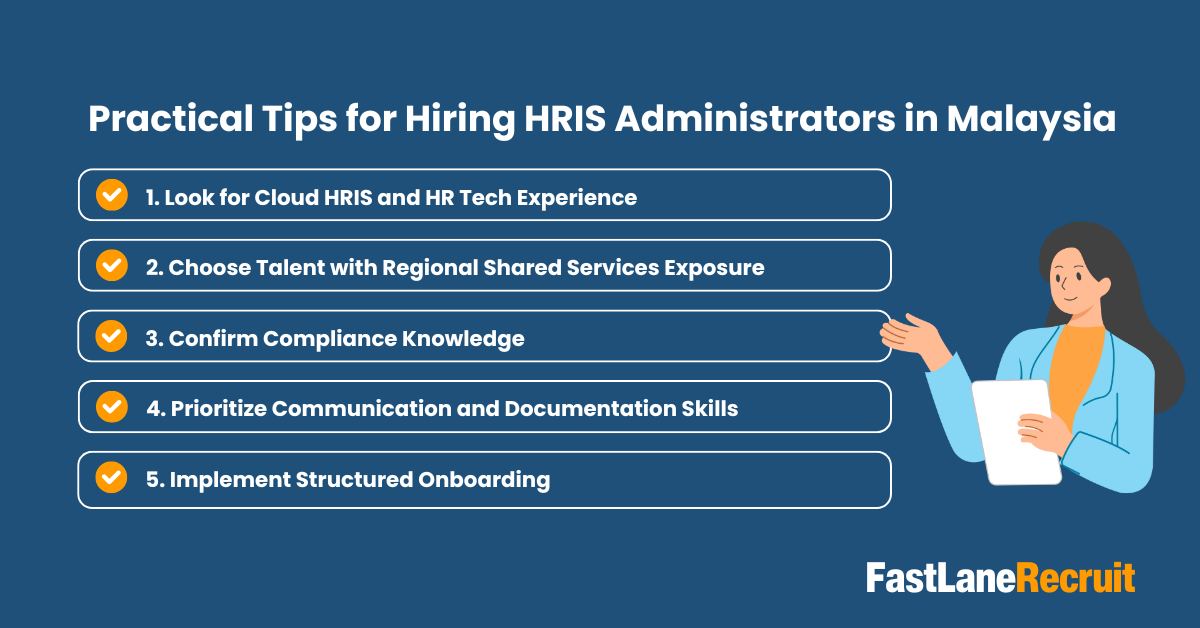
To build a successful HRIS team in Malaysia, global companies should focus on skills, experience, and process expertise. Here’s how to approach hiring effectively:
1. Look for Cloud HRIS and HR Tech Experience
Candidates with hands-on experience in platforms like Workday, SAP SuccessFactors, BambooHR, or other cloud HR systems integrate faster into global workflows.
Example:
An HRIS administrator familiar with Workday can immediately manage payroll inputs, generate reports, and maintain employee records without extensive training.
Why It Matters:
- Reduces onboarding time.
- Ensures accurate and consistent HR data.
- Helps global teams adopt digital workflows quickly.
2. Choose Talent with Regional Shared Services Exposure
Candidates who have worked in shared services or multi-country HR teams are familiar with regional payroll, reporting, and compliance requirements.
Example:
A Malaysia-based HRIS professional who has supported APAC payroll and onboarding can seamlessly handle employees in Singapore, Indonesia, and Australia.
Why It Matters:
- Ensures smooth HR operations across multiple countries.
- Reduces errors in payroll and reporting.
- Supports global consistency in HR processes.
3. Confirm Compliance Knowledge
Understanding Malaysian labor law and data protection rules (PDPA) is critical for safe and legal HR operations.
Example:
An HRIS administrator maintains employment contracts, HR policies, and audit-ready documentation, ensuring the company remains compliant with local and international regulations.
Why It Matters:
- Minimizes legal risk.
- Protects sensitive employee information.
- Ensures audit readiness for regulated industries like finance or healthcare.
Also Read: Labour Law, Payroll & Compliance in Malaysia for HR Administrators
4. Prioritize Communication and Documentation Skills
Remote HRIS teams support employees and managers across time zones, so clear communication and accurate documentation are essential.
Example:
An HRIS administrator documents system updates, onboarding workflows, and payroll adjustments, ensuring teams in different countries understand and follow processes consistently.
Why It Matters:
- Reduces errors and misunderstandings.
- Supports smooth collaboration with international teams.
- Helps maintain consistency in HR operations.
5. Implement Structured Onboarding
Structured onboarding workflows, checklists, and system access procedures help new employees start smoothly and allow HRIS teams to deliver consistent results.
Example:
A Malaysia-based HRIS team uses automated checklists to set up accounts, grant system permissions, and track completion for every new hire in multiple countries.
Why It Matters:
- Speeds up employee productivity.
- Reduces mistakes in system access or data entry.
- Ensures every hire has the same high-quality onboarding experience.
Also Read: Why Global Companies Outsource HR Administration Roles
Example: Outsourcing HR Tech to Malaysia
Global companies are increasingly outsourcing HR tech operations to Malaysia because it offers a cost-effective, digitally skilled, and compliance-ready workforce. Here’s how Malaysia-based HRIS administrators can support international businesses:
1. Global Onboarding & Payroll
Malaysia-based HRIS teams handle the entire employee onboarding process digitally, from account creation to system access, ensuring new hires are productive from day one. They also manage automated payroll and benefits administration, guaranteeing timely and accurate salary processing across multiple countries.
Example:
A multinational e-commerce company relies on its Malaysia HRIS team to onboard employees in Singapore, Indonesia, and Australia. The team sets up digital onboarding checklists, grants system access, configures payroll inputs, and ensures benefits like health insurance and leave entitlements are correctly applied for every employee.
Why It Matters:
- Provides a consistent onboarding experience for all employees, regardless of location.
- Reduces errors and delays in payroll processing.
- Ensures employee benefits are accurately managed across regions.
2. Employee Query Handling
HRIS teams in Malaysia often manage an internal HR tech helpdesk. Employees submit requests related to system access, payroll issues, benefits, or self-service tools, and the HRIS team resolves them promptly.
Example:
Employees from different time zones submit tickets through a digital system. The Malaysia-based HRIS team responds with clear guidance, updates records if needed, and closes tickets efficiently.
Why It Matters:
- Improves employee satisfaction by resolving issues quickly.
- Reduces administrative workload on managers and HR leaders.
- Ensures consistent and documented responses for audit and compliance purposes.
3. HR Analytics & Reporting
HRIS administrators use HR systems to generate dashboards, reports, and analytics on workforce data. These insights help HR leaders and management teams make informed strategic decisions.
Example:
A regional HR director reviews reports prepared by the Malaysia HRIS team, analyzing headcount trends, turnover, leave usage, and recruitment performance to plan upcoming hiring and training initiatives.
Why It Matters:
- Supports data-driven decision-making.
- Helps identify areas for improvement in workforce planning.
- Provides actionable insights for HR strategy across multiple regions.
Also Read: How to Pay International Employees
4. Compliance Documentation
Malaysia-based HRIS teams maintain structured digital records of contracts, HR policies, and employee data. They ensure compliance with local labor laws and the Personal Data Protection Act (PDPA), keeping records audit-ready at all times.
Example:
A fintech company relies on its Malaysia HRIS specialists to maintain employment contracts and HR policies digitally, ensuring everything is securely stored and easily retrievable for internal audits or regulatory reviews.
Why It Matters:
- Reduces legal and regulatory risk.
- Keeps sensitive employee information secure and organized.
- Ensures companies are always prepared for audits.
5. Regional Expansion
Outsourcing HR tech to Malaysia allows companies to scale operations in new markets without the administrative burden of setting up local entities. Malaysia-based HRIS teams can handle onboarding, payroll, compliance, and reporting for multiple countries from a single hub.
Example:
A software company expanding into Southeast Asia adds new HRIS administrators in Malaysia to manage HR tech functions for employees in Thailand, Vietnam, and Singapore, allowing the business to expand quickly without creating separate HR departments in each country.
Why It Matters:
- Supports rapid regional growth.
- Reduces overhead costs and administrative complexity.
- Provides a centralized HR tech hub for multiple countries.
How FastLaneRecruit’s EOR Can Help
Hiring HRIS administrators abroad can be complex due to local labour laws, payroll compliance, and benefits administration. FastLaneRecruit’s Employer of Record (EOR) service simplifies the process by allowing companies to:
- Legally hire HRIS administrators in Malaysia.
- Stay fully compliant with Malaysian labour laws and PDPA.
- Manage payroll, contracts, and employee benefits efficiently.
- Scale HR tech teams without setting up a local entity.
Example:
A European technology firm wanted to support its APAC workforce but didn’t want the time and cost of establishing a local entity in Malaysia. Using FastLaneRecruit’s EOR service, they onboarded a complete HRIS team in a few weeks. FastLaneRecruit handled employment contracts, payroll, benefits, and compliance, while the company focused on onboarding, employee engagement, and operational strategy. The Malaysia-based HRIS team was fully integrated into global HR workflows, supporting employees across multiple countries efficiently and securely.
Why It Matters:
- Saves months of setup time and legal complexity.
- Enables fast hiring of skilled HR tech talent.
- Allows companies to focus on strategy rather than administrative burdens.
Conclusion
Malaysia is a trusted hub for HRIS administrators and HR tech talent. Its digitally skilled workforce, multilingual capabilities, strong compliance culture, and experience with shared services make it an ideal destination for global HR tech operations. By leveraging Malaysia-based HRIS teams, companies can efficiently manage onboarding, payroll, HR analytics, and compliance while scaling regionally without operational hurdles.
Build Your Global HR Tech Team with FastLaneRecruit
Hiring skilled HRIS administrators and HR tech specialists in Malaysia has never been easier. FastLaneRecruit’s EOR service allows companies to build compliant, efficient, and fully integrated HR tech teams to support a global workforce from day one.
Start building your Malaysia-based HRIS team today and streamline your HR operations.