Going global sounds exciting, but managing HR across borders can be a real headache. Mistakes in payroll, benefits, or compliance don’t just waste time; they can trigger disputes, penalties, and operational disruption. Many companies solve this by outsourcing HR administration, handing off operational tasks while keeping strategic HR in-house.
In this article, we will explore why HR administration is one of the first functions global companies outsource, what tasks are typically delegated, and how solutions like Employer of Record (EOR) service, especially in Malaysia, can make expansion smoother.
Content Outline
Key Summary
HR Administration Outsourcing Explained
Outsourcing HR administration delegates payroll, benefits, contracts, leave, compliance reporting, and employee data management to experts, reducing operational burden.
Global Expansion Increases Complexity
Each country introduces unique labour laws, payroll rules, statutory benefits, data privacy regulations, and language requirements, making in-house management challenging.
Commonly Outsourced HR Functions
Payroll, benefits administration, employment contracts, leave tracking, compliance reporting, and employee data management are often outsourced to mitigate risk and save time.
Compliance Risk Reduction
Specialist providers stay updated with local regulations across jurisdictions, reducing fines, legal exposure, and reputational risks for international companies.
Faster Market Entry
Outsourcing HR administration enables companies to hire quickly, operate compliantly from day one, and avoid delays from local entity setup, especially in Southeast Asia.
Operational Efficiency and Data Security
Outsourcing consolidates HR systems, legal support, and training into predictable fees while leveraging secure platforms and governance to protect sensitive employee data.
Employer of Record (EOR) as a Strategic Solution
EORs like FastLaneRecruit are ideal for companies entering new markets without a legal entity. They handle payroll, benefits, compliance, and onboarding, enabling rapid expansion and strategic HR focus.
What Is HR Administration Outsourcing?
HR administration outsourcing is the practice of appointing a third-party specialist to handle day-to-day HR administration and compliance operations that keep a workforce running smoothly. These tasks are essential but highly administrative, time-consuming, and sensitive to local laws.
Also Read: Outsourcing IT Support Specialists: Cost Savings & Service Quality
Common HR administration functions that are outsourced include:
- Payroll processing
Calculating salaries, overtime, bonuses, tax deductions, and ensuring employees are paid accurately and on time, in line with local payroll regulations. - Employment contracts and documentation
Preparing compliant employment agreements, offer letters, amendments, and employee records that meet local labour law requirements. - Statutory benefits and contributions
Managing mandatory employer contributions such as social security, pensions, health insurance, and other government-required benefits, which vary by country. - Leave and attendance administration
Tracking annual leave, sick leave, public holidays, parental leave, and attendance in accordance with local employment laws and company policies. - Regulatory reporting
Submitting required reports to labour authorities, tax offices, and social security agencies to maintain legal compliance. - Employee data management
Maintaining accurate employee records while ensuring data privacy, security, and compliance with local data protection regulations.
Unlike strategic HR, which focuses on long-term initiatives such as company culture, leadership development, talent planning, and employee engagement, HR administration is largely operational. It demands deep local knowledge, attention to detail, and continuous monitoring of regulatory changes.
For companies operating across multiple countries, keeping up with different payroll rules, labour laws, and reporting requirements internally can be overwhelming. HR administration outsourcing allows businesses to hand over these complex tasks to specialists, reducing compliance risk while enabling internal teams to focus on higher-value, strategic priorities.
Why HR Administration Becomes Harder as Companies Go Global
As companies expand into new countries, HR complexity grows far faster than employee headcount. Hiring even one employee in a new market can introduce new administrative, legal, and compliance responsibilities.
Every country introduces its own requirements, including:
- Local labour laws
Employment regulations covering contracts, working hours, termination rules, and employee protections differ widely from country to country. - Different payroll tax structures
Each jurisdiction has its own income tax rules, social security contributions, and employer obligations, all of which must be calculated accurately and reported on time. - Mandatory benefits
Governments often require employers to provide specific benefits such as pension contributions, health coverage, insurance schemes, or statutory allowances. - Data protection and privacy rules
Employee data must be handled in accordance with local data protection laws, such as GDPR, PDPA, or equivalent national regulations. - Language and documentation requirements
Employment contracts, payslips, and statutory filings may need to be prepared in local languages and formats approved by authorities.
Employment regulations vary significantly by jurisdiction and are frequently updated, increasing compliance risk for employers managing cross-border workforces., increasing compliance risks for employers managing cross-border workforces.
When companies attempt to manage these responsibilities internally, it often results in:
- Overloaded HR teams
Internal teams spend excessive time on administration instead of supporting employees and business growth. - Increased compliance exposure
Small errors in payroll, benefits, or reporting can lead to penalties, audits, or legal disputes. - Slower market entry
Setting up local HR processes delays hiring and reduces speed to market. - Higher operational costs
Maintaining in-house expertise, systems, and legal support across multiple countries significantly increases overhead.
As a result, HR administration becomes a bottleneck that slows expansion and increases risk, prompting many global companies to outsource these functions or adopt alternative workforce models.
Also Read: Why Companies Outsource Game Design Talents
Commonly Outsourced Key HR Administration Functions
For companies operating across multiple countries, HR administration involves far more than basic paperwork. Each function carries legal, financial, and compliance risks that vary by location. To reduce complexity and avoid costly mistakes, global companies commonly outsource the following HR administration functions.
| HR Administration Area | Why Companies Outsource It |
| Payroll & Tax Filing | Payroll rules differ by country and change frequently. Outsourcing ensures accurate salary calculations, tax deductions, social security contributions, and timely filings, reducing the risk of penalties, audits, and employee dissatisfaction. |
| Benefits Administration | Many countries require employers to provide mandatory benefits such as pensions, insurance, or healthcare contributions. Outsourcing helps companies comply with local benefit requirements while managing enrolments, claims, and contributions efficiently. |
| Employment Contracts | Employment agreements must align with local labour laws and, in many cases, be drafted in the local language. Outsourced HR providers ensure contracts are legally compliant, up to date, and enforceable in each jurisdiction. |
| Leave & Attendance Management | Statutory leave entitlements, such as annual leave, sick leave, parental leave, and public holidays, vary widely by country. Outsourcing ensures accurate tracking and compliance with local employment regulations. |
| Compliance Reporting | Governments often require regular submissions to labour departments, tax authorities, and social security agencies. Outsourced providers stay on top of regulatory updates and handle reporting obligations on time. |
| Employee Data Management | Employee records must be stored and handled in line with data protection laws such as GDPR or PDPA. Outsourcing helps ensure secure data management, access controls, and compliance with privacy regulations. |
By outsourcing these administrative and compliance-heavy tasks, companies reduce operational risk and administrative burden. This allows internal HR teams to shift their focus from paperwork to people strategy, such as employee engagement, workforce planning, performance management, and long-term talent development.
Top Reasons Global Companies Outsource HR Administration Roles
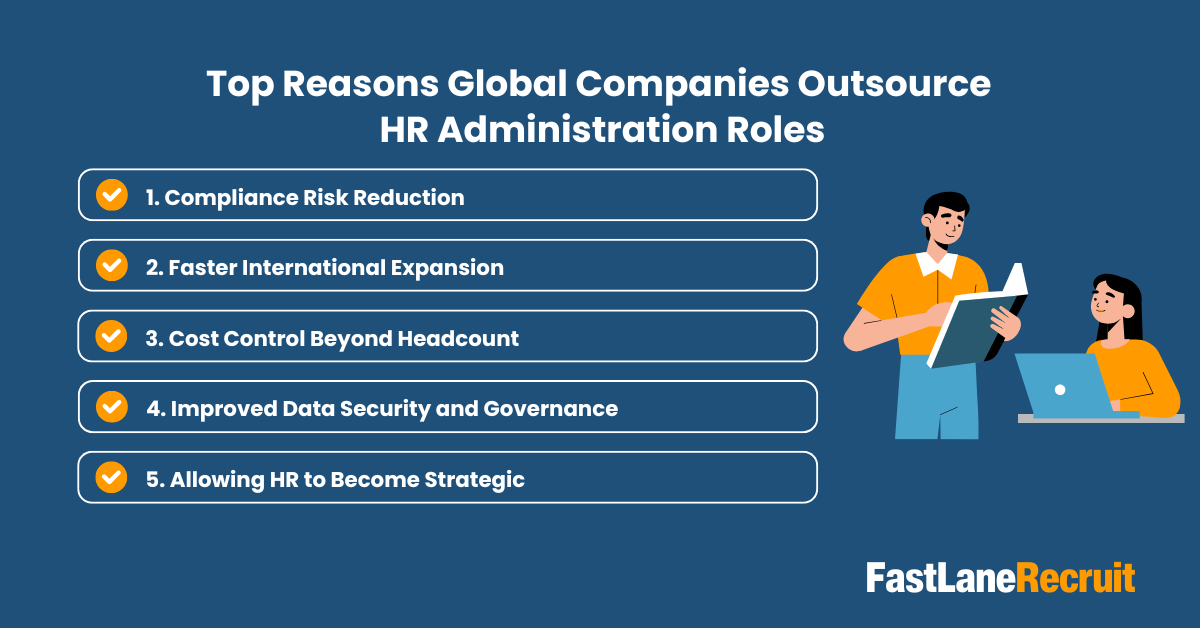
1. Compliance Risk Reduction
Employment and payroll regulations change frequently across countries, and even minor updates can directly affect payroll calculations, employment contracts, tax obligations, and statutory benefits. For companies operating internationally, keeping track of these changes across multiple jurisdictions is both complex and high risk.
Labour authorities and tax agencies around the world, such as national ministries of labour, revenue authorities, and social security institutions, publish regulatory updates and guidance that employers must monitor and follow to remain compliant. Examples include Malaysia’s Ministry of Human Resources (MOHR), the Inland Revenue Board of Malaysia (LHDN), and Singapore’s Ministry of Manpower (MOM), alongside similar bodies in Europe, the Americas, and other parts of Asia.
For global companies managing employees in multiple countries, monitoring and interpreting these updates internally can overwhelm HR teams and increase exposure to compliance errors. Outsourcing HR administration shifts execution to specialists with local expertise, reducing the burden on internal teams whose core function is staying current with local labour laws, tax requirements, and reporting obligations in each market. This significantly reduces the risk of non-compliance, financial penalties, operational disruptions, and reputational damage as companies scale internationally.
Also Read: Building a High-Performing Offshore HR and Payroll Management Team in Malaysia (Singapore Edition)
2. Faster International Expansion
Setting up local HR infrastructure, such as payroll systems, employment contracts, and statutory reporting processes, can take months in a new country. These delays often slow hiring and market entry.
By outsourcing HR administration, companies can:
- Hire employees more quickly
- Operate compliantly from day one
- Avoid delays caused by entity setup or system implementation
This is especially valuable for companies expanding across Southeast Asia, where each country has distinct employment frameworks despite regional proximity.
3. Cost Control Beyond Headcount
The real cost of in-house HR administration includes:
- Payroll and HR software systems
- Legal and compliance advisory services
- Backup coverage during staff turnover or absences
- Continuous training on regulatory changes
- Audit corrections and remediation efforts
Outsourcing consolidates these variable and often underestimated costs into predictable service fees. This improves budget planning, reduces unexpected expenses, and allows companies to allocate resources toward growth and innovation.
4. Improved Data Security and Governance
Employee data is among the most sensitive information a company handles. Under global data protection standards such as GDPR and local PDPA frameworks, improper handling of employee data can result in severe financial penalties and loss of trust.
Reputable HR outsourcing providers invest heavily in:
- Secure HR platforms and encrypted systems
- Strict access controls and user permissions
- Audit trails for transparency and accountability
- Data storage aligned with local regulatory requirements
By outsourcing HR administration, companies strengthen data governance while reducing the risk of data breaches or compliance failures.
5. Allowing HR to Become Strategic
When HR teams are consumed by administrative firefighting, payroll corrections, compliance checks, documentation updates, they have limited capacity to contribute strategically.
Outsourcing HR administration enables HR leaders to focus on higher-value initiatives such as:
- Workforce and succession planning
- Talent attraction and retention strategies
- Performance management frameworks
- Employee engagement and wellbeing programs
- Leadership and capability development
This shift from operational execution to strategic impact is one of the most underappreciated, but most powerful, benefits of outsourcing HR administration in a global organization.
Also Read: Building a High-Performing Offshore HR and Payroll Management Team in Malaysia (Hong Kong Edition)
Outsourcing vs Employer of Record (EOR): Which Is Better?
When expanding into new markets, companies often face a choice between traditional HR outsourcing and using an Employer of Record (EOR). While both solutions help manage HR administration tasks, they serve different purposes and are better suited for different scenarios.
| Scenario | HR Outsourcing | EOR |
| You have a local entity | Suitable for managing HR functions such as payroll, benefits, and compliance within your existing legal entity. HR outsourcing allows internal teams to offload transactional tasks while retaining overall employment responsibility. | Not required. If your company already has a registered legal entity, an EOR is generally unnecessary. |
| You don’t have a local entity | Limited. Traditional HR outsourcing can handle administrative tasks, but hiring employees without a legal entity can create compliance risks. | Ideal. An EOR legally employs your workforce on your behalf, allowing you to hire talent in a new country without setting up a local entity, while ensuring full compliance with local labor laws. |
| Need fast hiring | Depends. Outsourcing HR processes may improve efficiency, but hiring still requires managing local legalities, contracts, and payroll setup, which can be time-consuming. | Faster. An EOR can accelerate onboarding because the EOR already has local infrastructure to employ staff. |
| Compliance ownership | Shared. While HR outsourcing providers handle specific administrative and compliance tasks, your company retains ultimate responsibility for legal compliance and employee-related obligations. | EOR-led. The EOR becomes the legal employer and manages payroll, taxes, and statutory obligations in line with local requirements, while your company retains day-to-day management. |
| Market entry speed | Moderate. HR outsourcing reduces some administrative overhead, but establishing legal presence, contracts, and payroll may still take weeks or months. | Fast. By leveraging the EOR’s local entity and expertise, companies can enter the market immediately and start operations without the delay of entity registration. |
Key Takeaways:
- HR outsourcing is best suited for companies that already have a local legal entity and want to offload administrative and compliance-heavy HR tasks.
- EOR solutions are ideal for companies looking to hire in a new country quickly, without establishing a legal entity, while fully mitigating compliance risk.
- Combining these approaches is also possible: some companies use HR outsourcing to manage ongoing administration while leveraging an EOR for new market hires.
For companies looking to expand into Malaysia, FastLaneRecruit’s EOR service provides a smart solution to hire local HR talent or any employee type efficiently and compliantly, without the need to establish a legal entity. This approach ensures rapid market entry, full compliance, and a streamlined HR administration experience.
Tips for Choosing the Right HR Outsourcing Partner
Selecting the right HR outsourcing partner is crucial for ensuring compliance, efficiency, and smooth operations, especially when managing employees across multiple countries. Here are key considerations to guide your decision:
- Ensure Local Regulatory Expertise, Not Just Global Branding
A reputable HR outsourcing provider should have deep knowledge of local labor laws, tax regulations, and statutory benefits in the countries where you operate. Global brand recognition is helpful, but what matters most is their ability to navigate local compliance requirements accurately. - Ask How Often Compliance Updates Are Reviewed
Employment laws and payroll regulations can change frequently. Your outsourcing partner should have structured processes in place to monitor updates and adjust your HR policies, payroll, and reporting procedures accordingly. Regular compliance reviews reduce the risk of penalties and ensure your business stays aligned with local legislation. - Check Data Security Certifications
HR data is highly sensitive, including personal information, salaries, and benefits details. Ensure your outsourcing partner follows international and local data protection standards, such as ISO 27001, GDPR, or PDPA, and employs robust security measures including encryption, access controls, and audit logs. - Clarify Accountability for Payroll and Compliance Errors
Understand how responsibility is shared if mistakes occur. Will the provider take corrective action, cover penalties, or provide guidance to resolve issues? Clear accountability ensures your company is protected and reduces legal and financial exposure. - Understand Scalability Across Countries
If your company plans to expand into new markets, your HR outsourcing partner should be able to scale their services seamlessly. Ask about their ability to manage multiple jurisdictions, different currencies, diverse benefit structures, and varying employment laws without compromising service quality.
Bonus Tip: Consider outsourcing through an Employer of Record (EOR) solution, such as FastLaneRecruit, if you plan to hire employees in Malaysia or other Southeast Asian countries without a local entity. EORs provide full compliance management, payroll, benefits administration, and rapid onboarding, allowing your internal team to focus on strategic growth rather than operational HR tasks.
Also Read: Building a High-Performing Offshore Accounting Team in Malaysia (Hong Kong Edition)
Why Consider Hiring HR Talent in Malaysia
Malaysia has become a preferred destination… due to its strong talent pool, regional familiarity, and operational scalability. However, hiring locally can be complex for foreign companies because of regulatory requirements and administrative obligations. Employers need to navigate:
- Employment Act 1955 requirements
- EPF, SOCSO, and EIS contributions
- Monthly tax deductions (MTD)
- Statutory leave entitlements
| HR Task | Common Challenge for Foreign Companies |
| Payroll | Errors in statutory contribution rates or late submissions |
| Contracts | Non-compliant probation, termination clauses, or contract terms |
| Benefits | Misunderstanding mandatory versus optional employee benefits |
| Tax | Mistakes in monthly tax deduction calculations or reporting |
Hiring and managing HR professionals directly in Malaysia may require significant local knowledge, which can be time-consuming and risky for companies unfamiliar with local regulations.
By hiring HR talent in Malaysia, businesses can access experienced professionals who understand local employment laws, payroll compliance, and HR administration best practices. FastLaneRecruit’s Employer of Record (EOR) service provides a turnkey solution, enabling companies to:
- Hire qualified Malaysian HR professionals without establishing a local entity
- Manage payroll, benefits, and contracts in accordance with Malaysian regulations
- Reduce administrative burden and minimize compliance risks
- Quickly scale HR capacity as business needs evolve
Hiring in Malaysia through an EOR like FastLaneRecruit allows companies to focus on strategic growth, while trusted local experts handle day-to-day HR operations efficiently and compliantly.
Also Read: Employers of Record – What You Need to Know!
When an EOR Is a Better Alternative
While traditional HR outsourcing helps companies manage administrative HR tasks, there are situations where an Employer of Record (EOR) provides a more effective solution. An EOR not only handles HR administration but also legally employs your workforce on your behalf, taking full responsibility for compliance, payroll, and statutory obligations.
Consider using an EOR if your company:
- Wants to hire in Malaysia without setting up a legal entity
Establishing a local entity can take weeks or even months, along with significant administrative and legal costs. An EOR allows your company to legally employ Malaysian staff immediately. For example, a tech startup based in Europe can hire a local HR manager in Kuala Lumpur through FastLaneRecruit’s EOR service and start operations without registering a local company. - Needs rapid onboarding
Time-to-hire is critical when entering new markets. Traditional HR outsourcing may still require your company to manage employment contracts, payroll setup, and statutory compliance, which can delay onboarding. With an EOR, employees are onboarded immediately using the provider’s legal entity, enabling your business to start operations faster. - Wants full compliance ownership handled externally
Multinational companies face complex compliance requirements, including payroll taxes, statutory contributions, employee benefits, leave management, and local labor law regulations. An EOR assumes full responsibility for these obligations, reducing your risk of penalties and legal exposure. For instance, a marketing agency hiring remote Malaysian employees through an EOR does not need to manage EPF, SOCSO, and EIS contributions internally, as these are administered through the EOR model.
Example:
A global consulting firm planning to expand across Southeast Asia can use an EOR to hire local HR specialists in Malaysia and Singapore simultaneously. Instead of navigating two separate legal systems, the firm relies on the EOR to ensure compliant employment, handle payroll, and administer benefits, freeing internal teams to focus on business strategy and client delivery.
Also Read: Top 10 Reasons to Use an Employer of Record (EOR)
Key Takeaway:
An EOR is particularly suitable for companies entering new markets quickly, scaling across multiple countries, or seeking to reduce compliance risk. By combining employment management with full administrative support, EOR solutions like FastLaneRecruit allow businesses to hire local talent efficiently, legally, and with minimal operational burden.
Conclusion
Global companies outsource HR administration roles not because HR is less important, but because it has become too important to get wrong.
By delegating compliance-heavy, transactional HR tasks to specialists, businesses gain speed, reduce risk, and allow internal teams to focus on strategic growth.
As global workforces become the norm, outsourcing HR administration, or adopting an EOR model, has become a practical, scalable foundation for international expansion.
FastLaneRecruit’s Employer of Record: A Smarter Alternative for Hiring in Malaysia
If you’re planning to hire employees in Malaysia without setting up a local entity, FastLaneRecruit’s Employer of Record (EOR) service offers a compliant, low-risk alternative.
FastLaneRecruit handles:
- Employment contracts
- Payroll and statutory contributions
- Tax compliance
- Benefits administration
So you can build your Malaysian team quickly, compliantly, and with confidence, while staying focused on growing your business. Speak to FastLaneRecruit to explore a compliant hiring setup in Malaysia.