Hiring employees in another country can give businesses access to talent without requiring everyone to work from a traditional office. But when an employee regularly works from another jurisdiction, the employer may need to consider more than payroll and employment compliance.
Remote work permanent establishment (PE) risk is one of the key tax considerations for companies building international or distributed teams. Depending on the employee’s location, working pattern, business activities, and applicable tax rules, a remote-working arrangement may create a taxable presence for the employer.
The OECD’s 2025 update to its Model Tax Convention provides more detailed guidance on how remote work from a home or other relevant location should be assessed for fixed-place permanent establishment purposes. However, PE remains a facts-and-circumstances analysis rather than a simple checklist.
For businesses hiring internationally, understanding the risk early can help prevent unexpected tax exposure and make global expansion more predictable.
Content Outline
Key Summary
Remote work does not automatically create permanent establishment
Having an employee work remotely in another country does not, by itself, mean that the employer has a PE there. The analysis depends on the specific facts, applicable domestic law, and relevant tax treaty.
A home office can be relevant to PE analysis
The OECD’s updated commentary considers whether a home or another relevant location can constitute a place of business of the enterprise. Employers should therefore assess long-term cross-border remote-working arrangements rather than assuming a home office is always outside the scope of PE rules.
The employee’s activities matter
Risk can increase where a remote employee performs core business activities, develops local markets, maintains client relationships, manages suppliers or business partners, or performs activities that have a strong commercial connection to the country.
The OECD 2025 guidance provides a clearer framework
The updated Article 5 commentary introduces additional guidance for assessing remote work, including the extent of working time from the location and whether the enterprise has a commercial reason for the employee’s presence there. The 50% factor should not be treated as a universal automatic PE threshold.
An EOR can support compliant international hiring
An Employer of Record can help businesses employ workers where they do not have their own local entity and manage local employment, payroll, and HR compliance. However, using an EOR does not automatically eliminate permanent establishment risk. The company’s business activities and tax position still need to be assessed.
What Is Permanent Establishment?
Permanent establishment is an international tax concept used to determine whether a business has a sufficient taxable presence in another jurisdiction.
Where a PE exists, the jurisdiction may have taxing rights over profits attributable to that permanent establishment, subject to applicable domestic law and tax treaties.
A PE can arise in different circumstances, including through:
- A fixed place of business
- Certain dependent-agent activities
- Particular service activities, depending on local rules and treaty provisions
- Construction or installation activities where applicable
For remote employers, the fixed-place PE and dependent-agent PE concepts are particularly relevant.
The exact rules differ between countries, so businesses should not assume that an arrangement that is acceptable in one jurisdiction will produce the same result elsewhere.
How Can Remote Work Create Permanent Establishment Risk?
Remote work becomes more complex when an employee performs business activities from a country where the employer does not otherwise have an established presence.
Several factors may need to be considered.
1. Where the employee works
The first question is simple: Where is the employee physically performing their work?
A remote employee working from another country can create tax and employment considerations even when:
- The employer has no local office
- The employee works from home
- The employee was originally hired in another country
- The company has no local subsidiary
The employee’s actual work location should therefore be included in international workforce compliance reviews.
2. How regularly the employee works there
Occasional or temporary remote work can produce different considerations from a long-term arrangement.
The OECD’s 2025 commentary provides more specific guidance for evaluating remote work from a home or other relevant location, including consideration of the proportion of working time spent there.
However, employers should not treat a specific percentage as a standalone safe harbor. The analysis also considers the nature of the work and the enterprise’s connection to the location.
3. Whether the business has a commercial reason for the location
This is one of the most important questions:
Does the business have a commercial reason for the employee to work from that country?
Relevant circumstances can include activities such as:
- Developing or servicing a local market
- Maintaining client relationships
- Managing local suppliers or business partners
- Performing core business functions
- Supporting local business operations
By contrast, an employee working from another country purely for personal reasons may present a different PE analysis where the enterprise has no commercial interest in that location.
4. What the employee actually does
Not all remote jobs carry the same level of potential PE exposure.
A back-office employee performing internal administrative duties may present different considerations from an employee who:
- Negotiates commercial contracts
- Closes sales
- Develops local customers
- Represents the company commercially
- Manages important local relationships
- Performs core revenue-generating activities
The substance of the employee’s activities therefore matters as much as their job title.
What Are the Main Permanent Establishment Risk Factors for Remote Workers?
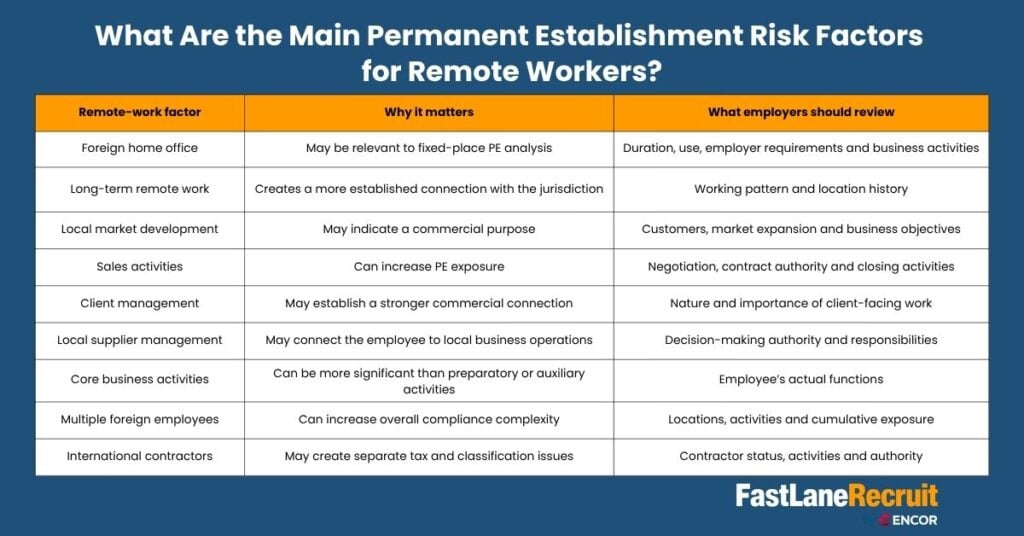
| Remote-work factor | Why it matters | What employers should review |
| Foreign home office | May be relevant to fixed-place PE analysis | Duration, use, employer requirements and business activities |
| Long-term remote work | Creates a more established connection with the jurisdiction | Working pattern and location history |
| Local market development | May indicate a commercial purpose | Customers, market expansion and business objectives |
| Sales activities | Can increase PE exposure | Negotiation, contract authority and closing activities |
| Client management | May establish a stronger commercial connection | Nature and importance of client-facing work |
| Local supplier management | May connect the employee to local business operations | Decision-making authority and responsibilities |
| Core business activities | Can be more significant than preparatory or auxiliary activities | Employee’s actual functions |
| Multiple foreign employees | Can increase overall compliance complexity | Locations, activities and cumulative exposure |
| International contractors | May create separate tax and classification issues | Contractor status, activities and authority |
The presence of one factor does not automatically establish a PE. Businesses should assess the complete factual and legal context.
What Did the OECD 2025 Update Change for Remote Work?
On 19 November 2025, the OECD published an update to the Commentary on its Model Tax Convention. The update provides more detailed guidance on Article 5 and remote work, particularly situations where an employee works from a home or another relevant location in a country different from that of the employer.
The remote-work assessment is more structured
The updated commentary helps employers evaluate questions such as:
- How much of the employee’s working time is performed from the location?
- Does the enterprise have a commercial reason for the employee to work from that location?
The commercial-reason analysis can consider whether the employee’s physical presence contributes to activities such as maintaining or developing client relationships, entering or servicing a local market, managing suppliers or business partners, or carrying out core business activities.
The 50% factor is not a universal PE rule
Some summaries of the OECD update refer to a 50% working-time factor over a 12-month period. However, this should not be interpreted as a blanket rule that automatically creates or eliminates PE.
The OECD framework remains dependent on the facts and circumstances, including the business’s commercial interest in the location.
Practical takeaway: Companies with employees regularly working across borders should review their remote-work arrangements rather than relying on a single percentage or assumption.
What Are the Consequences of Permanent Establishment Risk?
If a business is considered to have a PE in another jurisdiction, potential consequences can include:
Corporate tax exposure
The foreign jurisdiction may seek to tax profits attributable to the PE under applicable local rules and treaty provisions.
Additional tax compliance
The business may need to understand local registration, tax filing, reporting, documentation, and record-keeping requirements.
Interest and penalties
Unidentified or unmanaged tax exposure can result in additional costs, including interest or penalties depending on local law.
Employment and payroll considerations
A PE assessment can exist alongside separate employment, payroll, social security, and immigration obligations.
Increased administrative complexity
Managing employees across multiple jurisdictions can require coordination between tax, HR, payroll, legal, and finance teams.
For this reason, PE risk should be considered as part of the broader global hiring and international expansion strategy, rather than treated as an isolated tax issue.
How Can Employers Manage Permanent Establishment Risk?
There is no universal approach that works for every company or country. Instead, businesses should establish a structured cross-border workforce review.
1. Map where employees actually work
Maintain accurate records of employees’ working locations, including cross-border relocations and long-term remote arrangements.
2. Review employee activities
Identify whether employees perform:
- Sales
- Contract negotiation
- Customer management
- Market development
- Supplier management
- Revenue-generating functions
- Core business activities
3. Assess the commercial reason
Ask whether the business benefits commercially from having the employee physically present in that jurisdiction.
4. Review the applicable rules
PE treatment depends on the relevant country’s domestic tax rules and, where applicable, the relevant tax treaty.
5. Separate PE analysis from employment compliance
A company can have multiple obligations at the same time. Review:
- Corporate tax
- Payroll
- Employment law
- Social security
- Immigration
- Worker classification
- Data and HR requirements
6. Establish a remote-work policy
For companies with distributed teams, a cross-border remote-work policy can define:
- Approved countries
- Maximum periods of overseas work
- Required approvals
- Employee responsibilities
- Tax and immigration reviews
- Location reporting requirements
7. Consider an EOR for international hiring
When a company wants to hire in a country where it does not have its own legal entity, an EOR can provide a more structured employment solution.
Can an EOR Help Manage Permanent Establishment Risk?
An Employer of Record (EOR) is a third-party organization that legally employs workers on behalf of a client in a country where the EOR has the appropriate local infrastructure.
An EOR can help businesses:
- Hire employees without immediately establishing their own local entity
- Manage local employment requirements
- Support compliant payroll administration
- Handle employment documentation
- Manage statutory benefits and deductions
- Provide local employment expertise
- Enter new markets more efficiently
However, an EOR is not a guaranteed solution to PE risk. You should discuss with our experts to go deep dive on the topic.
EOR vs. establishing your own entity
| Option | EOR | Own local entity |
| Local entity required from client | No, where EOR coverage is available | Yes |
| Speed to hire | Generally faster | Usually slower to establish |
| Local employment administration | Supported by EOR | Managed by your business/local team |
| Market testing | Suitable for many early-stage expansions | More infrastructure required |
| Control over daily work | Client retains day-to-day management | Client retains day-to-day management |
| PE analysis | Still required based on business activities | Still required |
| Best suited for | Hiring, testing markets and building small teams | Long-term established operations |
When Should You Consider an EOR for Remote Hiring?
An EOR can be particularly useful when:
You want to hire one or a small number of employees abroad
Creating a legal entity may not be proportionate to the size of your initial team.
You want to test a new market
An EOR can allow businesses to enter a market without immediately committing to a full local corporate structure.
You need to hire quickly
Setting up an entity, payroll infrastructure, employment processes, and local compliance can take considerably more time than using an established EOR structure.
You are expanding across multiple countries
Managing employment requirements independently in every jurisdiction can create significant administrative complexity.
You want local employment expertise
An experienced EOR can help coordinate local employment, payroll, statutory benefits, and HR administration.
Also Read: Employer of Record Philippines: Best Solution for Global Companies Hiring Remote Teams in 2026
FastLaneRecruit: Hire Globally Without Unnecessary Complexity
FastLaneRecruit helps businesses expand their international workforce through Employer of Record and global hiring solutions.
We support businesses hiring in: Malaysia, Singapore, Hong Kong, China, India, Philippines, Taiwan, Vietnam, Australia, United Kingdom, Switzerland, UAE, Saudi Arabia, Qatar
With FastLaneRecruit, businesses can explore international hiring without immediately building their own employment infrastructure in every market.
Our EOR services can support key employment processes, including:
- Local employee onboarding
- Employment documentation
- Payroll administration
- Statutory contributions and deductions
- Benefits administration
- Local employment compliance
- Employee lifecycle management
- Offboarding support
Why use FastLaneRecruit for global hiring?
Hire without a local entity
Expand your team in supported markets without first establishing your own local employment entity.
Simplify international employment
Centralize key employment and payroll processes through an experienced local partner.
Enter new markets more efficiently
Build a team or test a market before committing to a larger local infrastructure.
Reduce administrative burden
Let FastLaneRecruit manage key employment processes while your team focuses on managing employees and growing the business.
Make informed expansion decisions
Our EOR model can help you understand the practical employment requirements of hiring in a new country while you assess the broader tax, legal, and corporate implications.
Ready to Hire Globally?
Remote work can open access to international talent, but global hiring should be structured around more than simply finding an employee in another country.
Before expanding your remote workforce, assess the permanent establishment risk, employment requirements, payroll obligations, and local compliance considerations of your target market.
FastLaneRecruit can help you hire employees in supported countries through an EOR model without requiring you to immediately establish your own local employment infrastructure.
Talk to FastLaneRecruit about your international hiring plans and explore a practical EOR solution for your next market.
Frequently Asked Questions About Remote Work and Permanent Establishment
Can remote work create permanent establishment?
Yes, remote work can potentially contribute to permanent establishment risk, but remote work does not automatically create a PE. The assessment depends on factors such as the employee’s location, working pattern, activities, commercial purpose, applicable domestic law, and tax treaty provisions.
Does a remote employee’s home office create PE?
It can in certain circumstances. The OECD’s 2025 commentary provides additional guidance on when a home or other relevant location may constitute a place of business. The analysis remains dependent on the specific facts and circumstances.
What is permanent establishment risk for a remote workforce?
Permanent establishment risk is the possibility that a company’s activities through a remote workforce create a taxable business presence in another jurisdiction, potentially resulting in corporate tax and compliance obligations.
Does working remotely from another country for less than 183 days avoid PE?
Not necessarily. The 183-day concept should not be treated as a universal permanent establishment rule. PE, individual tax residence, employment taxation, and social security are separate issues that can have different thresholds and tests.
Does the OECD 2025 update mean that working remotely 50% of the time creates PE?
No. The 50% working-time factor should not be treated as an automatic PE trigger. The updated OECD commentary also considers whether the enterprise has a commercial reason for the employee’s presence in the location and requires a facts-and-circumstances assessment.
Can an EOR eliminate permanent establishment risk?
No. An EOR can help businesses manage international employment and local compliance, but it does not automatically eliminate the client’s permanent establishment exposure. The company’s activities, structure, and tax position still need to be assessed.
Is an EOR better than establishing a local entity?
It depends on the company’s objectives. An EOR can be useful for hiring quickly, testing a market, or employing a small team without immediately establishing an entity. A local entity may be more appropriate for businesses planning substantial, long-term operations.
Can contractors create permanent establishment risk?
Yes. Worker classification does not automatically remove PE concerns. The activities performed by contractors, particularly sales or other commercially significant activities, can be relevant to the analysis.
What should a company do before allowing an employee to work abroad?
The company should review the employee’s location, duration of work, activities, commercial purpose, immigration position, employment requirements, payroll implications, and potential tax exposure before approving a long-term cross-border remote-work arrangement.