

Hiring independent contractors can give businesses access to specialized talent without committing to a traditional employment arrangement. But flexibility does not remove compliance responsibilities. Before engaging a contractor, businesses need to understand the worker’s legal status, agree on payment terms, document responsibilities, and follow the rules that apply in the contractor’s location.
For companies hiring contractors across borders, the challenge becomes more complex. Worker classification, contracts, tax treatment, payment requirements, intellectual property, and local regulations can differ by country.
Understanding independent contractor rights and contractor rights and responsibilities helps businesses build compliant working relationships while knowing when a contractor arrangement may no longer be the right structure.
Content Outline
Key Summary
Independent contractors have contractual rights
An independent contractor’s rights are generally established through the contractor agreement and applicable local laws. Key areas can include payment terms, scope of work, termination provisions, intellectual property, confidentiality, and dispute resolution.
Independent contractor payment rights depend on the arrangement
Contractors are generally paid according to agreed contractual terms rather than employee-style wage and benefit rules. The agreement should clearly establish the fee, invoicing process, payment schedule, currency, reimbursable expenses, and applicable tax responsibilities.
Classification matters
Calling someone an “independent contractor” or signing a contractor agreement does not necessarily determine their legal status. Worker classification can depend on the actual working relationship and applicable law. The U.S. Department of Labor, for example, emphasizes that the economic reality of the relationship matters rather than simply the label used by the parties.
Contractor compliance is country-specific
There is no single global rule governing independent contractors. Businesses hiring internationally should assess the laws of the country where the contractor performs the work and consider tax, labor, payment, data, intellectual property, and other applicable requirements.
EOR may be appropriate when the worker should be an employee
If the relationship is more appropriately structured as employment, an Employer of Record (EOR) can provide an alternative to direct employment without requiring the business to establish its own local entity, subject to the applicable country’s rules and service scope.
What Are Independent Contractor Rights?
Independent contractor rights are the rights established by the contractor’s agreement, applicable laws, and the nature of the business relationship.
Unlike employees, independent contractors are generally engaged to provide services as a separate business or self-employed professional. Their relationship with the client is typically governed by commercial terms rather than an employment relationship.
However, contractor status does not mean that a business can ignore contractual or legal obligations.
Common areas of contractor rights include:
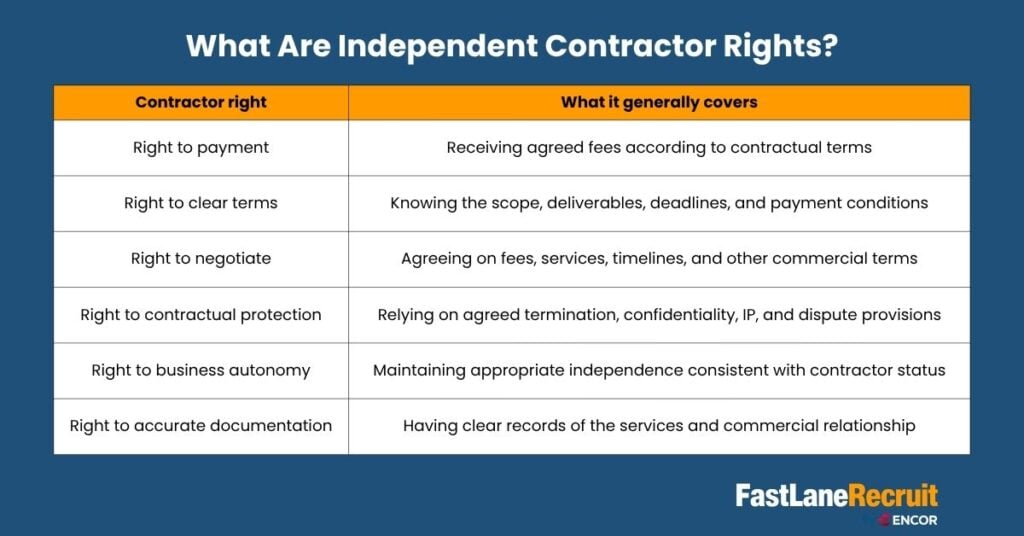
| Contractor right | What it generally covers |
| Right to payment | Receiving agreed fees according to contractual terms |
| Right to clear terms | Knowing the scope, deliverables, deadlines, and payment conditions |
| Right to negotiate | Agreeing on fees, services, timelines, and other commercial terms |
| Right to contractual protection | Relying on agreed termination, confidentiality, IP, and dispute provisions |
| Right to business autonomy | Maintaining appropriate independence consistent with contractor status |
| Right to accurate documentation | Having clear records of the services and commercial relationship |
The exact rights available to a contractor vary by country, contract, and legal classification.
For this reason, businesses should not assume that an agreement alone determines the worker’s status or legal rights.
What Are Independent Contractor Payment Rights?
Payment is one of the most important parts of an independent contractor relationship.
Unlike employees, contractors typically negotiate their fees and payment arrangements with the client. The contract should establish exactly what the contractor will be paid, when payment is due, and what documentation is required.
What Should a Contractor Payment Agreement Include?
A well-structured agreement should address:
- Contractor fees or rates
- Payment frequency
- Invoicing requirements
- Payment deadlines
- Currency and exchange-rate considerations
- Approved payment methods
- Reimbursable business expenses
- Late-payment provisions, where applicable
- Applicable tax responsibilities
- Required payment documentation
For international contractors, businesses should also consider cross-border payment requirements and whether local tax or reporting obligations apply.
Can Independent Contractors Set Their Own Rates?
In a genuine contractor relationship, fees are generally established through commercial negotiation between the parties.
Depending on the arrangement, a contractor may charge:
- An hourly rate
- A daily rate
- A fixed project fee
- A milestone-based fee
- A retainer
- A commission or other agreed structure
The appropriate structure depends on the services and applicable law.
Do Independent Contractors Receive Employee Benefits?
Generally, independent contractors do not receive employee benefits simply because they provide services to a company.
Employee benefits can include statutory leave, employer-sponsored insurance, retirement contributions, or other employment-related benefits. Whether any benefit, payment, or protection applies depends on the worker’s legal status and the relevant jurisdiction.
Businesses should therefore avoid treating contractor arrangements as interchangeable with employment.
Also Read: International Independent Contractor: How US Companies Hire Global Talent Legally
Contractor Rights and Responsibilities: What Both Parties Should Understand
Understanding contractor rights and responsibilities requires looking at both sides of the relationship.
Independent Contractor Responsibilities
Contractor responsibilities commonly include:
- Delivering the agreed services
- Meeting contractual deadlines
- Providing accurate invoices
- Maintaining required business records
- Protecting confidential information
- Complying with applicable laws
- Protecting client intellectual property
- Meeting agreed quality standards
- Managing their own business operations where appropriate
The exact obligations should be clearly documented in the contractor agreement.
Business Responsibilities When Hiring Contractors
Businesses should:
- Determine whether the contractor classification is appropriate.
- Prepare a clear written agreement.
- Define the scope of services and deliverables.
- Establish payment terms.
- Identify applicable tax and reporting requirements.
- Protect confidential information and intellectual property.
- Maintain appropriate documentation.
- Review the relationship if the working arrangement changes.
A business should not assume that simply paying a contractor through invoices eliminates its compliance obligations.
What Should an Independent Contractor Agreement Include?
A strong contractor agreement reduces ambiguity and gives both parties a clear framework for the relationship.
1. Scope of Work
Define:
- Services
- Deliverables
- Deadlines
- Performance expectations
- Project milestones
2. Payment Terms
Specify:
- Fees
- Currency
- Invoice requirements
- Payment schedule
- Expenses
- Payment method
3. Independent Contractor Status
The agreement should accurately describe the intended commercial relationship. However, the contractual label should not be treated as the only factor determining legal classification.
4. Confidentiality and Data Protection
Include appropriate provisions covering:
- Confidential information
- Business information
- Customer data
- Personal data
- Data handling requirements
5. Intellectual Property
The agreement should clarify ownership and permitted use of work product, inventions, materials, or other intellectual property, subject to applicable law.
6. Termination
Define:
- Notice requirements
- Contract end dates
- Termination events
- Final payment
- Return or deletion of company property and information
7. Dispute Resolution
Where appropriate, establish how disputes will be handled and which governing law or jurisdiction applies.
Independent Contractor vs Employee: What Is the Difference?
One of the most important decisions for an employer is determining whether the person should actually be engaged as an independent contractor or employed as an employee.
| Factor | Independent Contractor | Employee |
| Relationship | Commercial/service relationship | Employment relationship |
| Control | Generally greater independence | Employer typically has greater control |
| Payment | Contractual fees/invoices | Wages or salary |
| Benefits | Generally not employee benefits | May receive statutory and contractual benefits |
| Business expenses | Often managed by contractor | Often managed or reimbursed by employer |
| Work structure | Usually project/service-oriented | Often integrated into business operations |
| Compliance | Contractor and commercial obligations | Employment, payroll, and statutory obligations |
The distinction is not determined by one factor.
The IRS, for example, considers evidence relating to behavioral control, financial control, and the type of relationship when determining U.S. federal tax classification.
The U.S. Department of Labor’s approach under the FLSA also examines the economic realities of the relationship rather than relying solely on contractual labels. Its 2024 rule used six factors, while a proposed rule published in February 2026 would revise that analysis.
Important: These are U.S.-specific frameworks. Businesses hiring internationally must assess the applicable rules in the relevant country. You can discuss with our experts!
Also Read: Hiring Contractors vs Employees: How to Determine Worker Classification Correctly
Can a Contractor Be Misclassified as an Employee?
Yes. Misclassification can occur when a worker is treated as an independent contractor even though the actual relationship meets the legal definition of employment.
A contractor agreement does not automatically make someone a contractor. The U.S. Department of Labor specifically states that the reality of the working relationship matters, and the IRS likewise considers the full relationship rather than relying on a single factor.
Common Misclassification Warning Signs
Businesses should review an arrangement when:
- The company controls how the person performs their work.
- The worker is treated like an internal employee.
- The relationship is continuous and open-ended.
- The individual has little business independence.
- The company provides most of the tools and resources.
- The worker performs work that is deeply integrated into the company’s operations.
- The company provides employee-type benefits.
- The contractor has limited ability to operate as an independent business.
No single factor necessarily determines classification. The overall relationship and applicable law matter.
Why Misclassification Matters
Misclassification can create exposure to:
- Back taxes
- Employment-related contributions
- Wage and benefit claims
- Penalties
- Interest
- Reporting obligations
- Disputes over worker rights
- Additional compliance costs
The consequences vary significantly by jurisdiction.
How to Manage Independent Contractors Compliantly
A practical contractor compliance process can be divided into six steps.
Step 1: Determine the Appropriate Worker Classification
Before signing an agreement, assess whether the proposed relationship genuinely supports independent contractor status under the applicable law.
Step 2: Confirm Local Requirements
Identify requirements relating to:
- Contractor classification
- Registration
- Tax
- Invoicing
- Payments
- Data protection
- Intellectual property
- Sector-specific regulations
Step 3: Create a Clear Contractor Agreement
Document the commercial relationship, services, payment terms, confidentiality, IP, termination, and other relevant provisions.
Step 4: Establish a Compliant Payment Process
Set clear procedures for invoices, approvals, payments, currencies, expenses, and records.
Step 5: Maintain Documentation
Keep appropriate records of:
- Agreements
- Invoices
- Payments
- Deliverables
- Communications
- Classification assessments
- Compliance documentation
Step 6: Review the Relationship Regularly
A contractor relationship can change over time.
If a contractor gradually becomes integrated into the business and is managed like an employee, the company should reassess whether the existing structure remains appropriate.
Should You Hire an Independent Contractor or Use an EOR?
The right structure depends on the nature of the relationship, the country, and the level of control and employment obligations involved.
| Consideration | Independent Contractor | EOR |
| Intended relationship | Independent service provider | Employee |
| Employment relationship | No, if genuinely a contractor | Yes |
| Payroll | Contractor payment process | EOR-managed payroll |
| Employee benefits | Generally not applicable as employee benefits | Applicable according to employment structure and local requirements |
| Local employment compliance | Business must assess contractor requirements | EOR supports employment compliance |
| Best suited for | Genuine independent services | Hiring employees without establishing a local entity |
| Key consideration | Correct classification | Appropriate employment structure |
When an Independent Contractor May Be Appropriate
A contractor arrangement may make sense when:
- The worker genuinely operates an independent business.
- The engagement is project-based or service-based.
- The worker maintains appropriate autonomy.
- The commercial relationship is clearly documented.
- Local law permits the arrangement.
When EOR May Be More Appropriate
An EOR structure may be worth considering when:
- The individual should be an employee.
- The business wants to hire in a country without establishing its own entity.
- The role is expected to be ongoing.
- The worker will be integrated into the company’s workforce.
- Local payroll and employment compliance create significant administrative requirements.
An EOR should not be used to disguise a contractor relationship. The appropriate structure should be determined based on the actual working relationship and applicable law.
How FastLaneRecruit Helps With Contractor and EOR Needs
International hiring becomes more complicated when businesses manage workers across different legal and regulatory environments.
FastLaneRecruit provides support for businesses that need to engage independent contractors or employ international workers through an EOR structure, depending on the appropriate workforce model.
Our services can help businesses address areas such as:
Independent Contractor Support
Businesses can use contractor services when they have a genuine independent contractor relationship and need support with international contractor management.
Employer of Record Services
When a worker should be employed rather than engaged as an independent contractor, FastLaneRecruit’s EOR solution can support international employment without requiring the business to establish its own local entity, subject to applicable local requirements.
International Workforce Management
FastLaneRecruit supports businesses across: Malaysia, Singapore, Hong Kong, China, India, Philippines, Taiwan, Vietnam, Australia, United Kingdom, Switzerland, UAE, Saudi Arabia, Qatar
This allows businesses to consider contractor and EOR options within a broader international workforce strategy.
Need Help Choosing Between Contractor and EOR?
The right workforce structure depends on more than how a worker is paid or what the contract calls them. Classification, control, independence, payment, local requirements, and the intended length of the relationship should all be considered.
If you’re hiring an international contractor or considering employing a worker abroad, FastLaneRecruit can help you evaluate the appropriate workforce solution.
Talk to FastLaneRecruit about your international hiring needs and explore contractor or EOR support for your target market.
Book a Free Consultation with an Expert
Why Businesses Choose FastLaneRecruit
One Partner for Contractor and EOR Needs
Businesses may need different workforce structures as they expand. FastLaneRecruit can support both independent contractor requirements and EOR-based employment, helping businesses evaluate the appropriate model for their needs.
International Coverage
Our coverage across Asia Pacific, Europe, and the Middle East & Africa helps businesses manage international workforce requirements across multiple markets.
Compliance-Focused Approach
Worker classification, contracts, payroll, payments, and employment requirements can vary by jurisdiction. FastLaneRecruit helps businesses navigate these requirements as part of their international workforce planning.
Support for Business Expansion
Whether a company is testing a new market, hiring a specialized contractor, or building a longer-term international team, the appropriate workforce structure can change as the business grows.
Practical Workforce Solutions
Instead of treating every worker as a contractor or every international hire as an employee, businesses can assess the relationship and select the structure that fits their operational and compliance requirements.
Frequently Asked Questions About Independent Contractor Rights
What are the rights of an independent contractor?
Independent contractor rights generally come from the contractor agreement and applicable laws. They may include rights relating to payment, contractual terms, confidentiality, intellectual property, termination, and dispute resolution. The exact rights vary by country and legal classification.
Do independent contractors have payment rights?
Independent contractors generally have contractual rights to receive the fees agreed with the client. The agreement should specify the payment amount, invoicing requirements, payment schedule, currency, expenses, and other relevant terms. Local laws may provide additional protections depending on the jurisdiction and classification.
Can an independent contractor demand employee benefits?
Not necessarily. Independent contractors generally do not receive employee benefits simply because they provide services to a company. Whether a particular payment, benefit, or statutory protection applies depends on the legal status and applicable jurisdiction.
Does signing an independent contractor agreement make someone a contractor?
No. A contract is important, but it does not necessarily determine legal classification. The actual working relationship can be considered under applicable law. Both the IRS and U.S. Department of Labor emphasize that businesses should consider the substance of the relationship rather than relying only on the contractual label.
What are the responsibilities of an independent contractor?
Responsibilities can include delivering agreed services, meeting deadlines, submitting accurate invoices, protecting confidential information, complying with applicable laws, and fulfilling contractual obligations. The exact responsibilities should be established in the agreement.
What responsibilities does a company have when hiring a contractor?
A company should assess classification, establish clear contractual terms, follow applicable payment and tax requirements, protect relevant business information, maintain appropriate records, and monitor whether the relationship continues to meet the requirements for contractor status.
Can an international contractor be paid from another country?
Cross-border contractor payments may be possible, but businesses should consider the contractor’s location, payment rules, tax obligations, currency, invoicing requirements, and applicable reporting requirements before making payments.
When should a company consider an EOR instead of an independent contractor?
An EOR may be appropriate when the worker should be an employee and the business wants to hire in a country without establishing its own local entity. Businesses should first assess the actual working relationship and applicable local requirements before choosing the structure.
Can FastLaneRecruit help with both contractors and employees?
Yes. FastLaneRecruit supports businesses with independent contractor services and EOR solutions, allowing companies to consider different workforce structures depending on their hiring needs and the applicable requirements in each market.