

Paying an international contractor can be as simple as approving an invoice and sending a payment—but managing the process correctly across countries is more complex. Currency conversion, payment fees, tax documentation, worker classification, local requirements, and recordkeeping can all affect the cost and compliance of an international contractor arrangement.
For businesses building a global workforce, the payment method is only one part of the process. You also need to establish whether the worker is genuinely an independent contractor, document the relationship correctly, understand applicable tax obligations, and choose a payment process that works for both the business and contractor.
This guide explains how to pay international contractors, the main payment methods, tax and compliance considerations, typical cost factors, and when businesses should consider professional contractor support or an Employer of Record (EOR).
Content Outline
Key Summary
Paying International Contractors Requires More Than a Transfer
Current international contractor payment guidance increasingly treats payment as an end-to-end workflow rather than simply sending money across borders.
There Is No Single Best Payment Method
The appropriate payment method depends on the contractor’s country, currency, payment frequency, transaction value, speed requirements, fees, and documentation needs.
Classification Comes Before Payment
Changing how a worker is paid does not change their legal classification. If the working relationship resembles employment, simply paying the person as a contractor may not eliminate employment-law or tax exposure.
EOR and Contractor Engagement Are Different
A genuine independent contractor can generally be engaged under a contractor agreement. An EOR is designed for an employment relationship, where the EOR becomes the local employer and handles employment-related responsibilities according to the applicable structure.
The right solution therefore depends first on how the individual will actually work, not simply on how you want to pay them.
How to Pay International Contractors: Step-by-Step
A consistent process helps businesses reduce payment errors, maintain documentation, and identify compliance issues before they become expensive problems.
1. Confirm the Worker Is an Independent Contractor
Start with the relationship, not the payment method.
Consider factors such as:
- Who controls how the work is performed?
- Does the contractor operate an independent business?
- Can the contractor serve other clients?
- Is the engagement based on defined deliverables or an ongoing employment-like role?
- Who determines working hours and methods?
- Does the contractor provide their own equipment and resources?
- Is the individual operating independently under local law?
Worker-classification rules vary by jurisdiction. For example, the IRS notes that control over what work is done and how it is done can be relevant when determining whether a worker is an employee.
Decision point: If the intended relationship involves substantial employer control, fixed employment-like duties, or an ongoing role integrated into the business, reassess whether an employment structure may be more appropriate.
2. Check the Contractor’s Country Requirements
Before the first payment, identify:
- Contractor’s country and tax residence
- Individual or business status
- Local tax identification requirements
- Applicable invoicing requirements
- Currency restrictions
- Payment-method availability
- Relevant registration or documentation requirements
- Any applicable withholding or reporting obligations
Requirements can differ depending on where the contractor lives, where services are performed, the contractor’s legal status, and where the hiring company is established.
3. Sign a Written Contractor Agreement
A contractor agreement should clearly establish the commercial relationship.
Important terms can include:
| Contract Element | What It Should Clarify |
| Scope of work | Services, deliverables and responsibilities |
| Payment | Rate, currency and payment schedule |
| Invoicing | Invoice requirements and approval process |
| Expenses | Which expenses are reimbursable |
| Taxes | Responsibility for applicable taxes |
| Intellectual property | Ownership and permitted use of work product |
| Confidentiality | Protection of confidential information |
| Termination | Notice and termination conditions |
| Governing law | Applicable contractual framework |
A well-drafted agreement supports clarity, but the contract alone does not determine worker classification. The actual working relationship also matters.
4. Collect the Required Information
Before paying an international contractor, businesses may need:
- Full legal name or registered business name
- Address and country of residence
- Tax identification information where applicable
- Business registration details where relevant
- Bank account information
- SWIFT/BIC or other routing details where required
- Invoice information
- Applicable tax forms
- Supporting onboarding documentation
For U.S. payers, foreign-person documentation can include IRS Forms W-8BEN or W-8BEN-E depending on whether the payee is an individual or entity and the circumstances. U.S. tax treatment also depends on where services are performed.
5. Agree on Currency and Payment Terms
Before the first invoice, agree on:
- Payment currency
- Invoice currency
- Who bears transaction fees
- Who bears currency-conversion costs
- Payment frequency
- Invoice due date
- Expected settlement time
- What happens if a payment fails
This avoids a common problem: the company believes it paid the agreed amount while the contractor receives less after intermediary-bank fees or currency conversion.
6. Choose the Payment Method
The best method depends on the circumstances rather than simply the advertised transfer fee.
7. Approve the Invoice and Send Payment
A basic payment workflow should connect:
Contract → Work/Deliverables → Invoice → Approval → Payment → Payment Confirmation → Recordkeeping
Keeping these records together makes reconciliation and compliance reviews easier.
8. Review the Arrangement Regularly
Contractor relationships can change over time.
A contractor who initially provides project-based services may eventually become a long-term, highly integrated member of the business.
Review the arrangement when there are changes to:
- Responsibilities
- Working hours
- Supervision
- Exclusivity
- Compensation
- Contract duration
- Location
- Reporting structure
What Are the Best Ways to Pay International Contractors?
Businesses can use several payment methods when paying international contractors.
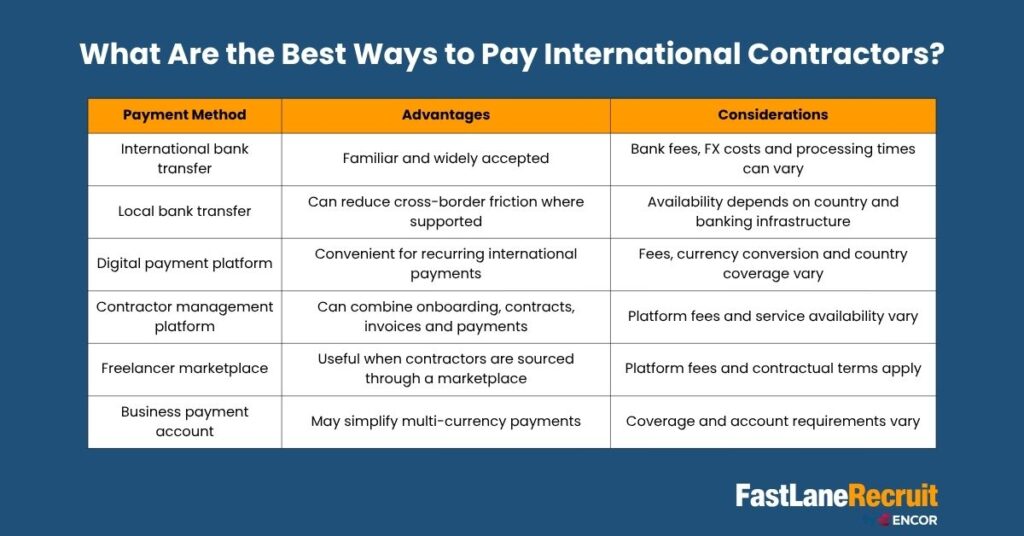
| Payment Method | Advantages | Considerations |
| International bank transfer | Familiar and widely accepted | Bank fees, FX costs and processing times can vary |
| Local bank transfer | Can reduce cross-border friction where supported | Availability depends on country and banking infrastructure |
| Digital payment platform | Convenient for recurring international payments | Fees, currency conversion and country coverage vary |
| Contractor management platform | Can combine onboarding, contracts, invoices and payments | Platform fees and service availability vary |
| Freelancer marketplace | Useful when contractors are sourced through a marketplace | Platform fees and contractual terms apply |
| Business payment account | May simplify multi-currency payments | Coverage and account requirements vary |
There is no universal lowest-cost option. Businesses should compare the total cost, including transaction fees, foreign-exchange spreads, intermediary charges, payment speed, administrative work, and compliance support. Current 2026 guidance similarly emphasizes comparing the complete payment workflow rather than looking only at the headline transfer fee.
How Much Does It Cost to Pay International Contractors?
The cost of paying an international contractor consists of more than the contractor’s agreed fee.
Common Cost Components
1. Contractor compensation
The amount specified in the contractor agreement or invoice.
2. Payment transaction fees
Banks and payment providers may charge fixed or percentage-based fees.
3. Foreign exchange costs
If the company pays in a different currency, the exchange rate and FX markup can materially affect the final amount.
4. Intermediary-bank charges
International bank transfers can involve correspondent banks or receiving-bank fees.
5. Administrative costs
Manual invoice processing, payment reconciliation, document collection, and compliance administration all create internal costs.
6. Compliance costs
Professional tax, legal, HR, or contractor-management support may be required depending on the countries and complexity involved.
A Better Way to Compare Costs
Instead of asking:
“Which payment method has the lowest fee?”
Ask:
“What is the total cost of paying and managing this contractor compliantly?”
For recurring payments across multiple countries, a slightly higher transaction fee may be justified if the solution reduces manual work, payment errors, FX costs, and compliance administration.
What Taxes Apply When Paying International Contractors?
There is no single global tax rule for international contractors.
Tax treatment can depend on:
- Contractor’s tax residence
- Where the services are physically performed
- Contractor’s legal status
- Hiring company’s jurisdiction
- Applicable tax treaty
- Nature of the services
- Local withholding rules
- Whether the contractor performs services in the payer’s country
Do International Contractors Pay Their Own Taxes?
Often, independent contractors are responsible for their own income taxes and other applicable obligations in their country of residence.
However, businesses should not assume that all international contractor payments are automatically free from withholding or reporting requirements.
The payer may have documentation, reporting, or withholding responsibilities depending on the applicable jurisdiction.
For example, U.S. tax rules distinguish between services performed inside and outside the United States. The IRS states that compensation for personal services is generally sourced according to where the services are performed, with different withholding and reporting rules potentially applying to U.S.-source services.
Important: Tax treatment must be assessed based on the specific countries and facts involved. A contractor agreement should not be treated as a substitute for country-specific tax advice.
What Tax Documents Do You Need to Pay Foreign Contractors?
Documentation depends on the countries involved.
For example, a U.S. business paying a foreign contractor may need to establish the contractor’s foreign status and collect appropriate IRS documentation. Depending on the contractor and circumstances, this can include Form W-8BEN for an individual or Form W-8BEN-E for a foreign entity.
If services are performed in the United States, additional U.S. withholding and reporting rules can apply. The IRS states that payments for independent personal services performed in the United States by nonresident aliens can be subject to withholding, subject to applicable exemptions or treaty provisions.
Practical Rule
Do not use a generic tax-document checklist for every country.
Instead:
Identify the countries → determine the worker status → establish where services are performed → check applicable tax rules → collect the required documentation.
How Does Currency Affect International Contractor Payments?
Currency can significantly affect both the company’s cost and the contractor’s take-home amount.
Before agreeing to payment terms, clarify:
- Which currency is stated in the contract?
- Which currency will the contractor receive?
- Who absorbs FX costs?
- What exchange rate will be used?
- When is the exchange rate determined?
- What happens when exchange rates change significantly?
Example
Suppose a contractor invoices in EUR but the company operates in USD.
The company may incur:
USD → EUR conversion cost + FX spread + payment fee
The contractor may also face receiving or conversion charges depending on their banking arrangement.
For recurring international payments, agreeing on the currency and fee responsibility in advance can prevent disputes.
What Compliance Risks Should Businesses Consider?
Paying a contractor correctly requires more than successful delivery of funds.
Worker Misclassification
A contractor may be treated as an employee under applicable law if the actual relationship meets employee criteria.
Potential consequences can include:
- Back taxes
- Social contributions
- Employment benefits
- Interest and penalties
- Local labor-law exposure
- Disputes over employment rights
Classification rules differ between jurisdictions, so businesses should assess the actual working relationship rather than relying solely on the contract label.
Inadequate Documentation
Missing agreements, invoices, tax documentation, or payment records can make it difficult to demonstrate how and why payments were made.
Incorrect Tax Treatment
International payments may trigger different reporting or withholding requirements depending on the payer, contractor, location, and service.
Payment Restrictions
Certain countries or banking corridors may have additional requirements affecting currencies, payment routes, transfer purposes, or documentation.
Data and Security Risks
Contractor payment processes involve sensitive personal, financial, and business information. Businesses should use appropriate controls for storing and transferring this information.
How Can Businesses Pay International Contractors Compliantly?
Use this checklist before making recurring international contractor payments:
| Check | Question |
| Classification | Is the worker genuinely an independent contractor? |
| Country | What local rules apply in the contractor’s country? |
| Work location | Where are the services physically performed? |
| Agreement | Is there a written contractor agreement? |
| Tax documents | Have the required documents been collected? |
| Invoice | Does the invoice meet the agreed requirements? |
| Currency | Is the payment currency clearly defined? |
| Fees | Who pays transfer and FX costs? |
| Payment | Is the payment route secure and supported? |
| Records | Are agreements, invoices and payment confirmations retained? |
| Review | Has the relationship changed since onboarding? |
This checklist helps businesses separate payment administration from the broader question of whether the engagement remains compliant.
When Should You Use Independent Contractors?
Independent contractors can be useful when a business needs:
- Specialized expertise
- Project-based support
- Flexible capacity
- Short-term market expertise
- Services from an independent business
- Access to international talent without establishing an employment relationship
The contractor model is most appropriate when the individual genuinely operates independently and the arrangement complies with applicable local requirements.
When Contractor Engagement May Need Reassessment
Consider reassessing the structure when the worker:
- Works continuously as part of the core team
- Has fixed employee-like working hours
- Is closely supervised by company management
- Performs work under extensive company control
- Has limited independence over how work is performed
- Receives responsibilities similar to employees
- Has become deeply integrated into the organization
These factors do not automatically determine classification, but they are useful signals that the relationship should be reviewed.
Also Read: Freelancer Vs. Contractor
When Should You Consider an Employer of Record?
An Employer of Record (EOR) can be relevant when a business needs to employ someone in another country but does not have its own local employing entity or wants support with local employment administration.
With an EOR arrangement, the EOR generally serves as the local legal employer while the client directs the employee’s day-to-day work, subject to the applicable legal structure.
Contractor vs EOR: Which Model Fits?
| Business Situation | Potentially Relevant Model |
| Independent professional providing defined services | Independent contractor |
| Project-based specialist operating independently | Independent contractor |
| Contractor network requiring structured administration | Contractor management/support |
| Long-term role that operates like employment | Employment/EOR should be considered |
| Hiring an employee in a country without your own entity | EOR |
| Expanding internationally while avoiding immediate local-entity setup | EOR may be an option |
The key decision is not “Which payment method should I use?” It is “What type of relationship am I actually creating?”
If the individual is genuinely an independent contractor, paying them through an appropriate contractor payment process may be suitable. If the role is an employment relationship, an EOR may provide a more appropriate structure.
Also Read: When to Use an Employer of Record: 7 Signs Your Business Needs an EOR
How FastLaneRecruit Can Help With International Contractors and EOR
Managing international workers becomes more complex as the number of countries, currencies, contracts, invoices, and compliance requirements increases.
FastLaneRecruit can support businesses with international workforce needs through independent contractor services and Employer of Record solutions, depending on the nature of the engagement.
For Independent Contractors
Businesses can use contractor support when they need to engage genuine independent professionals while improving the administration around international contractor relationships.
This can help businesses manage:
- Contractor engagement
- Agreements and documentation
- Payment administration
- International workforce processes
- Country-specific considerations
- Contractor compliance requirements
For Employees
When the worker should be employed rather than engaged as an independent contractor, FastLaneRecruit’s EOR solution can provide an alternative to establishing a local employing entity.
This can support businesses that want to:
- Hire internationally
- Enter a new market
- Build a small overseas team
- Test a market before establishing an entity
- Employ workers where they do not have their own local entity
- Simplify international employment administration
The distinction matters: contractor services are for genuine independent contractor relationships; EOR is for employment relationships.
Why Businesses Choose FastLaneRecruit
FastLaneRecruit supports international workforce expansion across:Malaysia, Singapore, Hong Kong, China, India, Philippines, Taiwan, Vietnam, Australia, United Kingdom, Switzerland, UAE, Saudi Arabia, Qatar
One Partner for Different Workforce Needs
Rather than treating every international worker as a contractor, businesses can assess the appropriate engagement structure and choose between contractor support and EOR where applicable.
International Hiring Without Unnecessary Entity Setup
An EOR can help businesses employ workers in supported countries without immediately establishing their own local employing entity.
Support for Growing Global Teams
FastLaneRecruit can help businesses manage international workforce requirements as they expand across multiple markets.
Practical, Compliance-Focused Support
International hiring involves more than recruitment and payments. The engagement structure, documentation, local requirements, and ongoing administration all matter.
FastLaneRecruit helps businesses approach international workforce expansion with a more structured process.
Common Mistakes When Paying International Contractors
Treating Every Overseas Worker as a Contractor
Location does not determine contractor status. The actual working relationship and applicable local rules matter.
Choosing a Payment Method Based Only on Fees
A low transfer fee does not necessarily mean the lowest total cost. Consider FX, intermediary charges, administration, payment speed, and compliance requirements.
Assuming Contractors Always Handle All Taxes
Contractors may have their own tax obligations, but the payer can also have documentation, reporting, or withholding responsibilities.
Using the Same Process in Every Country
International tax, labor, banking, and documentation requirements vary by jurisdiction.
Failing to Review Long-Term Contractor Relationships
A relationship can evolve. A contractor arrangement that was appropriate at the beginning may require reassessment as responsibilities and working practices change.
Paying Without Maintaining Supporting Records
Keep agreements, invoices, approvals, payment confirmations, and relevant tax documentation organized and accessible.
Ready to Pay or Hire International Talent?
International contractor payments should be efficient but they also need to fit the underlying worker relationship and applicable compliance requirements.
If you are hiring independent contractors, FastLaneRecruit can help you structure and manage international contractor engagements.
If the role is actually an employment relationship, FastLaneRecruit’s Employer of Record services can help you employ talent internationally without requiring your business to immediately establish its own local employing entity in the supported market.
Talk to FastLaneRecruit about your international hiring needs and determine whether contractor services or an EOR structure is the right fit for your workforce.
Book a Free Consultation with an Expert
Frequently Asked Questions About Paying International Contractors
What is the best way to pay international contractors?
There is no single best payment method for every business. Bank transfers, local transfers, digital payment platforms, and contractor-management solutions can all be appropriate depending on the contractor’s country, currency, payment frequency, fees, and documentation requirements.
How do you pay international contractors?
A typical process is to confirm contractor classification, check local requirements, sign an agreement, collect required documentation, agree on currency and payment terms, receive and approve an invoice, send the payment, and retain the supporting records.
Do I need a contract to pay an international contractor?
A written contractor agreement is strongly advisable. It should define the services, payment terms, responsibilities, intellectual-property provisions, confidentiality, termination terms, and other relevant commercial conditions.
Do international contractors pay their own taxes?
Independent contractors often have responsibility for their own taxes, but this is not universal. The payer may have separate reporting or withholding obligations depending on the countries involved and where the services are performed.
Do I need to withhold tax when paying a foreign contractor?
It depends on the jurisdictions and circumstances. For example, U.S. tax rules can impose withholding on certain payments for services performed in the United States by nonresident aliens, while different rules can apply to services performed outside the United States.
What documents should I collect from an international contractor?
Depending on the country and circumstances, you may need identification and address information, tax details, business-registration information, bank details, invoices, tax forms, and a signed contractor agreement.
Can I pay an international contractor in USD?
Often, yes, where the payment route and contractor’s country support it. However, the contractor may prefer or be required to receive funds in local currency. The contract should clearly state the agreed payment currency and responsibility for conversion costs.
What is the difference between paying a contractor and using an EOR?
A contractor is engaged as an independent service provider. An EOR supports an employment relationship by serving as the local legal employer under the applicable arrangement. Businesses should determine the correct relationship before choosing the payment or employment structure.
When should I switch from a contractor to an EOR?
Consider reviewing the arrangement when a contractor becomes a long-term, highly integrated member of the organization or the working relationship increasingly resembles employment. The correct decision depends on the facts and applicable local law.
Can FastLaneRecruit help me hire international contractors?
Yes. FastLaneRecruit supports businesses with international contractor and EOR needs across its supported markets. The appropriate service depends on whether the worker is genuinely an independent contractor or should be employed.