Thailand offers international businesses access to a diverse workforce and opportunities across technology, manufacturing, financial services, tourism, and professional services. However, expanding into a new market involves more than finding the right employees. Businesses must also navigate local employment laws, payroll administration, tax withholding, statutory benefits, and ongoing employer responsibilities.
For companies looking to build a team without the time and administrative commitment of establishing a Thai legal entity, an Employer of Record (EOR) provides an alternative.
An Employer of Record in Thailand enables businesses to hire local employees through an EOR’s local employment structure. The EOR becomes the legal employer and manages agreed employment administration, payroll, and statutory responsibilities, while the client company retains control over employees’ daily activities, business objectives, and performance.
With FastLaneRecruit’s EOR services, businesses can simplify the process of hiring in Thailand, reduce the administrative burden of international employment, and focus on developing their local workforce.
Whether you are hiring your first employee, establishing a small regional team, or exploring the Thai market before setting up a company, understanding how EOR Thailand works can help you choose the right employment model.
Content Outline
Key Summary
Hire Employees Without Establishing a Thai Entity
An Employer of Record allows international businesses to employ workers in Thailand through an established local employment structure without setting up their own Thai company.
Simplify Local Employment Compliance
An EOR manages agreed employer responsibilities, including employment contracts, payroll administration, tax withholding, social security contributions, and statutory employment benefits.
Maintain Control Over Your Team
Your business continues to direct employees’ daily responsibilities, work priorities, performance, and operational activities, while the EOR handles the formal employment relationship.
Understand Thailand’s Employment Requirements
Businesses must account for local minimum wages, working hours, leave entitlements, social security, personal income tax, and termination requirements when hiring in Thailand.
Choose the Right Hiring Model
An EOR is particularly useful for businesses hiring a small team, entering Thailand for the first time, or expanding without immediately committing to their own legal entity.
What Is an Employer of Record in Thailand?
An Employer of Record (EOR) in Thailand is a third-party organization that legally employs workers on behalf of another business. It provides a local employment arrangement that allows international companies to hire employees without directly establishing their own legal entity in Thailand.
Under this arrangement, the EOR enters into the employment relationship with the employee and assumes the applicable legal employer responsibilities. The client company directs the employee’s daily work, assigns responsibilities, manages performance, and determines business objectives.
An EOR typically supports the following employment functions:
- Employment contracts: Preparing and administering locally compliant employment agreements.
- Employee onboarding: Coordinating employment documentation and onboarding procedures.
- Payroll processing: Calculating salaries, applicable deductions, and employee payments.
- Tax administration: Withholding and remitting applicable employment taxes.
- Social security contributions: Managing employer and employee contributions in accordance with applicable requirements.
- Statutory benefits: Administering legally required leave and employee entitlements.
- Employee offboarding: Supporting compliant termination procedures, final payments, and relevant documentation.
For international businesses, this arrangement reduces the need to establish and administer a separate local employment infrastructure.
How does the arrangement work?
| Responsibility | Employer of Record | Client Company |
| Legal employment relationship | Acts as the legal employer | Receives the employee’s services |
| Employment agreement | Prepares and administers the agreement | Defines the role and business requirements |
| Payroll administration | Processes payroll and applicable deductions | Approves compensation arrangements |
| Statutory contributions | Administers applicable employer obligations | Funds agreed employment costs |
| Daily work management | Handles formal employment administration | Directs daily work and priorities |
| Performance management | Supports relevant employment administration | Evaluates performance and productivity |
| Offboarding | Manages formal employment procedures | Communicates business decisions and requirements |
The division of responsibilities should be clearly documented in the EOR service agreement. An EOR arrangement does not remove every legal responsibility or liability from the client company.
Why Are International Companies Hiring in Thailand?
Thailand is an established business destination in Southeast Asia, supported by its regional connectivity, developed industrial sectors, and diverse talent pool.
Businesses expanding into Thailand may recruit employees for regional operations, customer support, technology development, manufacturing, sales, and business management.
Several factors make Thailand an attractive hiring destination.
1. Access to a Diverse Talent Pool
Thailand offers professionals across multiple sectors, including information technology, engineering, finance, manufacturing, hospitality, digital services, and business operations.
International companies can recruit local employees who understand the domestic business environment, customer expectations, and regional market conditions.
2. Strategic Position in Southeast Asia
Thailand’s location provides access to regional business networks and opportunities to coordinate operations across Southeast Asia.
Companies establishing regional teams may recruit Thai employees for local market development, customer service, sales, and operational management.
3. Opportunities Across Growing Industries
Businesses can explore hiring opportunities in sectors such as:
- Technology and software development
- Manufacturing and supply chain management
- Financial and professional services
- Tourism and hospitality
- Digital marketing and e-commerce
- Business process outsourcing
- Sales and customer support
4. Flexible Market Entry
Businesses do not always need to establish a full local operation before hiring their first employees.
An Employer of Record provides an alternative employment structure for companies that want to build a local team, test market opportunities, or support regional operations before committing to a separate Thai entity.
How Does EOR Thailand Work?
An Employer of Record simplifies hiring in Thailand by managing the formal employment process while allowing your business to retain operational control over its employees.
The process generally involves the following stages.
Step 1: Identify Your Hiring Requirements
Determine the number of employees you intend to hire, their job responsibilities, proposed salaries, employment arrangements, and expected start dates.
Your EOR provider can review the requirements and identify the applicable employment considerations.
Step 2: Establish the Employment Arrangement
The EOR and client company agree on the employment structure, service scope, responsibilities, fees, and relevant employment terms.
The EOR establishes the formal employment relationship with the selected employee.
Step 3: Prepare Employment Contracts
The EOR prepares the employment agreement in accordance with applicable Thai employment requirements.
The contract should clearly address:
- Job title and responsibilities
- Salary and payment arrangements
- Working hours and work location
- Employment commencement date
- Leave entitlements
- Benefits and applicable deductions
- Notice and termination provisions
- Other relevant employment conditions
Step 4: Complete Employee Onboarding
The employee provides the necessary personal and employment documentation. The EOR coordinates the applicable onboarding procedures, employment registration, and payroll setup.
Step 5: Process Payroll and Statutory Contributions
Once employment begins, the EOR administers the agreed payroll cycle, salary payments, applicable tax withholding, social security contributions, and statutory employment obligations.
Step 6: Manage Ongoing Employment Administration
Throughout employment, the EOR supports payroll administration, employee documentation, statutory benefits, and relevant employment changes.
Your business continues managing the employee’s daily work and performance.
Step 7: Coordinate Employee Offboarding
If employment ends, the EOR supports the formal termination process, including applicable notice requirements, severance calculations, final salary payments, and employment documentation.
Following the appropriate procedures helps both parties manage employment transitions more effectively.
Thailand Employment Laws and Requirements for Foreign Employers
Understanding Thailand’s employment regulations is essential when hiring local employees. Businesses must ensure that employment arrangements meet the requirements of the Labour Protection Act B.E. 2541 (1998), the Social Security Act, and applicable tax legislation.
An EOR can help administer these obligations through a locally structured employment arrangement.
The following are important considerations for businesses hiring in Thailand.
1. Employment Contracts in Thailand
Employment agreements establish the terms and conditions of the employment relationship between the legal employer and employee.
Contracts should clearly specify the employment conditions and comply with applicable Thai labour legislation.
Important provisions include:
- Employee and employer details
- Position and job responsibilities
- Salary and payment frequency
- Working hours and rest periods
- Annual leave and other statutory leave
- Benefits and applicable deductions
- Notice periods and termination conditions
Written employment agreements are particularly important for documenting responsibilities, compensation, and other employment terms.
2. Minimum Wage Requirements
Thailand has a province-based minimum daily wage system. The applicable rate depends on the employee’s work location and, in certain cases, the type of business.
As of November 2026, the latest generally applicable minimum wage announcement identified is Notification No. 14, effective from 1 July 2025.
| Daily Minimum Wage | Applicable Locations or Categories |
| THB 400 | Bangkok, Phuket, Chachoengsao, Chonburi, Rayong, Koh Samui district, and specified hotel and entertainment businesses nationwide |
| THB 380 | Mueang Chiang Mai and Mueang Songkhla districts |
| THB 372 | Nakhon Pathom, Nonthaburi, Pathum Thani, Samut Prakan, and Samut Sakhon |
| THB 337–359 | Other provinces, depending on the applicable local rate |
Important: The applicable minimum wage must be checked against the employee’s actual work location and business category. The rates are not uniform nationwide.
Businesses should review the latest Wage Committee announcements before finalizing employee compensation.
3. Working Hours and Overtime
Thailand’s Labour Protection Act establishes working-hour limits and overtime requirements.
For general work, the standard maximum is generally:
- Normal working hours: Up to 8 hours per day.
- Weekly working hours: Up to 48 hours per week.
- Hazardous work: Generally limited to 7 hours per day and 42 hours per week.
Overtime and holiday work are subject to applicable legal requirements, including employee consent where required and statutory compensation rates.
Employers should also account for legally required rest periods and weekly holidays when designing employee schedules.
4. Annual Leave and Public Holidays
Employees in Thailand are entitled to statutory leave under applicable employment legislation.
Key considerations include:
- Annual leave: Employees who have completed one uninterrupted year of service are entitled to at least six working days of annual leave per year.
- Public holidays: Employers must provide at least 13 traditional holidays annually, including National Labour Day.
- Sick leave: Employees are entitled to sick leave as necessary, with paid sick leave generally capped at 30 working days per year.
- Maternity leave: Eligible employees are entitled to statutory maternity leave under the applicable legal provisions.
- Other leave: Additional statutory leave may apply depending on the employee’s circumstances and current legislation.
Employers should distinguish statutory minimum entitlements from additional benefits provided under company policies or employment agreements.
5. Social Security Contributions in Thailand
Thailand’s Social Security Fund (SSF) provides statutory protection for eligible employees.
Employers and employees generally contribute 5% of the employee’s applicable monthly wage, subject to the statutory contribution ceiling.
From 1 January 2026, the maximum monthly wage base for calculating Section 33 Social Security Fund contributions increased to THB 17,500.
| Contribution | Rate | Maximum Monthly Amount |
| Employer contribution | 5% | THB 875 |
| Employee contribution | 5% | THB 875 |
| Combined contribution | 10% | THB 1,750 |
These maximum amounts apply when the employee’s contributable monthly wage reaches the THB 17,500 ceiling.
Employers must also consider Workmen’s Compensation Fund obligations, which are separate from regular Social Security Fund contributions and depend on the applicable assessment rate.
6. Personal Income Tax and Payroll Administration
Employers in Thailand must comply with applicable payroll withholding and tax reporting requirements.
Personal income tax uses progressive rates based on an individual’s taxable income.
| Annual Taxable Income (THB) | Tax Rate |
| Up to 150,000 | Exempt |
| 150,001–300,000 | 5% |
| 300,001–500,000 | 10% |
| 500,001–750,000 | 15% |
| 750,001–1,000,000 | 20% |
| 1,000,001–2,000,000 | 25% |
| 2,000,001–5,000,000 | 30% |
| Over 5,000,000 | 35% |
The actual tax payable depends on applicable deductions, allowances, exemptions, and the employee’s individual tax circumstances.
For employers, payroll administration involves more than transferring monthly salaries. It also requires accurate calculations, withholding, reporting, and timely remittance to the relevant authorities.
An EOR can administer these payroll responsibilities as part of its agreed employment services.
7. Termination and Severance Pay
Employment termination in Thailand must follow applicable legal procedures.
Employers should consider notice requirements, valid termination grounds, outstanding wages, unused leave entitlements, and statutory severance obligations.
Under the Labour Protection Act, statutory severance generally depends on the employee’s continuous period of service.
| Continuous Employment | Minimum Statutory Severance |
| 120 days to less than 1 year | 30 days’ wages |
| 1 year to less than 3 years | 90 days’ wages |
| 3 years to less than 6 years | 180 days’ wages |
| 6 years to less than 10 years | 240 days’ wages |
| 10 years to less than 20 years | 300 days’ wages |
| 20 years or more | 400 days’ wages |
Certain statutory exceptions apply, including qualifying cases of serious misconduct. Additional requirements may also apply depending on the circumstances of termination.
Businesses should seek appropriate local guidance before making termination decisions to avoid unnecessary disputes and financial exposure.
How Much Does It Cost to Hire Employees in Thailand?
The cost of hiring employees in Thailand depends on more than the agreed monthly salary.
Businesses should consider statutory employer contributions, employee benefits, payroll administration, and the service fees charged by an Employer of Record.
Key Employment Costs to Consider
| Cost Component | Description |
| Gross salary | Monthly compensation agreed with the employee |
| Social Security Fund | Employer contribution, generally 5% subject to the applicable wage ceiling |
| Workmen’s Compensation Fund | Employer contribution based on the applicable assessment rate |
| Statutory benefits | Legally required leave and other employment entitlements |
| Additional benefits | Private health insurance, allowances, bonuses, or other agreed benefits |
| EOR service fee | Fee charged by the EOR for employment administration and related services |
The total employment cost varies according to salary, employee location, benefits, role requirements, and the EOR service arrangement.
EOR Service Fees vs. Establishing a Local Entity
There is no universal EOR fee in Thailand. Pricing depends on the provider, number of employees, service scope, and employment requirements.
When comparing costs, businesses should evaluate the overall financial commitment rather than looking only at the monthly EOR fee.
Establishing a local company may involve incorporation costs, legal and accounting services, ongoing administrative expenses, payroll infrastructure, and regulatory compliance.
An EOR consolidates many employment administration requirements into a service arrangement, which can be more practical for businesses hiring a smaller team or entering the market for the first time.
For accurate budgeting, request an EOR quotation based on your expected headcount, salary range, benefits, and employment requirements.
EOR vs. Setting Up a Company in Thailand: Which Is Better?
Choosing between an Employer of Record and establishing a local entity depends on your business objectives, expected headcount, operational requirements, and long-term expansion plans.
Both approaches offer different levels of control, flexibility, and administrative responsibility.
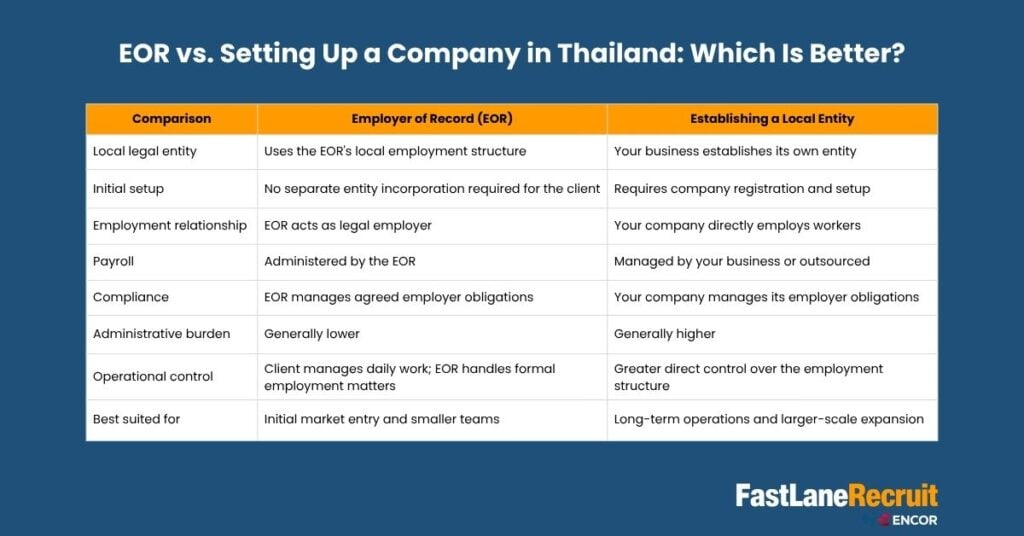
| Comparison | Employer of Record (EOR) | Establishing a Local Entity |
| Local legal entity | Uses the EOR’s local employment structure | Your business establishes its own entity |
| Initial setup | No separate entity incorporation required for the client | Requires company registration and setup |
| Employment relationship | EOR acts as legal employer | Your company directly employs workers |
| Payroll | Administered by the EOR | Managed by your business or outsourced |
| Compliance | EOR manages agreed employer obligations | Your company manages its employer obligations |
| Administrative burden | Generally lower | Generally higher |
| Operational control | Client manages daily work; EOR handles formal employment matters | Greater direct control over the employment structure |
| Best suited for | Initial market entry and smaller teams | Long-term operations and larger-scale expansion |
When Should You Choose an EOR in Thailand?
An EOR may be the more suitable option if:
- You want to hire your first employees in Thailand.
- You do not want to establish a local company immediately.
- You are testing the Thai market before making a long-term investment.
- You need to recruit a small or distributed workforce.
- You want to simplify local payroll and employment administration.
- You prefer to focus on business operations rather than building an internal HR infrastructure.
When Should You Establish Your Own Thai Entity?
Setting up a local company may be more appropriate if:
- You intend to maintain a substantial workforce in Thailand.
- You plan to operate a permanent local business.
- You need to enter into local commercial agreements through your own entity.
- You require direct control over the entire local employment structure.
- You have long-term investment and operational plans in Thailand.
Decision point: An EOR can be a practical starting point, but it is not a substitute for establishing a local entity when your business activities require one. Consider your commercial activities, tax exposure, regulatory requirements, and long-term operating model before deciding.
EOR vs. PEO vs. Independent Contractor in Thailand
Businesses exploring international hiring may encounter several employment models. Understanding the differences helps avoid choosing an arrangement that does not match the actual working relationship.
| Factor | EOR | PEO | Independent Contractor |
| Legal employer | EOR provider | Generally the client’s local entity | Contractor operates independently |
| Client’s local entity | Not generally required for EOR employment | Generally required | Depends on the arrangement and applicable activities |
| Employment contracts | Administered by EOR | Managed under the client’s employment structure | Independent services agreement |
| Payroll | EOR administers employee payroll | PEO supports payroll administration | Contractor invoices for services |
| Statutory benefits | Applicable employee entitlements administered through EOR | Managed through the client’s employment structure | Generally not provided as employee benefits |
| Best suited for | Hiring employees without a local entity | Businesses with an existing local entity | Genuine independent service engagements |
Employer of Record
An EOR is suitable when a business wants to hire employees in Thailand without establishing its own local entity. The EOR assumes the formal employer role and manages agreed employment responsibilities.
Professional Employer Organization
A PEO generally provides HR and payroll administration support to businesses that already have a local legal entity and employ workers directly.
A PEO does not automatically replace the need for a local entity.
Independent Contractor
Independent contractors provide services under a commercial agreement rather than an employment relationship.
This model can work for genuinely independent professionals. However, businesses should not classify workers as contractors simply to avoid employment obligations.
Thai authorities and courts may consider the actual working relationship, level of control, and nature of the engagement when determining employment status.
Which model should you choose?
- Choose EOR if you need employees but do not have a Thai entity.
- Consider PEO if you already have a local entity and need HR administration support.
- Consider contractor engagement when the individual genuinely operates as an independent service provider.
Also Read: Guide to PEO vs EOR
Hiring Foreign Employees in Thailand: What Businesses Need to Know
Hiring foreign nationals in Thailand involves additional immigration and employment considerations.
Foreign employees generally need the appropriate visa and work authorization before undertaking work in Thailand. The applicable requirements depend on nationality, job responsibilities, employer structure, and immigration category.
Businesses should consider:
- Appropriate visa and work authorization.
- Employer eligibility and applicable work permit requirements.
- Job categories and restrictions under Thai law.
- Required employment and supporting documents.
- Ongoing immigration and work authorization compliance.
An EOR arrangement does not automatically guarantee work permit eligibility or eliminate immigration requirements.
Foreign employers should confirm whether the EOR’s local entity meets the applicable conditions for sponsoring or employing the proposed foreign employee.
This is particularly important for businesses hiring expatriates, regional managers, or specialized foreign professionals.
Why Businesses Choose FastLaneRecruit for EOR Services
Expanding into Thailand requires a reliable employment structure and an understanding of local workforce requirements. Businesses need more than payroll processing; they need an employment partner that can support their international hiring operations.
FastLaneRecruit provides Employer of Record services to help businesses hire internationally without establishing separate local entities in every target market.
By using our EOR services, businesses can simplify employment administration and focus on managing their workforce and achieving their expansion objectives.
1. Simplify International Hiring
Build your workforce in Thailand without taking on the initial administrative commitment of establishing your own local employment entity.
2. Support Local Employment Administration
Coordinate employment contracts, payroll administration, statutory contributions, and other agreed employment responsibilities through an EOR arrangement.
3. Focus on Your Core Business
Your business retains control over employee responsibilities, daily operations, and performance while we support the formal employment administration.
4. Expand Across Multiple Markets
Businesses planning regional expansion can also explore our EOR services across multiple countries, reducing the complexity of coordinating separate employment arrangements in different markets.
5. Support Your Workforce as You Grow
Whether you are hiring your first international employee or building a distributed team, an appropriate EOR arrangement can help make workforce expansion more manageable.
FastLaneRecruit Operates Across Multiple Markets
FastLaneRecruit supports international employment through its EOR services across the following markets.
FastLaneRecruit operates in
- Asia Pacific: Malaysia, Singapore, Hong Kong, China, India, Philippines, Taiwan, Vietnam, Australia,
- Europe: United Kingdom, Switzerland
- Middle East & Africa: UAE, Saudi Arabia, Qatar
With coverage across Asia Pacific, Europe, and the Middle East, FastLaneRecruit helps businesses explore international hiring opportunities and manage employment arrangements across multiple markets.
For companies expanding beyond Thailand, our regional coverage provides an opportunity to coordinate workforce requirements through one EOR service partner.
Hire in Thailand with FastLaneRecruit’s Employer of Record Services
Building a team in Thailand should not require your business to navigate every aspect of local employment administration alone.
Whether you are hiring your first employee, expanding an existing regional team, or exploring Thailand as a new business market, an Employer of Record can provide a more manageable approach to international employment.
FastLaneRecruit helps businesses simplify global hiring through EOR services, supporting employment administration so you can concentrate on managing your people and growing your business.
Ready to hire employees in Thailand?
Contact FastLaneRecruit to discuss your hiring requirements, understand the EOR arrangement, and receive a tailored solution for your international workforce.
Book a Free Consultation with an Expert and start planning your expansion into Thailand.
Frequently Asked Questions About Employer of Record Thailand
1. What is an Employer of Record in Thailand?
An Employer of Record (EOR) in Thailand is a third-party organization that legally employs workers on behalf of another business. It manages agreed employment responsibilities, including employment contracts, payroll, tax withholding, social security contributions, and statutory benefits, while the client company directs the employee’s daily work.
2. Can I hire employees in Thailand without setting up a company?
Yes. International businesses can hire employees in Thailand through an Employer of Record without establishing their own Thai legal entity for that employment arrangement. The EOR employs the workers through its local employment structure and manages the applicable employer responsibilities.
However, this does not exempt the client business from other legal, tax, immigration, or commercial obligations that may arise from its activities in Thailand.
3. How does an EOR work in Thailand?
An EOR becomes the legal employer of the selected employee and manages formal employment administration. The client company selects the candidate, determines the role, directs daily work, and manages performance. The EOR administers the employment contract, payroll, statutory contributions, and other agreed employer responsibilities.
4. How much does an Employer of Record in Thailand cost?
EOR costs vary depending on the provider, monthly salary, number of employees, benefits, and service scope. Businesses should consider the EOR service fee alongside gross salary, employer social security contributions, Workmen’s Compensation Fund contributions, and other employment-related expenses.
Requesting a customized quotation is the best way to estimate your total hiring costs.
5. What are the benefits of using an EOR in Thailand?
The main benefits include:
- Hiring without establishing a separate local entity.
- Simplifying employment contracts and onboarding.
- Supporting local payroll and statutory administration.
- Reducing internal HR and administrative workload.
- Accessing local employment support.
- Building a workforce before committing to long-term entity establishment.
6. Is an EOR the legal employer in Thailand?
Yes. Under the EOR arrangement, the EOR is the formal legal employer and enters into the employment relationship with the employee. It assumes the applicable employer obligations, while the client company typically manages daily work and business operations.
The exact division of responsibilities should be set out in the relevant service agreement.
7. What employment laws apply when hiring in Thailand?
Employers must comply with relevant Thai legislation, including:
- Labour Protection Act B.E. 2541 (1998).
- Social Security Act B.E. 2533 (1990).
- Workmen’s Compensation Act B.E. 2537 (1994).
- Revenue Code.
- Applicable immigration and work authorization legislation.
The specific requirements depend on the employee’s circumstances and the nature of the employment arrangement.
8. What is the minimum wage in Thailand?
As of November 2026, the latest generally applicable minimum wage rates identified range from THB 337 to THB 400 per day under the Wage Committee’s Notification No. 14, effective from 1 July 2025.
The applicable rate depends on the employee’s province and, for certain categories, the type of business.
9. What are the social security contributions for employees in Thailand?
Under the standard Section 33 Social Security Fund arrangement, employers and employees generally contribute 5% of the applicable monthly wage.
From January 2026, the maximum contribution wage base is THB 17,500 per month, resulting in a maximum employer contribution of THB 875 and employee contribution of THB 875 per month.
10. Can an EOR hire foreign employees in Thailand?
An EOR may support the employment of foreign nationals, provided the relevant employer, employee, immigration, and work authorization requirements are satisfied.
Businesses should confirm work permit eligibility and visa requirements before proceeding with an expatriate hire.
11. What is the difference between an EOR and a PEO in Thailand?
An EOR acts as the legal employer and enables businesses to hire employees without establishing their own local entity. A PEO generally provides HR and payroll administration services to businesses that already have a registered local entity and directly employ their workers.
12. When should a company switch from an EOR to its own entity in Thailand?
A company may consider establishing its own entity when it develops a substantial local workforce, requires a permanent commercial presence, or needs greater direct control over its local operations.
The decision should consider incorporation costs, ongoing compliance obligations, commercial activities, tax implications, and long-term business objectives.
13. How long does it take to hire employees through an EOR in Thailand?
The timeline depends on candidate readiness, employment documentation, onboarding requirements, and any necessary work authorization. An EOR can generally reduce the administrative steps associated with establishing a separate company, but a specific start date should be confirmed with the provider.
14. Does an EOR manage employee termination in Thailand?
An EOR can administer formal employment termination procedures, including applicable notice requirements, final salary calculations, statutory severance, and relevant documentation. Termination must comply with Thai employment legislation and the circumstances of the individual case.